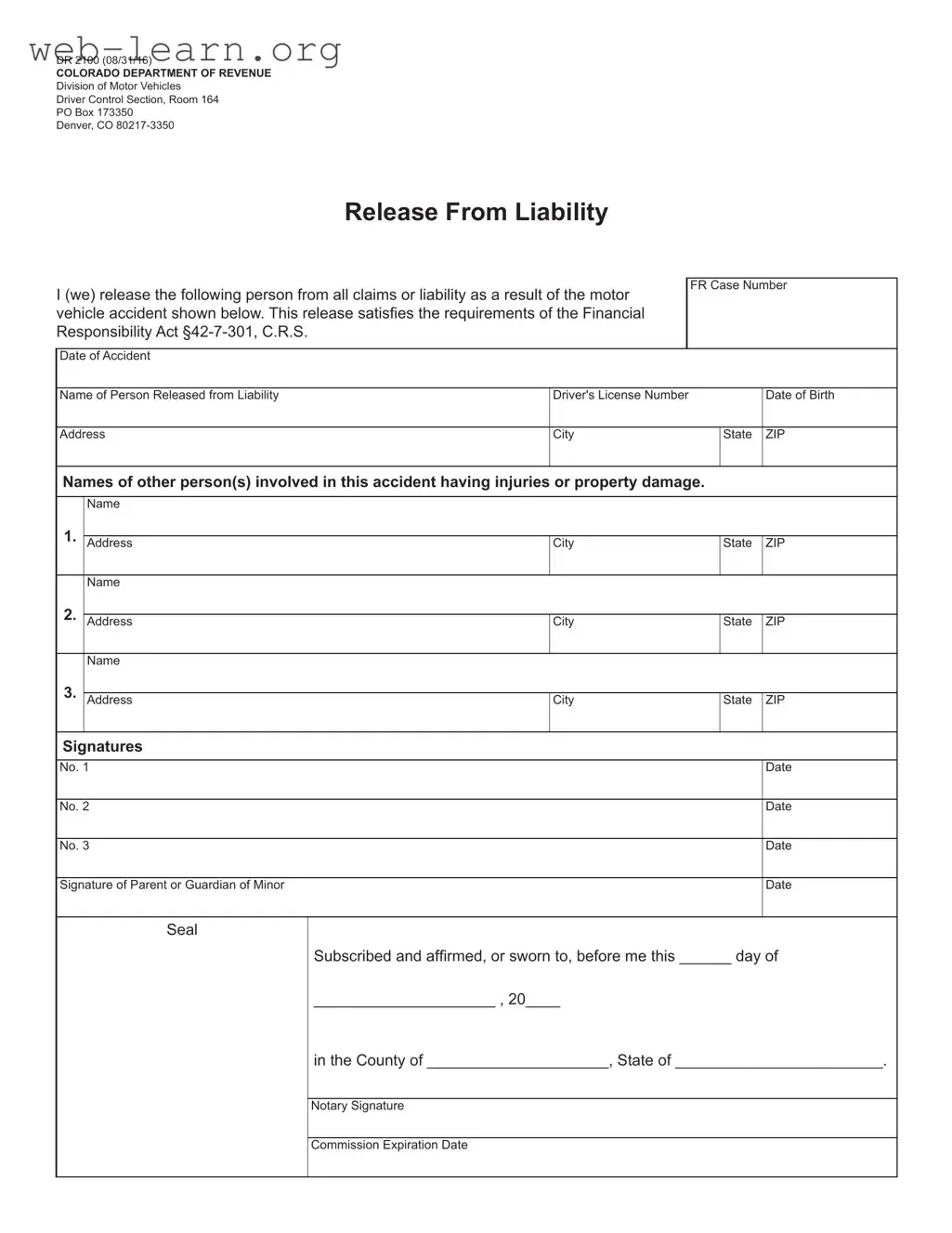
The Colorado DR 2100 form is an important document used in the context of motor vehicle accidents. This form serves as a release from liability, allowing individuals to formally release another party from any claims or liabilities arising from a specific accident. It is designed to meet the requirements set forth by the Financial Responsibility Act, ensuring that all necessary legal standards are adhered to. Key information required on the form includes the date of the accident, a Financial Responsibility case number, and the name and contact details of the person being released from liability. Additionally, the form collects information about other individuals involved in the accident who may have sustained injuries or property damage. Signatures from the parties involved, as well as a parent or guardian if a minor is included, are necessary for the document's validity. The form must also be notarized, which adds an extra layer of verification to the release process. This comprehensive approach helps protect the rights of all parties involved while providing a clear record of the agreement reached.

| Fact Name | Details |
|---|---|
| Purpose | The Colorado DR 2100 form is used to release a person from all claims or liability resulting from a motor vehicle accident. |
| Governing Law | This form satisfies the requirements of the Financial Responsibility Act §42-7-301, C.R.S. |
| Required Information | Individuals must provide details such as the date of the accident, names of persons involved, and their addresses. |
| Notarization | The form requires notarization, ensuring that signatures are verified and legitimate. |
Completing the Colorado DR 2100 form is essential for releasing a person from liability following a motor vehicle accident. After filling out the form, ensure that all necessary signatures are obtained and that it is submitted to the appropriate authorities.
What is the purpose of the Colorado DR 2100 form?
The Colorado DR 2100 form serves as a Release From Liability document. It allows individuals involved in a motor vehicle accident to formally release another party from claims or liabilities resulting from that incident. This release meets the requirements outlined in the Financial Responsibility Act.
Who should fill out the DR 2100 form?
Any party involved in a motor vehicle accident who wishes to release another person from liability should complete the DR 2100 form. This includes the individual releasing the claim, as well as any guardians if a minor is involved.
What information is required on the form?
The form requires the following information:
How do I submit the DR 2100 form?
After completing the form, it should be submitted to the Colorado Department of Revenue, Division of Motor Vehicles. The address is:
Driver Control Section, Room 164
PO Box 173350
Denver, CO 80217-3350
Is notarization required for the DR 2100 form?
Yes, the form must be notarized. This means that the signatures on the document should be affirmed or sworn to before a notary public. The notary will also provide their signature and the expiration date of their commission.
What happens after I submit the form?
Once the Colorado DR 2100 form is submitted and processed, it will serve as a legal release from liability for the specified parties. It is advisable to keep a copy for personal records and to confirm that all parties involved are aware of the release.
Filling out the Colorado DR 2100 form can seem straightforward, but many individuals make common mistakes that can lead to complications. One frequent error is failing to include the date of the accident. This detail is crucial as it establishes the context for the release from liability. Without it, the form may be considered incomplete.
Another common mistake is neglecting to provide the Financial Responsibility Act case number. This number is essential for tracking the case and ensuring that all parties involved are properly documented. Omitting this information can delay processing and create confusion.
Individuals often overlook the importance of accurately filling out the name and address of the person being released from liability. Errors in spelling or incorrect addresses can lead to legal complications. It is vital to double-check these details to avoid potential issues down the line.
Many people also forget to list all other individuals involved in the accident. The form requires the names and addresses of all parties with injuries or property damage. Failing to include this information can result in a lack of accountability and may affect any claims made later.
In addition to these omissions, individuals sometimes fail to sign the form. Each signature is necessary to validate the release. If any required signatures are missing, the form will not be accepted. It is important to ensure that all relevant parties have signed before submission.
Another mistake involves not dating the signatures. Each signature must be accompanied by the date to confirm when the release was signed. Without this, the form may be questioned or deemed invalid.
People often underestimate the importance of having the form witnessed by a notary. A notary's signature and seal lend credibility to the document. Skipping this step can lead to challenges in enforcing the release.
Some individuals fail to check the commission expiration date of the notary. If the notary's commission has expired, the document may not hold up in court. It is crucial to verify that the notary is authorized to sign at the time of the document's execution.
Lastly, individuals sometimes submit the form without reviewing it thoroughly. Typos or missing information can lead to delays or rejections. Taking the time to carefully review the entire document before submission can save significant time and effort.
By being aware of these common mistakes, individuals can ensure that their completion of the Colorado DR 2100 form is accurate and effective, thereby facilitating a smoother process in the aftermath of an accident.
The Colorado DR 2100 form is a crucial document for individuals involved in a motor vehicle accident who wish to release another party from liability. However, several other forms and documents may accompany it to ensure a comprehensive understanding and resolution of the situation. Below is a list of additional documents often used in conjunction with the DR 2100 form.
Understanding these accompanying documents can streamline the process of resolving issues following a motor vehicle accident. Each document plays a specific role in ensuring that all parties are informed and protected throughout the resolution process.
The Colorado DR 2100 form serves a specific purpose in the context of motor vehicle accidents, particularly related to the release of liability. It is similar to several other documents used in similar situations. Below is a list of nine documents that share characteristics with the DR 2100 form:
Each of these documents plays a critical role in managing liability and protecting parties involved in motor vehicle accidents. Understanding their similarities to the Colorado DR 2100 form can aid in navigating the complexities of accident-related legal matters.
When filling out the Colorado DR 2100 form, it's important to follow certain guidelines to ensure your submission is accurate and complete. Here are nine things you should and shouldn't do:
By following these guidelines, you can help ensure that your Colorado DR 2100 form is filled out correctly and processed without unnecessary delays.
Here are six common misconceptions about the Colorado DR 2100 form, along with clarifications for each:
Key Takeaways for Filling Out and Using the Colorado DR 2100 Form: