Homepage Blank Colorado Dr 1191 Form
Outline

The Colorado DR 1191 form is an essential document for businesses looking to take advantage of sales tax exemptions on machinery and machine tools. This form is specifically designed for those purchasing equipment that will be used in manufacturing processes, allowing them to avoid state sales and use tax under certain conditions. To qualify, the machinery must be utilized directly and predominantly for the production of tangible personal property intended for sale or profit. Notably, the exemption extends to both new and used equipment, provided that the used items do not exceed an annual purchase limit of $150,000. Businesses located within designated enterprise zones can benefit from additional exemptions, making the DR 1191 form even more valuable. It’s important for purchasers to complete the form accurately, as it requires details such as the seller's and purchaser's Colorado sales tax account numbers, the date and amount of purchase, and a description of how the machinery will be used. The form must be submitted to both the seller and the Colorado Department of Revenue, ensuring that the seller is relieved of any sales tax liability while the purchaser assumes responsibility for any future tax obligations. Understanding the requirements and implications of the DR 1191 form can significantly impact a business's financial strategy, particularly in managing tax liabilities associated with equipment purchases.

Sample - Colorado Dr 1191 Form

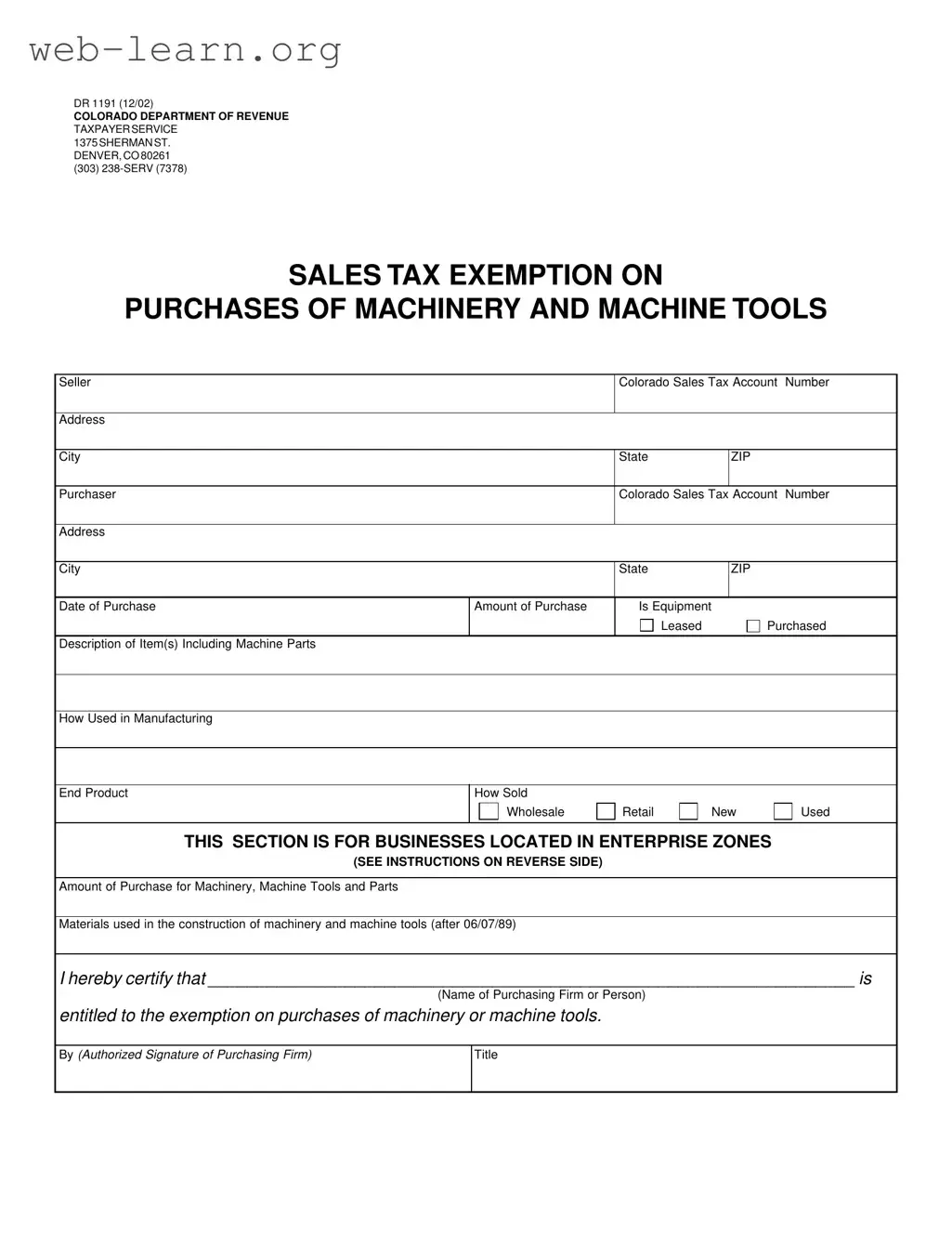
DR 1191 (12/02)
COLORADO DEPARTMENT OF REVENUE
TAXPAYER SERVICE
1375 SHERMAN ST.
DENVER, CO 80261
(303) 238-SERV (7378)
SALES TAX EXEMPTION ON
PURCHASES OF MACHINERY AND MACHINE TOOLS
(Name of Purchasing Firm or Person)
THIS SECTION IS FOR BUSINESSES LOCATED IN ENTERPRISE ZONES
(SEE INSTRUCTIONS ON REVERSE SIDE)
Seller Colorado Sales Tax Account Number
Address
City State ZIP
Purchaser Colorado Sales Tax Account Number
Address
City State ZIP
Date of Purchase Amount of Purchase Is Equipment
Description of Item(s) Including Machine Parts
How Used in Manufacturing
End Product How Sold
Wholesale Retail New Used
Amount of Purchase for Machinery, Machine Tools and Parts
Materials used in the construction of machinery and machine tools (after 06/07/89)
I hereby certify that __________________________________________________________________ is
entitled to the exemption on purchases of machinery or machine tools.
By
(Authorized Signature of Purchasing Firm)
Title
Leased Purchased
DR 1191 Instructions
GENERAL INFORMATION
Purchases of machinery or machine tools and parts thereof are exempt from state sales and use tax when the
machinery will be used in manufacturing. [C.R.S. 39-26-114(11)].
To qualify the machinery must:
Be used in Colorado,
Be used directly and predominantly to manufacture tangible personal property for sale or profit.
Be of a nature that would have qualified for the federal investment tax credit under the definition of
section 38 property found in the Internal Revenue Code of 1954, as amended. This includes tangible
personal property with a useful life of one year or more and limits qualifying purchases of used equipment
to a maximum of $150,000 annually,
Be included on a purchase order or invoice totaling more than $500,
Be capitalized.
ENTERPRISE ZONES
The manufacturing exemption is expanded to exempt additional purchases from sales and use tax when
machinery is used solely and exclusively in an enterprise zone. Equipment that is used both within and
outside an enterprise zone only qualifies for the regular statewide exemption, as is equipment used at a
location prior to that location’s designation as an enterprise zone. [C.R.S. 39-30-106(1)]
Machinery used solely and exclusively in a designated enterprise zone may be capitalized or expensed to
qualify for the exemption.
Materials for construction or repair of machinery or machine tools are exempt from the state sales and use
tax if the machinery is used exclusively in an enterprise zone.
Mining operations are included in the definition of manufacturing when performed in an enterprise zone.
For further information, see FYI Sales 69, “Enterprise Zone Exemption for Machinery and Machine Tools
Used in Mining.”
LOCAL TAXES
Cities, counties and special districts may or may not exempt manufacturing equipment from local sales taxes.
Refer to publication DRP1002 for a list of localities that exempt this equipment from local tax. Special districts
that impose sales tax on manufacturing equipment cannot impose use tax on the equipment.
CLAIMING THE EXEMPTION
Complete Form DR 1191 Sales Tax Exemption on Purchases of Machinery and Machine Tools. Give one copy
of the completed form to the seller of the machinery and a second copy to the Department of Revenue. The
purchaser must also keep a copy. An exemption cannot be claimed for sales tax paid in another state which is
credited against Colorado sales or use tax. NOTE: Acceptance of this certificate by the seller removes any
sales tax liability from the seller and the purchaser is liable for any subsequent sales or use tax liability for the
purchase.
For further information regarding the manufacturing exemption, see FYI Sales 10 available on our Website at
www.taxcolorado.com, or call (303) 238-SERV (7378).

Form Information

Fact Name Description
Purpose of Form The DR 1191 form is used to claim a sales tax exemption on purchases of machinery and machine tools in Colorado.
Governing Law This form is governed by Colorado Revised Statutes (C.R.S.) 39-26-114(11), which outlines the conditions for sales tax exemptions on manufacturing equipment.
Eligibility Criteria To qualify for the exemption, machinery must be used directly in manufacturing tangible personal property for sale and have a useful life of one year or more.
Enterprise Zones Machinery used exclusively in designated enterprise zones may qualify for expanded exemptions, as outlined in C.R.S. 39-30-106(1).
Local Taxes Local jurisdictions may have different rules regarding the exemption of manufacturing equipment from local sales taxes. Refer to publication DRP1002 for specifics.
Claiming the Exemption To claim the exemption, complete the DR 1191 form and provide copies to both the seller and the Colorado Department of Revenue.
Sales Tax Liability Acceptance of the DR 1191 form by the seller removes their sales tax liability, while the purchaser assumes responsibility for any future sales or use tax related to the purchase.

Detailed Guide for Filling Out Colorado Dr 1191

Filling out the Colorado DR 1191 form is a straightforward process. After completing the form, you will provide copies to both the seller and the Colorado Department of Revenue. It's essential to keep a copy for your records as well. This ensures that all parties are aware of the sales tax exemption being claimed.

  1. Begin by entering the Seller's Colorado Sales Tax Account Number in the designated space.
  2. Fill in the Seller's Address, including the city, state, and ZIP code.
  3. Next, enter the Purchaser's Colorado Sales Tax Account Number.
  4. Provide the Purchaser's Address, including the city, state, and ZIP code.
  5. Indicate the Date of Purchase in the specified format.
  6. Write the Amount of Purchase clearly in the provided field.
  7. Specify whether the equipment is Leased or Purchased.
  8. Describe the Item(s) being purchased, including any machine parts.
  9. Explain How the item is used in manufacturing and what the end product is.
  10. Indicate How the item is sold (Wholesale or Retail) and whether it is New or Used.
  11. If applicable, fill out the section for businesses located in Enterprise Zones, including the Amount of Purchase for Machinery and any materials used.
  12. In the certification section, write the name of the purchasing firm or person entitled to the exemption.
  13. Have an authorized representative sign the form and include their Title.

After completing these steps, make sure to provide one copy of the form to the seller and another to the Colorado Department of Revenue. Retain a copy for your own records. This process helps ensure compliance with state tax regulations and secures your exemption claim.

Obtain Answers on Colorado Dr 1191

  1. What is the Colorado DR 1191 form?

    The Colorado DR 1191 form is a Sales Tax Exemption form that allows businesses to claim an exemption from state sales and use tax on purchases of machinery and machine tools. This exemption applies when the machinery is used directly in manufacturing tangible personal property for sale or profit.

  2. Who can use the DR 1191 form?

    The form is primarily for businesses located in Colorado that purchase machinery or machine tools for manufacturing purposes. It is also relevant for businesses operating in designated enterprise zones, which can qualify for additional exemptions.

  3. What are the requirements to qualify for the exemption?

    • The machinery must be used directly and predominantly in manufacturing.
    • It must be used in Colorado.
    • It should have a useful life of at least one year and qualify for the federal investment tax credit.
    • The purchase must total more than $500.
    • It must be capitalized.

  4. What additional benefits are available for businesses in enterprise zones?

    Businesses located in enterprise zones can enjoy expanded exemptions. Machinery used exclusively in these zones can be capitalized or expensed for the exemption. Additionally, materials used for construction or repair of machinery in these zones are also exempt from state sales and use tax.

  5. How do I complete the DR 1191 form?

    To complete the DR 1191 form, fill in the required details such as the seller's and purchaser's information, date of purchase, amount, and description of the machinery. After completing the form, provide a copy to the seller and another to the Colorado Department of Revenue. Keep a copy for your records as well.

  6. Can I claim an exemption for sales tax paid in another state?

    No, the exemption cannot be claimed for sales tax paid in another state, even if that amount is credited against Colorado sales or use tax. It is important to ensure that the exemption is claimed correctly to avoid any tax liability.

  7. What happens if the seller accepts the DR 1191 form?

    When the seller accepts the completed DR 1191 form, they are relieved of any sales tax liability associated with that transaction. However, the purchaser assumes responsibility for any future sales or use tax liability related to the purchase.

  8. Where can I find more information about the manufacturing exemption?

    For more detailed information, you can refer to FYI Sales 10 available on the Colorado Department of Revenue's website at www.taxcolorado.com. Alternatively, you can contact the Department of Revenue directly at (303) 238-SERV (7378).

Common mistakes

Filling out the Colorado DR 1191 form can seem straightforward, but many people make common mistakes that can lead to complications. One frequent error is failing to provide the correct Colorado Sales Tax Account Number for both the seller and the purchaser. This number is essential for verifying tax-exempt status, and without it, the form may be rejected.

Another mistake involves not including a complete and accurate description of the item(s) being purchased. The form requires a detailed description, including how the machinery or tools will be used in manufacturing. Omitting this information can result in delays or denial of the exemption.

Some individuals forget to indicate whether the equipment is leased or purchased. This distinction is crucial, as it affects how the exemption is applied. If this section is left blank, it could lead to confusion and potentially impact the validity of the exemption.

Additionally, many people overlook the requirement that the machinery must be used directly and predominantly for manufacturing. It’s essential to ensure that the equipment meets this criterion. If it doesn’t, the exemption will not apply, and taxes may be owed.

Another common error is not capitalizing the machinery correctly. The form states that the machinery must be capitalized to qualify for the exemption. If the machinery is expensed instead, it may not meet the necessary requirements.

People also sometimes fail to keep a copy of the completed form for their records. It’s important to retain a copy for future reference, as it serves as proof of the exemption claimed. Without this documentation, it may be challenging to defend the exemption if questioned later.

Lastly, some individuals mistakenly believe that they can claim an exemption for sales tax paid in another state. This is not allowed under Colorado law, and attempting to do so can lead to issues with the Department of Revenue. Understanding these common pitfalls can help ensure a smoother process when filling out the DR 1191 form.

Documents used along the form

The Colorado DR 1191 form is essential for claiming sales tax exemptions on machinery and machine tools used in manufacturing. Alongside this form, several other documents may be necessary to facilitate the exemption process or provide additional information to the Colorado Department of Revenue. Below is a list of related forms and documents commonly used in conjunction with the DR 1191.

  • Form DR 1002: This form is used to apply for a sales tax exemption certificate. It provides the necessary information about the purchaser and the items being purchased, ensuring that the exemption is properly documented.
  • Form DR 105: This is a general sales tax license application. Businesses must complete this form to obtain a sales tax license, which is required before making tax-exempt purchases.
  • Form DR 0400: This document serves as a sales tax return. It must be filed by businesses to report sales tax collected and remit it to the state. It helps ensure compliance with state tax laws.
  • Form FYI Sales 10: This informational publication provides guidance on the manufacturing exemption for sales tax. It outlines the criteria and requirements for qualifying machinery and tools, serving as a reference for businesses.
  • Form DRP1002: This publication lists localities that exempt manufacturing equipment from local sales taxes. It assists businesses in understanding their local tax obligations and potential exemptions.

These documents collectively aid in the process of claiming tax exemptions and ensuring compliance with both state and local tax regulations. It is crucial for businesses to maintain accurate records and utilize the appropriate forms to avoid any potential issues during the exemption process.

Similar forms

The Colorado DR 1191 form is designed to certify sales tax exemptions for machinery and machine tools used in manufacturing. Several other documents serve similar purposes in different contexts or jurisdictions. Here is a list of those documents and how they relate to the DR 1191 form:

  • IRS Form 4562: This form is used to claim depreciation and amortization for business assets, similar to how the DR 1191 allows businesses to exempt certain purchases from sales tax.
  • California BOE-230: This document is a sales tax exemption certificate for manufacturing equipment in California, providing similar tax relief as the DR 1191 form does in Colorado.
  • Texas Form 01-339: This is a Texas sales and use tax exemption certificate for manufacturing equipment. Like the DR 1191, it certifies that certain purchases are exempt from sales tax.
  • Florida DR-5: This form serves as a sales tax exemption certificate for various types of purchases, including machinery used in manufacturing, mirroring the intent of the DR 1191.
  • New York ST-121: This exemption certificate is used in New York for sales tax exemptions on manufacturing equipment, similar to the function of the DR 1191 in Colorado.
  • Illinois CRT-61: This form is an exemption certificate for manufacturing machinery and equipment in Illinois, providing similar tax benefits as the DR 1191.
  • Georgia ST-5: This is the sales tax exemption certificate for manufacturing equipment in Georgia, which aligns with the purpose of the DR 1191 form in facilitating tax exemptions.
  • Michigan STC 3372: This document serves as a sales tax exemption certificate for manufacturing machinery and equipment in Michigan, paralleling the DR 1191’s function in Colorado.

Dos and Don'ts

When filling out the Colorado DR 1191 form, it is essential to follow specific guidelines to ensure a smooth process. Here are seven things you should and shouldn't do:

  • Do provide accurate information regarding both the seller and purchaser, including their Colorado Sales Tax Account Numbers.
  • Do clearly describe the item(s) being purchased, including any machine parts and how they will be used in manufacturing.
  • Do ensure that the amount of purchase exceeds $500 to qualify for the exemption.
  • Do keep a copy of the completed form for your records, as it may be needed for future reference.
  • Don't forget to sign the form. An unsigned form will not be accepted.
  • Don't claim an exemption for sales tax paid in another state that is credited against Colorado sales or use tax.
  • Don't submit the form without double-checking all entries for accuracy and completeness.

By adhering to these guidelines, you can help ensure that your application for the sales tax exemption is processed efficiently and correctly.

Misconceptions

There are several misconceptions about the Colorado DR 1191 form. Understanding these can help businesses navigate sales tax exemptions more effectively. Here are eight common misconceptions:

  • Only new machinery qualifies for the exemption. Many believe that only new equipment can be exempt from sales tax. In reality, used machinery can also qualify, provided it meets certain conditions.
  • The exemption applies to all types of machinery. Some think that any machinery purchase is exempt. However, the machinery must be used directly in manufacturing to qualify for the exemption.
  • Local taxes do not affect the exemption. It is a common belief that local taxes are irrelevant. In fact, some cities and counties may impose their own sales taxes on manufacturing equipment, which can impact overall costs.
  • Any amount spent on machinery is exempt. Many assume that any purchase amount qualifies for exemption. However, the total must exceed $500 for the exemption to apply.
  • Only large businesses can benefit from the exemption. There is a misconception that only large manufacturers can take advantage of the DR 1191 form. Small businesses can also qualify if they meet the requirements.
  • The form is only for businesses in enterprise zones. Some believe that only businesses located in enterprise zones can use the DR 1191. While there are additional benefits for these zones, businesses outside of them can still qualify for the exemption.
  • The seller is responsible for ensuring the exemption is valid. It is often thought that the seller must verify the exemption. In fact, the purchaser is responsible for providing a valid DR 1191 form to the seller.
  • Once the exemption is claimed, it cannot be challenged. Some think that claiming the exemption is final. However, if the machinery is not used as stated, tax authorities may review and challenge the exemption later.

Understanding these misconceptions can help businesses make informed decisions regarding their machinery purchases and potential tax exemptions.

Key takeaways

Here are some key takeaways about filling out and using the Colorado DR 1191 form:

  • Purpose of the Form: The DR 1191 form is used to claim a sales tax exemption on purchases of machinery and machine tools that will be used in manufacturing.
  • Eligibility Criteria: To qualify for the exemption, the machinery must be used directly in Colorado to manufacture tangible personal property for sale or profit.
  • Enterprise Zones: If the machinery is used exclusively in a designated enterprise zone, additional exemptions may apply, allowing for capitalized or expensed purchases.
  • Local Taxes: Be aware that local jurisdictions may have different rules regarding the exemption. Always check if your city or county exempts manufacturing equipment from local sales taxes.
  • Submission Process: After completing the form, provide one copy to the seller and another to the Colorado Department of Revenue. Keep a copy for your records.

Understanding these points can help ensure a smooth process when claiming your sales tax exemption in Colorado.