Homepage Blank Colorado Dr 0204 Form
Outline

The Colorado DR 0204 form is a critical tool for taxpayers who need to compute penalties related to the underpayment of estimated individual income tax. This form outlines the specific conditions under which taxpayers may be exempt from penalties, particularly for those whose income primarily comes from farming or fishing. It breaks down the necessary calculations into clear parts, allowing individuals to determine their required annual payment based on their tax liability from the previous year or a percentage of their current year’s liability. Additionally, the form provides a detailed penalty computation section, which helps taxpayers understand how to calculate any penalties owed if they fail to meet their estimated tax payment obligations. By following the structured sections of the DR 0204, taxpayers can navigate their responsibilities and avoid unnecessary penalties, ensuring compliance with Colorado tax laws.

Sample - Colorado Dr 0204 Form

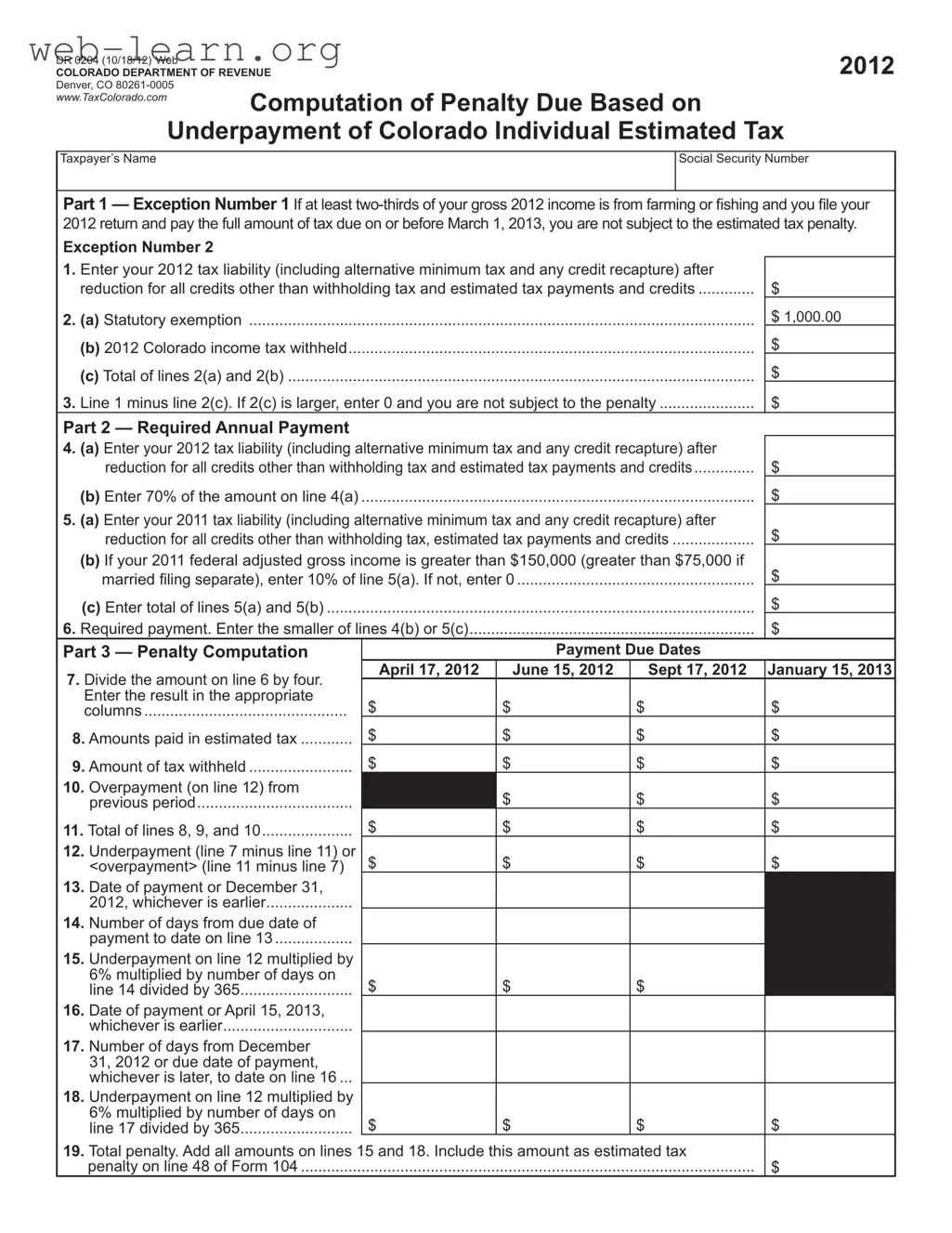
2012
Computation of Penalty Due Based on
Underpayment of Colorado Individual Estimated Tax
Taxpayer’s Name Social Security Number
Part 1 — Exception Number 1 
2012 return and pay the full amount of tax due on or before March 1, 2013, you are not subject to the estimated tax penalty.
Exception Number 2
1.
Enter your 2012 tax liability
(including alternative minimum tax and any credit recapture) after
reduction for all credits other than
withholding tax and estimated tax payments and credits ............. $
2. (a) Statutory exemption .....................................................................................................................
$ 1,000.00
(b) 2012 Colorado income tax withheld ..............................................................................................
$
(c) Total of lines 2(a) and 2(b) ............................................................................................................
$
3. Line 1 minus line 2(c). If 2(c) is larger, enter 0 and you are not subject to the penalty ...................... $
Part 2 — Required Annual Payment
4. (a)
E
nter your 2012 tax liability (including alternative minimum tax and any credit recapture) after
reduction for
all credits other than withholding tax and estimated tax payments and credits
.............. $
(b) Enter 70% of the amount on line 4(a) ...........................................................................................
$
5. (a)
Enter your 2011 tax liability (including alternative minimum tax and any credit recapture) after
reduction for
all credits other than
withholding
tax,
estimated tax payments and credits
...................
$
(b) If your 2011
federal adjusted gross inc
ome is greater than
$150,000
(greater than $75,000 if
married

enter 10% of line 5(a). If not, enter 0
.......................................................
$
(c) Enter total of lines 5(a) and 5(b) ...................................................................................................
$
6. Required payment. Enter the smaller of lines 4(b) or 5(c) .................................................................. $
Part 3 — Penalty Computation
Payment Due Dates
7.
Divide the amount on line 6 by four.
Enter the
result in the appropriate
columns ...............................................
April 17, 2012 June 15, 2012 Sept 17, 2012 January 15, 2013
$ $ $ $
8. Amounts paid in estimated tax ............
$ $ $ $
9. Amount of tax withheld ........................
$ $ $ $
10. Overpayment (on line 12) from
previous period ....................................
$ $ $
11. Total of lines 8, 9, and 10 .....................
$ $ $ $
12. Underpayment (line 7 minus line 11) or
<overpayment> (line 11 minus line 7)
$ $ $ $
13. Date of payment or December 31,
2012, whichever is earlier ....................
14. Number of days from due date of
payment to date on line 13 ..................
15. Underpayment on line 12 multiplied by
6% multiplied by number of days on
line 14 divided by 365 ..........................
$ $ $
16. Date of payment or April 15, 2013,
whichever is earlier ..............................
17. Number of days from December
31, 2012 or due date of payment,
whichever is later, to date on line 16 ...
18. Underpayment on line 12 multiplied by
6% multiplied by number of days on
line 17 divided by 365 ..........................
$ $ $ $
19. Total penalty. Add all amounts on lines 15 and 18. Include this amount as estimated tax
penalty on line 48 of Form 104 .........................................................................................................
$
DR 0204 (10/18/12)
COLORADO DEPARTMENT OF REVENUE
Denver, CO 80261-0005
www.TaxColorado.com
Web
Part 4 — Annualized Installment Method Schedule
20. Ending date of annualization period March 31, 2012 May 31, 2012 August 31, 2012
Dec 31,
2012
21. Colorado taxable income computed
through the date on line 20 .................
$ $ $ $
22. Annualization factor .............................
4 2.4 1.5 1
23. Annualized taxable income
Line 21 times line 22 ...........................
$ $ $ $
24. Annualized Colorado tax
Line 23 times 4.63% ...........................
$ $ $ $
25. Applicable percentage .........................
17.5% 35% 52.5% 70%
26. Installment payment due.
Line 24 multiplied by line 25, minus
amounts entered on line 26 in earlier
quarters.Enter here and on line 7 ....... $ $ $ $
Instructions for DR 0204
Part 1 Generally you are subject to an estimated tax
penalty if your 2012 estimated tax payments are not paid
in a timely manner. The estimated tax penalty will not be
assessed if either of the exceptions are met.
Part 2 The required annual amount to be paid is the
lesser of:
1. 70% of actual 2012 net Colorado tax liability.
2. 100% of preceding year’s net Colorado tax liability.
(This amount only applies if the preceding year was

return and the federal adjusted gross income for the
preceding year was $150,000 or less, $75,000 or less
if married separate.)
3. 110% of preceding year’s net Colorado tax liability.
(This amount only applies if the preceding year

Colorado return.)
Part 3 If neither exception applies to you, compute your
penalty on lines 7 through 19 of Form 204. Complete
each column before going on to the next column. See FYI
Income 51, Estimated Income Tax, regarding estimated
tax payment allocation on line 8. The amount entered on
line 10 is the net overpayment from the preceding period.
On line 17, if the payment was made prior to January 1,

is paid by January 31, 2013, no penalty will be computed
in column four. Estimated tax payments from a farmer or

2013 and only column four is used to compute the penalty.
Part 4 Taxpayers who do not receive income evenly during
the year may elect to use the annualized income installment
method to compute their estimated tax payments if they
elect annualized installments for the payment of their
federal income tax. Complete the annualized installment
method schedule to compute the amounts to enter on line
7. See FYI Income 51 regarding this computation method.
Example: Taxpayer's net tax liability for 2012 is $10,000.
He had $1,000 withholding and none of the exceptions
apply. He paid $4,000 on June 12, 2012, and made no
additional estimated tax payments.
April 17 June 15 September 17 January 15
Line 7 $1,750 $1,750 $1,750 $1,750
Line 8 $0 $4,000 $0 $0
Line 9 $250 $250 $250 $250
Line 10 $1,000**
Line 11 $250 $4,250 $1,250 $250
Line 12 $1,500 $(2,500) $500 $1,500
Line 13 6/12/12 6/12/12 12/31/12
Line 14 56 107
Line 15 $13.81 $8.79
Line 16 6/12/12 6/12/12 4/15/13 4/15/13
Line 17 0 0 108 91
Line 18 0 0 $8.85 $22.38
Line 19 $53.83
** June 12 Payment $4,000
April withholding 250
June withholding 250
$4,500
April installment $1,750
June installment 1,750 3,500
Overpayment to September $1,000
For additional information regarding the estimated tax penalty see FYI Income 51, which is available at www.TaxColorado.com

Form Information

Fact Name Description
Purpose The DR 0204 form is used to compute the penalty for underpayment of Colorado individual estimated tax.
Exceptions Taxpayers are exempt from penalties if at least two-thirds of their gross income is from farming or fishing and they file their return by March 1, 2013.
Payment Schedule Estimated tax payments are due in four installments: April 17, June 15, September 17, and January 15 of the following year.
Governing Laws This form is governed by Colorado Revised Statutes, specifically those related to income tax and estimated tax payments.

Detailed Guide for Filling Out Colorado Dr 0204

Filling out the Colorado DR 0204 form requires careful attention to detail. This form is used to compute any penalties due based on underpayment of Colorado individual estimated tax. It is important to ensure that all information is accurate and complete to avoid potential issues with the Department of Revenue.

  1. Begin by entering your name and Social Security Number at the top of the form.
  2. In Part 1, check if you qualify for any exceptions. If you do, complete the relevant lines. If not, proceed to Part 2.
  3. In Part 2, enter your 2012 tax liability on line 1. This includes alternative minimum tax and any credit recapture.
  4. On line 2(a), enter your statutory exemption. On line 2(b), enter the amount of Colorado income tax withheld.
  5. Calculate the total of lines 2(a) and 2(b) and enter it on line 2(c).
  6. Subtract line 2(c) from line 1 and enter the result on line 3. If line 2(c) is larger, enter 0.
  7. On line 4(a), re-enter your 2012 tax liability from line 1. On line 4(b), calculate and enter 70% of the amount on line 4(a).
  8. On line 5(a), enter your 2011 tax liability. On line 5(b), determine if your 2011 federal adjusted gross income is greater than $150,000 and enter the appropriate percentage on line 5(b).
  9. Calculate the total of lines 5(a) and 5(b) and enter it on line 5(c).
  10. Enter the smaller amount from lines 4(b) or 5(c) on line 6.
  11. In Part 3, divide the amount on line 6 by four and enter the result in the appropriate columns for each payment due date.
  12. Record the amounts paid in estimated tax, tax withheld, and any overpayment from the previous period in lines 8, 9, and 10 respectively.
  13. Calculate the total of lines 8, 9, and 10 and enter it on line 11.
  14. Subtract line 11 from line 7 to determine underpayment or overpayment on line 12.
  15. Fill in the date of payment or December 31, 2012, whichever is earlier, on line 13.
  16. Calculate the number of days from the due date of payment to the date on line 13 and enter it on line 14.
  17. Complete lines 15 and 18 by multiplying the underpayment on line 12 by 6%, then by the number of days from lines 14 and 17, respectively, divided by 365.
  18. Add the amounts on lines 15 and 18 to get the total penalty on line 19.
  19. In Part 4, if applicable, complete the annualized installment method schedule, entering the ending dates and calculating the amounts as instructed.

After completing the form, review all entries for accuracy. It is advisable to keep a copy for your records before submitting it to the Colorado Department of Revenue.

Obtain Answers on Colorado Dr 0204

  1. What is the Colorado DR 0204 form?

    The Colorado DR 0204 form is used to calculate penalties for underpayment of estimated taxes by individuals in Colorado. It outlines the process for determining if a taxpayer owes a penalty due to insufficient estimated tax payments throughout the year.

  2. Who needs to file the DR 0204 form?

    Taxpayers who are required to make estimated tax payments and who do not meet specific exceptions must file this form. If you underpaid your estimated tax payments, this form helps you compute any penalties owed.

  3. What are the exceptions to the estimated tax penalty?

    • If at least two-thirds of your gross income is from farming or fishing and you file your return and pay the full tax amount by March 1, you are exempt from the penalty.
    • If your total tax liability after credits is less than the amount withheld or estimated payments, you also avoid the penalty.
  4. How is the required annual payment calculated?

    The required annual payment is the lesser of:

    • 70% of your actual tax liability for the current year,
    • 100% of your previous year's tax liability (if your AGI was $150,000 or less), or
    • 110% of your previous year's tax liability (if your previous year was a full 12-month tax year).
  5. What information is needed to complete the DR 0204 form?

    You will need your tax liability for the current year, any estimated tax payments made, the amount of tax withheld, and details of any overpayments from the previous period. This information is used to compute both your required payments and any potential penalties.

  6. How is the penalty for underpayment computed?

    The penalty is calculated based on the amount of underpayment for each installment due date. The form provides a step-by-step method to determine the penalty, which includes multiplying the underpayment by a specified interest rate and the number of days late.

  7. What are the due dates for estimated tax payments?

    Estimated tax payments are typically due on the following dates:

    • April 15
    • June 15
    • September 15
    • January 15 of the following year
  8. Can I use the annualized installment method with this form?

    Yes, if your income is not received evenly throughout the year, you may elect to use the annualized installment method. This allows you to calculate your estimated payments based on actual income received during specific periods.

  9. Where can I find more information about the DR 0204 form?

    Additional information is available on the Colorado Department of Revenue's website at www.taxcolorado.com. You can also refer to FYI Income 51 for more details regarding estimated tax payments and penalties.

Common mistakes

Filling out the Colorado DR 0204 form can be a daunting task, and mistakes can lead to unnecessary penalties. One common mistake is failing to check eligibility for exceptions. Taxpayers who earn two-thirds of their income from farming or fishing may avoid penalties if they file their 2012 return by March 1, 2013. Not being aware of this exception can lead to an unexpected penalty.

Another frequent error is incorrectly calculating the tax liability. When entering the tax liability on line 1, it’s essential to include all relevant amounts, including alternative minimum tax and any credit recapture. Omitting any of these figures can result in an inaccurate calculation, leading to potential penalties.

People often miscalculate the required annual payment as well. Lines 4 and 5 require careful attention to detail. Entering the wrong figures from previous years can skew the required payment, making it larger than necessary. This mistake can lead to overpayment or additional penalties if the actual tax owed is underestimated.

Additionally, taxpayers sometimes overlook the importance of timely payments. Each estimated tax payment has specific due dates. Missing these deadlines can result in penalties, even if the form is filled out correctly. Keeping track of these dates is crucial to avoid unnecessary fees.

Some individuals also fail to properly account for amounts paid in estimated tax or withheld. Lines 8 and 9 must be accurately filled in to reflect actual payments made. If these amounts are underestimated, the underpayment on line 12 may be higher than it should be, leading to penalties.

Another common mistake involves misunderstanding the annualized installment method. Taxpayers who do not receive income evenly throughout the year may choose this method, but they must complete the corresponding schedule accurately. Failing to do so can result in incorrect calculations of the installment payments due.

Moreover, people often neglect to check the instructions thoroughly. Each part of the form has specific guidelines that must be followed. Ignoring these instructions can lead to errors in calculations and missed opportunities for exceptions.

Finally, a lack of attention to detail in the final calculations can lead to mistakes in the total penalty. Adding up the amounts on lines 15 and 18 must be done carefully. A simple miscalculation here can result in a larger penalty than necessary, impacting overall tax liability.

Documents used along the form

The Colorado DR 0204 form is essential for taxpayers to compute penalties related to underpayment of estimated taxes. However, several other forms and documents are often used in conjunction with it to ensure compliance with tax regulations and to facilitate accurate reporting. Below is a list of these documents, each accompanied by a brief description.

  • Form 104: This is the standard Colorado Individual Income Tax Return form. Taxpayers use it to report their total income, calculate their tax liability, and determine any refund or amount due.
  • Form DR 0104PN: This form is used for Colorado Part-Year Resident and Nonresident Income Tax Return. It helps individuals who lived in Colorado for only part of the year to report their income accurately.
  • Form DR 0104AD: This is the Colorado Individual Income Tax Return for the Amended Return. Taxpayers file this form to correct errors on their original tax return, whether related to income, deductions, or credits.
  • Form DR 0104CH: This document is for the Colorado Child Care Contribution Credit. Taxpayers use it to claim credits for contributions made to child care facilities, which can reduce their overall tax liability.
  • Form DR 0158-I: This is the Colorado Individual Estimated Tax Payment form. Taxpayers use it to make quarterly estimated tax payments to avoid penalties associated with underpayment of taxes throughout the year.
  • FYI Income 51: This is a publication from the Colorado Department of Revenue that provides detailed information about estimated income tax and the penalties for underpayment. It serves as a helpful resource for taxpayers seeking clarity on their obligations.

Understanding these forms and documents can significantly aid taxpayers in navigating their responsibilities and ensuring compliance with Colorado tax laws. Each document plays a unique role in the overall process of tax reporting and payment, making them integral to effective tax management.

Similar forms

  • IRS Form 1040-ES: This form is used for estimating and paying federal income tax. Like the Colorado DR 0204, it helps taxpayers calculate their estimated tax payments based on their expected income and deductions for the year.
  • California Form 540-ES: Similar to the DR 0204, this form is for California taxpayers to estimate and pay their state income tax. It includes calculations for penalties and exceptions, just like the Colorado form.
  • New York State Form IT-2105: This form allows New York residents to make estimated income tax payments. It includes guidance on penalties for underpayment, paralleling the structure of the Colorado DR 0204.
  • Florida Estimated Tax Payment Form: While Florida has no state income tax, this form is used by certain businesses to estimate and pay taxes. It shares a similar purpose of estimating tax liabilities and avoiding penalties.
  • Texas Franchise Tax Estimated Payment Form: This form is used for estimating franchise taxes in Texas. It contains calculations for penalties and payment deadlines, similar to the Colorado form.
  • Illinois Form IL-1040-ES: This form is for estimating Illinois state income tax. It provides a method for taxpayers to avoid penalties by calculating their estimated tax payments, akin to the DR 0204.
  • Massachusetts Form 1-ES: This form is utilized by Massachusetts residents to estimate their state income tax. Like the Colorado DR 0204, it includes provisions for exceptions and penalty calculations.

Dos and Don'ts

When filling out the Colorado DR 0204 form, there are important dos and don'ts to keep in mind. Following these guidelines can help ensure that your submission is accurate and complete.

  • Do read the instructions carefully before starting the form.
  • Do provide your correct Social Security Number to avoid processing delays.
  • Do double-check your math in each section to ensure accuracy.
  • Do enter any applicable exceptions clearly to prevent penalties.
  • Do keep a copy of the completed form for your records.
  • Don't leave any fields blank; if a question doesn't apply, write "N/A."
  • Don't rush through the form; take your time to avoid mistakes.
  • Don't ignore the payment due dates; timely payments can help you avoid penalties.
  • Don't forget to sign and date the form before submission.
  • Don't hesitate to seek help if you're unsure about any part of the form.

By following these guidelines, you can navigate the Colorado DR 0204 form with confidence and minimize any potential issues.

Misconceptions

Understanding the Colorado DR 0204 form can be challenging, and several misconceptions exist about its purpose and requirements. Below are ten common misconceptions, along with clarifications.

  1. The DR 0204 form is only for farmers and fishermen. While the form includes specific exceptions for farmers and fishermen, it is applicable to all taxpayers who may owe estimated tax penalties.
  2. Filing the DR 0204 form automatically incurs a penalty. A penalty is only assessed if estimated tax payments are not made on time and no exceptions apply.
  3. All taxpayers must pay estimated taxes quarterly. Not all taxpayers are required to make quarterly payments. Some may meet exceptions that exempt them from penalties.
  4. Only income from farming or fishing qualifies for exceptions. The exceptions pertain to the source of income, but other factors, such as timely filing and payment, also play a role.
  5. The penalty is calculated based on total income. The penalty is calculated based on underpayment of estimated tax, not total income.
  6. Taxpayers can ignore the form if they have no tax liability. Even if there is no tax liability, filing the form may still be necessary to avoid penalties in the future.
  7. Once filed, the DR 0204 form cannot be amended. Taxpayers can amend their form if they discover errors or if their tax situation changes.
  8. The form only applies to individuals. While it is primarily for individuals, certain entities may also need to use it if they meet specific criteria.
  9. Payments made after the due date will not be considered. Payments made after the due date can still affect the penalty calculation, but they may incur additional penalties.
  10. Using the annualized installment method is complicated and not worth it. This method can benefit those with uneven income throughout the year, potentially reducing their estimated tax payments.

By addressing these misconceptions, taxpayers can better understand their obligations and avoid unnecessary penalties related to estimated tax payments in Colorado.

Key takeaways

When filling out the Colorado DR 0204 form, keep these key takeaways in mind:

  • Understand Exceptions: If two-thirds of your income comes from farming or fishing, you may avoid the estimated tax penalty by filing and paying your tax by March 1, 2013.
  • Calculate Your Tax Liability: Enter your total 2012 tax liability after accounting for all credits except withholding and estimated tax payments.
  • Determine Required Annual Payment: The required payment is the lesser of 70% of your current year tax liability or 100% of the previous year’s liability, with specific conditions based on income levels.
  • Complete Penalty Computation: If no exceptions apply, compute your penalty using the provided lines from 7 to 19. Follow the instructions carefully for accurate calculations.
  • Track Payment Dates: Be aware of payment due dates: April 17, June 15, September 17, and January 15. Timely payments can help avoid penalties.
  • Annualized Installment Method: If your income is not evenly distributed throughout the year, consider using the annualized income installment method for your estimated tax payments.
  • Utilize Prior Overpayments: If you have overpayments from a previous period, include them in your calculations to reduce your current tax liability.
  • Seek Additional Information: For further guidance, refer to FYI Income 51 on the Colorado Department of Revenue website.