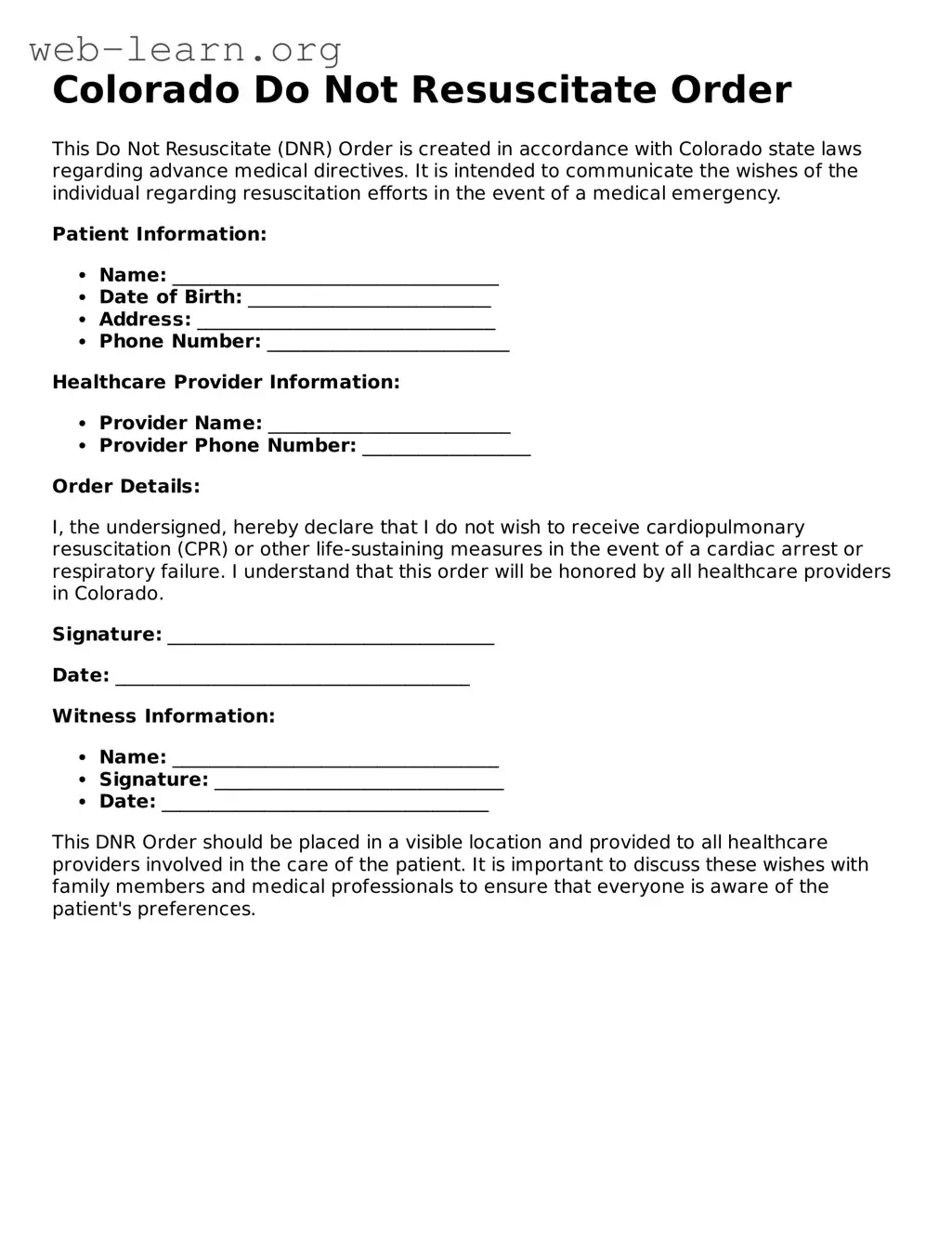
In Colorado, the Do Not Resuscitate (DNR) Order form serves as a vital tool for individuals who wish to express their preferences regarding medical treatment in critical situations. This legally recognized document allows patients to communicate their desire not to receive cardiopulmonary resuscitation (CPR) or other life-sustaining measures in the event of cardiac arrest or respiratory failure. The form is designed to be straightforward, ensuring that individuals can easily articulate their wishes. It requires the signature of the patient or their legal representative, along with the approval of a licensed physician, which adds an important layer of medical oversight. Additionally, the DNR Order must be readily accessible, as emergency medical personnel must be able to locate it quickly during a crisis. Understanding the nuances of this form can empower individuals to take control of their healthcare decisions, providing peace of mind for both patients and their families during challenging times.
Colorado Do Not Resuscitate Order
This Do Not Resuscitate (DNR) Order is created in accordance with Colorado state laws regarding advance medical directives. It is intended to communicate the wishes of the individual regarding resuscitation efforts in the event of a medical emergency.
Patient Information:
Healthcare Provider Information:
Order Details:
I, the undersigned, hereby declare that I do not wish to receive cardiopulmonary resuscitation (CPR) or other life-sustaining measures in the event of a cardiac arrest or respiratory failure. I understand that this order will be honored by all healthcare providers in Colorado.
Signature: ___________________________________
Date: ______________________________________
Witness Information:
This DNR Order should be placed in a visible location and provided to all healthcare providers involved in the care of the patient. It is important to discuss these wishes with family members and medical professionals to ensure that everyone is aware of the patient's preferences.
| Fact Name | Description |
|---|---|
| Purpose | The Colorado Do Not Resuscitate Order (DNR) form is designed to inform medical personnel of a patient's wish to forgo resuscitation efforts in the event of cardiac arrest or respiratory failure. |
| Governing Law | The DNR order in Colorado is governed by the Colorado Revised Statutes, specifically under Title 25, Article 48, which outlines the legal framework for advance medical directives. |
| Eligibility | Any adult who is capable of making medical decisions can complete a DNR order. This includes patients with terminal conditions or those who wish to avoid aggressive medical interventions. |
| Implementation | The DNR form must be signed by the patient and a physician. It should be readily available in medical records and presented during emergencies to ensure that the patient's wishes are honored. |
Filling out the Colorado Do Not Resuscitate Order form is an important step in expressing your healthcare preferences. Once completed, this form should be shared with your healthcare providers and kept in a place where it can be easily accessed in case of a medical emergency.
What is a Do Not Resuscitate (DNR) Order?
A Do Not Resuscitate Order is a legal document that allows a person to refuse resuscitation efforts in the event of cardiac arrest or respiratory failure. In Colorado, this order is intended to guide medical personnel in respecting the wishes of individuals who do not wish to receive life-saving measures such as CPR or advanced cardiac life support.
Who can request a DNR Order in Colorado?
In Colorado, a DNR Order can be requested by individuals who are at least 18 years old and are capable of making informed decisions about their medical care. Additionally, a legally authorized representative, such as a guardian or a healthcare proxy, may also request a DNR on behalf of an individual who is unable to make decisions for themselves.
How is a DNR Order created in Colorado?
To create a DNR Order in Colorado, an individual must complete the state-approved DNR form. This form must be signed by the individual and their physician. It is essential that the form clearly states the individual's wishes regarding resuscitation. Once completed, the form should be kept in an accessible location and shared with healthcare providers and family members.
What should I do with my DNR Order once it is completed?
After completing the DNR Order, it is crucial to keep multiple copies of the document. Share copies with your healthcare provider, family members, and anyone involved in your care. It is also advisable to carry a copy with you, especially when visiting hospitals or emergency care facilities, to ensure that your wishes are known and respected in critical situations.
Can a DNR Order be revoked or changed?
Yes, a DNR Order can be revoked or changed at any time. If an individual decides to change their mind about resuscitation efforts, they can do so by destroying the existing DNR form and creating a new one. It is important to inform healthcare providers and family members about any changes to ensure that your current wishes are understood.
Will a DNR Order affect other medical treatments?
A DNR Order specifically addresses resuscitation efforts and does not impact other medical treatments. Patients with a DNR Order can still receive all other appropriate medical care, including pain management, medications, and other interventions. The DNR Order solely indicates that the individual does not wish to be resuscitated in the event of cardiac or respiratory failure.
When completing the Colorado Do Not Resuscitate Order form, individuals often make several common mistakes that can lead to confusion or complications in critical situations. One frequent error is failing to provide clear and specific instructions. The form requires explicit language to ensure that medical personnel understand the individual’s wishes. Ambiguous phrases or incomplete sentences can result in misinterpretation, potentially leading to unwanted resuscitation efforts.
Another mistake is neglecting to sign and date the form. A signature is essential for the document to be legally binding. Without it, healthcare providers may not recognize the order as valid. Additionally, the date is crucial, as it indicates when the wishes were expressed. An unsigned or undated form can create unnecessary delays and stress during medical emergencies.
People also often forget to discuss their decisions with family members and healthcare providers. Open communication is vital. When loved ones are unaware of the individual’s wishes, it can lead to conflicts or confusion during critical moments. Having a conversation ensures that everyone is on the same page and can support the individual’s choices.
Finally, individuals may overlook the importance of reviewing and updating the Do Not Resuscitate Order regularly. Life circumstances can change, and so can one’s preferences regarding medical treatment. It is essential to revisit the form periodically and make any necessary adjustments. This practice ensures that the document accurately reflects current wishes and provides peace of mind for both the individual and their family.
When considering end-of-life care options, individuals often use the Colorado Do Not Resuscitate (DNR) Order form alongside other important documents. Each of these forms serves a unique purpose in ensuring that a person's healthcare wishes are respected. Below are five commonly used documents that complement the DNR Order.
Understanding these documents can empower individuals to make informed decisions about their healthcare. It is crucial to have clear communication with loved ones and healthcare providers to ensure that one's wishes are honored during critical moments.
Living Will: This document outlines an individual's wishes regarding medical treatment in situations where they are unable to communicate. Like a Do Not Resuscitate Order, a living will can specify preferences about life-sustaining measures and end-of-life care.
Durable Power of Attorney for Health Care: This legal document allows a person to designate another individual to make medical decisions on their behalf if they become incapacitated. Similar to a DNR, it focuses on health care preferences and can include instructions about resuscitation.
POLST (Physician Orders for Life-Sustaining Treatment): A POLST form is used to communicate a patient's preferences regarding medical treatment in emergency situations. It is similar to a DNR in that it provides specific instructions to healthcare providers about the level of care desired.
Advance Directive: An advance directive is a broader term that encompasses various documents, including living wills and durable powers of attorney. It allows individuals to express their wishes regarding medical care, including decisions about resuscitation.
Health Care Proxy: This document appoints someone to make health care decisions for an individual if they are unable to do so. It is similar to a DNR in that it can address preferences about resuscitation and other life-sustaining treatments.
When filling out the Colorado Do Not Resuscitate Order form, it is essential to approach the process with care. Here are some important dos and don'ts to keep in mind:
Many people have misconceptions about the Colorado Do Not Resuscitate (DNR) Order form. Understanding the facts can help individuals make informed decisions about their healthcare preferences. Here are nine common misconceptions:
Understanding these misconceptions can empower individuals to make informed choices about their healthcare preferences. It is crucial to have open discussions with healthcare providers and loved ones about DNR orders and what they entail.
The Colorado Do Not Resuscitate (DNR) Order form is an important legal document for individuals who wish to express their preferences regarding resuscitation efforts in the event of a medical emergency. Below are key takeaways regarding the completion and use of this form.
How Old Do You Have to Be to Sign a Dnr - Having a DNR order can facilitate discussions about end-of-life care with family and healthcare providers.
Is a Dnr an Advance Directive - Having a DNR order can facilitate discussions about other aspects of end-of-life care.