Homepage Blank Colorado Correction Form
Outline

The Colorado Correction form serves as a vital tool for addressing and rectifying errors in property conveyance documents. This form is particularly important when a mutual mistake has been identified in a previously recorded deed. By utilizing the Colorado Correction form, parties involved can ensure that the public record accurately reflects the intended details of the property transaction. The form includes sections for identifying the grantor and grantee, as well as specific property descriptions. It also acknowledges the receipt of a specified sum, confirming the grantor's authority to convey the property. Additionally, the document contains clauses that warrant the grantor's ownership and the absence of encumbrances on the property. Furthermore, it requires notarization to validate the corrections made. By following this structured approach, individuals can effectively safeguard their property rights and maintain clear title records.


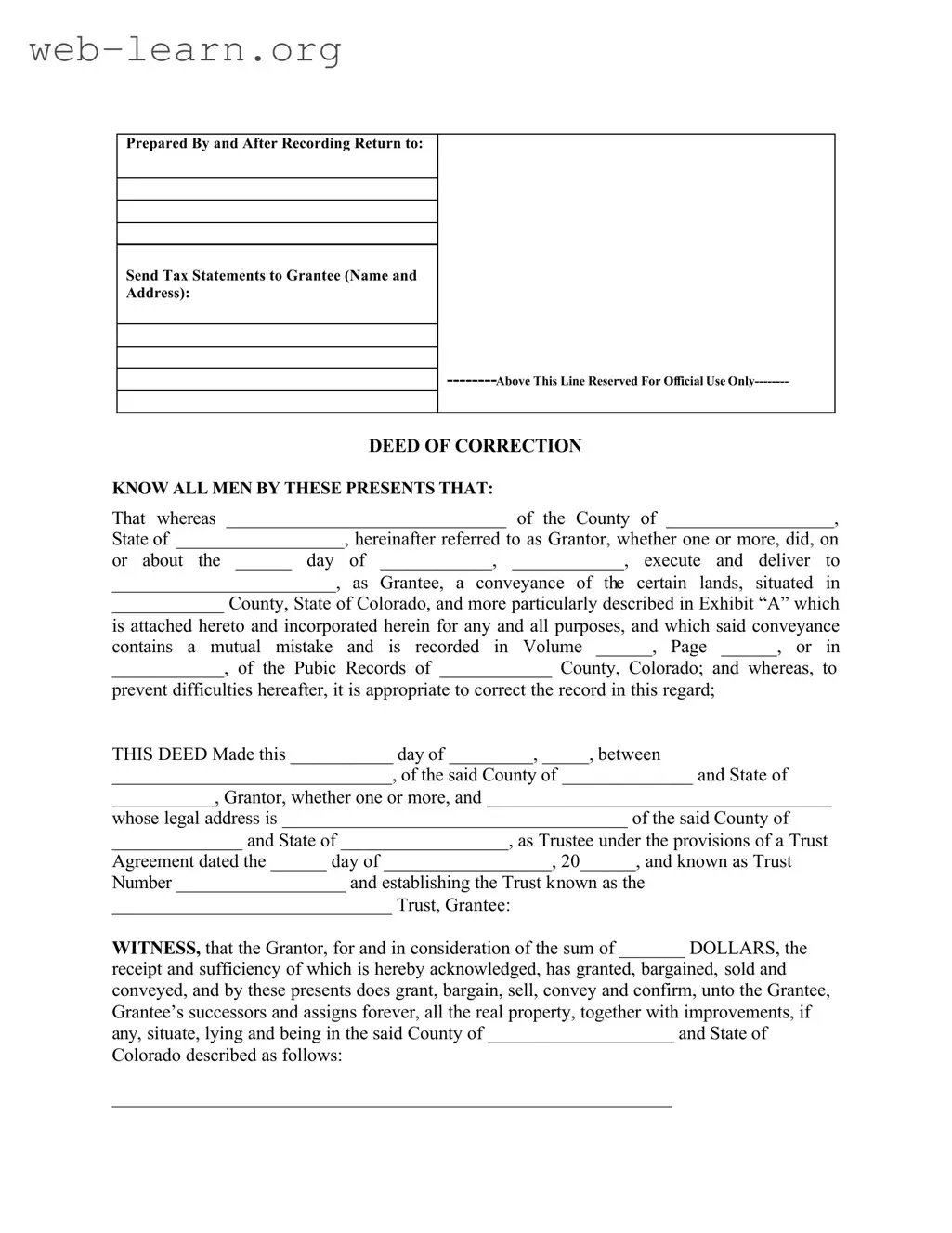
Sample - Colorado Correction Form

Prepared By and After Recording Return to:
Send Tax Statements to Grantee (Name and
Address):
--------Above This Line Reserved For Official Use Only--------
DEED OF CORRECTION
KNOW ALL MEN BY THESE PRESENTS THAT:
That whereas ______________________________ of the County of __________________,
State of __________________, hereinafter referred to as Grantor, whether one or more, did, on
or about the ______ day of ____________, ____________, execute and deliver to
________________________, as Grantee, a conveyance of the certain lands, situated in
____________ County, State of Colorado, and more particularly described in Exhibit “A” which
is attached hereto and incorporated herein for any and all purposes, and which said conveyance
contains a mutual mistake and is recorded in Volume ______, Page ______, or in
____________, of the Pubic Records of ____________ County, Colorado; and whereas, to
prevent difficulties hereafter, it is appropriate to correct the record in this regard;
THIS DEED Made this ___________ day of _________, _____, between
______________________________, of the said County of ______________ and State of
___________, Grantor, whether one or more, and _____________________________________
whose legal address is _____________________________________ of the said County of
______________ and State of __________________, as Trustee under the provisions of a Trust
Agreement dated the ______ day of __________________, 20______, and known as Trust
Number __________________ and establishing the Trust known as the
______________________________ Trust, Grantee:
WITNESS, that the Grantor, for and in consideration of the sum of _______ DOLLARS, the
receipt and sufficiency of which is hereby acknowledged, has granted, bargained, sold and
conveyed, and by these presents does grant, bargain, sell, convey and confirm, unto the Grantee,
Grantee’s successors and assigns forever, all the real property, together with improvements, if
any, situate, lying and being in the said County of ____________________ and State of
Colorado described as follows:
____________________________________________________________
also known by street and number as: ____________________________________
TOGETHER with all and singular the hereditaments and appurtenances thereto belonging, or in
anywise appertaining, and the reversion and reversions, remainder and remainders, rents, issues
and profits thereof, and all the estate, right, title, interest, claim and demand whatsoever of the
grantor, either in law or equity, of, in and to the above bargained premises, with the
hereditaments and appurtenances.
TO HAVE AND TO HOLD the said premises above bargained and described, with the
appurtenances, unto the Grantee, his/her successors and assigns forever. And the Grantor, for
Grantor, Grantor’s heirs, and personal representatives, does covenant, grant, bargain, and agree
to and with the Grantee, Grantee’s successors and assigns, that at the time of ensealing and
delivery of these presents, Grantor is well seized of the premises above conveyed, has good,
sure, perfect, absolute and indefeasible estate of inheritance, in law, in fee simple, and has good
right, full power and lawful authority to grant, bargain, sell and convey the same in manner and
form as aforesaid, and that the same are free and clear from all former and other grants, bargains,
sales, liens, taxes, assessments, encumbrances and restrictions of whatever kind or nature except:
The Grantor shall and will WARRANT AND FOREVER DEFEND the above-bargained
premises in the quiet and peaceable possession of the Grantee, Grantee’s successors and assigns,
against all and every person or persons lawfully claiming the whole or any part thereof. The
singular number shall include the plural and the singular, and the use of any gender shall be
applicable to all genders.
IN WITNESS WHEREOF, the Grantor has executed this deed on the date set forth above.
Grantor
Type or Print Name
Grantor
Type or Print Name
State of Colorado
County of __________________
The foregoing instrument was acknowledged before me this ____________ (date) by
______________________________ (name of person acknowledged).
Notary Public
My commission expires:
Type or Print Name
State of Colorado
County of __________________
The foregoing instrument was acknowledged before me this ____________ (date) by
______________________________ (name of person acknowledged).
Notary Public
My commission expires:
Type or Print Name
Grantor(s) Name, Address and phone:
Grantee(s) Name, Address and Phone:

Form Information

Fact Name Fact Description
Purpose The Colorado Correction form is used to correct errors in previously recorded deeds.
Governing Law This form is governed by Colorado Revised Statutes, Title 38, Article 30.
Parties Involved The form involves a Grantor (the seller) and a Grantee (the buyer).
Property Description It requires a detailed description of the property being conveyed, including its location.
Consideration The Grantor must acknowledge the receipt of a specific sum of money as part of the transaction.
Notarization The form must be notarized to validate the signatures of the parties involved.

Detailed Guide for Filling Out Colorado Correction

Filling out the Colorado Correction form requires careful attention to detail. This process ensures that any errors in the original deed are rectified, allowing for accurate public records. Follow the steps below to complete the form accurately.

  1. Identify the Grantor: Fill in the name of the Grantor, who is the person or entity making the correction.
  2. Provide County and State: Enter the County and State where the Grantor resides.
  3. Enter the Date: Specify the date when the original deed was executed.
  4. Complete the Grantee Information: Input the name of the Grantee, the person or entity receiving the property.
  5. Provide Grantee's Address: Fill in the Grantee's legal address.
  6. Detail the Trust Agreement: If applicable, include the date of the Trust Agreement and its Trust Number.
  7. State the Consideration: Indicate the amount of money involved in the transaction.
  8. Describe the Property: Clearly describe the property being corrected, including any street addresses.
  9. Sign the Document: The Grantor must sign and date the form to validate the correction.
  10. Notary Acknowledgment: Have the document notarized by a licensed Notary Public.

Once completed, the form must be recorded with the appropriate county office to ensure that the corrections are officially recognized. This step is crucial for maintaining accurate property records and protecting the interests of all parties involved.

Obtain Answers on Colorado Correction

  1. What is the Colorado Correction form?

    The Colorado Correction form is a legal document used to correct mistakes in a previously recorded deed. It serves to clarify the details of the property transfer, ensuring that the public record accurately reflects the intentions of the parties involved. This form is essential for preventing future disputes over property ownership or rights.

  2. Who needs to use the Colorado Correction form?

    Any party involved in a property transaction that has experienced a mutual mistake in the recorded deed should consider using this form. This includes grantors (sellers) and grantees (buyers) who wish to correct errors related to the property description, names, or other critical details.

  3. What types of mistakes can be corrected using this form?

    The Colorado Correction form can address various types of mistakes, including:

    • Incorrect property descriptions
    • Misspelled names of parties involved
    • Errors in the legal description of the property
    • Inaccurate dates or references in the original deed
  4. How do I fill out the Colorado Correction form?

    To fill out the form, you will need to provide specific information, including:

    • The names and addresses of the grantor and grantee
    • The date of the original deed and its recording information
    • A clear description of the property being corrected
    • The nature of the correction being made

    It is crucial to ensure that all information is accurate and complete to avoid further complications.

  5. Do I need a notary to sign the Colorado Correction form?

    Yes, the Colorado Correction form must be acknowledged by a notary public. This requirement helps to verify the identities of the parties involved and ensures that the document is legally binding. Each party should sign the form in the presence of a notary.

  6. Where do I file the Colorado Correction form?

    The completed Colorado Correction form should be filed with the county clerk and recorder's office in the county where the property is located. This ensures that the correction is officially recorded and becomes part of the public record.

  7. Is there a fee to file the Colorado Correction form?

    Yes, there is typically a filing fee associated with submitting the Colorado Correction form. The fee may vary by county, so it is advisable to check with the local county clerk and recorder's office for the specific amount and acceptable payment methods.

  8. Can I make multiple corrections with one form?

    Generally, the Colorado Correction form is designed to address one specific mistake at a time. If multiple corrections are needed, it is best to submit separate forms for each correction to ensure clarity and proper documentation.

  9. What happens if I do not file a correction?

    If a correction is not filed, the original deed remains in the public record, which can lead to confusion or disputes regarding property ownership. Failure to correct errors may affect the legal standing of the property and the rights of the parties involved.

  10. Can I seek legal assistance for the Colorado Correction form?

    Yes, seeking legal assistance is advisable, especially if the corrections are complex or if there are disputes among the parties involved. An attorney can provide guidance on how to properly complete the form and ensure that all legal requirements are met.

Common mistakes

Filling out the Colorado Correction form can seem straightforward, but many people make common mistakes that can lead to delays or complications. One significant error is failing to provide complete information in the designated fields. For instance, leaving out the name of the Grantor or Grantee can render the form invalid. Every blank should be filled in accurately to ensure the document serves its intended purpose.

Another frequent mistake is incorrect descriptions of the property involved. The form requires a precise description of the property, including the county and any relevant details. Omitting this information or providing vague descriptions can create confusion and may result in legal challenges. Always double-check the property details to avoid this pitfall.

People also often overlook the necessity of including the correct recording information. This includes the volume and page number where the original deed is recorded. Missing or incorrect recording details can complicate the correction process, making it essential to verify this information before submission.

Additionally, many individuals neglect to have the document notarized properly. The form must be signed in the presence of a notary public to be legally binding. Failing to do so can lead to issues with the document's acceptance. It’s crucial to ensure that all signatures are witnessed and notarized correctly.

Another common mistake is not including the date of the correction. While it may seem minor, the date is vital for establishing the timeline of the correction. Without it, the document may lack clarity regarding when the correction took effect, which can lead to misunderstandings in the future.

Lastly, individuals sometimes forget to keep copies of the completed form. After submitting the correction, it’s wise to retain a copy for personal records. This can be helpful for future reference or if any disputes arise. Keeping thorough records can save time and hassle down the line.

Documents used along the form

The Colorado Correction form is often used in conjunction with several other documents to ensure clarity and accuracy in property transactions. Below is a list of related forms and documents that may be required or beneficial when filing a correction. Each document serves a specific purpose in the process.

  • Deed of Trust: This document secures a loan by transferring the title of the property to a trustee until the loan is repaid. It outlines the terms of the loan and the rights of all parties involved.
  • Quitclaim Deed: A quitclaim deed transfers any ownership interest the grantor may have in a property to the grantee, without guaranteeing that the title is clear. It is often used to clear up title issues.
  • Affidavit of Heirship: This document establishes the heirs of a deceased property owner. It can help clarify ownership when transferring property after someone has passed away.
  • Warranty Deed: A warranty deed guarantees that the grantor holds clear title to the property and has the right to sell it. It provides the highest level of protection for the grantee.
  • Title Insurance Policy: This insurance protects property owners and lenders against losses from defects in the title. It is often required during real estate transactions.
  • Property Transfer Declaration: This form provides information about the property being transferred, including its value and the names of the buyer and seller. It is often used for tax assessment purposes.
  • Real Estate Purchase Agreement: This contract outlines the terms and conditions of the sale of the property. It includes details such as the sale price and contingencies.
  • Notice of Default: This document notifies a borrower that they have defaulted on their loan. It is often the first step in the foreclosure process.
  • Release of Lien: This document formally removes a lien from a property once the debt has been paid. It is important for clearing the title for future transactions.

Each of these documents plays a crucial role in ensuring that property transactions are handled correctly and legally. Understanding their functions can help individuals navigate the complexities of real estate dealings more effectively.

Similar forms

The Colorado Correction form is a specific legal document used to correct errors in previously recorded deeds. It shares similarities with several other legal documents that serve similar purposes in real estate transactions. Below is a list of seven documents that are comparable to the Colorado Correction form, along with a brief explanation of how they are similar.

  • Deed of Trust: Like the Colorado Correction form, a Deed of Trust is used in real estate transactions to clarify ownership and secure a loan. It often requires corrections to reflect accurate information about the parties involved or the property description.
  • Quitclaim Deed: This document allows a property owner to transfer their interest in a property without making any guarantees about the title. Similar to the Colorado Correction form, it can be used to rectify mistakes in the ownership records.
  • Warranty Deed: A Warranty Deed provides a guarantee that the grantor holds clear title to the property. If errors are found in the original Warranty Deed, a Colorado Correction form may be necessary to amend those inaccuracies.
  • Affidavit of Correction: This document is specifically designed to correct clerical errors in recorded documents. Like the Colorado Correction form, it serves to clarify the intent of the original document and ensure accurate public records.
  • Grant Deed: A Grant Deed conveys property ownership and often includes warranties regarding the title. If a mistake is identified in a Grant Deed, a Colorado Correction form can be utilized to amend the records appropriately.
  • Bill of Sale: Although primarily used for personal property, a Bill of Sale can also include real estate transactions. If errors are present in the Bill of Sale related to property, a correction similar to the Colorado Correction form may be needed.
  • Power of Attorney: This document allows one person to act on behalf of another in legal matters. If the Power of Attorney contains inaccuracies regarding property transactions, a Colorado Correction form may be required to ensure the correct representation of the parties involved.

Understanding these documents can be critical for anyone involved in real estate transactions in Colorado. Ensuring that all records are accurate is essential to prevent future disputes and complications.

Dos and Don'ts

When filling out the Colorado Correction form, it’s important to follow certain guidelines to ensure accuracy and compliance. Here are five things you should and shouldn't do:

  • Do double-check all names and addresses for accuracy.
  • Don't leave any fields blank; all sections must be completed.
  • Do ensure the date is filled out correctly in the specified format.
  • Don't use abbreviations for counties or states; write them out fully.
  • Do have the form notarized after signing to validate the document.

Misconceptions

  • Misconception 1: The Colorado Correction form is only for minor errors.

    In reality, this form can address significant mistakes in property records, such as incorrect legal descriptions or misidentified parties. It serves to clarify and correct any discrepancies that could affect ownership rights.

  • Misconception 2: Anyone can file a correction without consent.

    Contrary to this belief, all parties involved in the original deed must agree to the correction. This ensures that all interests are protected and that the correction reflects a mutual understanding.

  • Misconception 3: The form is only necessary if the error was made by the grantor.

    This is not accurate. Errors can occur at any stage of the property transaction, including mistakes made by title companies or clerks. The correction form is applicable regardless of who made the mistake.

  • Misconception 4: Filing a correction is a lengthy and complicated process.

    While it may seem daunting, the process is relatively straightforward. Once the necessary information is gathered and the form is completed, it can be filed with the appropriate county office without extensive delays.

  • Misconception 5: A correction deed negates the original deed.

    In fact, a correction deed does not invalidate the original deed; instead, it clarifies and amends it. The correction deed serves as an official acknowledgment of the prior error while maintaining the validity of the original transaction.

  • Misconception 6: All corrections require a new notarization.

    This is misleading. While some corrections may need notarization, others can be made without it, depending on the nature of the correction and the specific requirements of the county where the property is located.

  • Misconception 7: The correction form is only for residential properties.

    This form is applicable to all types of real estate, including commercial and agricultural properties. Any property transaction that requires correction can utilize this form.

  • Misconception 8: Once a correction is filed, it cannot be changed again.

    While it is true that corrections should be made carefully, subsequent corrections can be filed if new errors are discovered or if further clarification is needed. The legal system allows for ongoing adjustments to ensure accurate records.

Key takeaways

When filling out and using the Colorado Correction form, it's essential to keep several key points in mind. Here are some takeaways to ensure the process goes smoothly:

  • Identify the Grantor and Grantee: Clearly state the names and addresses of both the Grantor and Grantee. This information is crucial for the legal validity of the document.
  • Provide Accurate Property Description: Ensure that the property description is precise and matches the information in the original deed. This helps prevent any future disputes regarding property ownership.
  • Correct Any Mistakes: The purpose of the form is to correct any mutual mistakes found in the original deed. Clearly outline what needs to be corrected to avoid any confusion.
  • Include Consideration Amount: Specify the amount of consideration (payment) involved in the transaction. This is a standard requirement in property transactions.
  • Notarization is Required: After completing the form, it must be acknowledged by a notary public. This step is necessary to validate the document legally.

By following these guidelines, you can effectively fill out the Colorado Correction form and ensure that your property records are accurate and up to date.