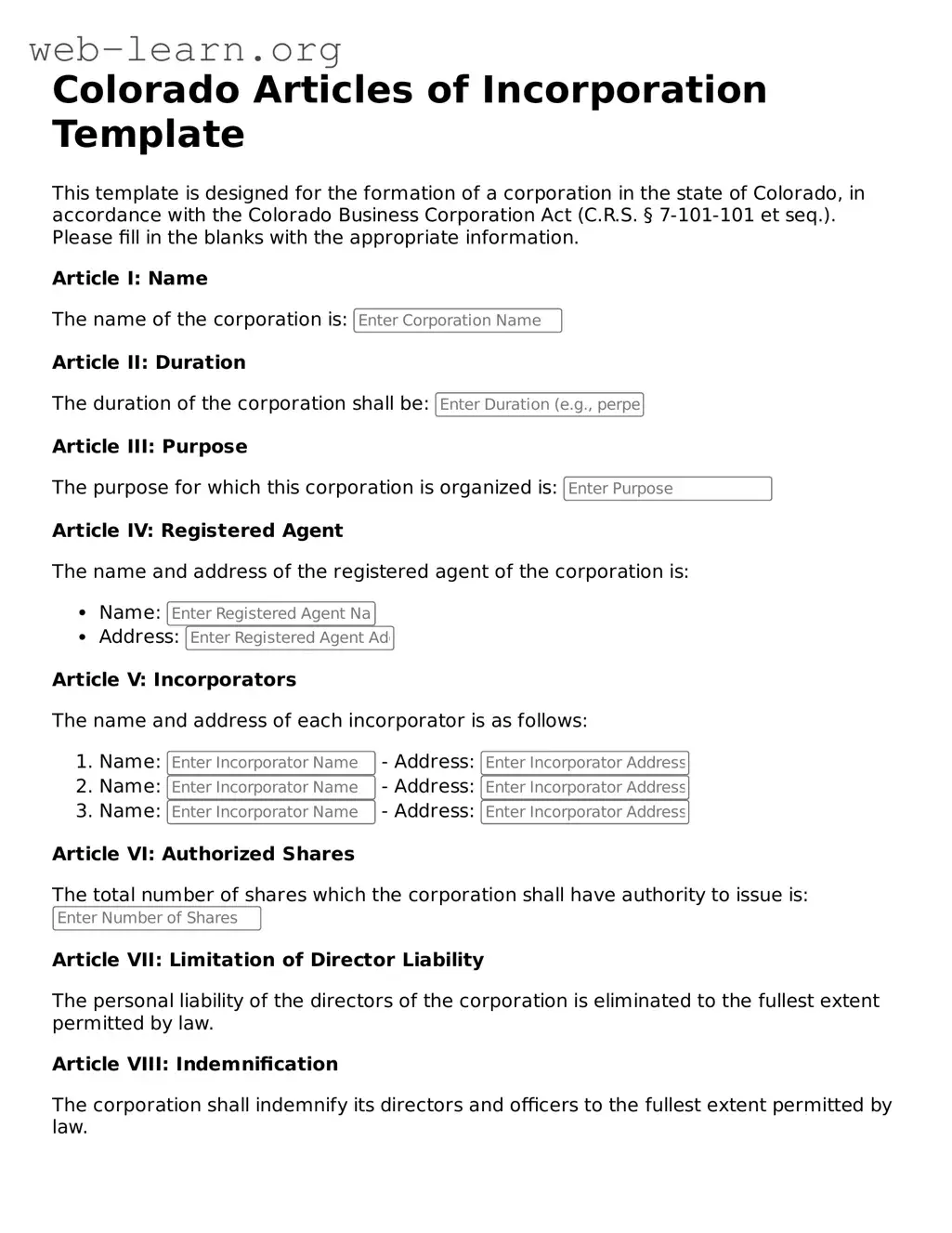
When starting a business in Colorado, one of the first essential steps is completing the Articles of Incorporation form. This document serves as the foundation for establishing your corporation, outlining key details that define its structure and purpose. The form requires you to provide the corporation's name, which must be unique and comply with state regulations. Additionally, it includes information about the registered agent, who will be responsible for receiving legal documents on behalf of the corporation. You'll also need to specify the corporation's duration, which can be perpetual or for a limited time. Another critical aspect involves detailing the number of shares the corporation is authorized to issue, along with the par value of those shares. This form not only sets the legal framework for your business but also helps ensure compliance with Colorado state laws. Completing the Articles of Incorporation accurately is vital, as it can affect your corporation’s ability to operate effectively and legally within the state.
Colorado Articles of Incorporation Template
This template is designed for the formation of a corporation in the state of Colorado, in accordance with the Colorado Business Corporation Act (C.R.S. § 7-101-101 et seq.). Please fill in the blanks with the appropriate information.
Article I: Name
The name of the corporation is:
Article II: Duration
The duration of the corporation shall be:
Article III: Purpose
The purpose for which this corporation is organized is:
Article IV: Registered Agent
The name and address of the registered agent of the corporation is:
Article V: Incorporators
The name and address of each incorporator is as follows:
Article VI: Authorized Shares
The total number of shares which the corporation shall have authority to issue is:
Article VII: Limitation of Director Liability
The personal liability of the directors of the corporation is eliminated to the fullest extent permitted by law.
Article VIII: Indemnification
The corporation shall indemnify its directors and officers to the fullest extent permitted by law.
IN WITNESS WHEREOF, the undersigned incorporators have executed these Articles of Incorporation on this .
Signature of Incorporator: ________________________________
Signature of Incorporator: ________________________________
Signature of Incorporator: ________________________________
| Fact Name | Description |
|---|---|
| Governing Law | The Colorado Articles of Incorporation are governed by the Colorado Revised Statutes, specifically Title 7, Article 90. |
| Purpose of Filing | This form is used to legally create a corporation in the state of Colorado. |
| Required Information | Incorporators must provide the corporation's name, principal office address, and registered agent details. |
| Filing Fee | The standard filing fee for the Articles of Incorporation in Colorado is $50, which may vary based on specific circumstances. |
| Submission Method | The form can be submitted online through the Colorado Secretary of State's website or via mail. |
| Effective Date | The Articles of Incorporation become effective upon filing unless a delayed effective date is specified. |
| Amendments | Corporations can amend their Articles of Incorporation by filing an amendment form with the Colorado Secretary of State. |
| Public Record | Once filed, the Articles of Incorporation become part of the public record and can be accessed by anyone. |
After completing the Colorado Articles of Incorporation form, you will be ready to submit it to the appropriate state office. This is an important step in establishing your business entity in Colorado.
What is the purpose of the Articles of Incorporation in Colorado?
The Articles of Incorporation serve as a foundational document for creating a corporation in Colorado. This document officially establishes your business as a legal entity separate from its owners. By filing the Articles, you are essentially telling the state that you intend to operate a business and outlining key details about your corporation, such as its name, purpose, and structure.
What information is required to complete the Articles of Incorporation?
To complete the Articles of Incorporation in Colorado, you will need to provide several key pieces of information:
How do I file the Articles of Incorporation in Colorado?
Filing the Articles of Incorporation in Colorado can be done online, by mail, or in person. To file online, you can visit the Colorado Secretary of State's website, where you will find a user-friendly portal for submitting your documents. If you prefer to file by mail, you can download the form, complete it, and send it to the appropriate address along with the required filing fee. In-person filings can be made at the Secretary of State's office. Always ensure that you have the correct fee ready, as it varies depending on the type of corporation you are forming.
What is the filing fee for the Articles of Incorporation?
The filing fee for the Articles of Incorporation in Colorado varies based on the type of corporation you are establishing. As of October 2023, the fee for a standard corporation is typically around $50, while a nonprofit corporation may have a different fee structure. It's essential to check the Colorado Secretary of State’s website for the most current fee schedule, as fees can change over time.
Can I amend my Articles of Incorporation after filing?
Yes, you can amend your Articles of Incorporation after they have been filed. If your business undergoes changes, such as a new registered agent, a change in the number of authorized shares, or a modification of your business purpose, you will need to file an amendment with the Colorado Secretary of State. This process usually requires completing a specific form and paying a nominal fee. Keeping your Articles up to date is crucial for maintaining compliance and ensuring that your corporation operates smoothly.
When individuals set out to incorporate a business in Colorado, they often encounter the Articles of Incorporation form. This document is essential for establishing a corporation, but mistakes can lead to delays or complications. One common error is failing to provide a clear and accurate name for the corporation. The name must be unique and not deceptively similar to existing entities. If the name does not meet these criteria, the state may reject the application.
Another frequent mistake is neglecting to include the correct registered agent information. The registered agent serves as the point of contact for legal documents and must have a physical address in Colorado. Omitting this information or providing an incorrect address can result in significant setbacks, including potential legal issues if the corporation cannot be reached.
People also often misinterpret the purpose of the corporation. The Articles of Incorporation require a statement of purpose, which should clearly articulate what the corporation intends to do. Some individuals provide vague or overly broad descriptions, which can lead to confusion or questions from state officials. A precise and specific purpose statement is crucial for clarity and compliance.
In addition, many applicants overlook the importance of specifying the number of shares the corporation is authorized to issue. This detail is vital, as it determines ownership structure and can affect future fundraising efforts. Failing to outline this information can create complications down the line, especially if the corporation seeks to attract investors.
Another common oversight involves the signatures on the form. All incorporators must sign the Articles of Incorporation, but sometimes individuals forget to do so or fail to include the date. Without the proper signatures, the form is incomplete, and the state will not process the application.
Lastly, individuals sometimes forget to check for filing fees. The Articles of Incorporation cannot be submitted without the appropriate fee, which varies depending on the type of corporation being formed. Ensuring that the correct payment accompanies the application is essential to avoid unnecessary delays in the incorporation process.
When forming a corporation in Colorado, the Articles of Incorporation is a critical document. However, several other forms and documents are often required to ensure compliance with state regulations and to facilitate smooth business operations. Below is a list of important documents that should be considered alongside the Articles of Incorporation.
Gathering these documents is essential for establishing a solid foundation for your corporation. Each form serves a specific purpose and contributes to the overall compliance and functionality of your business. Be sure to review the requirements carefully to avoid any potential delays in the incorporation process.
The Articles of Incorporation form serves a specific purpose in the process of establishing a corporation. However, there are several other documents that share similarities with it in terms of function and importance. Here are five such documents:
When completing the Colorado Articles of Incorporation form, it is essential to follow specific guidelines to ensure accuracy and compliance. Below is a list of things to do and avoid during this process.
Things You Should Do:
Things You Shouldn't Do:
When it comes to the Colorado Articles of Incorporation form, several misconceptions can lead to confusion. Understanding these can help ensure a smoother process when establishing a business entity in Colorado. Here are eight common misconceptions:
By clarifying these misconceptions, individuals can better navigate the process of filing Articles of Incorporation in Colorado and set a solid foundation for their business.
When filling out and using the Colorado Articles of Incorporation form, it is essential to understand several key aspects to ensure a smooth incorporation process. Here are some important takeaways:
By keeping these key points in mind, you can navigate the process of incorporating your business in Colorado with greater confidence and clarity.
Hawaii Articles of Incorporation - The form is a critical step in the process of forming a new corporation.
Articles of Incorporation Kentucky - The form can include provisions for employee stock options.
Michigan Llc Filing - Includes the effective date of the Articles of Incorporation.