Homepage Blank Colorado 26 Form
Outline

The Colorado 26 form, known as the Writ of Continuing Garnishment, serves a critical role in the enforcement of court judgments in the state of Colorado. This form allows a judgment creditor to collect debts owed by a judgment debtor through garnishment of their earnings. It outlines essential information, including the names and addresses of the parties involved, the case number, and the amount of the judgment. The form specifies the effective garnishment period and details the calculations necessary to determine the amount that can be garnished from the debtor's earnings. Additionally, it provides instructions for the garnishee, the party responsible for paying the debtor, detailing their obligations to respond and remit payments. Both the judgment debtor and garnishee are informed of their rights and responsibilities, ensuring transparency throughout the process. By understanding this form, individuals can navigate the complexities of garnishment with greater confidence, whether they are creditors seeking repayment or debtors seeking to protect their rights.


Sample - Colorado 26 Form

FORM 26 R7/12 WRIT OF CONTINUING GARNISHMENT Page 1 of 4
© 2012 Colorado Judicial Department for use in the Courts of Colorado
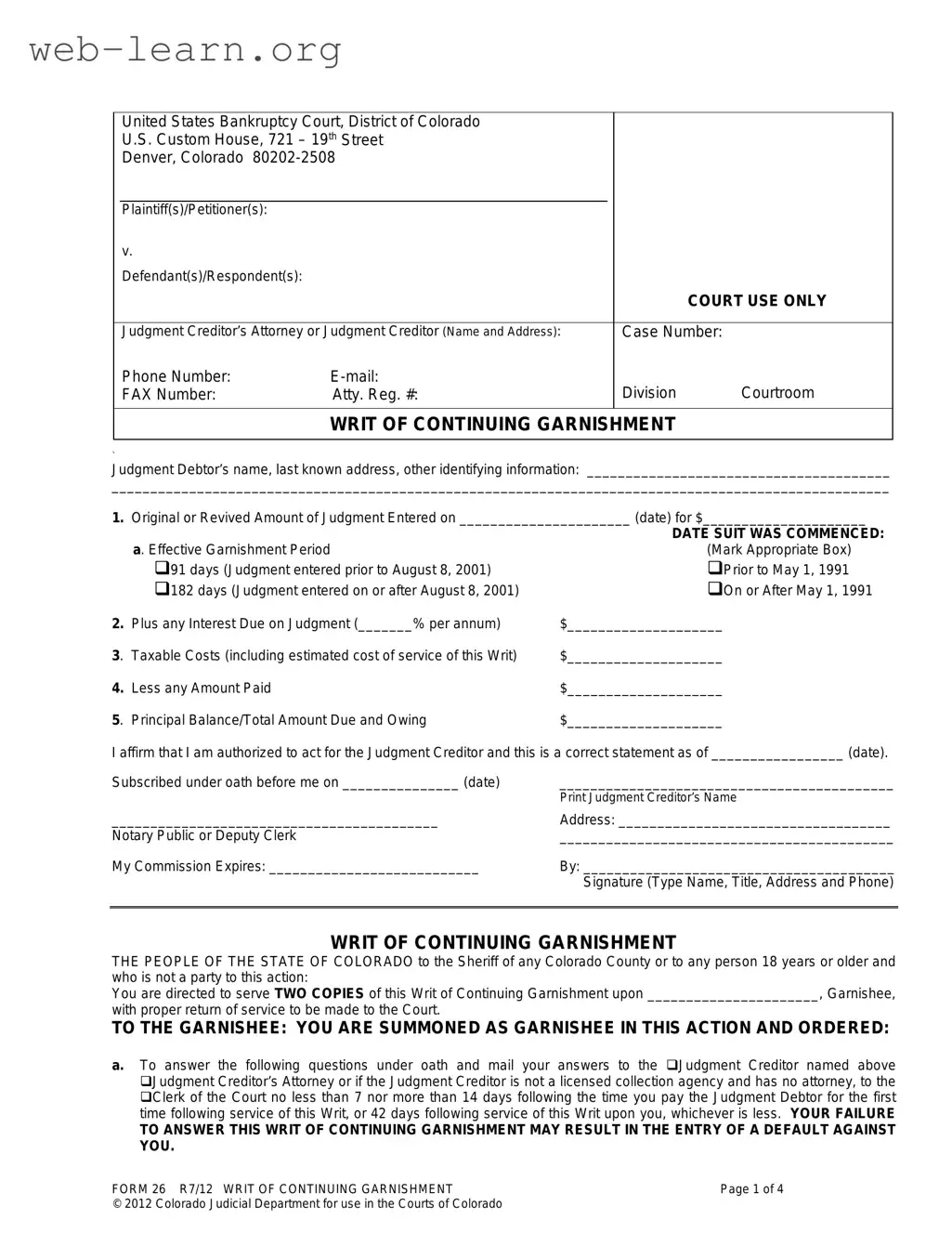
United States Bankruptcy Court, District of Colorado
U.S. Custom House, 721 – 19
th
Street
Denver, Colorado 80202-2508
Plaintiff(s)/Petitioner(s):
v.
Defendant(s)/Respondent(s):
COURT USE ONLY
Judgment Creditor’s Attorney or Judgment Creditor (Name and Address):
Phone Number: E-mail:
FAX Number: Atty. Reg. #:
Case Number:
Division Courtroom
WRIT OF CONTINUING GARNISHMENT
`
Judgment Debtor’s name, last known address, other identifying information: _______________________________________
____________________________________________________________________________________________________
1. Original or Revived Amount of Judgment Entered on ______________________ (date) for $_____________________
DATE SUIT WAS COMMENCED:
a. Effective Garnishment Period (Mark Appropriate Box)
91 days (Judgment entered prior to August 8, 2001) Prior to May 1, 1991
182 days (Judgment entered on or after August 8, 2001) On or After May 1, 1991
2. Plus any Interest Due on Judgment (_______% per annum) $____________________
3. Taxable Costs (including estimated cost of service of this Writ) $____________________
4. Less any Amount Paid $____________________
5. Principal Balance/Total Amount Due and Owing $____________________
I affirm that I am authorized to act for the Judgment Creditor and this is a correct statement as of _________________ (date).
Subscribed under oath before me on _______________ (date) ___________________________________________
Print Judgment Creditor’s Name
__________________________________________ Address: ___________________________________
Notary Public or Deputy Clerk
___________________________________________
My Commission Expires: ___________________________ By: ________________________________________
Signature (Type Name, Title, Address and Phone)
WRIT OF CONTINUING GARNISHMENT
THE PEOPLE OF THE STATE OF COLORADO to the Sheriff of any Colorado County or to any person 18 years or older and
who is not a party to this action:
You are directed to serve TWO COPIES of this Writ of Continuing Garnishment upon ______________________, Garnishee,
with proper return of service to be made to the Court.
TO THE GARNISHEE: YOU ARE SUMMONED AS GARNISHEE IN THIS ACTION AND ORDERED:
a. To answer the following questions under oath and mail your answers to the Judgment Creditor named above
Judgment Creditor’s Attorney or if the Judgment Creditor is not a licensed collection agency and has no attorney, to the
Clerk of the Court no less than 7 nor more than 14 days following the time you pay the Judgment Debtor for the first
time following service of this Writ, or 42 days following service of this Writ upon you, whichever is less. YOUR FAILURE
TO ANSWER THIS WRIT OF CONTINUING GARNISHMENT MAY RESULT IN THE ENTRY OF A DEFAULT AGAINST
YOU.
FORM 26 R7/12 WRIT OF CONTINUING GARNISHMENT Page 2 of 4
© 2012 Colorado Judicial Department for use in the Courts of Colorado
b. To pay any nonexempt earnings to the party designated in “e” below no less than 7 nor more than 14 days following each
time you pay the Judgment Debtor during the effective Garnishment Period of this Writ and attach a copy of the
Calculation of the Amount of Exempt Earnings used (the Calculation under “Questions to be Answered by Garnishee”
should be used for the first pay period, and one of the multiple Calculation forms included with this Writ should be used for
all subsequent pay periods).
c. To deliver a copy of this Writ, together with the Calculation of the Amount of Exempt Earnings and a blank Objection to
Calculation of the Amount of Exempt Earnings form, the first time you pay the Judgment Debtor.
d. To deliver to the Judgment Debtor a copy of each subsequent Calculation of the Amount of Exempt Earnings each time
you pay the Judgment Debtor for earnings subject to this Writ.
e. MAKE CHECKS PAYABLE AND MAIL TO:
Judgment Creditor named above; Judgment Creditor’s Attorney or if the
Judgment Creditor is not a licensed collection agency and has no attorney; to the Clerk of the _______________ Court
Name: _________________
_________________________________________________________________________
Address:
___________________________________________________________________________________________________
PLEASE PUT THE CASE NUMBER (shown above) ON THE FRONT OF THE CHECK.
CLERK OF THE COURT By Deputy Clerk: ________________________________
Kenneth S. Gardner
Date: ______________________________________
NOTICE TO GARNISHEE
a. This Writ applies to all nonexempt earnings owed or owing during the Effective Garnishment Period shown on Line 1a on
the front of this Writ or until you have paid to the party, designated in paragraph “e” on the front of this Writ, the amount
shown on Line 5 on the front of this Writ, whichever occurs first. However, if you have already been served with a Writ
of Continuing Garnishment for Child Support, this new Writ is effective for the Effective Garnishment Period after
any prior Writ terminates.
b. Earnings” includes all forms of compensation for Personal Services. Also read “Notice to Judgment Debtor” below.
c. In no case may you withhold any amount greater than the amount on Line 5 on the front of this Writ.
QUESTIONS TO BE ANSWERED BY GARNISHEE
Judgment Debtor’s Name: Case Number:
The following questions MUST be answered by you under oath:
a. On the date and time this Writ of Continuing Garnishment was served upon you, did you owe or do you anticipate owing
any of the following to the Judgment debtor within the Effective Garnishment Period shown on Line 1a on the front of this
Writ? (Mark appropriate box(es)):
1.
WAGES/SALARY/COMMISSIONS/BONUS/OTHER COMPENSATION FOR PERSONAL SERVICES (Earnings)
2.
Health, Accident or Disability Insurance Funds or Payments
3.
Pension or Retirement Benefits (for suits commenced prior to 5/1/91 ONLY - check front of Writ for date)
If you marked any box above, indicate how the Judgment debtor is paid: weekly bi-weekly semi-monthly
monthly other The Judgment Debtor will be paid on the following dates during the Effective Garnishment Period
shown on Line 1a (front of this Writ):________________________________________________________________
b. Are you under one or more of the following writs of garnishment? (Mark appropriate box(es)):
4.
Writ of Continuing Garnishment (Expected Termination Date: ___________________________________)
5.
Writ of Garnishment for Support (Expected Termination Date: ___________________________________)
c. If you marked Box 1 and you did NOT mark either Box 4 or 5, complete the Calculation below for the “First Pay Period”
following receipt of this Writ. If you marked either Box 4 or 5, you must complete Calculations beginning with the first pay
period following termination of the prior writ(s).
FORM 26 R7/12 WRIT OF CONTINUING GARNISHMENT Page 3 of 4
© 2012 Colorado Judicial Department for use in the Courts of Colorado
d. If you marked Box 2 or 3 and you did NOT mark either Box 4 or 5, complete the Calculation below for the “First Pay
Period” following receipt of this Writ. If you marked either box 4 or 5, you must complete Calculations beginning with the
first pay period following termination of the prior writ(s). However, there are a number of total exemptions, and you should
seek legal advice about such exemptions. If the earnings are totally exempt, please mark box 6 below:
6.
The earnings are totally exempt because:
CALCULATION OF THE AMOUNT OF EXEMPT EARNINGS (First Pay Period)
Gross Earnings for the First Pay Period from ______________ thru _______________ $ ___________________
Less Deductions Required by Law (For Example, Withholding Taxes, FICA) - $ ____________________
Disposable Earnings (Gross Earnings less Deductions) = $ ____________________
Less Statutory Exemption (Use Exemption Chart Below) - $ ____________________
Net Amount Subject to Garnishment = $ ____________________
Less Wage/Income Assignment(s) During Pay Period (If Any) - $ ____________________
Amount to be withheld and paid = $ ___________________
EXEMPTION CHART
(“Minimum Hourly Wage” means
state or federal minimum wage,
whichever is greater.)
PAY PERIOD
Weekly
Bi-weekly
Semi-monthly
Monthly
AMOUNT EXEMPT IS THE GREATER OF:
30 x Minimum Hourly Wage or 75% of Disposable Earnings
60 x Minimum Hourly Wage or 75% of Disposable Earnings
65 x Minimum Hourly Wage or 75% of Disposable Earnings
130 x Minimum Hourly Wage or 75% of Disposable Earnings
I certify that I am authorized to act for the Garnishee; that the above answers are true and correct; and that I have delivered a
copy of this Writ, together with the Calculation of the Amount of Exempt Earnings and a blank Objection to Calculation of the
Amount of Exempt Earnings form to the Judgment Debtor at the time earnings were paid for the “First Pay Period” (if earnings
were paid).
Name of Garnishee (Print) ________________________________
Address
Phone Number
Subscribed under affirmation or oath
before me on __________________ (date)
_________________________________________________
Notary Public/Deputy Clerk
My Commission Expires
: ___________________________
Name of Person Answering (Print)
________________________________________________________
Signature of Person Answering
NOTICE TO JUDGMENT DEBTOR
a. The Garnishee may only withhold nonexempt earnings from the amount due you, but in no event more than the amount
on Line 5 on the front of this Writ, UNLESS YOUR EARNINGS ARE TOTALLY EXEMPT, in which case NO EARNINGS
CAN BE WITHHELD. You may wish to contact a lawyer who can explain your rights.
b. If you disagree with the amount withheld, you must talk with the Garnishee within 7 days after being paid.
c. If you cannot settle the disagreement with the Garnishee, you may complete and file the attached Objection with the Clerk
of the Court issuing this Writ within 14 days after being paid. YOU MUST USE THE FORM ATTACHED or a copy of it.
d. You are entitled to a court hearing on your written objection.
e. Your employer cannot fire you because your earnings have been garnished. If your employer discharges you in violation
of your legal rights, you may, within 91 days, bring a civil action for the recovery of wages lost because you were fired and
for an order requiring that you be reinstated. Damages will not exceed 6 weeks’ wages and attorney fees.
FORM 26 R7/12 WRIT OF CONTINUING GARNISHMENT Page 4 of 4
© 2012 Colorado Judicial Department for use in the Courts of Colorado
RETURN OF SERVICE
Judgment Debtor’s Name: ___________________________________ Case Number: ___________________
I certify that I am 18 years or older; that I am not a party to the action; and that I have served two copies of the Writ of
Continuing Garnishment, together with a blank Objection to Calculation of the Amount of Exempt Earnings on
________________________ (name of party) in _______________________ (County) ___________________ (State) on
___________________________ (date) __________ (time) at the following location:
____________________________________________________________________________________________________
By (Check one):
By handing it to a person identified to me as ______________________________ (name of garnishee).
By leaving it with _________________________________________ (Type or write name legibly), who is designated to
receive service because of a legal relationship with _______________________ (name of garnishee) as provided for in
C.R.C.P. 4(e).
I attempted to serve ___________________________ (name of garnishee) on _______ occasions but have not been able
to locate him/her/it. Return to the Judgment Creditor is made on ___________________ (date).
I attempted to leave it with __________________________ (name of person) who refused service.
Private process server ___________________________________
Sheriff, _________________________County Signature of Process Server
Fee $ ____________ Mileage $ ________
___________________________________
Name (Print or type)
Subscribed under affirmation or oath before me in the County of ______________________, State of ________________,
this ___________ day of _______________, 20 _______.
Note: Notarization is not required for service by a sheriff or deputy.
My Commission Expires: ________________________ ___________________________________
Notary Public/Clerk
County Court District Court
______________________County, Colorado
Court address:
Plaintiff(s):__________________________________
v.
Defendant(s):__________________________________
COURT USE ONLY
Judgment Debtor’s Attorney or Judgment Debtor (Name and Address):
Phone Number: E-mail:
FAX Number: Atty.Reg. #:
Case Number:
Division Courtroom
OBJECTION TO CALCULATION OF THE AMOUNT OF EXEMPT EARNINGS
Instructions to Judgment Debtor: Use this form to object to the calculations of your exempt earnings.
Name: ______________________________________________________Phone Number: _________________________
Street Address: _________________________________________________________________________________
Mailing Address, if different: _____________________________________________________________________________
City: ____________________________ State: _______________________________ Zip Code: ______________________
1. I object to the Garnishee’s Calculation of the Amount of Exempt Earnings because I believe that the correct
calculation is:
Gross Earnings for My Pay Period from ___________________thru _________________ $ ____________
Less Deductions Required by Law (For Example, Withholding Taxes, FICA) - $ ____________
Disposable Earnings (Gross Earnings Less Deductions) = $ ____________
Less Statutory Exemption (Use Exemption Chart on Writ) - $ ____________
Net Amount Subject to Garnishment = $ ____________
Less Wage/Income Assignment(s) During Pay Period (If Any) - $ ____________
Amount which should be withheld = $ ____________
OR
2. The earnings garnished are pension or retirement benefits/deferred compensation/health, accident or disability insurance
and they are totally exempt because:
_________________________________________________________________________________________________
I understand that I must make a good faith effort to resolve my dispute with the Garnishee.
I
have have not attempted to resolve this dispute with the Garnishee.
Name of Person I Talked to: _________________________________________________
Position: _________________________________________ Phone Number: __________________________________
FORM 28 R11/10 OBJECTION TO CALCULATION OF THE AMOUNT OF EXEMPT EARNINGS
Debtor’s Notice to Garnishee: Even though I am filing this Objection, you are directed to send my nonexempt earnings
to the Court at the address noted instead of to the party designated in paragraph “e” on the front of the Writ of Continuing
Garnishment. The Court will hold my nonexempt earnings in its registry until my Objection is resolved.
I certify that the above is correct to the best of my knowledge and belief and that I sent a copy of this document by
certified mail (return receipt requested) to both the Garnishee and to the Judgment Creditor, or if the Judgment Creditor
is represented by Counsel, certified mail (return receipt requested) to the Judgment Creditor’s Attorney or E-Service
to the Judgment Creditor’s Attorney.
Garnishee Judgment Creditor or Attorney
Address: ________________________________________ Address: ___________________________________
________________________________________________ ___________________________________________
Subscribed under affirmation or oath
before me on ______________________
(date)
___________________________________________
Signature of Judgment Debtor or
Judgment Debtor’s Counsel and Reg. Number
My Commission Expires: ____________________________
________________________________________________
Notary Public/Deputy Clerk

Form Information

Fact Name Details
Governing Law The Colorado Rules of Civil Procedure govern the Writ of Continuing Garnishment, specifically C.R.C.P. Rule 103.
Purpose This form is used to collect a judgment debt by garnishing the wages or earnings of the judgment debtor.
Effective Garnishment Period The garnishment period can be either 91 days or 182 days, depending on when the judgment was entered.
Response Requirement The garnishee must respond to the writ within 7 to 14 days after paying the judgment debtor for the first time.
Exempt Earnings Certain earnings may be exempt from garnishment, and it is advisable to seek legal advice regarding these exemptions.
Judgment Creditor's Affirmation The judgment creditor must affirm their authority to act on behalf of the creditor and provide accurate information under oath.
Return of Service The process server must provide a return of service, detailing how and when the writ was served on the garnishee.

Detailed Guide for Filling Out Colorado 26

Filling out the Colorado 26 form is a crucial step in the garnishment process. After completing the form, it must be served to the appropriate parties, and the process will continue based on the responses received. Accurate completion is essential to ensure compliance with the legal requirements of garnishment.

  1. Begin by entering the Plaintiff(s)/Petitioner(s) name at the top of the form.
  2. Fill in the Defendant(s)/Respondent(s) name in the designated area.
  3. Provide the name and address of the Judgment Creditor or their attorney, along with their phone number, email, FAX number, and attorney registration number.
  4. In the "COURT USE ONLY" section, include the case number, division, and courtroom information.
  5. Enter the Judgment Debtor's name, last known address, and any other identifying information in the appropriate section.
  6. State the original or revived amount of the judgment, including the date it was entered.
  7. Select the effective garnishment period by marking the appropriate box based on the judgment date.
  8. Fill in any interest due on the judgment as a percentage per annum.
  9. List the taxable costs, including the estimated cost of service of the writ.
  10. Subtract any amounts already paid from the total judgment amount to calculate the principal balance due.
  11. Affirm your authorization to act for the Judgment Creditor by signing and dating the form.
  12. Have the form notarized or signed by a deputy clerk, including the expiration date of the notary's commission.
  13. Complete the section detailing the garnishee's obligations, including instructions for payment and delivery of documents.
  14. Review the questions to be answered by the garnishee and ensure they are clear and concise.
  15. Finish by certifying that the answers provided are true and correct, and include the name and address of the garnishee.

Obtain Answers on Colorado 26

  1. What is the purpose of the Colorado 26 form?

    The Colorado 26 form, also known as the Writ of Continuing Garnishment, is used to collect a judgment debt from a debtor's earnings. This legal document allows a creditor to garnish a debtor's wages or other compensation to satisfy an outstanding judgment. It provides a structured process for notifying the garnishee (the entity that pays the debtor) of the garnishment and outlines the obligations of both the garnishee and the debtor.

  2. Who can file a Colorado 26 form?

    Only a judgment creditor, who has obtained a court judgment against a debtor, can file this form. The creditor must be authorized to act on behalf of the judgment creditor and must provide accurate information about the judgment and the debtor. This includes details such as the amount owed and the effective garnishment period.

  3. What information is required to complete the Colorado 26 form?

    To complete the form, the following information is necessary:

    • Names and addresses of the plaintiff and defendant.
    • Details about the judgment, including the original amount and date entered.
    • Information about any interest due and taxable costs.
    • The garnishee's name and address, along with their contact information.

    Accurate completion of these sections is crucial to ensure the garnishment process proceeds smoothly.

  4. What happens if the garnishee does not respond to the Colorado 26 form?

    If the garnishee fails to respond to the Writ of Continuing Garnishment, they may face legal consequences. A default judgment may be entered against them, which could result in additional penalties or obligations. It is important for the garnishee to respond within the specified timeframe to avoid these issues.

  5. How long does the garnishment last?

    The effective garnishment period is specified on the form and can vary based on the date the judgment was entered. Generally, it lasts for either 91 days or 182 days, depending on when the judgment was issued. If a prior garnishment exists, the new writ may only take effect after the previous one has terminated.

  6. Can a debtor object to the garnishment?

    Yes, a debtor has the right to object to the calculations of exempt earnings. If they believe the garnishment amount is incorrect, they can file an objection using the attached form. This must be done within 14 days after being paid, and a hearing may be requested to resolve the dispute.

  7. What types of earnings can be garnished?

    The Writ of Continuing Garnishment applies to nonexempt earnings, which include wages, salaries, commissions, and bonuses. However, certain earnings may be exempt from garnishment, such as disability payments or pension benefits. The garnishee is required to determine the exempt amount before withholding any funds.

  8. What should the garnishee do upon receiving the Colorado 26 form?

    Upon receiving the Writ of Continuing Garnishment, the garnishee must:

    • Respond to the writ with the required information about the debtor's earnings.
    • Pay any nonexempt earnings to the designated party.
    • Provide copies of the calculations related to exempt earnings to both the debtor and the creditor.

    Failure to comply with these requirements can lead to legal repercussions for the garnishee.

Common mistakes

Completing the Colorado 26 form can be a complex task, and mistakes can lead to significant delays or complications in legal proceedings. Here are eight common errors individuals make when filling out this important document.

First, many people forget to provide the Judgment Debtor’s complete name and address. This information is crucial for the court and the garnishee to identify the correct individual involved in the garnishment process. Incomplete or incorrect details can cause the writ to be ineffective.

Second, a frequent oversight is failing to accurately indicate the original or revived amount of the judgment. It's essential to ensure that this figure reflects the correct amount, including any interest accrued. Errors here can lead to disputes and potential legal ramifications.

Another mistake often made involves the effective garnishment period. Individuals may select the wrong box corresponding to the date of the judgment. This can affect how long the garnishment remains in effect and may result in funds being withheld incorrectly.

In addition, some individuals neglect to include interest due on the judgment. Failing to calculate and add this amount can lead to underpayment and further complications down the line. It is crucial to double-check calculations to ensure accuracy.

Moreover, people sometimes overlook the taxable costs associated with the writ. These costs can include service fees and should be included in the total amount due. Missing this information can lead to an incomplete picture of what is owed.

Another common error is not subtracting the amount already paid from the total amount due. This oversight can result in confusion regarding the remaining balance and can complicate the garnishment process.

Additionally, individuals often forget to sign and date the form. This step is vital, as a missing signature can render the document invalid and delay proceedings. Always ensure that the form is signed and dated before submission.

Finally, some may not provide a correct mailing address for the garnishee. Accurate contact information is necessary for effective communication and to ensure that the writ is served properly. Double-checking this information can prevent unnecessary delays.

By avoiding these common mistakes, individuals can help ensure that the Colorado 26 form is completed accurately and efficiently, thereby facilitating a smoother legal process.

Documents used along the form

When dealing with the Colorado 26 form, also known as the Writ of Continuing Garnishment, several other documents often come into play. These forms help facilitate the garnishment process, ensuring that all parties understand their rights and obligations. Below is a list of commonly used forms and documents associated with the Colorado 26 form.

  • Writ of Garnishment: This document initiates the garnishment process against a debtor's wages or bank account. It outlines the amount owed and instructs the garnishee (the entity holding the debtor's funds) on how to proceed.
  • Objection to Calculation of the Amount of Exempt Earnings: Used by the judgment debtor to contest the garnishee's calculation of exempt earnings. This form allows the debtor to present their version of the calculations and assert any exemptions they believe apply.
  • Answer of Garnishee: This form is completed by the garnishee in response to the Writ of Continuing Garnishment. It provides information about the debtor's earnings and any amounts that may be withheld.
  • Notice to Judgment Debtor: This document informs the judgment debtor about their rights regarding the garnishment process, including how to respond if they believe their earnings are exempt from garnishment.
  • Return of Service: A form completed by the process server to confirm that the Writ of Continuing Garnishment has been properly served to the garnishee. This document is crucial for establishing that the garnishment process has been initiated correctly.
  • Calculation of the Amount of Exempt Earnings: This form is used by the garnishee to determine how much of the debtor's earnings can be garnished, factoring in any applicable exemptions.
  • Request for Hearing: If a judgment debtor disputes the garnishment, they may file this form to request a court hearing to resolve the matter. It outlines the reasons for the dispute and the desired outcome.
  • Affidavit of Exemptions: This document allows the judgment debtor to formally assert that certain funds or earnings are exempt from garnishment under state or federal law.
  • Motion to Quash Writ of Garnishment: If the judgment debtor believes the garnishment is unjust or incorrect, they can file this motion to ask the court to nullify the Writ of Garnishment.

Each of these documents plays a vital role in the garnishment process, ensuring that all parties are informed and that the process adheres to legal standards. Understanding these forms can help individuals navigate the complexities of garnishment more effectively.

Similar forms

  • Writ of Garnishment: This document initiates the process of garnishing a debtor's wages or bank account. Like the Colorado 26 form, it requires the garnishee to respond and provide information about the debtor's earnings.
  • Writ of Execution: This document allows a creditor to collect on a judgment by seizing property. Similar to the Colorado 26 form, it involves court approval and requires compliance from the garnishee.
  • Notice of Garnishment: This document informs the debtor that their wages or assets are being garnished. It shares similarities with the Colorado 26 form in that it outlines the rights and obligations of both the creditor and the debtor.
  • Objection to Garnishment: A debtor can file this document if they believe the garnishment is improper. Like the Colorado 26 form, it involves legal calculations and provides a means for the debtor to contest the garnishment.
  • Motion to Quash Garnishment: This legal request seeks to nullify a garnishment order. It is similar to the Colorado 26 form in its need for a formal response from the court and the parties involved.
  • Affidavit of Exemptions: This document allows a debtor to claim certain exemptions from garnishment. It mirrors the Colorado 26 form in that it requires detailed financial information and calculations.
  • Writ of Continuing Garnishment for Child Support: This specific writ functions similarly to the Colorado 26 form but is focused on child support payments. It also mandates the garnishee to provide information about the debtor's earnings.
  • Financial Disclosure Statement: This document requires a debtor to disclose their financial situation. It shares the need for accurate financial reporting, much like the calculations required in the Colorado 26 form.
  • Request for Hearing: This document is filed by a debtor to contest a garnishment. It is similar to the Colorado 26 form in that it seeks judicial intervention regarding the garnishment process.

Dos and Don'ts

When filling out the Colorado 26 form, it is important to approach the process with care. Here are five key dos and don’ts to keep in mind:

  • Do double-check all personal information for accuracy, including names and addresses.
  • Do ensure that you provide the correct case number as it appears on the court documents.
  • Do include all relevant amounts, such as the original judgment amount and any interest due.
  • Don't leave any sections blank; incomplete forms may lead to delays or rejections.
  • Don't forget to sign and date the form where required to validate your submission.

By following these guidelines, individuals can help ensure that their completion of the Colorado 26 form is both accurate and efficient.

Misconceptions

The Colorado 26 form, known as the Writ of Continuing Garnishment, is often misunderstood. Here are nine common misconceptions about this important legal document:

  • It only applies to wages. Many people believe that the Writ of Continuing Garnishment only affects wages. In reality, it can apply to various forms of compensation, including bonuses, commissions, and even certain benefits like pensions and insurance payments.
  • Garnishment is immediate. Some assume that once the Writ is served, garnishment starts immediately. However, the garnishee has a specific time frame, usually between 7 to 14 days, to respond and begin withholding funds.
  • All earnings can be garnished. A common misconception is that all of a debtor's earnings can be garnished. In fact, there are exemptions in place that protect a portion of earnings from being garnished, ensuring that the debtor can still meet basic living expenses.
  • The debtor has no rights. Many believe that once a Writ is issued, the debtor loses all rights. This is not true. Debtors have the right to contest the garnishment and can file objections if they believe the calculations are incorrect or if their earnings are exempt.
  • Garnishees can ignore the Writ. Some garnishees think they can disregard the Writ if they do not agree with it. Ignoring the Writ can lead to serious consequences, including potential default judgments against them.
  • The process is simple and straightforward. While the form may appear simple, the process of garnishment can be complex. It involves multiple steps and strict timelines, making it essential for all parties to understand their responsibilities.
  • Only the creditor can initiate the process. There is a misconception that only creditors can initiate garnishment. However, the debtor also has the right to respond and engage in the process, including filing objections.
  • Once a Writ is issued, it cannot be challenged. Many believe that a Writ of Continuing Garnishment is final and cannot be challenged. In reality, debtors can contest the garnishment and seek legal advice to protect their rights.
  • Employers can fire employees for garnishment. Some individuals think that employers have the right to terminate employees simply because their wages are being garnished. This is incorrect; it is illegal for an employer to fire an employee solely due to wage garnishment.

Understanding these misconceptions can help individuals navigate the complexities of the Colorado 26 form and the garnishment process more effectively. It is crucial to seek legal advice if you find yourself involved in this situation.

Key takeaways

Understanding the Colorado 26 form, also known as the Writ of Continuing Garnishment, is essential for anyone involved in a garnishment action. Here are some key takeaways to consider:

  • Purpose of the Form: The Colorado 26 form is designed to facilitate the garnishment of wages or other earnings from a judgment debtor.
  • Parties Involved: The form identifies the plaintiff (or petitioner) and the defendant (or respondent), ensuring clarity on who is involved in the legal action.
  • Judgment Information: It is crucial to accurately enter the original or revived amount of the judgment, including any interest and taxable costs.
  • Effective Garnishment Period: The form requires you to specify the garnishment period, which can vary based on when the judgment was entered.
  • Garnishee Responsibilities: The garnishee, typically an employer, must respond to the writ and withhold nonexempt earnings as directed.
  • Calculation of Exempt Earnings: The garnishee must calculate and report the amount of exempt earnings, ensuring compliance with state guidelines.
  • Response Timeframe: The garnishee is required to respond within a specific timeframe, usually between 7 to 14 days after paying the judgment debtor.
  • Objections: If the judgment debtor disagrees with the garnishee's calculations, they have the right to file an objection within 14 days.
  • Legal Representation: Both parties may benefit from consulting with an attorney to navigate the complexities of the garnishment process.
  • Non-Retaliation Clause: Employers cannot terminate an employee solely due to garnishment, protecting the debtor's employment rights.

Filling out the Colorado 26 form accurately and understanding its implications is crucial for both creditors and debtors. Each step in the process carries significance, and being informed can lead to better outcomes in garnishment proceedings.