Homepage Blank Colorado 1Dr 0112Ep Form
Outline

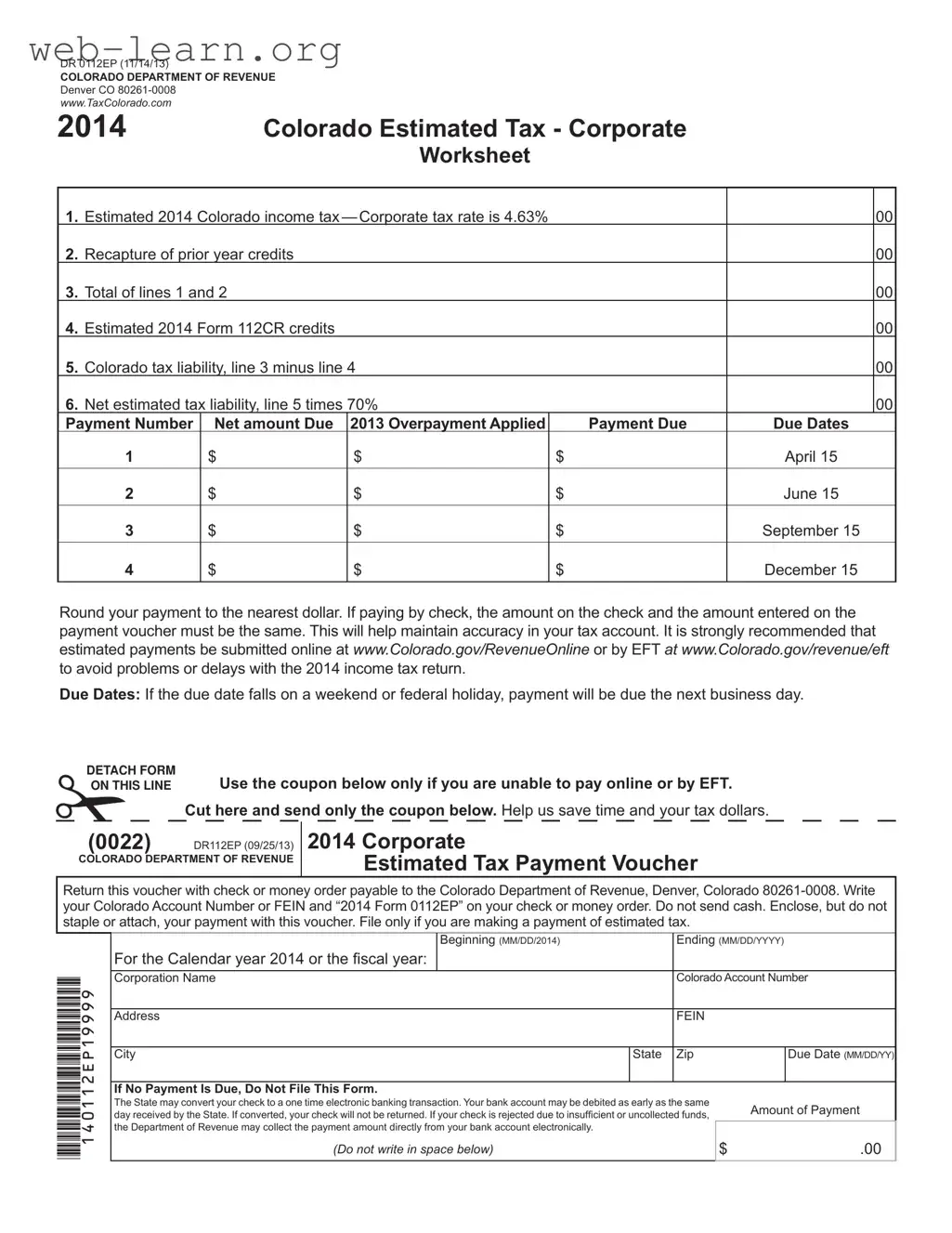
The Colorado 1Dr 0112Ep form serves as a vital tool for corporations in managing their estimated tax obligations for the year 2014. This form outlines the necessary steps and calculations for determining the estimated Colorado income tax liability, which is set at a corporate tax rate of 4.63%. Corporations must account for prior year credits, ensuring that these are recaptured appropriately. The form provides a structured worksheet where businesses can detail their estimated tax liability and the applicable credits, ultimately leading to the net estimated tax owed. Payment deadlines are clearly specified, with quarterly payments due on April 15, June 15, September 15, and December 15. It is essential for corporations to adhere to these deadlines to avoid penalties. The form also encourages electronic payments to streamline the process and reduce the likelihood of errors. By utilizing the Colorado 1Dr 0112Ep form, corporations can effectively manage their tax responsibilities while ensuring compliance with state regulations.


Sample - Colorado 1Dr 0112Ep Form

1. Estimated 2014 Colorado income tax Corporate tax rate is 4.63% 00
2. Recapture of prior year credits 00
3. Total of lines 1 and 2 00
4. Estimated 2014 Form 112CR credits 00
5. Colorado tax liability, line 3 minus line 4 00
6. Net estimated tax liability, line 5 times 70% 00
Payment Number Net amount Due 2013 Overpayment Applied Payment Due Due Dates
1 $ $ $ April 15
2 $ $ $ June 15
3 $ $ $ September 15
4 $ $ $ December 15
DR 0112EP (11/14/13)
COLORADO DEPARTMENT OF REVENUE
Denver CO 80261-0008
www.TaxColorado.com
Colorado Estimated Tax - Corporate
Worksheet
2014
Round your payment to the nearest dollar. If paying by check, the amount on the check and the amount entered on the
payment voucher must be the same. This will help maintain accuracy in your tax account. It is strongly recommended that
estimated payments be submitted online at www.Colorado.gov/RevenueOnline or by EFT at www.Colorado.gov/revenue/eft
to avoid problems or delays with the 2014 income tax return.
Due Dates: If the due date falls on a weekend or federal holiday, payment will be due the next business day.
2014 Corporate
Estimated Tax Payment Voucher
Return this voucher with check or money order payable to the Colorado Department of Revenue, Denver, Colorado 80261-0008. Write
your Colorado Account Number or FEIN and “2014 Form 0112EP” on your check or money order. Do not send cash. Enclose, but do not
staple or attach, your payment with this voucher. File only if you are making a payment of estimated tax.

Beginning (MM/DD/2014) Ending (MM/DD/YYYY)
Corporation Name
Colorado Account Number
Address FEIN
City State Zip Due Date (MM/DD/YY)
If No Payment Is Due, Do Not File This Form.
The State may convert your check to a one time electronic banking transaction. Your bank account may be debited as early as the same

the Department of Revenue may collect the payment amount directly from your bank account electronically.
Amount of Payment
$ .00
(Do not write in space below)
*140112EP19999*
(0022)
DR112EP (09/25/13)
COLORADO DEPARTMENT OF REVENUE
Use the coupon below only if you are unable to pay online or by EFT.
Cut here and send only the coupon below. Help us save time and your tax dollars.
DETACH FORM
ON THIS LINE
See publication FYI Income 51 for more information,
available at www.TaxColorado.com
General Rule
In most cases, a corporation is required to pay estimated
tax if it can reasonably expect the net tax liability will
exceed $5,000 for 2014. For taxpayers with a short taxable
year, estimated tax payments must be remitted if the tax
is expected to exceed $5,000 plus estimated credits.
Or, if a short taxable year is the result of a change in the
accounting period, then income for the short period must
be multiplied in a manner so that income is estimated at a
full 12-month year. In this case, estimated tax would be due
if the net tax liability on the calculated full-year is expected
to exceed $5,000.
Required Payments

a. 70% of the actual net Colorado tax liability.
b. 100% of the preceding year’s net Colorado tax liability.
This rule only applies if the preceding year was a

return, and the corporation is not
corporation* under section 6655 of the federal Internal
Revenue Code.

tax payment on 25% of the tax liability from the previous
year. However, the remaining payments must be based on
the actual tax liability for the current year. If, after calculating
the tax liability for the current year, it is determined that

calculated into and paid with the second quarter.
Calculating the Payment
Use the provided Worksheet to calculate the amount of
estimated tax owed. Payments and forms shall be submitted
using the same method (separate, consolidated, combined)
and using the same account number as will be used on the
annual income tax return, Form 112. If, for any reason, the
account numbers are inconsistent, the department must be

Corporate Estimated Income Tax
Instructions

Colorado Department of Revenue
Income Tax Section, Room 238
Denver CO 80261-0008
Remit payments according to the due date table

recommended that these payments be submitted
electronically to avoid problems and delays. See the box
below for details. The single form can be copied and used
for each of the four quarterly payments if an electronic
payment cannot be made for any reason.
Penalties
Failure to timely remit estimated tax as necessary will result
in a Estimated Tax Penalty. Penalty will be calculated for

or to remit this penalty before being billed, see Form 205,
Underpayment of Corporate Estimated Tax.
Go Green with Revenue Online
Taxpayers can use www.Colorado.gov/RevenueOnline to
pay online. Online payments reduce errors and provide


accounts. The paper Form 0112EP or an online return is not
required if an online payment is made. Please be advised
that a nominal processing fee may apply to online payments.
Pay by Electronic Funds Transfer (EFT)
The EFT payment option is a free service. EFT payments
can be made safely, and can be scheduled up to 12 months
ahead of time to avoid forgetting to make a quarterly payment.
EFT services require pre-registration before payments can
be made. Visit www.Colorado.gov/revenue/eft
Additional information, FYI publications and forms are
available at www.TaxColorado.com or you may call
303-238-SERV (7378) for assistance.

Form Information

Fact Name Details
Form Purpose The DR 0112EP form is used for making estimated tax payments for corporations in Colorado for the year 2014.
Tax Rate The corporate tax rate for Colorado is set at 4.63% for the year 2014.
Payment Due Dates Payments are due on April 15, June 15, September 15, and December 15 of 2014.
Payment Method It is recommended to submit payments electronically via the Colorado Department of Revenue's website to avoid issues.
Governing Law The form is governed by Colorado Revised Statutes related to corporate income tax and estimated payments.

Detailed Guide for Filling Out Colorado 1Dr 0112Ep

Completing the Colorado 1Dr 0112Ep form requires careful attention to detail. This form is used for submitting estimated corporate tax payments for the year 2014. After filling out the form, ensure that you submit it according to the specified due dates to avoid any penalties.

  1. Obtain the Colorado 1Dr 0112Ep form from the Colorado Department of Revenue website or a local office.
  2. Fill in the corporation's name in the designated field.
  3. Enter the Colorado Account Number or FEIN (Federal Employer Identification Number) in the appropriate section.
  4. Provide the corporation's address, including city, state, and zip code.
  5. Indicate the due date for the estimated payment in the specified format (MM/DD/YY).
  6. Calculate the estimated 2014 Colorado income tax using the corporate tax rate of 4.63%. Enter this amount on line 1.
  7. If applicable, enter any recapture of prior year credits on line 2.
  8. Add the amounts from lines 1 and 2 and write the total on line 3.
  9. Enter any estimated Form 112CR credits on line 4.
  10. Subtract the amount on line 4 from line 3 to determine the Colorado tax liability. Write this amount on line 5.
  11. Calculate the net estimated tax liability by multiplying the amount on line 5 by 70%. Enter this figure on line 6.
  12. Complete the payment section by filling in the payment number, net amount due, and due dates for each quarter.
  13. Round the payment amount to the nearest dollar.
  14. If paying by check, ensure the amount on the check matches the payment voucher amount. Write the Colorado Account Number or FEIN and “2014 Form 0112EP” on the check.
  15. Detach the coupon at the indicated line if you are not submitting the form electronically.
  16. Submit the completed form along with the payment to the Colorado Department of Revenue at the specified address.

Obtain Answers on Colorado 1Dr 0112Ep

  1. What is the Colorado 1Dr 0112Ep form?

    The Colorado 1Dr 0112Ep form, also known as the Corporate Estimated Tax Payment Voucher, is used by corporations to calculate and remit estimated tax payments for the tax year 2014. This form is essential for corporations that expect to owe more than $5,000 in Colorado income tax.

  2. Who needs to file this form?

    Corporations that anticipate a net tax liability exceeding $5,000 for the year must file this form. This requirement applies even if the corporation has a short taxable year or if there has been a change in the accounting period. In such cases, income must be estimated as if it were for a full 12-month year.

  3. How do I calculate my estimated tax liability?

    To calculate your estimated tax liability, follow these steps:

    • Determine your estimated Colorado income tax using the corporate tax rate of 4.63%.
    • Add any recapture of prior year credits.
    • Subtract any estimated Form 112CR credits from the total calculated.
    • Multiply the remaining tax liability by 70% to find your net estimated tax liability.
  4. What are the payment due dates?

    Payments are due on the following dates:

    • April 15
    • June 15
    • September 15
    • December 15

    If a due date falls on a weekend or federal holiday, the payment is due the next business day.

  5. How should I submit my payment?

    It is highly recommended to submit payments online through the Colorado Department of Revenue's website or via Electronic Funds Transfer (EFT). If you are unable to pay online, you may use the payment voucher and send a check or money order. Ensure that the amount on your check matches the amount entered on the payment voucher.

  6. What happens if I miss a payment?

    Failure to remit estimated tax payments on time will result in an Estimated Tax Penalty. This penalty is calculated for each missed or late payment. For specifics on penalty calculations, refer to Form 205, Underpayment of Corporate Estimated Tax.

  7. Can I make payments electronically?

    Yes, electronic payments are encouraged. You can make payments online at www.Colorado.gov/RevenueOnline or set up EFT payments. EFT services are free and allow for scheduling payments up to 12 months in advance.

  8. Where can I find more information?

    Additional information, forms, and FYI publications are available at www.TaxColorado.com. For assistance, you may also contact the Colorado Department of Revenue at 303-238-SERV (7378).

Common mistakes

Filling out the Colorado 1Dr 0112Ep form can be a straightforward process, but mistakes can lead to complications. One common error is failing to include the correct Colorado Account Number or Federal Employer Identification Number (FEIN). This information is essential for the Colorado Department of Revenue to accurately process your payment. Omitting or miswriting these numbers can delay processing and create issues with your tax account.

Another frequent mistake is neglecting to calculate the estimated tax liability accurately. Taxpayers should ensure that they follow the calculation steps outlined in the form. Specifically, they must correctly add the estimated income tax and any recapture of prior year credits. Errors in these calculations can lead to underpayment or overpayment, both of which can have financial consequences.

Some individuals also overlook the importance of rounding the payment amount to the nearest dollar. The instructions clearly state this requirement, yet many people still submit amounts that do not comply. This can result in confusion and may require additional correspondence with the Department of Revenue.

Moreover, failing to submit the payment on time is another mistake that can lead to penalties. The due dates for payments are set, and if they fall on a weekend or holiday, payments are due the next business day. Missing these deadlines can incur late fees, which can add up quickly.

In addition, some taxpayers mistakenly think they can file the form even if no payment is due. The instructions clearly state that if no payment is due, the form should not be filed. Ignoring this guideline can lead to unnecessary complications and additional paperwork.

Using an incorrect method of payment is also a common error. Taxpayers should ensure that the payment method they choose matches the method indicated on the form. For instance, if you are paying by check, the amount on the check must match the amount entered on the voucher. Discrepancies can cause processing delays.

Another mistake involves not keeping a copy of the submitted form and payment for personal records. This is essential for tracking purposes and for any future inquiries regarding your tax account. Without proper documentation, it may be challenging to resolve any issues that arise later.

Some people also fail to take advantage of electronic payment options. Submitting payments online or via Electronic Funds Transfer (EFT) can reduce the likelihood of errors and provide instant confirmation of payment. Ignoring these options can lead to unnecessary complications.

Lastly, not reviewing the form for completeness before submission is a critical oversight. Each section should be double-checked to ensure that all required fields are filled out correctly. A thorough review can prevent many of the issues mentioned above and facilitate a smoother process.

Documents used along the form

The Colorado 1Dr 0112Ep form is an essential document for corporations to estimate their tax liabilities for the year. However, several other forms and documents may accompany it to ensure compliance and accuracy in tax reporting. Here are five commonly used documents:

  • Form 112: This is the annual corporate income tax return that corporations must file with the Colorado Department of Revenue. It summarizes the corporation's income, deductions, and tax liability for the year.
  • Form 112CR: This form is used to claim credits against the corporate income tax. Corporations can report various tax credits they are eligible for, which can reduce their overall tax liability.
  • Form 205: This form is used to report any underpayment of estimated taxes. Corporations that fail to meet their estimated tax obligations may need to file this form to calculate penalties for late or insufficient payments.
  • FYI Income 51: This publication provides guidance on corporate estimated income tax payments in Colorado. It outlines the rules and requirements for making estimated payments and helps corporations understand their obligations.
  • EFT Registration Form: Corporations opting to pay their estimated taxes electronically must complete this registration form. It allows them to set up Electronic Funds Transfer (EFT) payments, ensuring timely and secure transactions.

Utilizing these documents alongside the Colorado 1Dr 0112Ep form can help corporations navigate their tax responsibilities more effectively. Staying organized and informed is key to maintaining compliance and avoiding penalties.

Similar forms

The Colorado 1Dr 0112Ep form, used for corporate estimated tax payments, shares similarities with several other tax-related documents. Each of these forms serves a unique purpose but often overlaps in functionality or intent. Here’s a breakdown of seven documents that are similar:

  • Form 112 - This is the annual corporate income tax return for Colorado. Like the 1Dr 0112Ep, it requires detailed income and expense reporting, but it summarizes the entire year instead of just estimated payments.
  • Form 112CR - This form is used to claim credits against the corporate income tax. Similar to the 1Dr 0112Ep, it helps corporations reduce their tax liability, although it focuses specifically on credits rather than estimated payments.
  • Form 205 - This form addresses underpayment of estimated tax. It is similar to the 1Dr 0112Ep in that it deals with estimated tax payments, but it is specifically for corporations that have not paid enough during the year.
  • Form DR 0100 - This is the Colorado Corporate Income Tax Return. While the 1Dr 0112Ep is about making estimated payments, the DR 0100 is a comprehensive summary of a corporation’s tax situation for the year.
  • Form DR 0102 - This form is used for corporate tax extensions. It shares the same goal of ensuring compliance with tax obligations, but it is focused on extending the filing deadline rather than making payments.
  • Form DR 0890 - This is a payment voucher for individual income tax. While it targets individuals, it functions similarly to the 1Dr 0112Ep by facilitating tax payments, albeit for personal rather than corporate taxes.
  • Form 1040-ES - This is the estimated tax payment form for individuals. It parallels the 1Dr 0112Ep in that it helps taxpayers estimate and pay their taxes throughout the year, but it is designed for individual filers rather than corporations.

Understanding these forms can help navigate the complexities of tax obligations, ensuring compliance and potentially reducing liabilities. Each document has its own nuances, but they all play a crucial role in the tax landscape.

Dos and Don'ts

When filling out the Colorado 1Dr 0112Ep form, there are several important do's and don'ts to keep in mind to ensure a smooth process.

  • Do read the instructions carefully before starting.
  • Do ensure all calculations are accurate to avoid penalties.
  • Do submit payments electronically whenever possible.
  • Do include your Colorado Account Number or FEIN on your payment.
  • Don't send cash with your form or payment.
  • Don't file the form if no payment is due.
  • Don't forget to round your payment to the nearest dollar.
  • Don't attach or staple your payment to the voucher.

Misconceptions

Many people have misunderstandings about the Colorado 1Dr 0112Ep form. Here are some common misconceptions, along with clarifications to help you better understand this important tax document.

  • Misconception 1: The form is only for large corporations.
  • This form is required for all corporations that expect their net tax liability to exceed $5,000, not just large corporations.

  • Misconception 2: You can file the form anytime during the year.
  • There are specific due dates for payments, typically on April 15, June 15, September 15, and December 15. Missing these dates can result in penalties.

  • Misconception 3: You don’t need to make estimated payments if you filed last year.
  • Even if you filed last year, you must make estimated payments if your tax liability is expected to exceed $5,000 this year.

  • Misconception 4: Payments can be made in cash.
  • The form specifically states that cash should not be sent. Payments must be made by check or money order.

  • Misconception 5: You can ignore the form if no payment is due.
  • If no payment is due, you do not need to file the form. However, you should keep track of your tax liability to avoid future issues.

  • Misconception 6: The form can be submitted without calculating the estimated tax.
  • It is essential to use the provided worksheet to calculate the estimated tax owed before submitting the form.

  • Misconception 7: You can use any account number for payments.
  • Payments must be submitted using the same account number as will be used on the annual income tax return, Form 112.

  • Misconception 8: Online payments are not secure.
  • Online payments are a secure option. They reduce errors and provide instant confirmation of your payment.

Understanding these points can help ensure compliance and avoid unnecessary penalties. If you have further questions, consider seeking assistance from a tax professional.

Key takeaways

When filling out the Colorado 1Dr 0112Ep form, consider the following key takeaways:

  • Understand the Purpose: This form is used for making estimated tax payments for corporations in Colorado for the 2014 tax year.
  • Calculate Accurately: Use the provided worksheet to determine your estimated tax liability based on your expected income and applicable credits.
  • Payment Methods: It is recommended to submit payments online or via Electronic Funds Transfer (EFT) to avoid delays and ensure accuracy.
  • Due Dates: Payments are due on April 15, June 15, September 15, and December 15. Adjust for weekends or holidays as necessary.
  • Penalties for Late Payments: Missing payment deadlines can result in penalties, which are calculated for each late payment.
  • Keep Records: Always retain copies of your payments and correspondence with the Colorado Department of Revenue for your records.