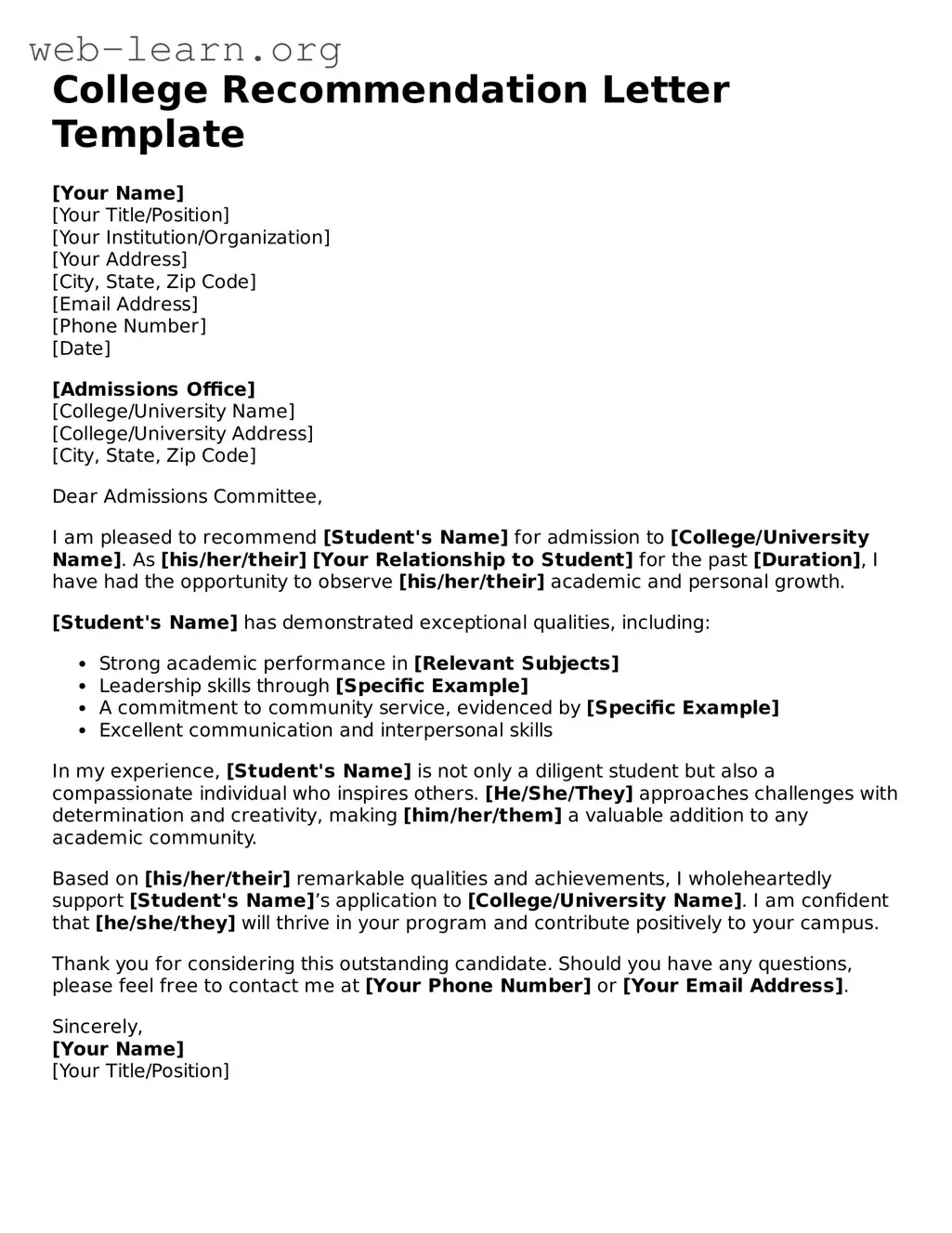
When it comes to college applications, a recommendation letter can play a pivotal role in showcasing a student’s strengths and potential. This letter, typically written by a teacher, counselor, or mentor, provides insights into a student's character, academic achievements, and extracurricular involvement. It serves as a personal endorsement, highlighting qualities that may not be evident from grades or test scores alone. The College Recommendation Letter form typically includes essential components such as the recommender's contact information, the student's details, and specific prompts or questions that guide the recommender in crafting a thoughtful letter. Furthermore, the form may outline deadlines and submission guidelines to ensure that the letter is submitted on time. Understanding the significance of this document can empower students to choose the right person to write their recommendation and to communicate effectively about their accomplishments and aspirations.
College Recommendation Letter Template
[Your Name]
[Your Title/Position]
[Your Institution/Organization]
[Your Address]
[City, State, Zip Code]
[Email Address]
[Phone Number]
[Date]
[Admissions Office]
[College/University Name]
[College/University Address]
[City, State, Zip Code]
Dear Admissions Committee,
I am pleased to recommend [Student's Name] for admission to [College/University Name]. As [his/her/their] [Your Relationship to Student] for the past [Duration], I have had the opportunity to observe [his/her/their] academic and personal growth.
[Student's Name] has demonstrated exceptional qualities, including:
In my experience, [Student's Name] is not only a diligent student but also a compassionate individual who inspires others. [He/She/They] approaches challenges with determination and creativity, making [him/her/them] a valuable addition to any academic community.
Based on [his/her/their] remarkable qualities and achievements, I wholeheartedly support [Student's Name]’s application to [College/University Name]. I am confident that [he/she/they] will thrive in your program and contribute positively to your campus.
Thank you for considering this outstanding candidate. Should you have any questions, please feel free to contact me at [Your Phone Number] or [Your Email Address].
Sincerely,
[Your Name]
[Your Title/Position]
| Fact Name | Description |
|---|---|
| Purpose | The College Recommendation Letter form is used to provide insight into a student's character, achievements, and potential from a trusted source, typically a teacher or counselor. |
| Confidentiality | Many colleges require that recommendation letters be submitted confidentially to ensure honest and unbiased evaluations. |
| State-Specific Requirements | Some states may have specific guidelines governing the content and submission process of recommendation letters, influenced by local educational laws. |
| Submission Process | Recommendations are often submitted electronically through college application platforms, ensuring a streamlined process for both recommenders and applicants. |
Once you have the College Recommendation Letter form in front of you, it's time to get started. Filling out this form accurately will help ensure that your recommendation letter reflects your strengths and achievements. Follow these steps carefully to complete the form.
After completing the form, review it for any errors before submitting it to your recommender. Make sure they have all the information they need to write a strong letter on your behalf.
A College Recommendation Letter is a document written by a teacher, counselor, or another individual who knows a student well. This letter provides insights into the student's character, achievements, and potential for success in college. Colleges often use these letters to assess a student's fit for their programs and to understand their personal qualities beyond academic performance.
Choose someone who knows you well and can speak positively about your skills and experiences. Ideally, this should be a teacher from a subject related to your intended major or a counselor who understands your academic journey. Other options include coaches, employers, or community leaders who can provide a different perspective on your abilities and character.
To help your recommender write a strong letter, provide them with the following:
Providing this information can help ensure the letter is tailored to your goals and highlights your strengths.
Typically, a recommendation letter should be one to two pages long. It should be concise while still providing enough detail to give a clear picture of who you are. Your recommender should focus on quality over quantity, ensuring that the letter is meaningful and relevant to your application.
It is best to ask for your recommendation letter at least a month before the deadline. This gives the writer ample time to prepare a thoughtful letter without feeling rushed. Make sure to provide them with any necessary forms or guidelines from the colleges, along with your deadline, to ensure everything is submitted on time.
Filling out a College Recommendation Letter form can be a daunting task. Many people make mistakes that can affect the quality of the recommendation. One common mistake is not providing enough specific examples. Generic statements do not showcase the student's unique qualities. Instead, focus on particular achievements and experiences that highlight their strengths.
Another frequent error is failing to follow the instructions. Each college may have specific requirements regarding the format or content. Ignoring these guidelines can lead to a recommendation that does not meet the college's expectations. Always read the instructions carefully before starting.
Some recommenders forget to proofread their letters. Spelling and grammatical errors can create a negative impression. Taking the time to review the letter ensures clarity and professionalism. It’s essential to present a polished and well-written recommendation.
Additionally, some people make the mistake of being overly negative. While it is important to be honest, focusing too much on weaknesses can overshadow the student’s positive attributes. Strive for a balanced perspective that highlights both strengths and areas for improvement.
Another common oversight is not personalizing the letter. Using a template without tailoring it to the specific student can make the recommendation feel impersonal. Personal anecdotes and insights help the reader connect with the student on a deeper level.
Some recommenders fail to mention the student’s future goals. Colleges appreciate knowing what the student aims to achieve. Including information about the student’s aspirations can provide valuable context for the recommendation.
Another mistake is waiting until the last minute to write the letter. Rushing through the process often results in a less thoughtful recommendation. Start early to allow ample time for reflection and revisions.
It’s also important to avoid using overly complex language. While it’s good to be articulate, using jargon or complicated phrases can confuse the reader. Clear and straightforward language is more effective in conveying the message.
Some individuals neglect to include their contact information. Providing a way for the college to reach the recommender can be crucial. It shows willingness to discuss the student further if needed.
Lastly, not being aware of the submission process can lead to complications. Each college may have different methods for submitting recommendations. Understanding these processes ensures that the letter arrives on time and in the correct format.
When applying to college, students often need to submit various documents alongside their College Recommendation Letter. Each of these documents plays a crucial role in providing a comprehensive view of the applicant's qualifications, character, and potential for success. Below is a list of common forms and documents that may accompany the recommendation letter.
Each of these documents contributes to a well-rounded application. Together, they help admissions committees understand the student's unique qualities and readiness for college life. It is essential for students to prepare these materials thoughtfully to make a strong impression.
The College Recommendation Letter form shares similarities with several other documents commonly used in academic and professional settings. Below is a list of eight documents that exhibit comparable characteristics:
When filling out a College Recommendation Letter form, it is important to follow certain guidelines to ensure that the process goes smoothly and effectively. Here are six things to keep in mind:
By following these guidelines, you can help create a strong and effective recommendation letter that will support the student’s college application.
When it comes to college recommendation letters, many people hold misconceptions that can lead to confusion and missed opportunities. Here’s a list of nine common myths and the truth behind them.
This is not true. While teachers are common choices, anyone who knows you well and can speak to your character and achievements can write a recommendation. This could include coaches, employers, or community leaders.
Different colleges have different requirements. Some may ask for specific topics to be addressed, while others may have no guidelines at all. Always check the requirements for each school.
Understanding these misconceptions can help you navigate the recommendation process more effectively. Choose your recommenders wisely, communicate openly, and provide them with the tools they need to write a great letter on your behalf.
Filling out and using the College Recommendation Letter form is an important step in the college application process. Here are some key takeaways to keep in mind: