When individuals create a will, they often include specific instructions regarding the distribution of their assets after their passing. However, circumstances can change, leading to the need for updates without rewriting the entire document. A Codicil to Will form serves as a legal instrument that allows for modifications to an existing will. This form can address various changes, such as adding or removing beneficiaries, altering asset distribution, or appointing new executors. It is essential to ensure that the codicil is executed with the same formalities as the original will to maintain its validity. By utilizing a codicil, individuals can efficiently manage their estate planning needs while ensuring their wishes are accurately reflected. Understanding the components and requirements of a codicil is crucial for anyone looking to make adjustments to their estate plans in a clear and legally sound manner.
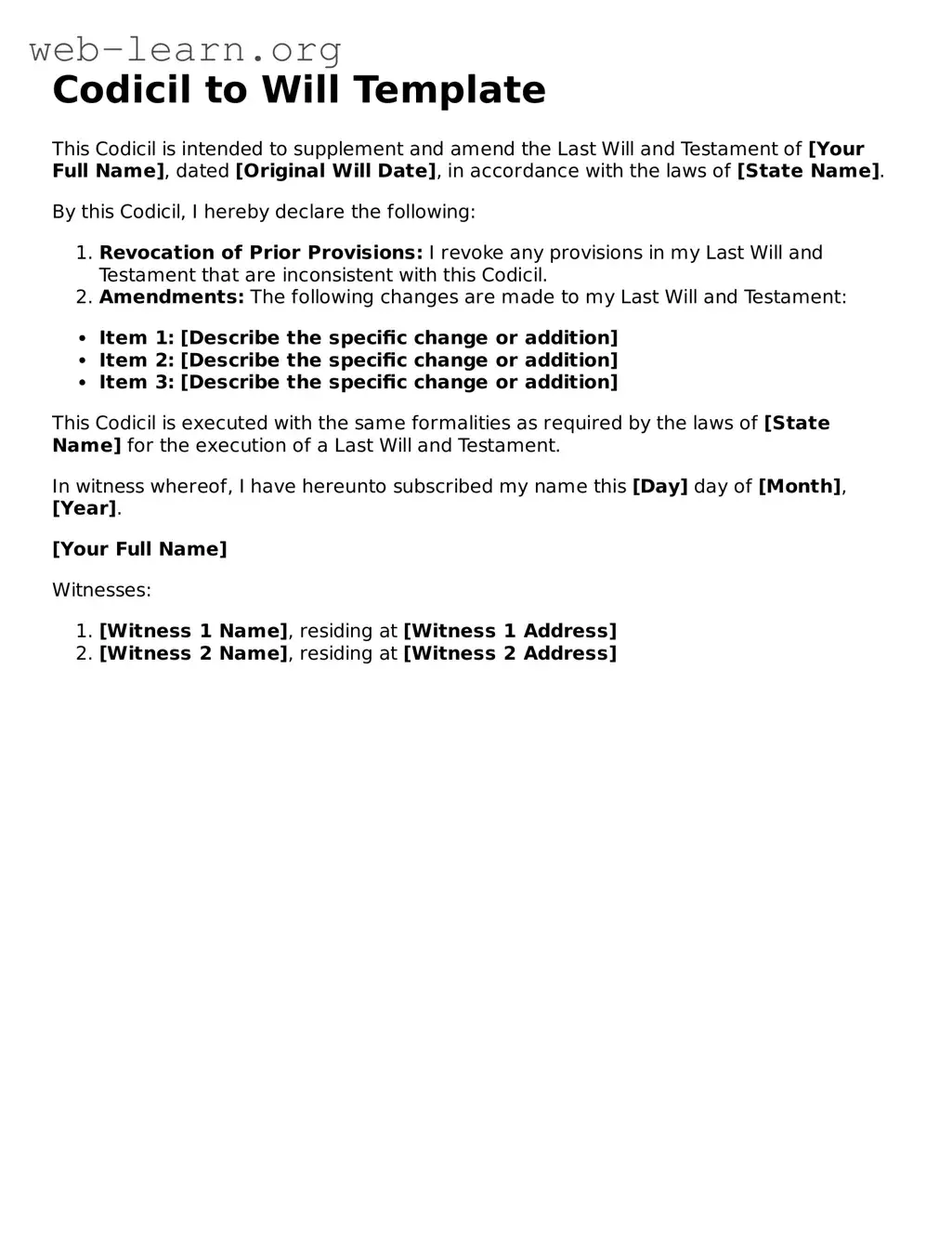
Codicil to Will Template
This Codicil is intended to supplement and amend the Last Will and Testament of [Your Full Name], dated [Original Will Date], in accordance with the laws of [State Name].
By this Codicil, I hereby declare the following:
This Codicil is executed with the same formalities as required by the laws of [State Name] for the execution of a Last Will and Testament.
In witness whereof, I have hereunto subscribed my name this [Day] day of [Month], [Year].
[Your Full Name]
Witnesses:
| Fact Name | Description |
|---|---|
| Definition | A codicil is a legal document that modifies an existing will without the need to rewrite the entire will. |
| Purpose | It allows individuals to make changes, such as adding or removing beneficiaries or altering asset distributions. |
| Requirements | Most states require that a codicil be signed and witnessed, similar to the original will, to be legally valid. |
| State-Specific Law | In California, codicils are governed by the California Probate Code Section 8800-8805. |
| Revocation | A codicil can revoke specific provisions of a will or even the entire will if it explicitly states so. |
After you have your Codicil to Will form ready, it’s time to fill it out carefully. Make sure you have all necessary information at hand, including details about your existing will and any changes you want to make. Once completed, the form will need to be signed and witnessed according to your state’s requirements.
What is a Codicil to a Will?
A codicil is a legal document that allows an individual to make changes to an existing will without having to rewrite the entire document. It can be used to add new provisions, modify existing ones, or revoke specific parts of the will. A codicil must be executed with the same formalities as a will, including signatures and witnesses, to ensure its validity.
When should I consider creating a Codicil?
You may want to create a codicil if there are changes in your circumstances, such as:
These changes can significantly impact how your estate is distributed, making a codicil a practical solution.
How do I create a valid Codicil?
To create a valid codicil, follow these steps:
It is advisable to consult with a legal professional to ensure that the codicil meets all legal requirements.
Can I revoke a Codicil?
Yes, you can revoke a codicil at any time. This can be done by creating a new codicil that explicitly states the revocation or by physically destroying the codicil, such as tearing it up. It is important to ensure that your intentions are clear to avoid any confusion regarding your wishes.
Will a Codicil affect the original Will?
A codicil modifies the original will but does not replace it. The original will remains in effect unless it is explicitly revoked. The changes made by the codicil will be considered alongside the original will, so it is essential to keep both documents together and organized.
Is it necessary to have a lawyer to create a Codicil?
While it is not legally required to have a lawyer to create a codicil, consulting with one is highly recommended. A legal professional can help ensure that the codicil complies with state laws and accurately reflects your intentions. This can help prevent potential disputes among heirs and ensure that your wishes are honored.
When it comes to updating a will, many individuals choose to use a codicil, which is a legal document that modifies an existing will. However, mistakes can easily occur during this process. One common error is failing to properly identify the original will. It’s crucial to reference the original document clearly, including the date it was executed. Without this information, the codicil may not be valid, leading to confusion and potential disputes among heirs.
Another frequent mistake is neglecting to sign the codicil in accordance with state laws. Each state has specific requirements regarding how a codicil must be executed, including the number of witnesses needed. If these requirements aren’t met, the codicil may be considered invalid. Therefore, it’s important to double-check the signing process to ensure it complies with local regulations.
Additionally, some individuals make the mistake of being vague in their modifications. A codicil should clearly state what changes are being made to the will. Ambiguities can lead to misinterpretations, which may cause unnecessary conflict among beneficiaries. Specificity is key; clearly outline any additions or deletions to ensure everyone understands the intentions behind the changes.
Lastly, a common oversight is failing to keep the codicil in a safe and accessible place. After completing the codicil, it should be stored with the original will. If the codicil is misplaced or not found when the will is being executed, the changes may not be honored. Keeping all documents organized and in a secure location can prevent such issues from arising.
A Codicil to a Will is an important document that allows individuals to make changes to their existing wills without needing to create a completely new one. Along with a Codicil, several other forms and documents may be used to ensure that a person's wishes are clearly expressed and legally binding. Here is a list of some common documents often associated with a Codicil to Will:
These documents work together to create a comprehensive estate plan. Each one serves a specific purpose, helping individuals ensure their wishes are honored and their loved ones are taken care of.
The Codicil to Will form serves as an important tool for individuals looking to make changes to their existing wills. Several other documents share similarities with the codicil, each serving a unique purpose in estate planning. Here are five documents that are comparable to the Codicil to Will form:
Each of these documents plays a vital role in ensuring that an individual’s wishes are respected and carried out, much like the codicil does for a will.
When filling out the Codicil to Will form, it's important to be careful and thorough. Here are some things you should and shouldn't do:
By following these guidelines, you can ensure that your wishes are clearly communicated and legally binding.
Understanding the Codicil to Will form is crucial for anyone looking to make changes to their estate plan. However, several misconceptions can lead to confusion. Here are nine common misunderstandings:
A codicil is not a complete will; it is a document that modifies an existing will. It can add, change, or revoke specific provisions without needing to create an entirely new will.
Many people believe that a codicil can be signed without witnesses. However, most states require that a codicil be witnessed, just like a will, to ensure its validity.
While codicils are often used for minor adjustments, they can also address significant changes. If you want to make substantial modifications, a codicil can still be appropriate.
This is true, but you must specify the change clearly. A codicil can indeed appoint a new executor or modify the powers of the existing one.
Some believe that a codicil must be a lengthy legal document. In reality, it can be a simple statement, as long as it meets the legal requirements of your state.
While it's possible to create a codicil independently, seeking legal advice can help ensure that it is properly drafted and executed, minimizing potential disputes later.
This is a misconception. A codicil supplements the original will; it does not invalidate it unless explicitly stated. Both documents work together.
A verbal codicil is not legally binding. Written documentation is essential to ensure that your wishes are honored and legally enforceable.
Even minor changes should be documented through a codicil to avoid confusion or disputes. Keeping your estate plan clear and updated is always best.
Addressing these misconceptions can help you navigate the estate planning process more effectively and ensure your wishes are carried out as intended.
When considering a Codicil to Will form, it's important to understand its purpose and how to properly fill it out. Here are some key takeaways: