Homepage Blank Cna Shower Sheets Form
Outline

The CNA Shower Sheets form is an essential tool for ensuring the health and safety of residents during their showering experience. This form guides Certified Nursing Assistants (CNAs) in conducting a thorough visual assessment of a resident's skin while providing care. It covers various aspects of skin monitoring, including identifying and documenting any abnormalities such as bruising, skin tears, rashes, and lesions. CNAs are instructed to report any concerning findings to the charge nurse immediately, facilitating prompt intervention. The form also includes a body chart for CNAs to accurately mark the location of any abnormalities, ensuring clear communication among the care team. Additionally, it prompts the CNA to assess whether the resident needs toenail care, further enhancing their overall well-being. After the initial assessment, the charge nurse reviews the findings, adds their signature, and may forward any concerns to the Director of Nursing (DON) for further evaluation. This structured approach not only promotes accountability but also supports the ongoing health monitoring of residents, making it a vital component of quality care.
Sample - Cna Shower Sheets Form

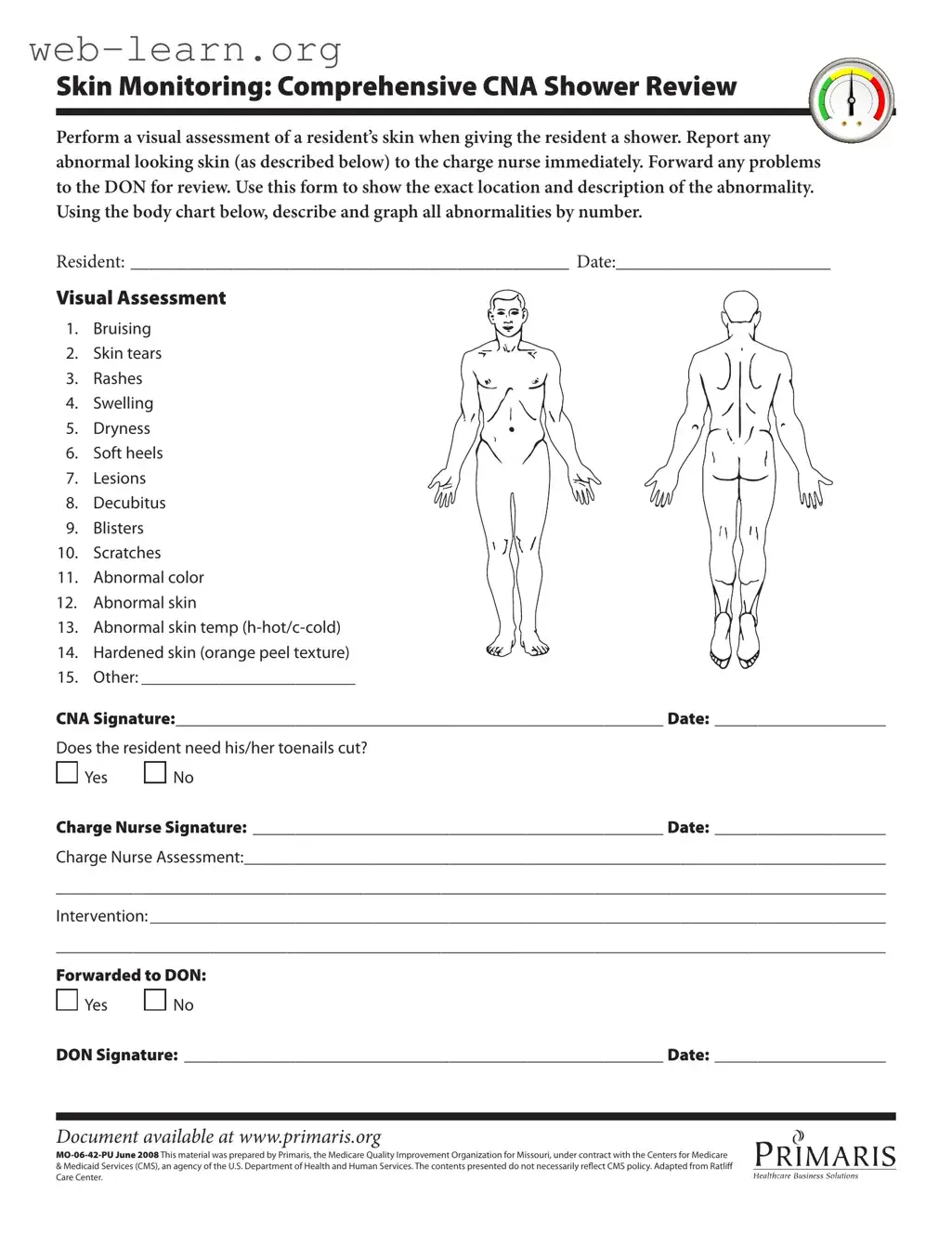
Perform a visual assessment of a residents skin when giving the resident a shower. Report any
abnormal looking skin (as described below) to the charge nurse immediately. Forward any problems
to the DON for review. Use this form to show the exact location and description of the abnormality.
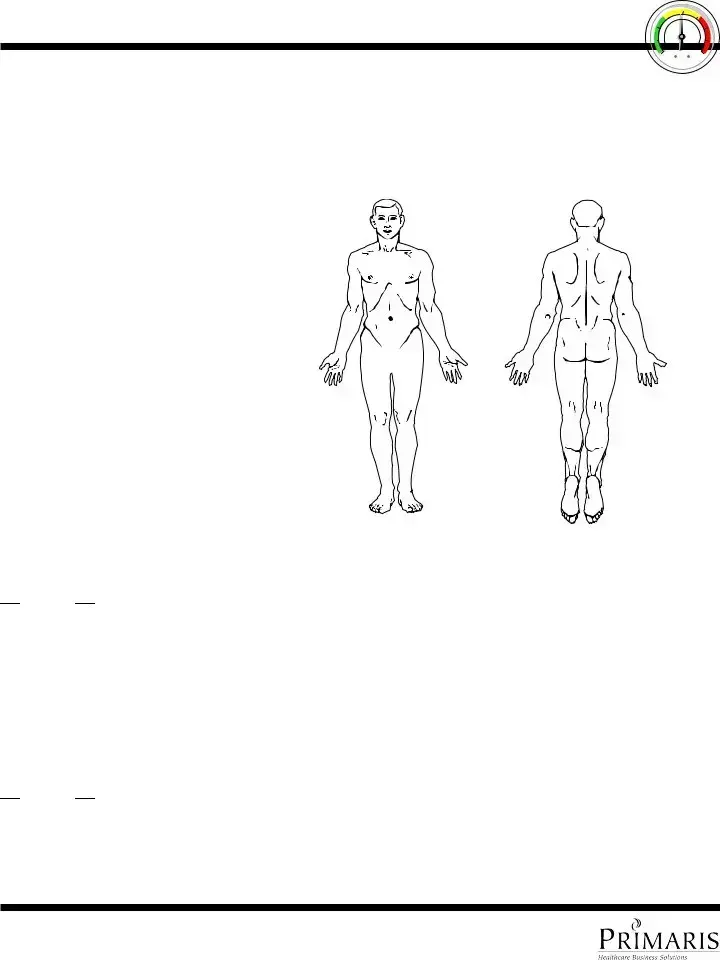
Using the body chart below, describe and graph all abnormalities by number.
Resident: _______________________________________________ Date:_______________________
MO-06-42-PU June 2008 This material was prepared by Primaris, the Medicare Quality Improvement Organization for Missouri, under contract with the Centers for Medicare
& Medicaid Services (CMS), an agency of the U.S. Department of Health and Human Services. The contents presented do not necessarily reect CMS policy. Adapted from Ratli
Care Center.
Document available at www.primaris.org
Skin Monitoring: Comprehensive CNA Shower Review
Visual Assessment
1. Bruising
2. Skin tears
3. Rashes
4. Swelling
5. Dryness
6. Soft heels
7. Lesions
8. Decubitus
9. Blisters
10. Scratches
11. Abnormal color
12. Abnormal skin
13. Abnormal skin temp (h-hot/c-cold)
14. Hardened skin (orange peel texture)
15. Other: _________________________
CNA Signature: _________________________________________________________ Date: ____________________
Does the resident need his/her toenails cut?
Yes No
Charge Nurse Signature: ________________________________________________ Date: ____________________
Charge Nurse Assessment: ___________________________________________________________________________
_________________________________________________________________________________________________
Intervention: ______________________________________________________________________________________
_________________________________________________________________________________________________
Forwarded to DON:
Yes No
DON Signature: ________________________________________________________ Date: ____________________

Form Information

Fact Name Description
Purpose The CNA Shower Sheets form is designed for documenting skin assessments during resident showers.
Assessment Areas It includes a visual assessment of various skin conditions such as bruising, rashes, and lesions.
Reporting Protocol Any abnormalities must be reported to the charge nurse immediately and forwarded to the Director of Nursing (DON) for review.
Signature Requirement The form requires signatures from both the CNA and the charge nurse to validate the assessment.
State-Specific Law In Missouri, this form is governed by state regulations regarding resident care and documentation standards.

Detailed Guide for Filling Out Cna Shower Sheets

Completing the CNA Shower Sheets form requires careful attention to detail. This form is essential for documenting the skin condition of residents during showers. Follow the steps below to ensure accurate and thorough completion of the form.

  1. Begin by entering the resident's name in the RESIDENT field.
  2. Fill in the DATE when the assessment is conducted.
  3. Perform a visual assessment of the resident's skin while giving the shower.
  4. Identify any abnormalities using the provided list. Mark each abnormality on the body chart by number.
  5. For each abnormality observed, write a brief description next to the corresponding number.
  6. In the section for CNA Signature, sign your name to confirm the assessment.
  7. Fill in the date next to your signature.
  8. Indicate whether the resident needs their toenails cut by selecting Yes or No.
  9. Have the charge nurse sign the form in the Charge Nurse Signature field.
  10. Enter the date next to the charge nurse's signature.
  11. In the Charge Nurse Assessment section, provide any additional observations or comments.
  12. In the Intervention section, outline any necessary actions to be taken based on the assessment.
  13. Decide whether to forward the report to the Director of Nursing (DON) by selecting Yes or No.
  14. If forwarded, have the DON sign the form in the DON Signature field.
  15. Enter the date next to the DON's signature.

Obtain Answers on Cna Shower Sheets

  1. What is the purpose of the CNA Shower Sheets form?

    The CNA Shower Sheets form is designed to assist Certified Nursing Assistants (CNAs) in conducting thorough skin assessments during resident showers. It serves as a tool for documenting any abnormalities observed on a resident’s skin, such as bruising, rashes, or lesions. This documentation is essential for ensuring that any issues are promptly reported to the charge nurse and subsequently reviewed by the Director of Nursing (DON).

  2. What should a CNA do if they notice an abnormality during the skin assessment?

    If a CNA identifies any abnormal skin conditions while giving a shower, they must report these findings to the charge nurse immediately. The form allows for the precise location and description of the abnormality to be recorded. This information is crucial for the charge nurse to evaluate the situation and determine any necessary interventions.

  3. How is the skin assessment documented on the form?

    The form includes a visual assessment section where CNAs can check off various skin conditions observed during the shower. Each abnormality is numbered, and CNAs are required to describe and graph these findings on a body chart provided within the form. This structured documentation helps maintain a clear record of the resident's skin condition over time.

  4. What happens after the charge nurse assesses the resident?

    Once the charge nurse completes their assessment, they will document their findings and any recommended interventions on the form. If necessary, the charge nurse may forward the information to the DON for further review. The form also includes a section to indicate whether the resident requires toenail care, ensuring that all aspects of the resident's well-being are addressed.

Common mistakes

Filling out the CNA Shower Sheets form is an essential task that helps ensure residents receive the proper care they need. However, many individuals make mistakes that can lead to serious consequences. One common error is failing to provide complete information about the resident. It's crucial to fill in all sections, including the resident's name and the date. Omitting this basic information can cause confusion and delay in addressing any issues that may arise.

Another mistake is not accurately documenting the findings during the visual assessment. The form includes specific categories for skin conditions, such as bruising, rashes, and swelling. Skipping these details or providing vague descriptions can hinder the charge nurse's ability to make informed decisions about the resident's care. Always take the time to thoroughly assess the skin and record what you observe.

Additionally, many people forget to sign and date the form. This step is not just a formality; it serves as a record of accountability. Without a signature, it can be challenging to trace back who conducted the assessment or when it was completed. This lack of documentation can lead to misunderstandings or disputes regarding the care provided.

Lastly, neglecting to communicate any abnormalities to the charge nurse promptly is a significant oversight. If you notice something unusual during the shower, such as a skin tear or lesion, it's essential to report it immediately. Delaying this communication can result in further complications for the resident. Always remember that timely reporting can make a difference in the quality of care provided.

Documents used along the form

The CNA Shower Sheets form is an essential document for monitoring residents' skin health during showers. However, several other forms and documents complement this process, ensuring comprehensive care and documentation. Below is a list of these related documents, each serving a specific purpose in the care continuum.

  • Resident Assessment Protocols (RAPs): These guidelines help identify specific care needs based on the resident's overall health and functional status.
  • Care Plan: A personalized plan that outlines the resident's goals, interventions, and expected outcomes based on their unique needs.
  • Incident Report: A form used to document any unexpected events or accidents that occur during care, ensuring transparency and accountability.
  • Skin Integrity Assessment Form: This document provides a detailed evaluation of the resident's skin condition, focusing on any existing wounds or risk factors for skin breakdown.
  • Daily Progress Notes: These notes track the resident's condition and any changes observed, providing a continuous record of care and observations.
  • Medication Administration Record (MAR): A log that details all medications administered to the resident, helping to prevent errors and ensure proper medication management.
  • Vital Signs Record: This form captures essential health metrics, such as blood pressure and temperature, which are critical for assessing the resident's overall well-being.
  • Fall Risk Assessment: A tool used to evaluate the likelihood of a resident falling, enabling staff to implement preventive measures.
  • Nutrition Assessment Form: This document assesses the resident's dietary needs and nutritional status, ensuring that they receive adequate nourishment.

These forms and documents work together to create a holistic approach to resident care. By maintaining thorough and accurate records, healthcare providers can ensure that each resident receives the attention and support they need for optimal health and well-being.

Similar forms

The CNA Shower Sheets form is essential for documenting skin assessments during resident showers. Several other documents serve similar purposes in healthcare settings, focusing on patient monitoring and care. Here’s a list of eight documents that share similarities with the CNA Shower Sheets:

  • Skin Assessment Form: This document records detailed observations of a patient's skin condition, similar to the CNA Shower Sheets. It includes assessments of rashes, bruising, and other skin abnormalities.
  • Patient Care Plan: This plan outlines the overall care strategy for a resident, including specific interventions for skin care. It often references findings from assessments like the CNA Shower Sheets.
  • Incident Report: When a significant skin issue arises, such as a severe rash or a fall leading to bruising, an incident report is created. This document captures the details and actions taken, paralleling the CNA Shower Sheets' focus on abnormalities.
  • Nursing Notes: These notes provide ongoing documentation of a patient’s condition and care. They may include observations of skin health, much like the CNA Shower Sheets.
  • Daily Vital Signs Record: While primarily focused on vital signs, this record may include notes on skin condition, especially if changes are noted during routine checks, reflecting a similar monitoring approach.
  • Wound Care Assessment: This document specifically addresses the evaluation and treatment of wounds, akin to the skin monitoring aspect of the CNA Shower Sheets.
  • Fall Risk Assessment: This assessment identifies patients at risk of falling, which can lead to skin injuries. It often includes skin condition checks, similar to those documented in the CNA Shower Sheets.
  • Medication Administration Record (MAR): This record tracks medications given to residents, including those for skin conditions. It complements the CNA Shower Sheets by ensuring that treatments align with observed skin issues.

Each of these documents plays a vital role in ensuring comprehensive care and monitoring of residents, emphasizing the importance of thorough documentation in healthcare settings.

Dos and Don'ts

When filling out the CNA Shower Sheets form, it is important to follow certain guidelines to ensure accuracy and clarity. Below is a list of things you should and shouldn't do while completing this form.

  • Do perform a thorough visual assessment of the resident’s skin during the shower.
  • Do report any abnormal findings to the charge nurse immediately.
  • Do use the body chart provided to accurately describe and graph any abnormalities.
  • Do ensure that all sections of the form are filled out completely, including the resident's name and date.
  • Don't leave any areas blank; every observation should be documented.
  • Don't use vague descriptions; be specific about the location and nature of any skin issues.
  • Don't forget to sign and date the form after completing it.
  • Don't hesitate to ask for clarification if you are unsure about any part of the form or the assessment process.

By adhering to these guidelines, you can help ensure that the resident's skin health is accurately monitored and reported. This attention to detail is crucial for providing the best care possible.

Misconceptions

Misconceptions about the CNA Shower Sheets form can lead to misunderstandings regarding its purpose and use. Below are five common misconceptions along with clarifications.

  • The form is only for reporting serious skin issues. Many believe that the CNA Shower Sheets form is only necessary for severe conditions. In reality, it is designed to document all skin abnormalities, regardless of their severity, to ensure comprehensive care.
  • Only the charge nurse can fill out the form. Some may think that only the charge nurse has the authority to complete this form. However, it is the responsibility of the CNA to perform the visual assessment and document findings before forwarding them to the charge nurse.
  • The body chart is optional. There is a misconception that using the body chart for graphing abnormalities is not mandatory. In fact, accurately marking the location of skin issues on the chart is crucial for effective communication and follow-up care.
  • Skin assessments are only needed during showers. Some individuals may assume that skin assessments are only necessary during shower times. However, regular monitoring should occur at all times, not just during bathing, to ensure ongoing skin health.
  • The form is not important for overall resident care. Many may underestimate the significance of the CNA Shower Sheets form in the overall care process. This form plays a vital role in identifying and addressing skin problems early, which can prevent more serious health issues.

Key takeaways

Filling out and using the CNA Shower Sheets form is an important task for ensuring resident care. Here are some key takeaways to keep in mind:

  • Visual Assessment is Crucial: Conduct a thorough visual assessment of the resident's skin during the shower.
  • Report Abnormalities: Immediately report any abnormal skin conditions to the charge nurse.
  • Document Details: Use the form to accurately describe and locate any skin abnormalities.
  • Body Chart Usage: Graph all abnormalities on the provided body chart to ensure clarity.
  • Skin Conditions to Monitor: Be aware of various conditions such as bruising, rashes, and lesions.
  • Toenail Care: Determine if the resident needs toenail trimming and document it accordingly.
  • Charge Nurse Involvement: The charge nurse should assess the situation and sign off on the form.
  • Forwarding Issues: If necessary, forward any concerns to the Director of Nursing (DON) for further review.
  • Follow-Up: Ensure that the DON signs the form to confirm receipt and review of the issues reported.

By following these guidelines, you can help maintain the health and safety of residents, ensuring they receive the best possible care.