Homepage Blank Clinical Social Experience Verification Form
Outline

The Clinical Social Experience Verification form is a crucial document for aspiring clinical social workers in California. This form serves as a formal verification of an applicant's supervised experience in the field, ensuring that they have met the necessary requirements to practice. Applicants must have their supervisors complete the form, providing detailed information about the work setting, including whether it lawfully offered clinical social work or mental health counseling. Additionally, supervisors must confirm that the applicant's work adhered to the experience and supervision standards set by the Board of Behavioral Sciences. The form requires specific details, such as the applicant's employment information, the supervisor's credentials, and a breakdown of hours spent in various types of supervision and clinical practice. Notably, the form mandates that applicants document a minimum of 3,000 hours of experience, with significant hours dedicated to direct client interaction. This verification process is not just a formality; it plays a vital role in maintaining the integrity and professionalism of the social work field. Careful attention to detail is essential, as inaccuracies or omissions can lead to serious consequences, including denial of licensure. The integrity of the information provided is paramount, reinforcing the commitment to ethical practice in social work.


Sample - Clinical Social Experience Verification Form

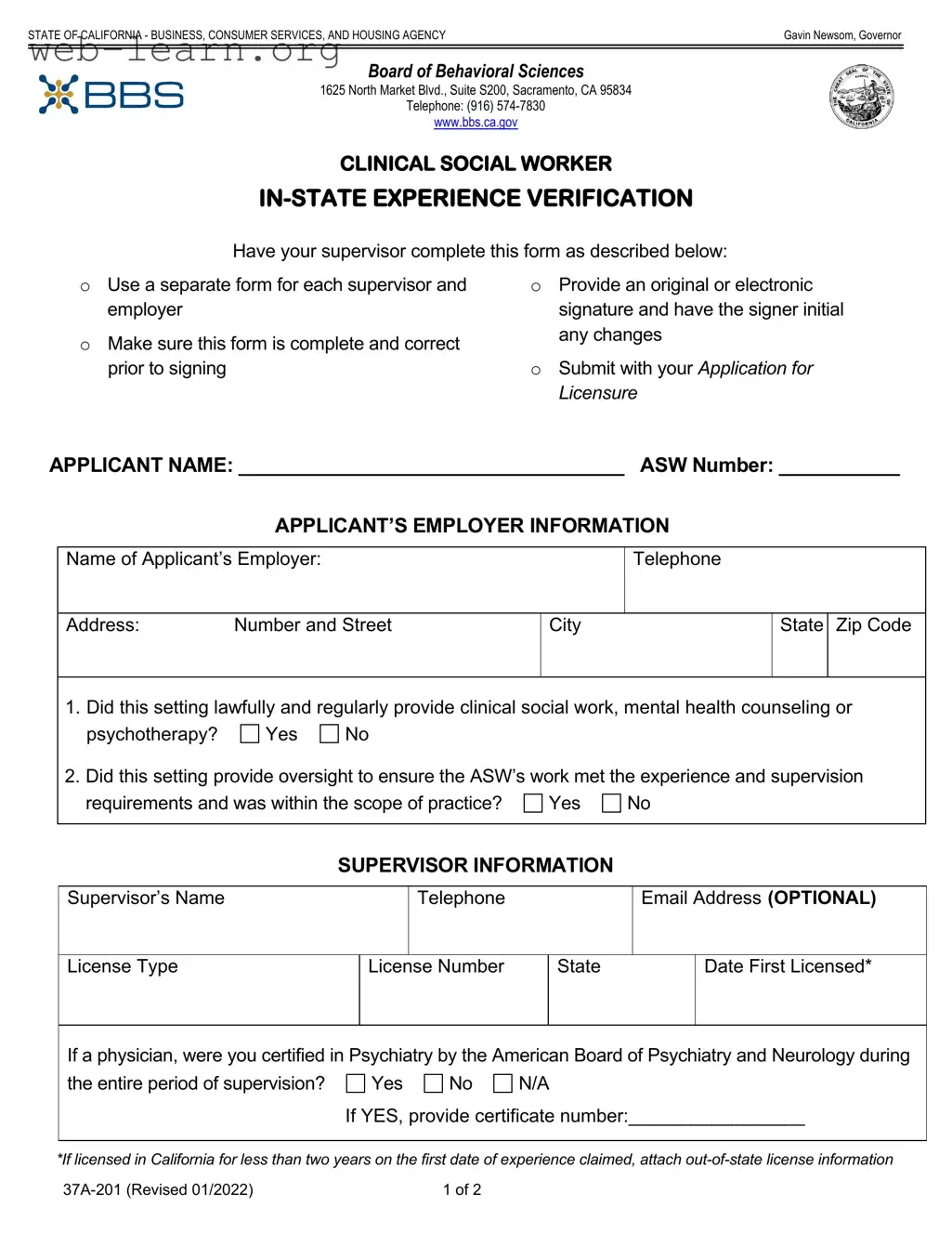
37A-201 (Revised 01/2022) 1 of 2
STATE OF CALIFORNIA - BUSINESS, CONSUMER SERVICES, AND HOUSING AGENCY Gavin Newsom, Governor
Board of Behavioral Sciences
1625 North Market Blvd., Suite S200, Sacramento, CA 95834
Telephone: (916) 574-7830
www.bbs.ca.gov
CLINICAL SOCIAL WORKER
IN-STATE EXPERIENCE VERIFICATION
Have your supervisor complete this form as described below:
o Use a separate form for each supervisor and
employer
o Make sure this form is complete and correct
prior to signing
o Provide an original or electronic
signature and have the signer initial
any changes
o Submit with your Application for
Licensure
APPLICANT NAME: ___________________________________ ASW Number: ___________
APPLICANT’S EMPLOYER INFORMATION
Name of Applicant’s Employer:
Telephone
Address: Number and Street
City
State
1. Did this setting lawfully and regularly provide clinical social work, mental health counseling or
psychotherapy? Yes No
2. Did this setting provide oversight to ensure the ASW’s work met the experience and supervision
requirements and was within the scope of practice? Yes No
SUPERVISOR INFORMATION
Supervisor’s Name
Telephone
Email Address (OPTIONAL)
License Type
License Number
State
Date First Licensed*
If a physician, were you certified in Psychiatry by the American Board of Psychiatry and Neurology during
the entire period of supervision? Yes No N/A
If YES, provide certificate number:_________________
*If licensed in California for less than two years on the first date of experience claimed, attach out-of-state license information
37A-201 (Revised 01/2022) 2 of 2
APPLICANT NAME: __________________________________________ ASW#: _______________
SUPERVISOR INFORMATION (continued)
Were you (the supervisor) employed by the supervisee’s employer? Yes No
If NO, did you and the supervisee’s employer sign a written agreement pertaining to oversight of
the supervisee? Yes No
EXPERIENCE INFORMATION: Dates of experience: From ____________ to ____________
(mm/dd/yyyy) (mm/dd/yyyy)
1. Total supervised weeks (Minimum 104 overall):
2. Total hours in individual or triadic supervision (Minimum 52 overall):
3. Total hours in group supervision:
4. Average hours worked per week (Maximum 40):
5. Total hours of clinical psychosocial diagnosis, assessment, and treatment, including
individual or group psychotherapy / counseling (Minimum 2,000 overall):
A.
6. Of the above hours, how many were gained performing face-to-face individual or
group psychotherapy/counseling (Minimum 750 overall):
7. Total hours of client-centered advocacy, consultation, evaluation, research,
workshops, seminars, training sessions or conferences and direct supervisor contact*
(Maximum 1,000 overall):
B.
8. Total hours of experience (Minimum 3,000 overall): (A + B = C) C.
9. Was one additional hour of face-to-face individual or triadic supervision OR two
additional hours of face-to-face group supervision provided for every week in which more
than 10 hours of direct clinical counseling was performed?
Yes
No
*A maximum of six (6) hours of direct supervisor contact per week may be counted toward
the 1,000 hours.
NOTE: Knowingly providing false information or omitting pertinent information may be
grounds for denial of the application. The Board may take disciplinary action on a licensee
who helps an applicant obtain a license by fraud, deceit or misrepresentation. All information
on this form is subject to verification.
Signature of Supervisor: _____________________________________ Date: ______________
ORIGINAL OR ELECTRONIC SIGNATURE REQUIRED

Form Information

Fact Name Details
Governing Agency The Clinical Social Experience Verification form is governed by the Board of Behavioral Sciences, part of the California Business, Consumer Services, and Housing Agency.
Purpose of the Form This form is used to verify the clinical social work experience of Associate Social Workers (ASWs) as part of their application for licensure.
Supervisor Requirements The form must be completed by a qualified supervisor, who should be licensed and have oversight responsibilities for the ASW’s clinical work.
Experience Verification It requires detailed information about the ASW's clinical experience, including total hours worked, supervision received, and types of services provided.
Signature Requirement An original or electronic signature from the supervisor is mandatory, along with initials for any changes made to the form.
Consequences of Misrepresentation Providing false information or omitting critical details may lead to denial of the application and potential disciplinary action against the supervisor.

Detailed Guide for Filling Out Clinical Social Experience Verification

Completing the Clinical Social Experience Verification form is an essential step in the licensing process for clinical social workers. It requires careful attention to detail and accuracy to ensure that all necessary information is provided. Once the form is filled out, it must be submitted along with your application for licensure.

  1. Obtain the Clinical Social Experience Verification form from the Board of Behavioral Sciences website or your supervisor.
  2. Fill in your name and ASW number at the top of the form.
  3. Provide your employer’s information, including the name, telephone number, and address.
  4. Answer the two questions regarding the setting's legality and oversight by marking "Yes" or "No."
  5. Complete the supervisor's information section, including their name, telephone number, email address (optional), license type, license number, state, and date first licensed.
  6. If applicable, indicate whether the supervisor was certified in Psychiatry and provide the certificate number.
  7. State whether the supervisor was employed by your employer and, if not, confirm if a written agreement was signed.
  8. Fill in the experience information, including the dates of experience and total supervised weeks.
  9. Record the total hours for individual or triadic supervision, group supervision, and clinical psychosocial diagnosis and treatment.
  10. Indicate how many of the treatment hours were face-to-face and the total hours of client-centered advocacy and other activities.
  11. Calculate the total hours of experience and ensure it meets the minimum requirements.
  12. Answer the question about additional supervision hours based on your direct clinical counseling hours.
  13. Have your supervisor review the completed form for accuracy and completeness.
  14. Obtain the supervisor's original or electronic signature and date the form.
  15. Submit the completed form along with your application for licensure to the Board of Behavioral Sciences.

Obtain Answers on Clinical Social Experience Verification

  1. What is the purpose of the Clinical Social Experience Verification form?

    The Clinical Social Experience Verification form is designed to confirm that an Associate Social Worker (ASW) has met the necessary clinical experience requirements under the supervision of a qualified professional. This form must be completed by the ASW's supervisor and submitted as part of the application for licensure. It ensures that the applicant has received adequate training and oversight in clinical social work, mental health counseling, or psychotherapy.

  2. Who is responsible for completing the form?

    The supervisor of the ASW is responsible for completing the Clinical Social Experience Verification form. Each supervisor should fill out a separate form for each ASW they supervise. It's crucial that the supervisor provides accurate information regarding the ASW's clinical experience and supervision to ensure the application process goes smoothly.

  3. What information must be included in the form?

    The form requires several key pieces of information:

    • The applicant's name and ASW number.
    • Details about the employer, including name, address, and phone number.
    • Supervisor's information, including name, license type, and license number.
    • Specifics about the clinical experience, such as total supervised weeks, hours of supervision, and hours of direct clinical work.

    Completing all sections accurately is essential, as incomplete forms may delay the licensure process.

  4. What happens if false information is provided on the form?

    Providing false information or omitting important details on the Clinical Social Experience Verification form can have serious consequences. It may lead to the denial of the application for licensure. Furthermore, the Board of Behavioral Sciences has the authority to take disciplinary action against any licensee who assists an applicant in obtaining a license through fraudulent means. Therefore, it is vital to ensure that all information submitted is truthful and complete.

Common mistakes

Filling out the Clinical Social Experience Verification form can be a straightforward process, but several common mistakes can lead to complications. One frequent error is failing to use a separate form for each supervisor and employer. This requirement is crucial because it ensures that each supervisor's input is accurately captured and linked to the specific employment context. Neglecting this step can result in incomplete or invalid submissions, potentially delaying the licensure process.

Another mistake often seen is not ensuring that the form is complete and correct before signing. Applicants might rush through the process, leading to missing information or inaccuracies. Each section of the form must be filled out thoroughly, as any omissions can raise red flags during the review process. Double-checking all entries can save time and prevent unnecessary back-and-forth communication with the Board.

Providing the wrong type of signature is also a common pitfall. The form requires an original or electronic signature, and any changes made must be initialed by the signer. Failing to follow these guidelines can lead to questions about the authenticity of the submission. It's essential to adhere to these requirements to maintain the integrity of the application.

Lastly, applicants sometimes overlook the importance of accurate experience documentation. This includes ensuring that all hours worked and types of supervision received are correctly recorded. Miscalculating total hours or misclassifying types of supervision can lead to significant discrepancies. Such errors can jeopardize the application, as the Board relies on accurate data to assess qualifications. Taking the time to verify these details can make a significant difference in the application outcome.

Documents used along the form

When applying for licensure as a Clinical Social Worker in California, several important forms and documents accompany the Clinical Social Experience Verification form. Each document plays a crucial role in ensuring that your application is complete and meets the necessary requirements. Here’s a brief overview of these essential documents:

  • Application for Licensure: This is the primary form that initiates your request for licensure. It collects personal information, educational background, and work experience relevant to your qualifications as a social worker.
  • Official Transcripts: These documents provide proof of your educational qualifications. They must be sent directly from your school to the Board, confirming that you have completed the necessary coursework for licensure.
  • Supervisor Agreement: This written agreement outlines the terms of supervision between you and your supervisor. It ensures that both parties understand their roles and responsibilities during your clinical experience.
  • Verification of Experience Form: Similar to the Clinical Social Experience Verification form, this document is completed by your supervisor to confirm your clinical hours and the nature of your work during your supervised experience.
  • Background Check Consent Form: This form grants permission for the Board to conduct a background check. It is a standard procedure to ensure the safety and integrity of the profession.
  • Proof of Liability Insurance: Having liability insurance is often a requirement for licensure. This document shows that you have coverage in case of any professional claims against you.
  • Continuing Education Certificates: If you have completed any continuing education courses, these certificates provide evidence of your commitment to professional development and staying current in the field.
  • Application Fee Payment Receipt: This receipt confirms that you have paid the required application fee. Without this, your application may not be processed.

By preparing these documents ahead of time, you can streamline the application process and avoid potential delays. Each form contributes to a comprehensive view of your qualifications and readiness to practice as a Clinical Social Worker in California.

Similar forms

  • Verification of Experience Form: Similar to the Clinical Social Experience Verification form, this document confirms an applicant's work experience in a specific field. It requires details about the applicant's role, responsibilities, and the duration of their experience.
  • Supervisory Agreement: This document outlines the relationship between a supervisor and a supervisee. It details the expectations, responsibilities, and oversight required during the supervision period, much like the verification form.
  • Professional Reference Form: This form collects information from individuals who can attest to an applicant's qualifications and experience. It serves a similar purpose in validating the applicant's professional background.
  • License Application Form: Just like the Clinical Social Experience Verification form, this document is essential for obtaining a professional license. It requires personal information and verification of qualifications.
  • Continuing Education Verification Form: This form verifies that an applicant has completed required continuing education courses. It parallels the experience verification form by confirming ongoing professional development.
  • Internship Verification Form: Similar to the Clinical Social Experience Verification form, this document confirms the completion of an internship. It includes details about the intern's role and the supervision received.
  • Clinical Supervision Log: This log tracks the hours and types of supervision an applicant has received. It serves a similar function to the verification form by documenting the supervisory experience.
  • Application for Certification: This document is used to apply for certification in a specific field. Like the verification form, it requires proof of experience and qualifications.
  • Employment Verification Letter: This letter, provided by an employer, confirms an individual's employment status and job responsibilities. It aligns with the verification form's purpose of validating experience.

Dos and Don'ts

When completing the Clinical Social Experience Verification form, it is essential to adhere to specific guidelines to ensure accuracy and compliance. Below are five important dos and don'ts to consider.

  • Do use a separate form for each supervisor and employer.
  • Do ensure the form is complete and correct before signing.
  • Do provide an original or electronic signature, and have the signer initial any changes.
  • Don't submit the form without verifying that all information is accurate.
  • Don't omit any required details, as this may lead to application denial.

Following these guidelines will help streamline the application process and reduce the likelihood of complications. Accuracy and attention to detail are crucial when submitting this form.

Misconceptions

  • Misconception 1: The Clinical Social Experience Verification form is optional.
  • This form is mandatory for applicants seeking licensure. It verifies the required clinical experience and supervision.

  • Misconception 2: One form can be used for multiple supervisors.
  • A separate form must be completed for each supervisor and employer. This ensures accurate tracking of experience.

  • Misconception 3: The supervisor does not need to sign the form.
  • An original or electronic signature from the supervisor is required. This confirms the authenticity of the information provided.

  • Misconception 4: The form can be submitted without a review for accuracy.
  • It is crucial to check the form for completeness and correctness before submission. Errors can delay the application process.

  • Misconception 5: All hours of supervision count equally.
  • Only specific types of supervision hours are counted towards the required totals. Individual, triadic, and group supervision have different limits.

  • Misconception 6: Experience hours can be rounded up.
  • Applicants must report exact hours. Rounding is not permitted and may lead to discrepancies in the application.

  • Misconception 7: There are no consequences for providing false information.
  • Providing false information can result in application denial and potential disciplinary action. Honesty is essential.

  • Misconception 8: The form does not require detailed information about the supervisor.
  • Supervisor details, including license type and number, are necessary. This information helps verify qualifications.

  • Misconception 9: Experience gained outside California does not need to be reported.
  • If licensed in California for less than two years, out-of-state license information must be attached. This ensures all experience is accounted for.

  • Misconception 10: The form can be submitted without any additional documentation.
  • Depending on the situation, additional documentation may be required, such as out-of-state licenses or agreements between supervisors and employers.

Key takeaways

Filling out the Clinical Social Experience Verification form is an important step in your journey to becoming a licensed clinical social worker. Here are some key takeaways to keep in mind:

  • Use separate forms for each supervisor: If you have multiple supervisors, each one must complete their own form. This ensures accurate and clear documentation of your experience.
  • Double-check for completeness: Before signing the form, make sure all sections are filled out correctly. Incomplete forms can delay your application.
  • Signatures matter: Ensure that the supervisor provides an original or electronic signature. If any changes are made, the supervisor should initial those changes to confirm their accuracy.
  • Submit with your application: Don't forget to include this form with your Application for Licensure. It is a crucial part of the process.
  • Be truthful: Providing false information or omitting details can lead to serious consequences, including denial of your application. Always provide accurate information.

By following these guidelines, you can navigate the process more smoothly and increase your chances of a successful application.