Homepage Blank Chiropractic Superbill Form
Outline

The Chiropractic Superbill form is an essential document for both chiropractors and their patients, serving as a comprehensive record of the services provided during a visit. This form includes critical details such as the patient's name and the date of service, which are fundamental for accurate record-keeping. It categorizes various procedures and treatments into clear sections, making it easier to understand the services rendered. For example, office visits are divided into new and established patient categories, each with corresponding codes and descriptions that outline the level of care provided. Additionally, the form lists passive modalities, such as massage and ultrasound, alongside active modalities like therapeutic exercises. Each service is assigned a specific fee code, which helps in billing and insurance claims. Furthermore, the Chiropractic Superbill encompasses CMT procedures, x-ray codes, and miscellaneous items, providing a detailed overview of the treatment plan. This structured approach not only aids in the financial aspects of chiropractic care but also enhances communication between healthcare providers and patients, ensuring transparency and clarity in the services rendered.

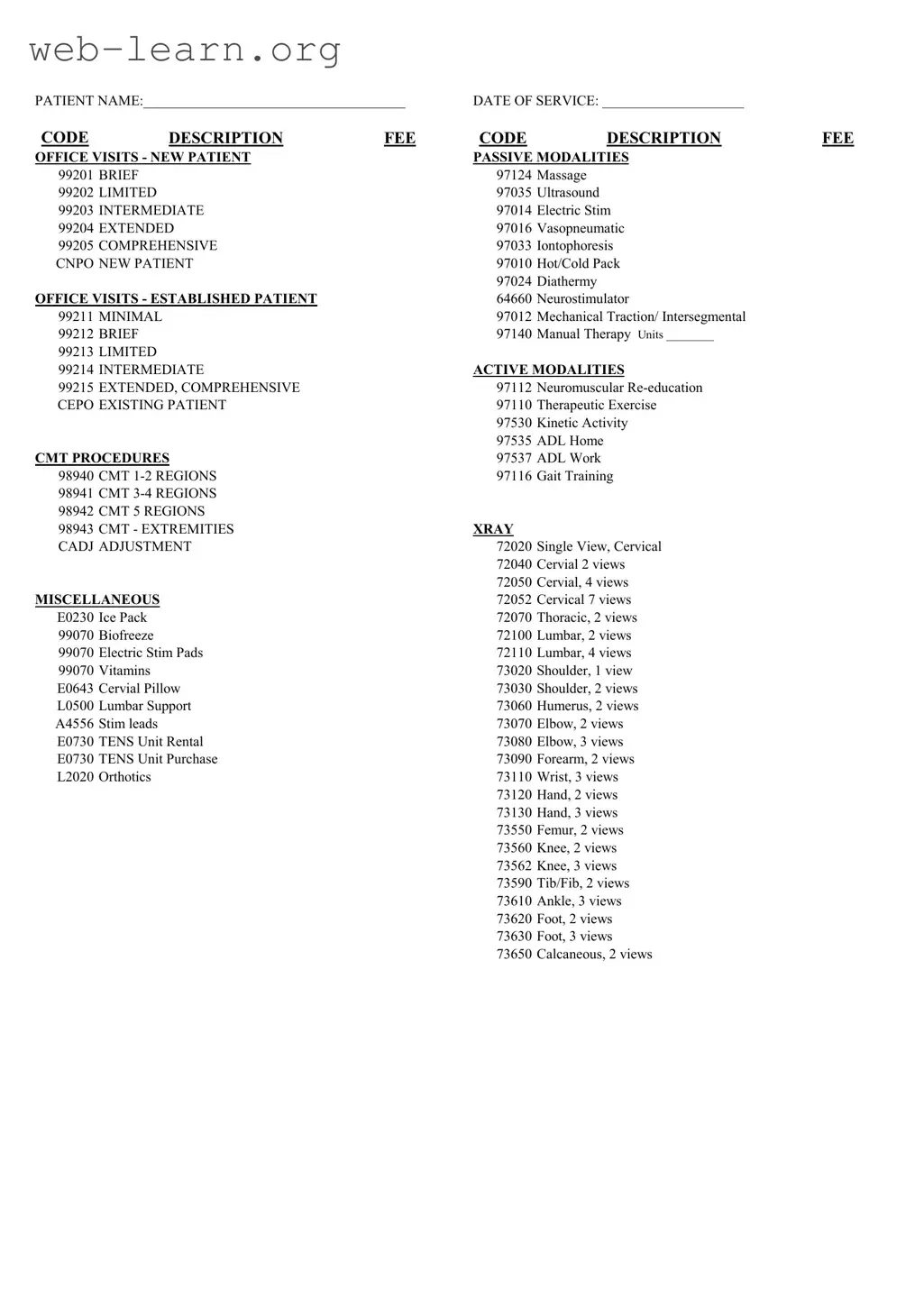
Sample - Chiropractic Superbill Form

PATIENT NAME:_____________________________________ DATE OF SERVICE: ____________________
CODE
DESCRIPTION FEE CODE DESCRIPTION FEE
OFFICE VISITS - NEW PATIENT PASSIVE MODALITIES
99201 BRIEF 97124 Massage
99202 LIMITED 97035 Ultrasound
99203 INTERMEDIATE 97014 Electric Stim
99204 EXTENDED 97016 Vasopneumatic
99205 COMPREHENSIVE 97033 Iontophoresis
CNPO NEW PATIENT 97010 Hot/Cold Pack
97024 Diathermy
OFFICE VISITS - ESTABLISHED PATIENT
64660 Neurostimulator
99211 MINIMAL 97012 Mechanical Traction/ Intersegmental
99212 BRIEF 97140
Manual Therapy Units ________
99213 LIMITED
99214 INTERMEDIATE ACTIVE MODALITIES
99215 EXTENDED, COMPREHENSIVE 97112 Neuromuscular Re-education
CEPO EXISTING PATIENT 97110 Therapeutic Exercise
97530 Kinetic Activity
97535 ADL Home
CMT PROCEDURES
97537 ADL Work
98940 CMT 1-2 REGIONS 97116 Gait Training
98941 CMT 3-4 REGIONS
98942 CMT 5 REGIONS
98943 CMT - EXTREMITIES XRAY
CADJ ADJUSTMENT 72020 Single View, Cervical
72040 Cervial 2 views
72050 Cervial, 4 views
MISCELLANEOUS 72052 Cervical 7 views
E0230 Ice Pack 72070 Thoracic, 2 views
99070 Biofreeze 72100 Lumbar, 2 views
99070 Electric Stim Pads 72110 Lumbar, 4 views
99070 Vitamins 73020 Shoulder, 1 view
E0643 Cervial Pillow 73030 Shoulder, 2 views
L0500 Lumbar Support 73060 Humerus, 2 views
A4556 Stim leads 73070 Elbow, 2 views
E0730 TENS Unit Rental 73080 Elbow, 3 views
E0730 TENS Unit Purchase 73090 Forearm, 2 views
L2020 Orthotics 73110 Wrist, 3 views
73120 Hand, 2 views
73130 Hand, 3 views
73550 Femur, 2 views
73560 Knee, 2 views
73562 Knee, 3 views
73590 Tib/Fib, 2 views
73610 Ankle, 3 views
73620 Foot, 2 views
73630 Foot, 3 views
73650 Calcaneous, 2 views

Form Information

Fact Name Description
Purpose The Chiropractic Superbill is used to itemize services provided to a patient for insurance billing and reimbursement.
Patient Information It includes essential details such as the patient's name and date of service.
Service Codes Each service provided is listed with a specific code, description, and associated fee.
New vs. Established Patients The form differentiates between services for new patients and established patients, with distinct coding for each.
Governing Laws In many states, the use of the Chiropractic Superbill is governed by healthcare billing regulations and insurance laws.
Miscellaneous Services The form also includes various miscellaneous services, such as supplies and equipment rentals.
Insurance Submission Chiropractors submit the Superbill to insurance companies for reimbursement, making accuracy crucial.

Detailed Guide for Filling Out Chiropractic Superbill

Filling out the Chiropractic Superbill form is essential for documenting the services provided during a chiropractic visit. This form helps ensure that all relevant information is captured accurately for billing and insurance purposes. Follow these steps to complete the form properly.

  1. Patient Name: Write the patient's full name in the designated space.
  2. Date of Service: Enter the date when the chiropractic service was provided.
  3. Office Visits: Select the appropriate code based on whether the patient is new or established. Write the code and description in the corresponding section.
  4. Passive Modalities: If applicable, check the relevant codes for passive modalities used during the visit. Write down the codes and fees next to them.
  5. Active Modalities: If any active modalities were performed, select the appropriate codes and enter them in the designated area.
  6. CMT Procedures: Indicate the number of regions treated by writing the corresponding CMT code.
  7. X-Ray: If x-rays were taken, select the appropriate code for the views provided and write it down.
  8. Miscellaneous: Include any additional items such as ice packs, electric stim pads, or vitamins by entering their respective codes and fees.
  9. Total Fees: Calculate the total fees for all services rendered and write the amount in the total fee section.

Obtain Answers on Chiropractic Superbill

  1. What is a Chiropractic Superbill?

    A Chiropractic Superbill is a detailed document that outlines the services provided during a chiropractic visit. It includes the patient's name, date of service, codes for the procedures performed, and associated fees. This form is essential for patients seeking reimbursement from their insurance providers, as it provides the necessary information about the treatments received.

  2. Why is the Superbill important for insurance claims?

    The Superbill serves as a crucial tool for insurance claims. It contains specific codes that correspond to the services rendered, which insurance companies require to process claims. By submitting a Superbill, patients can facilitate the reimbursement process and ensure that they receive the benefits entitled to them under their insurance plans.

  3. What information is typically included in a Superbill?

    A typical Chiropractic Superbill includes:

    • Patient's name
    • Date of service
    • Codes for office visits, including new and established patient visits
    • Descriptions of services provided, such as passive and active modalities
    • Fees associated with each service

    This comprehensive information helps streamline the claims process for both the patient and the insurance provider.

  4. How can patients use the Superbill for reimbursement?

    Patients can use the Superbill by submitting it to their insurance company along with any required claim forms. It's important to keep a copy for personal records. Some insurance companies may also require additional documentation, so checking with the insurer beforehand can help avoid delays in processing the claim.

  5. What types of services are typically coded on a Superbill?

    Services coded on a Chiropractic Superbill often include:

    • Office visits for new and established patients
    • Passive modalities such as massage, ultrasound, and electric stimulation
    • Active modalities like therapeutic exercise and neuromuscular re-education
    • CMT procedures for spinal adjustments
    • X-ray services

    Each service is assigned a specific code that corresponds to the procedure performed, making it easier for insurance companies to process claims accurately.

  6. Can patients request a Superbill after their appointment?

    Yes, patients can request a Superbill after their appointment. It is advisable to ask for it at the time of service or soon after, as it ensures that all information is accurate and fresh. Most chiropractic offices are accustomed to providing this document upon request, facilitating the claims process for patients.

Common mistakes

Filling out the Chiropractic Superbill form accurately is crucial for ensuring proper billing and reimbursement. However, many people make mistakes that can lead to delays or denials of claims. One common error is failing to include the patient’s name and the date of service. Without this essential information, the form may be considered incomplete, resulting in unnecessary complications.

Another frequent mistake involves misclassifying the type of office visit. Patients often confuse new and established patient visits, which can significantly impact the billing codes used. Selecting the wrong category may lead to incorrect charges and could even affect the patient’s insurance coverage.

Inaccurate coding is also a prevalent issue. Many individuals do not double-check the codes listed for each service. For instance, using the wrong code for a passive modality, such as selecting 97014 Electric Stim instead of 97035 Ultrasound, can cause discrepancies in billing. It is vital to ensure that the correct codes are used to reflect the services provided.

Another mistake is neglecting to document all services rendered. Patients may forget to include certain procedures, such as manual therapy units or neuromuscular re-education. Omitting these details can lead to underbilling and potential loss of revenue for the chiropractic practice.

Many people also overlook the importance of reviewing the fees associated with each service. Each code has a corresponding fee that must be accurately recorded. Failing to do so can result in incorrect billing amounts, leading to confusion and disputes with insurance companies.

Additionally, individuals often forget to sign the form before submission. A missing signature can delay the processing of claims and may require resubmission of the entire document. This simple oversight can lead to significant delays in payment.

Another common error is not keeping a copy of the completed Superbill. Patients should always retain a copy for their records. This practice can help in resolving any discrepancies that may arise later regarding the services billed or covered by insurance.

Some individuals also fail to provide additional information required by insurance companies. Certain insurers may request extra documentation or clarification on specific services. Not including this information can result in claim denials, forcing patients to navigate the appeals process.

Lastly, not updating the Superbill with changes in codes or fees can lead to outdated billing practices. As codes and fees may change over time, staying informed and making necessary adjustments is essential for accurate billing and compliance with insurance requirements.

Documents used along the form

When managing chiropractic care, several forms and documents complement the Chiropractic Superbill. Each of these documents plays a crucial role in ensuring accurate billing, tracking patient care, and maintaining compliance with insurance requirements. Below is a list of commonly used forms that practitioners should be familiar with.

  • Patient Intake Form: This document gathers essential information about the patient, including medical history, current health concerns, and personal details. It helps the chiropractor understand the patient's background before treatment begins.
  • Progress Notes: These notes document the patient's treatment sessions, including the techniques used and the patient's response to care. They are vital for tracking progress and justifying ongoing treatment to insurance providers.
  • Insurance Verification Form: This form is used to confirm a patient's insurance coverage and benefits. It helps the practice understand what services are covered and any patient responsibilities before treatment starts.
  • Authorization for Treatment: Patients sign this document to give consent for treatment. It ensures that they understand the procedures and agree to receive care.
  • Referral Form: If a patient needs to see another specialist, this form facilitates the referral process. It outlines the reason for the referral and any relevant patient information.
  • Billing Statement: This document details the services provided, their costs, and any payments made. It is sent to the patient or insurance company to request payment for services rendered.
  • Claim Form: This form is submitted to insurance companies to request reimbursement for services provided. It includes information about the patient, the treatment, and the associated costs.
  • Release of Information Form: This document allows the chiropractic office to share patient information with other healthcare providers or insurance companies as needed for treatment or billing purposes.
  • Patient Satisfaction Survey: After treatment, patients may fill out this survey to provide feedback on their experience. This information can help improve services and patient care.

Understanding these forms and documents is essential for any chiropractic practice. They not only streamline operations but also enhance the patient experience and ensure compliance with legal and insurance requirements.

Similar forms

  • Medical Invoice: A medical invoice serves as a billing statement for services rendered, similar to a Chiropractic Superbill. Both documents outline patient information, services provided, and associated fees, facilitating the payment process.
  • Health Insurance Claim Form (CMS-1500): This form is used to submit claims to insurance companies. Like the Chiropractic Superbill, it includes details about the patient, services, and codes for billing, ensuring proper reimbursement for healthcare providers.
  • Patient Encounter Form: This document records the details of a patient's visit to a healthcare provider. It shares similarities with the Chiropractic Superbill by documenting services performed, patient information, and often includes billing codes for easy reference.
  • Billing Statement: A billing statement provides a summary of charges and payments due. It is similar to the Chiropractic Superbill in that it outlines the services provided and the corresponding fees, making it clear what the patient owes.
  • Explanation of Benefits (EOB): An EOB is issued by insurance companies to explain what services were covered and what the patient is responsible for paying. It relates to the Chiropractic Superbill as both documents detail services rendered and financial obligations, although the EOB is specifically for insurance purposes.

Dos and Don'ts

When filling out the Chiropractic Superbill form, it’s essential to be thorough and accurate. Here’s a helpful list of things to do and avoid to ensure a smooth process.

  • Do write clearly and legibly. Your handwriting should be easy to read to prevent any misunderstandings.
  • Do include the patient's full name and date of service. This information is crucial for accurate record-keeping.
  • Do select the correct codes for services provided. Familiarize yourself with the code descriptions to ensure accuracy.
  • Do double-check the fees associated with each service. Accurate billing is essential for both the provider and the patient.
  • Do keep a copy of the completed Superbill for your records. This helps in case of any discrepancies later on.
  • Don't leave any sections blank. Each part of the form should be filled out to avoid delays in processing.
  • Don't use abbreviations that are not widely recognized. Clarity is key, so write out terms fully when possible.
  • Don't forget to sign the form if required. A signature may be necessary for validation.
  • Don't rush through the process. Taking your time can help prevent errors that may complicate billing.
  • Don't assume that the billing department will catch your mistakes. It’s your responsibility to ensure everything is correct.

By following these guidelines, you can help ensure that the Chiropractic Superbill is filled out correctly, making the billing process smoother for everyone involved.

Misconceptions

Many people have misunderstandings about the Chiropractic Superbill form. Here are some common misconceptions:

  • The Superbill is only for new patients. This is incorrect. The Superbill is used for both new and established patients. It includes various codes for different types of services provided to any patient.
  • All chiropractors use the same Superbill format. Not true. While many chiropractors may follow similar guidelines, each practice can customize their Superbill to fit their specific services and billing practices.
  • The Superbill is only necessary for insurance claims. This is a misconception. Although it is often used for insurance purposes, the Superbill can also serve as a detailed record for patients to understand their treatments and expenses.
  • Every code on the Superbill is required for every visit. This is misleading. Not all codes need to be used for every patient visit. The chiropractor will select only the codes that apply to the services provided during that specific visit.
  • The Superbill guarantees insurance reimbursement. This is false. While a properly completed Superbill can help facilitate the claims process, it does not guarantee that the insurance company will approve payment.
  • Patients do not need to keep a copy of their Superbill. This is not advisable. Patients should keep a copy for their records. It can be useful for tracking expenses and for any potential disputes with insurance companies.
  • The Superbill is the same as a receipt. This is an oversimplification. A Superbill contains specific codes and descriptions that provide detailed information about the services rendered, while a receipt may only show the total amount paid.

Key takeaways

Filling out and using the Chiropractic Superbill form is an essential process for both patients and practitioners. Here are some key takeaways to ensure effective use of this form:

  • Understand the Purpose: The Chiropractic Superbill serves as a detailed receipt for services rendered, making it easier for patients to submit claims to their insurance providers.
  • Complete Patient Information: Always fill in the patient's name and the date of service accurately. This information is crucial for record-keeping and billing.
  • Code Selection: Select the appropriate codes for the services provided. Each code corresponds to a specific treatment or procedure, ensuring clarity in billing.
  • Distinguish Between New and Established Patients: Different codes apply to new and established patients. Make sure to use the correct category to avoid billing errors.
  • Document Fees Clearly: Each service has a corresponding fee. Clearly list these fees next to the appropriate codes to provide transparency in billing.
  • Include Additional Services: If any miscellaneous services or supplies were provided, such as ice packs or TENS units, make sure to include these on the Superbill.
  • Review for Accuracy: Before finalizing the Superbill, double-check all entries. Errors can lead to delays in payment or claim denials.
  • Provide Copies: Offer a copy of the completed Superbill to the patient. This can assist them in their insurance claims process.
  • Keep Records: Maintain a copy of the Superbill in the patient’s file for future reference. This is important for both legal compliance and patient care continuity.
  • Stay Updated: Regularly review coding updates and changes in billing practices to ensure compliance with current regulations and insurance requirements.

By following these key takeaways, both practitioners and patients can navigate the billing process more effectively, ensuring that services are appropriately documented and reimbursed.