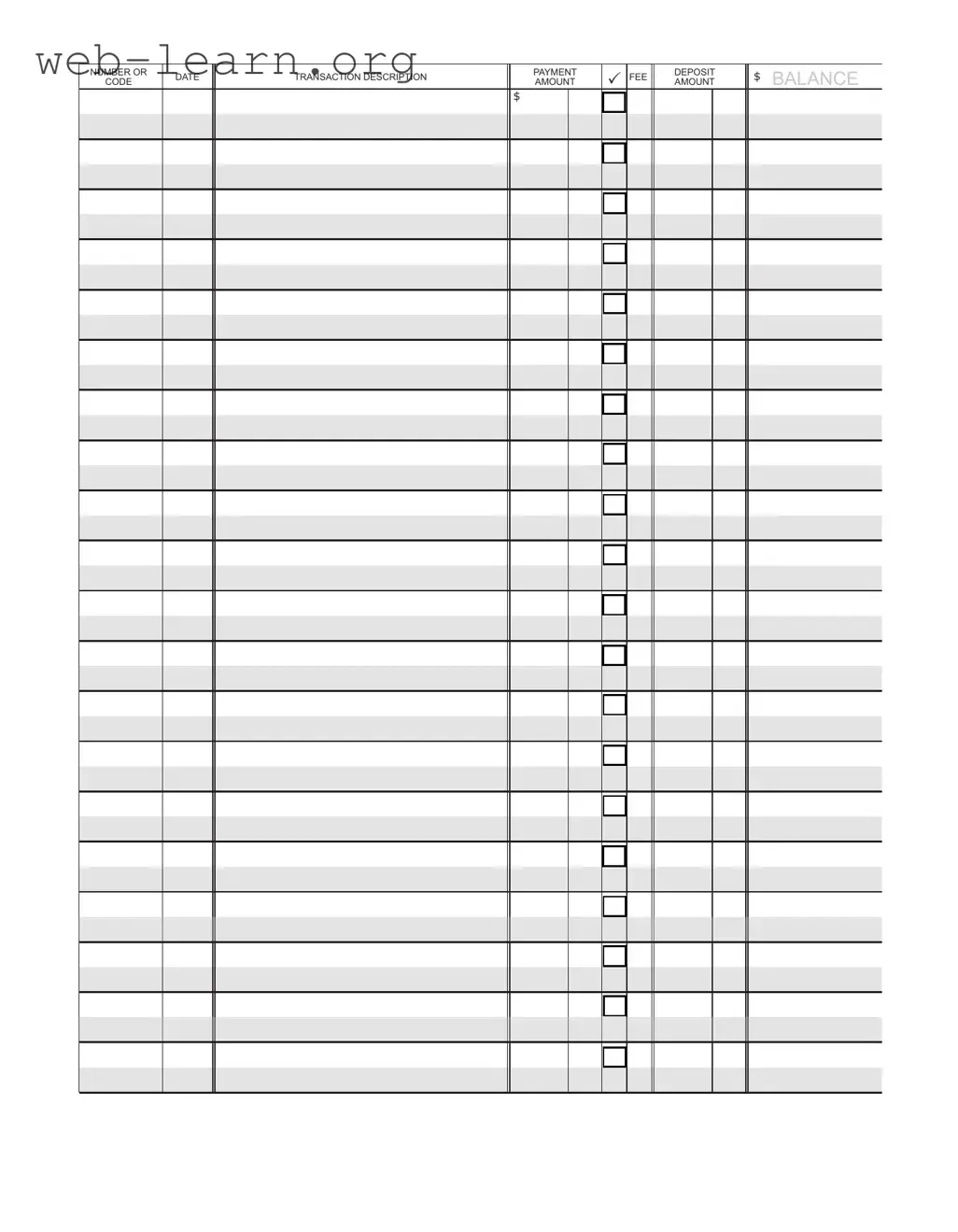
The Check Register form serves as an essential tool for individuals and businesses alike, providing a clear and organized method to track financial transactions. This form allows users to record details such as the date of each transaction, check numbers, payees, and amounts, ensuring that all expenditures and deposits are documented in one place. By maintaining an accurate check register, users can easily monitor their account balances, identify discrepancies, and manage their finances effectively. Additionally, the form often includes columns for notes and transaction types, which can help in categorizing expenses for budgeting purposes. Ultimately, a well-kept check register is invaluable for promoting financial responsibility and ensuring that all monetary activities are accounted for.
| Fact Name | Description |
|---|---|
| Purpose | The Check Register form is used to track all checks written from a bank account, ensuring accurate record-keeping of transactions. |
| Components | This form typically includes fields for the check number, date, payee, amount, and balance after each transaction. |
| Importance | Maintaining a Check Register helps individuals and businesses manage their finances, avoid overdrafts, and reconcile bank statements. |
| Frequency of Use | Users should update the Check Register regularly, ideally after every transaction, to ensure accuracy. |
| State-Specific Forms | Some states may have specific requirements for maintaining a Check Register, particularly for businesses. Check local laws for details. |
| Governing Laws | In many states, the governing laws related to financial record-keeping include the Uniform Commercial Code (UCC) and state banking regulations. |
| Digital Options | Many people now use digital tools or software to maintain their Check Register, which can simplify tracking and provide additional features. |
| Security | It is essential to keep the Check Register secure, especially if it contains sensitive information like account numbers or personal details. |
| Reconciliation | Regularly reconciling the Check Register with bank statements helps identify discrepancies and ensures the accuracy of financial records. |
Filling out a Check Register form is a straightforward process that helps individuals and businesses keep track of their financial transactions. After completing this form, you will have a clear record of your checks, deposits, and current balance, making it easier to manage your finances effectively.
What is a Check Register form?
A Check Register form is a financial document used to track all transactions related to a checking account. It records deposits, withdrawals, and checks issued. This form helps individuals and businesses maintain an accurate account balance and monitor spending habits.
How do I fill out a Check Register form?
To fill out a Check Register form, follow these steps:
Why is it important to maintain a Check Register?
Maintaining a Check Register is crucial for several reasons:
Can I use a digital version of the Check Register form?
Yes, many people opt for digital check registers, which can be found in personal finance software or mobile apps. These digital tools often offer additional features, such as automatic calculations and reminders for upcoming payments, making it easier to manage your finances.
How often should I update my Check Register?
It is advisable to update your Check Register regularly, ideally after each transaction. This practice ensures that your records remain accurate and up-to-date. Regular updates can help you quickly identify any errors or unauthorized transactions.
What should I do if I find an error in my Check Register?
If you discover an error in your Check Register, take the following steps:
Staying vigilant about discrepancies can help you maintain accurate financial records.
Filling out a Check Register form can seem straightforward, but many people make common mistakes that can lead to confusion and financial discrepancies. One frequent error is failing to record transactions promptly. When individuals wait too long to log their checks or deposits, they may forget important details, resulting in an inaccurate balance.
Another mistake is neglecting to update the running balance after each transaction. The purpose of the Check Register is to keep track of how much money is available. If people skip this step, they may end up spending more than they have, leading to overdraft fees and other complications.
Inaccurate entries are also a significant issue. Whether it’s a simple typo or miscalculating the amount of a check, these errors can throw off the entire register. It’s essential to double-check every entry to ensure that the information is correct.
Some individuals forget to include fees or other charges. Banks often impose fees for various services, and if these aren’t recorded, the balance will be misleading. Keeping track of all expenses, no matter how small, is crucial for an accurate financial picture.
Another common oversight is not reconciling the Check Register with bank statements. Regularly comparing the two helps catch discrepancies early. If a person waits too long to reconcile, they might miss errors that could have been easily corrected.
People also sometimes use the wrong format for dates. Consistency is key when recording transactions. Using different date formats can lead to confusion, especially when reviewing past entries. Sticking to one format helps maintain clarity.
Finally, some forget to keep their Check Register secure. Sensitive financial information is at stake. Losing the register or allowing it to fall into the wrong hands can lead to identity theft or fraud. Keeping it in a safe place is essential for protecting personal finances.
The Check Register form is an essential tool for tracking payments made through checks. It helps individuals and businesses maintain accurate financial records. Alongside the Check Register, several other forms and documents can assist in managing finances effectively. Below is a list of related documents often used in conjunction with the Check Register.
These documents play a vital role in maintaining accurate financial records and ensuring smooth financial operations. Using them in conjunction with the Check Register enhances overall financial management and accountability.
The Check Register form is an essential tool for tracking financial transactions. It shares similarities with several other documents that also help in managing finances effectively. Here are ten documents that are comparable to the Check Register form:
Understanding these documents can enhance financial management skills and ensure that all transactions are accurately recorded and monitored.
When filling out the Check Register form, it's important to keep a few key points in mind to ensure accuracy and clarity. Here’s a helpful list of things you should and shouldn’t do:
Following these guidelines will help you maintain an accurate and efficient check register. Good luck!
Understanding the Check Register form is crucial for managing personal finances effectively. However, several misconceptions can lead to confusion. Here are ten common misconceptions about the Check Register form, along with clarifications to help you navigate this important financial tool.
Misconception 1: The Check Register is only for checking accounts.
Many believe that the Check Register is exclusive to checking accounts. In reality, it can be used for any account where transactions occur, including savings accounts and credit cards.
Misconception 2: You only need to fill it out when you write a check.
Some people think the Check Register is only necessary when writing checks. However, it's important to record all transactions, including deposits, withdrawals, and fees, to maintain an accurate balance.
Misconception 3: The Check Register is outdated in the digital age.
While online banking is convenient, the Check Register remains a valuable tool. It helps individuals track their spending and reconcile their accounts more effectively.
Misconception 4: You can skip recording small transactions.
Many believe that small transactions don’t need to be recorded. However, even minor expenses can add up and impact your budget, making it essential to track everything.
Misconception 5: The Check Register is only for personal use.
Some think the Check Register is solely for personal finances. In fact, businesses can also benefit from maintaining a Check Register to keep track of their financial activities.
Misconception 6: You don’t need to update it regularly.
People often underestimate the importance of regular updates. Consistently updating your Check Register helps you avoid overdrafts and keeps your financial picture clear.
Misconception 7: It’s too complicated to use.
Some may feel intimidated by the Check Register format. In reality, it’s a straightforward tool designed to simplify tracking your finances.
Misconception 8: You can rely solely on bank statements.
While bank statements provide a summary of transactions, they may not reflect pending transactions or personal notes. The Check Register allows for more detailed tracking.
Misconception 9: You only need to reconcile your Check Register monthly.
Some believe monthly reconciliation is sufficient. However, reconciling your Check Register more frequently can help you catch errors and discrepancies sooner.
Misconception 10: Once it's filled out, you don’t need to look at it again.
Lastly, some think that once the Check Register is completed, it can be ignored. Regularly reviewing it is key to staying informed about your financial status.
By addressing these misconceptions, you can make better use of the Check Register form and enhance your financial management skills.
Filling out and using a Check Register form is essential for managing your finances effectively. Here are some key takeaways to keep in mind: