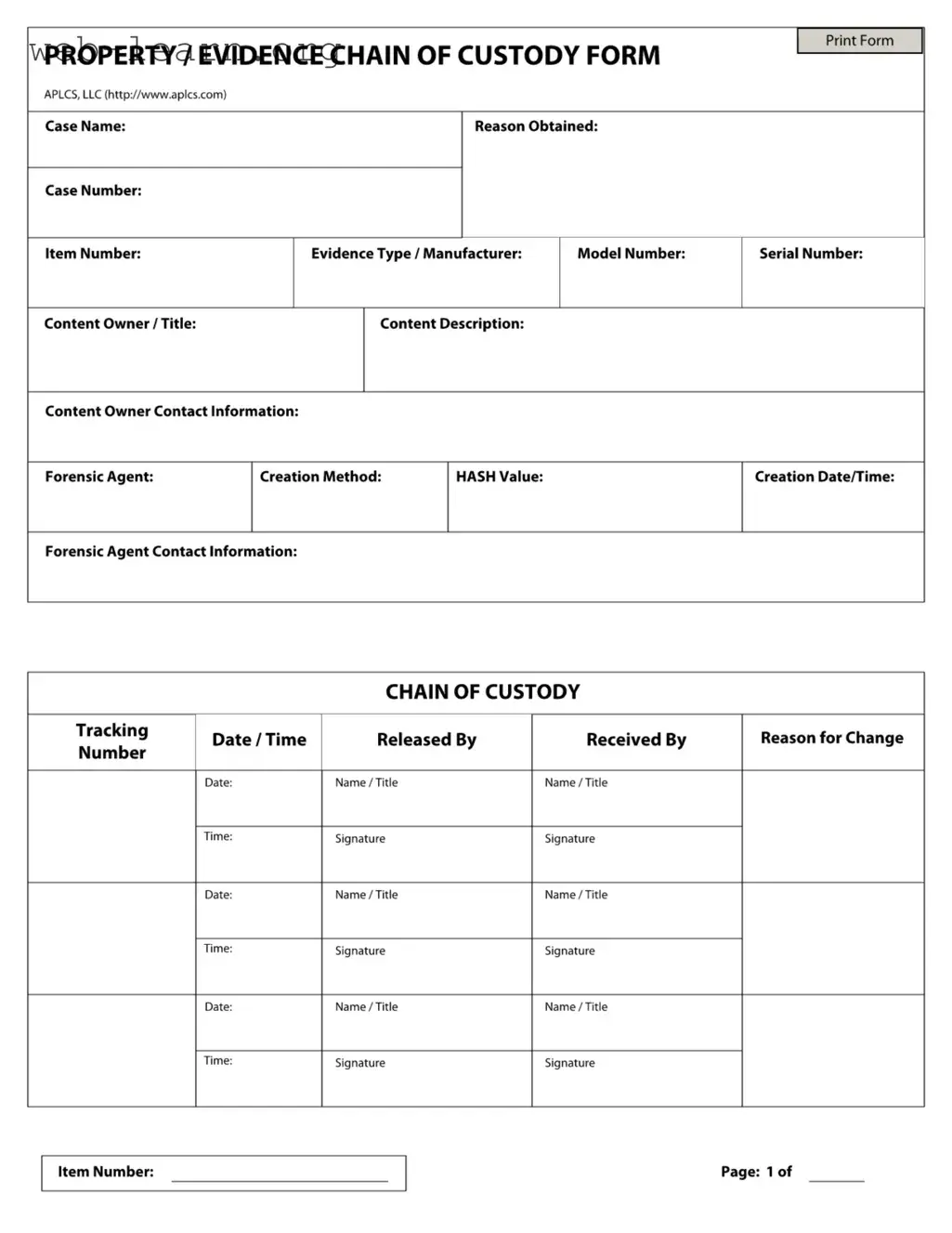
The Chain of Custody form serves a crucial role in the management and documentation of evidence within legal proceedings. It ensures that all items collected for a case are properly tracked from the moment they are obtained until they are presented in court. This form captures essential information, including the case name, case number, and item number, which helps to identify each piece of evidence clearly. Additionally, details such as the type of evidence, its manufacturer, model number, and serial number provide a comprehensive overview of the item’s specifications. The form also includes the content owner's information and a description of the evidence, which aids in establishing ownership and relevance to the case. Contact details for the forensic agent responsible for handling the evidence are included, along with the method of creation and a unique hash value that verifies the integrity of the data. The chain of custody section records the timeline of the evidence, documenting each transfer of custody with dates, names, titles, and signatures of individuals involved. This meticulous record-keeping is vital for maintaining the integrity of the evidence and ensuring that it can be reliably used in legal contexts.


| Fact Name | Description |
|---|---|
| Purpose | The Chain of Custody form tracks the handling of evidence from collection to presentation in court. |
| Importance | Maintaining a clear chain of custody is crucial to ensure the integrity and admissibility of evidence. |
| Key Components | The form includes sections for case details, item specifics, and signatures of individuals handling the evidence. |
| Signature Requirement | Each person who handles the evidence must sign the form, indicating their responsibility for the item. |
| Tracking Number | A unique tracking number is assigned to each item, facilitating easy reference and retrieval. |
| State-Specific Forms | Some states may have specific requirements or variations of the Chain of Custody form governed by local laws. |
| Retention Period | Evidence must be retained for a specific period, often dictated by state law, to ensure availability for legal proceedings. |
| Forensic Agent Role | A forensic agent is typically responsible for documenting the collection and handling of evidence on the form. |
| Hash Value | The hash value is a digital fingerprint of the evidence, ensuring that it remains unchanged throughout the process. |
Completing the Chain of Custody form is essential for maintaining the integrity of evidence. After filling out this form, it will be used to track the handling and transfer of items related to a specific case. Ensure that all information is accurate and complete to facilitate a smooth process.
For the Chain of Custody section, fill in the details of each transfer or handling of the evidence. This includes dates, names, titles, times, and signatures of individuals involved. Make sure to keep this section updated as the evidence moves through different hands.
Continue this process for every transfer until all signatures and details are complete. This will ensure that the evidence is properly documented throughout its handling.
What is a Chain of Custody form?
The Chain of Custody form is a crucial document used to track the handling of evidence or property throughout an investigation. It ensures that the evidence remains intact, unaltered, and properly accounted for from the moment it is collected until it is presented in court. This form records every individual who comes into contact with the evidence, along with the dates and times of these interactions.
Why is the Chain of Custody important?
The integrity of evidence is vital in legal proceedings. A well-maintained Chain of Custody form helps prevent tampering or contamination of evidence, which could jeopardize a case. It provides a clear history of the evidence, ensuring that it can be trusted by investigators, lawyers, and the court.
What information is included in the Chain of Custody form?
The form typically includes:
Who is responsible for filling out the Chain of Custody form?
Typically, the individual who collects the evidence is responsible for completing the initial sections of the Chain of Custody form. However, anyone who handles the evidence afterward must also sign and date the form, documenting their interaction with the evidence.
How should the Chain of Custody form be stored?
It is essential to keep the Chain of Custody form in a secure location, separate from the evidence itself. This ensures that the form remains intact and accessible for future reference. Digital copies may also be maintained, but they should be stored securely to prevent unauthorized access.
What happens if there is a break in the Chain of Custody?
A break in the Chain of Custody can lead to serious consequences, including the possibility of evidence being deemed inadmissible in court. If a gap is identified, it must be thoroughly documented and explained. Investigators may need to provide additional context to support the evidence's integrity.
Can the Chain of Custody form be modified?
While the Chain of Custody form should remain as accurate as possible, minor modifications can be made if necessary. Any changes must be clearly documented, including who made the change and why. This practice helps maintain transparency and accountability.
Is the Chain of Custody form required for all types of evidence?
Not all evidence may require a Chain of Custody form, but it is highly recommended for any significant items that could be used in legal proceedings. This includes physical evidence, digital evidence, and any other items that may impact the outcome of a case.
Completing the Chain of Custody form accurately is crucial for maintaining the integrity of evidence in any legal case. However, several common mistakes can lead to complications. Understanding these pitfalls can help ensure that the form is filled out correctly.
One frequent error is failing to provide complete information in the Case Name and Case Number fields. These details are essential for identifying the specific case related to the evidence. Omitting them can create confusion and hinder the tracking of evidence. Always double-check that this information is accurate and fully filled in.
Another mistake often made is neglecting to include the Content Owner Contact Information. This section is vital for establishing who is responsible for the evidence. Without this information, it may be challenging to reach the right person if questions arise later. It is important to ensure that contact details are current and complete.
Additionally, people sometimes forget to record the Creation Date/Time and the HASH Value. These elements are critical for verifying the authenticity of the evidence. The HASH value serves as a digital fingerprint, while the creation date helps establish a timeline. Missing these details can lead to doubts about the evidence's validity.
Inaccurate signatures can also pose significant issues. Each person who handles the evidence must sign the form, indicating their involvement. Failing to obtain a signature or providing an incorrect name can lead to disputes about who was responsible for the evidence at various stages. Therefore, it is vital to ensure that all signatures are legible and correctly attributed.
Moreover, the Reason for Change section is sometimes overlooked. If the evidence is transferred or modified in any way, it is important to document the reason clearly. This transparency helps maintain trust in the process and provides a clear record of the evidence's journey.
Lastly, individuals often neglect to review the entire form before submission. Taking the time to ensure that all sections are complete and accurate can prevent future complications. A careful review can catch errors or omissions that might otherwise go unnoticed.
By being aware of these common mistakes, individuals can better navigate the process of filling out the Chain of Custody form. Attention to detail not only supports the legal process but also upholds the integrity of the evidence involved.
The Chain of Custody form is a crucial document in the management of evidence. It ensures that the evidence is tracked and maintained properly from collection to presentation in court. Along with this form, several other documents are often used to support the chain of custody and maintain the integrity of the evidence. Below is a list of these important documents.
These documents work together to create a comprehensive and transparent process for handling evidence. Proper documentation not only protects the integrity of the evidence but also upholds the legal standards required in judicial proceedings.
When filling out the Chain of Custody form, attention to detail is crucial. Properly documenting evidence ensures its integrity and reliability in legal proceedings. Here are some important dos and don’ts to keep in mind:
By following these guidelines, you help ensure that the Chain of Custody form is completed accurately and effectively, preserving the integrity of the evidence involved.
This is not true. The Chain of Custody form can be essential in various types of cases, including civil litigation, family law, and administrative proceedings. It helps maintain the integrity of evidence, regardless of the case type.
In reality, the Chain of Custody form must be maintained throughout the entire process. It tracks evidence from the moment it is collected until it is presented in court, ensuring that the evidence remains unaltered and credible.
This is a common misunderstanding. While law enforcement often handles evidence collection, anyone who handles or transfers evidence should complete the form. This includes forensic agents, legal professionals, and other authorized personnel.
On the contrary, the Chain of Custody form is a crucial document that ensures the admissibility of evidence in court. A lack of proper documentation can lead to evidence being deemed unreliable or inadmissible.
This misconception overlooks the importance of tracking digital evidence. Just like physical evidence, digital files must be documented and tracked to preserve their integrity and ensure they can be used effectively in legal proceedings.
This is incorrect. The form must be updated every time evidence changes hands or is altered in any way. Each entry documents who handled the evidence and when, creating a comprehensive history that supports its validity.
When filling out and using the Chain Of Custody form, it is essential to follow certain guidelines to ensure accuracy and integrity. Here are some key takeaways:
By adhering to these guidelines, individuals can ensure that the Chain Of Custody form is used effectively and reliably in legal proceedings.