Homepage Blank Cg 20 26 04 13 Form
Outline

The CG 20 26 04 13 form is an important endorsement that modifies the standard Commercial General Liability (CGL) policy. This particular form introduces the concept of "additional insured," allowing specific individuals or organizations to be covered under the policy for certain liabilities. It is crucial for businesses to understand that this endorsement is not just a simple addition; it outlines specific conditions under which these additional insured parties are protected. The coverage applies primarily to liabilities arising from bodily injury, property damage, or personal and advertising injury that result from the named insured's actions or omissions, particularly in relation to ongoing operations or premises owned or rented by the insured. However, the form emphasizes that the protection granted to additional insureds is limited by existing laws and contractual obligations. If a contract stipulates certain coverage requirements, the insurance provided cannot exceed what is mandated. Additionally, the limits of insurance for these additional insured parties are clearly defined, ensuring that they align with the contractual obligations or the policy's declared limits, whichever is lower. Understanding the nuances of the CG 20 26 04 13 form is essential for businesses seeking to navigate their liability coverage effectively and ensure that all parties involved are adequately protected.

Sample - Cg 20 26 04 13 Form

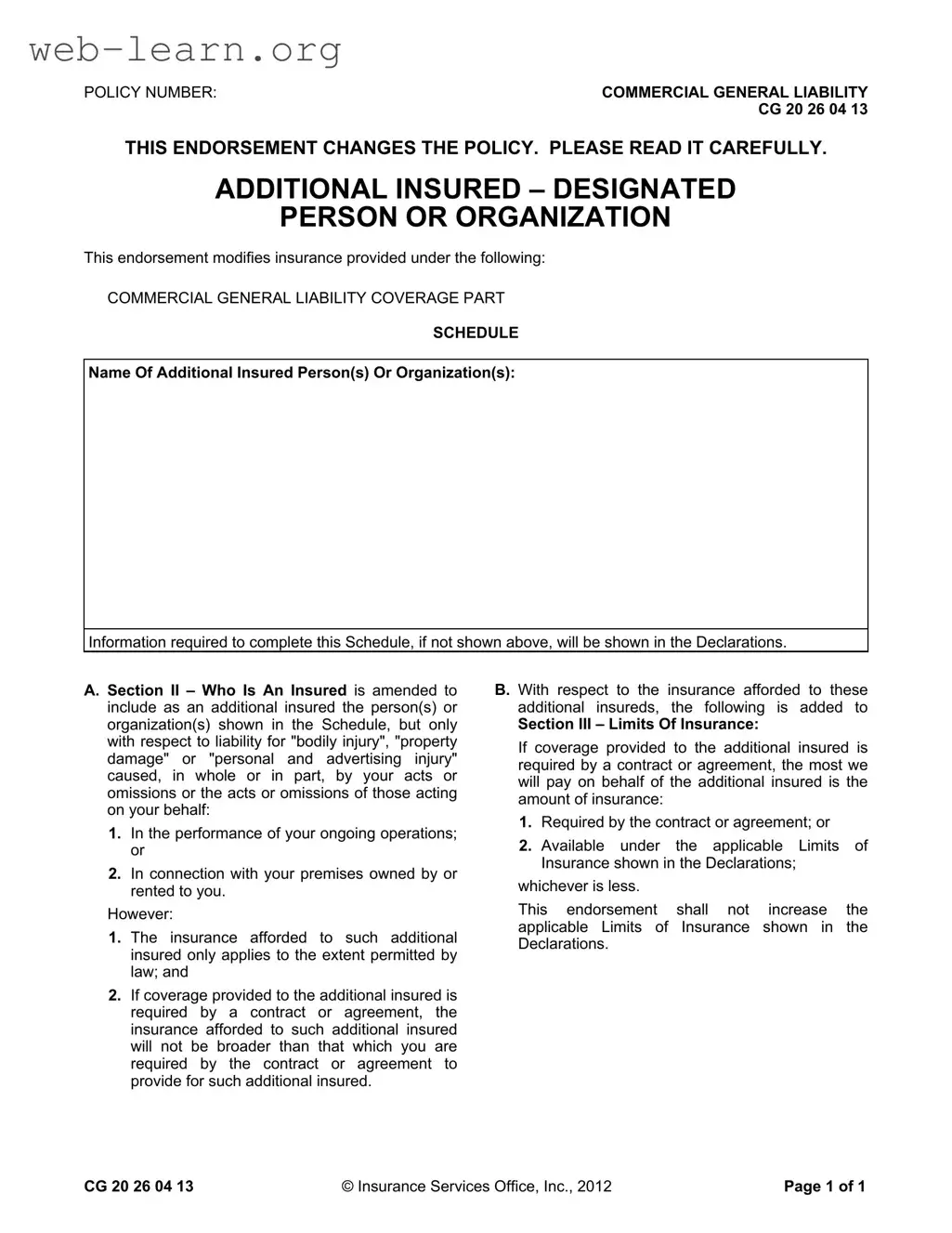
POLICY NUMBER: COMMERCIAL GENERAL LIABILITY
CG 20 26 04 13
THIS ENDORSEMENT CHANGES THE POLICY. PLEASE READ IT CAREFULLY.
CG 20 26 04 13 © Insurance Services Office, Inc., 2012 Page 1 of 1
ADDITIONAL INSURED – DESIGNATED
PERSON OR ORGANIZATION
This endorsement modifies insurance provided under the following:
COMMERCIAL GENERAL LIABILITY COVERAGE PART
SCHEDULE
Name Of Additional Insured Person(s) Or Organization(s):
Information required to complete this Schedule, if not shown above, will be shown in the Declarations.
A. Section II – Who Is An Insured is amended to
include as an additional insured the person(s) or
organization(s) shown in the Schedule, but only
with respect to liability for "bodily injury", "property
damage" or "personal and advertising injury"
caused, in whole or in part, by your acts or
omissions or the acts or omissions of those acting
on your behalf:
1. In the performance of your ongoing operations;
or
2. In connection with your premises owned by or
rented to you.
However:
1. The insurance afforded to such additional
insured only applies to the extent permitted by
law; and
2. If coverage provided to the additional insured is
required by a contract or agreement, the
insurance afforded to such additional insured
will not be broader than that which you are
required by the contract or agreement to
provide for such additional insured.
B. With respect to the insurance afforded to these
additional insureds, the following is added to
Section III – Limits Of Insurance:
If coverage provided to the additional insured is
required by a contract or agreement, the most we
will pay on behalf of the additional insured is the
amount of insurance:
1. Required by the contract or agreement; or
2. Available under the applicable Limits of
Insurance shown in the Declarations;
whichever is less.
This endorsement shall not increase the
applicable Limits of Insurance shown in the
Declarations.

Form Information

Fact Name Description
Policy Type This form is an endorsement for a Commercial General Liability (CGL) policy.
Additional Insured It allows for the inclusion of designated persons or organizations as additional insureds.
Coverage Scope The coverage applies to bodily injury, property damage, or personal and advertising injury.
Performance Context Coverage is applicable in connection with ongoing operations and premises owned or rented.
Contractual Limitations Coverage for additional insureds is limited to what is required by contract or agreement.
Insurance Limits The maximum payout for additional insureds is the lesser of contract limits or policy limits.
Legal Compliance The endorsement only applies to the extent permitted by law.
Governing Law This form is governed by the laws applicable to the state where the policy is issued.

Detailed Guide for Filling Out Cg 20 26 04 13

Filling out the CG 20 26 04 13 form is an important step in ensuring that the right individuals or organizations are covered under your commercial general liability insurance policy. Once you have completed the form, it will need to be submitted to your insurance provider for processing. Here’s how to fill it out correctly:

  1. Begin by locating the POLICY NUMBER section at the top of the form. Enter your policy number here.
  2. Next, find the section labeled Name Of Additional Insured Person(s) Or Organization(s). This is where you will list the names of the individuals or organizations you wish to add as additional insureds.
  3. If there are multiple additional insureds, ensure that each name is clearly written and separated by commas or listed on separate lines as needed.
  4. Review the Declarations section of your policy to confirm if any additional information is required for the names listed. If so, fill that information in as necessary.
  5. Make sure to check the box or provide a signature if the form requires acknowledgment of understanding the terms and conditions.
  6. Finally, double-check all entries for accuracy and completeness before submitting the form to your insurance provider.

Obtain Answers on Cg 20 26 04 13

  1. What is the purpose of the CG 20 26 04 13 form?

    The CG 20 26 04 13 form is an endorsement to a Commercial General Liability (CGL) policy. Its primary purpose is to add designated persons or organizations as additional insureds. This means that these additional insured parties will have coverage under the policy for certain liabilities arising from the named insured's operations or premises. This endorsement modifies the existing insurance policy to extend protection to others, ensuring that they are covered for specific incidents related to the named insured's activities.

  2. Who can be listed as an additional insured on this form?

    The form allows for the inclusion of any person or organization specified in the Schedule section. Typically, these might include clients, contractors, or other parties that require additional coverage due to their relationship with the named insured. It is essential that the additional insureds are clearly identified in the policy declarations to ensure they receive the appropriate coverage.

  3. What types of liabilities are covered for additional insureds?

    Coverage for additional insureds under the CG 20 26 04 13 form includes liabilities for bodily injury, property damage, and personal and advertising injury. This coverage applies when these liabilities arise from the acts or omissions of the named insured or those acting on their behalf. The endorsement specifically covers incidents occurring during ongoing operations or in connection with premises owned or rented by the named insured.

  4. Are there any limitations to the coverage provided?

    Yes, there are limitations. The coverage for additional insureds is subject to the extent permitted by law. Additionally, if the coverage is required by a contract or agreement, it cannot exceed the level of insurance specified in that contract. Therefore, the protection afforded to additional insureds will not be broader than what the named insured is obligated to provide under any existing agreements.

  5. How is the limit of insurance determined for additional insureds?

    The limits of insurance for additional insureds are determined based on two factors: the amount required by the contract or agreement and the limits available under the CGL policy. The lesser of these two amounts will be the maximum that the insurer will pay on behalf of the additional insured. Importantly, this endorsement does not increase the overall limits of insurance stated in the policy declarations.

  6. What should be done if there are changes to the additional insureds?

    If there are changes to the additional insureds, it is crucial to update the Schedule section of the CG 20 26 04 13 form. This ensures that any new parties requiring coverage are properly documented and protected under the policy. Keeping this information current helps avoid potential gaps in coverage and ensures compliance with contractual obligations.

Common mistakes

Filling out the CG 20 26 04 13 form can be straightforward, but several common mistakes can lead to complications. One frequent error is failing to include the policy number. This number is crucial for identifying the specific coverage and ensuring that the endorsement is properly attached to the right policy. Without it, the form may be considered incomplete.

Another mistake involves neglecting to accurately list the name of the additional insured. This section requires precise information. Any misspellings or incorrect titles can create issues when trying to enforce the coverage. It is essential to double-check the names against official documents to avoid any discrepancies.

People often overlook the importance of understanding the limits of insurance. The form includes specific language about the maximum amount payable to the additional insured. Failing to recognize these limits can lead to misunderstandings later on, especially if a claim arises. It is vital to read this section carefully to ensure compliance with contractual obligations.

In some cases, individuals may not fully grasp the implications of the contractual agreements mentioned in the form. If coverage for the additional insured is required by a contract, the insurance provided cannot exceed what is stipulated in that agreement. Ignoring this can result in inadequate coverage and potential liability issues.

Another common error is not providing sufficient detail regarding the scope of operations. The form specifies that the additional insured is covered only for liability arising from ongoing operations or premises owned or rented by the insured. Omitting details about these operations can lead to confusion and limit the effectiveness of the coverage.

Lastly, individuals sometimes fail to sign and date the form. A signature is necessary to validate the endorsement. Without it, the form may not be recognized as legitimate, which can cause significant delays in processing or claims.

By avoiding these mistakes, individuals can ensure that the CG 20 26 04 13 form is completed accurately and effectively, thereby safeguarding their interests and those of the additional insured.

Documents used along the form

The CG 20 26 04 13 form is an important document in the realm of commercial general liability insurance. It serves to add specific individuals or organizations as additional insured parties under a policy. However, there are other forms and documents that are frequently used alongside this endorsement to ensure comprehensive coverage and compliance with contractual obligations. Below is a list of such documents.

  • Certificate of Insurance: This document provides proof of insurance coverage. It outlines the types of coverage in place, policy limits, and the duration of the policy. Often required by clients or partners, it assures them that the necessary insurance is active and valid.
  • Additional Insured Endorsement (CG 20 10): Similar to the CG 20 26 04 13, this endorsement adds additional insured parties but may cover different liabilities or situations. It's crucial for ensuring that all parties involved in a contract are adequately protected.
  • Contractual Liability Endorsement: This document modifies the policy to cover liabilities assumed under a contract. It is particularly important for businesses that enter into agreements where they may take on additional risks.
  • Waiver of Subrogation: This document prevents the insurer from pursuing a third party for recovery of claims paid. It is often included in contracts to protect relationships between parties by ensuring that one party cannot seek damages from the other.
  • General Liability Policy Declarations: This document outlines the specifics of the general liability policy, including coverage limits, deductibles, and covered operations. It provides a comprehensive overview of the insurance terms and conditions.

Understanding these documents is essential for businesses to navigate their insurance needs effectively. Each serves a unique purpose and collectively ensures that all parties involved are adequately protected against potential liabilities.

Similar forms

The CG 20 26 04 13 form is an endorsement that adds an additional insured to a commercial general liability policy. Several other documents share similar functions or purposes. Here are six such documents:

  • CG 20 10 04 13 - Additional Insured – Owners, Lessees or Contractors: This form extends coverage to owners, lessees, or contractors, ensuring they are protected for liabilities arising from the named insured's operations.
  • CG 20 33 04 13 - Additional Insured – Completed Operations: This endorsement provides coverage to additional insureds specifically for liabilities that arise after the completion of a project, addressing risks associated with ongoing operations.
  • CG 20 37 04 13 - Additional Insured – Designated Person or Organization (Limited): Similar to the CG 20 26 04 13, this form limits the additional insured status to specific liabilities, ensuring coverage is not broader than required.
  • CG 24 04 10 93 - Waiver of Transfer of Rights of Recovery Against Others to Us: This document allows the named insured to waive their rights to recover damages from a third party, similar to how the CG 20 26 04 13 modifies coverage for additional insureds.
  • CG 21 44 07 98 - Additional Insured – Managers or Lessors of Premises: This endorsement provides coverage for property managers or lessors, similar to how the CG 20 26 04 13 adds protection for designated persons or organizations.
  • CG 20 01 04 13 - Commercial General Liability Coverage Form: This foundational document outlines the general terms and conditions of the commercial general liability policy, serving as the basis for endorsements like the CG 20 26 04 13.

Dos and Don'ts

When filling out the CG 20 26 04 13 form, it is essential to follow specific guidelines to ensure accuracy and compliance. Here are four things you should and shouldn't do:

  • Do provide accurate information in the "Name Of Additional Insured Person(s) Or Organization(s)" section.
  • Do read the entire endorsement carefully to understand the coverage details.
  • Don't leave any required fields blank; incomplete forms may lead to processing delays.
  • Don't assume that the coverage is broader than what is stated; adhere strictly to the limits outlined in the form.

Misconceptions

Understanding the CG 20 26 04 13 form is essential for anyone involved in commercial general liability insurance. However, several misconceptions often arise regarding its purpose and use. Here are ten common misconceptions clarified:

  1. It automatically provides full coverage for all parties. Many believe that adding someone as an additional insured means they receive full coverage. In reality, coverage is limited to specific liabilities related to the named insured's operations.
  2. All additional insureds have the same coverage limits. This form does not guarantee uniform coverage limits for all additional insureds. The coverage is subject to the limits specified in the contract or agreement.
  3. It covers all types of injuries and damages. The endorsement specifically addresses "bodily injury," "property damage," and "personal and advertising injury." Other types of claims may not be covered.
  4. It applies to past operations. The coverage is only applicable to ongoing operations or activities. It does not extend to past actions unless explicitly stated in the contract.
  5. Adding an additional insured is always beneficial. While it may seem advantageous, it can lead to complications, especially if the additional insured’s needs exceed the coverage limits provided.
  6. The endorsement changes the core policy. The CG 20 26 04 13 form modifies the existing policy but does not change its fundamental terms. It simply adds additional insureds under certain conditions.
  7. All contracts require the same level of coverage. The form emphasizes that coverage for additional insureds is limited to what is required by the contract. This can vary significantly from one agreement to another.
  8. It applies to any organization or person. Only those specifically listed in the schedule of the endorsement are considered additional insureds. General references do not suffice.
  9. Additional insured status is permanent. This status can be temporary and is often contingent upon the terms of the contract or agreement that necessitated its inclusion.
  10. The endorsement increases overall policy limits. Many mistakenly believe that adding additional insureds increases the total limits of insurance. However, the limits remain as stated in the declarations.

Being aware of these misconceptions can help you navigate the complexities of the CG 20 26 04 13 form more effectively. Always consult with an insurance professional for tailored advice regarding your specific situation.

Key takeaways

Understanding the CG 20 26 04 13 form is essential for ensuring proper coverage under a Commercial General Liability policy. Here are key takeaways to consider:

  • Purpose of the Form: This form serves as an endorsement to add designated persons or organizations as additional insureds under a general liability policy.
  • Schedule Requirement: You must complete the schedule section with the names of the additional insured persons or organizations. If not filled out, this information will be in the Declarations.
  • Scope of Coverage: The additional insureds are covered for liability related to bodily injury, property damage, or personal and advertising injury linked to your actions or those acting on your behalf.
  • Limitations: The coverage for additional insureds is limited to the extent permitted by law and cannot exceed what is required by any existing contract or agreement.
  • Insurance Limits: The maximum amount payable for additional insureds is either the amount specified in the contract or the limits in the Declarations, whichever is lower.
  • No Increase in Limits: This endorsement does not increase the overall limits of insurance outlined in the Declarations.
  • Read Carefully: It is crucial to read the endorsement thoroughly to understand its implications and ensure compliance with all requirements.