Homepage Blank Certification Of Incapacity Form
Outline

When navigating the complexities of healthcare decisions, understanding the Certification of Incapacity form is essential. This document serves a critical role in determining whether a patient is capable of making informed choices regarding their medical treatment. It requires the assessment of two physicians who must evaluate the patient's ability to comprehend the nature and consequences of proposed treatments. The form includes sections for both the attending physician and a second physician to certify their findings, ensuring a thorough evaluation. Key details such as the patient's condition and the specific treatments being considered must be documented. Additionally, the physicians must indicate whether the patient is unable to make rational decisions or communicate their choices. Timeliness is crucial; one of the certifications must be completed within two hours of the examination. This structure not only protects the rights of patients but also provides clarity and support for families and caregivers during challenging times.

Sample - Certification Of Incapacity Form

Copyright, 2014, Ober, Kaler, Grimes & Shriver
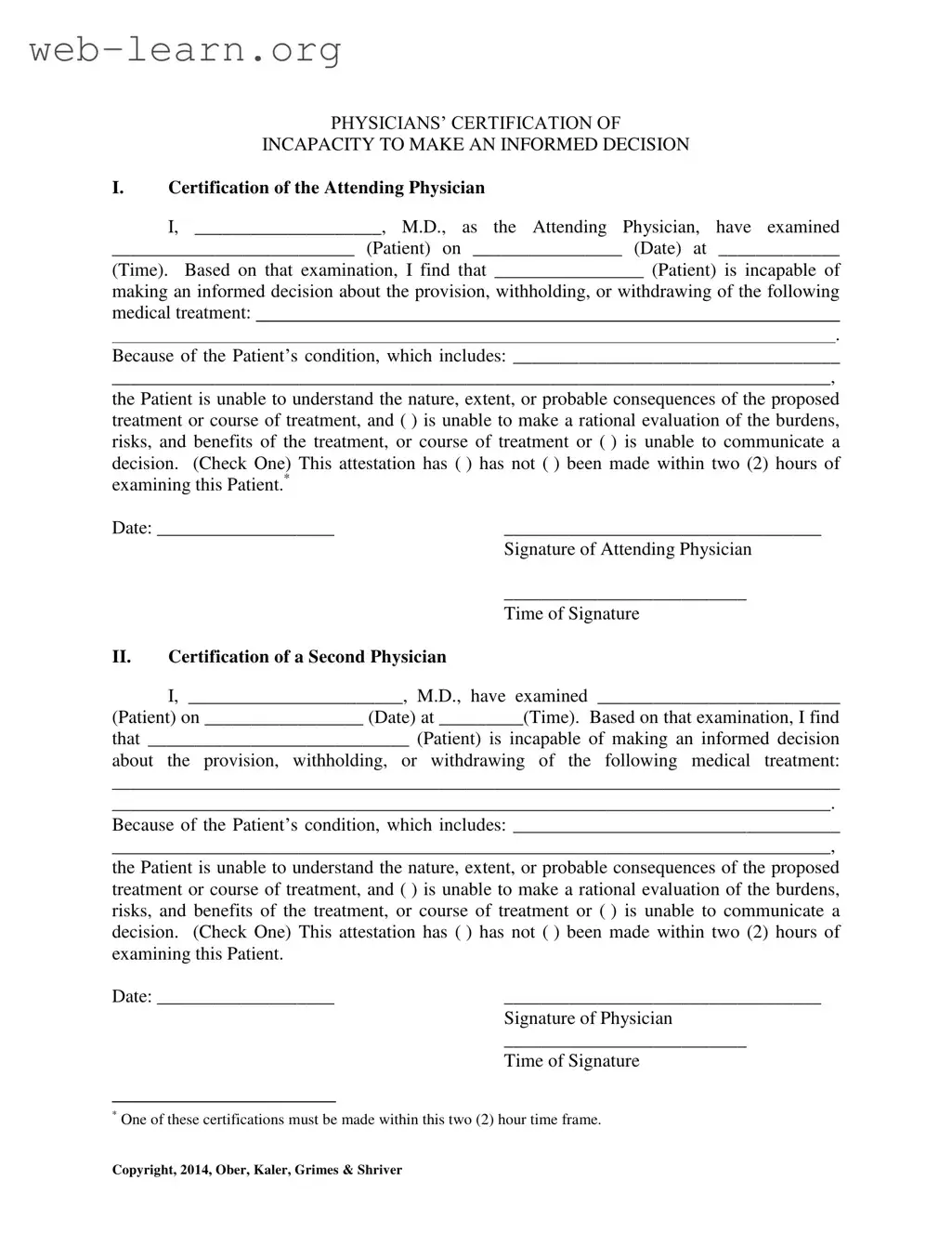
PHYSICIANS’ CERTIFICATION OF
INCAPACITY TO MAKE AN INFORMED DECISION
I. Certification of the Attending Physician
I, ____________________, M.D., as the Attending Physician, have examined
__________________________ (Patient) on ________________ (Date) at _____________
(Time). Based on that examination, I find that ________________ (Patient) is incapable of
making an informed decision about the provision, withholding, or withdrawing of the following
medical treatment:
.
Because of the Patients condition, which includes: ___________________________________
_____________________________________________________________________________,
the Patient is unable to understand the nature, extent, or probable consequences of the proposed
treatment or course of treatment, and ( ) is unable to make a rational evaluation of the burdens,
risks, and benefits of the treatment, or course of treatment or ( ) is unable to communicate a
decision. (Check One) This attestation has ( ) has not ( ) been made within two (2) hours of
examining this Patient.
*
Date: ___________________ __________________________________
Signature of Attending Physician
__________________________
Time of Signature
II. Certification of a Second Physician
I, _______________________, M.D., have examined __________________________
(Patient) on _________________ (Date) at _________(Time). Based on that examination, I find
that ____________________________ (Patient) is incapable of making an informed decision
about the provision, withholding, or withdrawing of the following medical treatment:
______________________________________________________________________________
_____________________________________________________________________________.
Because of the Patients condition, which includes: ___________________________________
_____________________________________________________________________________,
the Patient is unable to understand the nature, extent, or probable consequences of the proposed
treatment or course of treatment, and ( ) is unable to make a rational evaluation of the burdens,
risks, and benefits of the treatment, or course of treatment or ( ) is unable to communicate a
decision. (Check One) This attestation has ( ) has not ( ) been made within two (2) hours of
examining this Patient.
Date: ___________________ __________________________________
Signature of Physician
__________________________
Time of Signature
*
One of these certifications must be made within this two (2) hour time frame.

Form Information

Fact Name Description
Purpose The Certification of Incapacity form is used to determine a patient's ability to make informed medical decisions.
Attending Physician Requirement The form must be completed by the attending physician who has examined the patient.
Second Physician Certification A second physician must also certify the patient's incapacity, ensuring an additional layer of verification.
Time Frame Both certifications must be made within two hours of the examination to be valid.
Patient's Condition The form requires a detailed description of the patient's condition that affects their decision-making ability.
State-Specific Laws Governed by state-specific laws, such as the Uniform Health-Care Decisions Act, which varies by jurisdiction.

Detailed Guide for Filling Out Certification Of Incapacity

Completing the Certification of Incapacity form requires careful attention to detail. This form is essential for documenting a patient's inability to make informed medical decisions. Following these steps will help ensure that the form is filled out correctly.

  1. Begin by locating the section titled Certification of the Attending Physician.
  2. In the first blank space, write the name of the attending physician who examined the patient.
  3. Fill in the patient's name in the next blank space.
  4. Enter the date of the examination in the designated area.
  5. Record the time of the examination.
  6. In the next blank, specify the medical treatment in question.
  7. Provide details about the patient's condition in the following space, explaining why the patient is unable to make informed decisions.
  8. Check the appropriate box to indicate whether the patient is unable to make a rational evaluation or communicate a decision.
  9. Indicate whether the attestation was made within two hours of the examination by checking the corresponding box.
  10. Write the date of the attestation.
  11. Have the attending physician sign the form and record the time of the signature.

Next, proceed to the Certification of a Second Physician section. Repeat similar steps for the second physician, ensuring all required information is accurately filled out.

Obtain Answers on Certification Of Incapacity

  1. What is the purpose of the Certification of Incapacity form?

    The Certification of Incapacity form serves to document that a patient is unable to make informed medical decisions due to their current health condition. This form is typically completed by attending physicians and may require a second physician's certification. It ensures that medical professionals have a clear understanding of the patient's capacity to consent to or refuse treatment, which is essential for making ethical and legal medical decisions.

  2. Who can complete the Certification of Incapacity form?

    Only licensed medical doctors (M.D.s) can complete this form. The attending physician, who has examined the patient, is responsible for the first certification. A second physician must also evaluate the patient and provide their own certification. This dual certification process helps to ensure accuracy and provides a safeguard for patients who may be vulnerable due to their medical condition.

  3. What criteria must be met for a patient to be considered incapacitated?

    A patient is deemed incapable of making informed decisions if they cannot understand the nature, extent, or probable consequences of the proposed medical treatment. Additionally, they may be unable to evaluate the risks and benefits of the treatment rationally or communicate a decision effectively. Physicians must check one of these criteria on the form to confirm the patient's incapacity.

  4. What is the significance of the two-hour time frame mentioned in the form?

    The two-hour time frame is crucial because it ensures that the assessments of the patient’s incapacity are timely and relevant. One of the physicians must complete their certification within this period following their examination of the patient. This requirement helps to maintain the integrity of the decision-making process and ensures that the patient's condition has not changed significantly during that time.

Common mistakes

Filling out the Certification of Incapacity form is an important task that can have significant implications for a patient’s care. However, many individuals make common mistakes that can lead to complications. One frequent error is failing to provide complete patient information. It is crucial to fill in the patient's name, date, and time of the examination accurately. Missing or incorrect details can create confusion and delay necessary medical decisions.

Another mistake often seen is neglecting to check the appropriate box regarding the patient’s ability to make a decision. The form requires a clear indication of whether the patient can evaluate the burdens, risks, and benefits of treatment or if they can communicate a decision. Omitting this step can result in misunderstandings about the patient’s capacity and may affect their treatment options.

In addition, some individuals overlook the importance of the timing of the certification. The form specifies that one of the certifications must be made within two hours of the examination. If this time frame is not adhered to, the validity of the certification may be questioned, potentially impacting the patient’s care. It is essential to be mindful of this requirement to ensure that the certification holds up under scrutiny.

Furthermore, the signatures of the attending physician and the second physician must be included. Failing to obtain both signatures can render the form incomplete. This oversight can lead to delays in treatment and may require additional steps to rectify the situation, adding stress to an already challenging time for the patient and their loved ones.

Lastly, individuals sometimes do not provide a thorough explanation of the patient's condition. The section detailing the patient’s condition should be filled out with care. A vague or incomplete description may not accurately reflect the patient's incapacity and could lead to inappropriate medical decisions. Clear and comprehensive information is vital for ensuring that the patient receives the best possible care.

Documents used along the form

The Certification of Incapacity form is an important document used in healthcare settings to establish a patient's ability to make informed decisions regarding their medical treatment. Alongside this form, several other documents may be necessary to ensure comprehensive care and legal compliance. Below is a list of these additional forms and documents, each serving a specific purpose.

  • Durable Power of Attorney for Healthcare: This document allows an individual to appoint someone else to make medical decisions on their behalf if they become unable to do so. It ensures that the patient's wishes are honored even when they cannot communicate them.
  • Living Will: A living will outlines a person's preferences for medical treatment in situations where they are unable to express their wishes. It typically addresses end-of-life care and specific medical procedures.
  • Patient Advocate Designation: This form designates a specific person to act as a patient advocate, ensuring that the patient's healthcare decisions align with their values and preferences. It is particularly useful when the patient cannot communicate effectively.
  • Do Not Resuscitate (DNR) Order: A DNR order is a medical order that instructs healthcare providers not to perform CPR if a patient stops breathing or their heart stops. This document is essential for patients who wish to avoid aggressive life-saving measures.
  • Medical History Form: This form collects important information about a patient's medical background, including previous illnesses, surgeries, and allergies. It helps healthcare providers make informed decisions about treatment options.
  • Consent for Treatment Form: This document is used to obtain a patient's permission before providing medical treatment. It ensures that patients are informed about the procedures they will undergo and the associated risks.
  • HIPAA Authorization Form: This form allows patients to authorize the release of their medical information to specific individuals or entities. It is vital for protecting patient privacy while ensuring that necessary information is shared with authorized parties.

Each of these documents plays a crucial role in the overall healthcare process, particularly when a patient is unable to make decisions for themselves. It is essential for caregivers and family members to understand these forms to ensure that a patient's rights and preferences are respected at all times.

Similar forms

The Certification of Incapacity form shares similarities with several other important legal documents. Each serves a specific purpose related to medical decision-making and patient rights. Below is a list of six documents that are comparable to the Certification of Incapacity form:

  • Advance Directive: This document outlines a person's preferences for medical treatment in situations where they are unable to communicate their wishes. Like the Certification of Incapacity, it focuses on the individual's capacity to make informed decisions about their care.
  • Durable Power of Attorney for Health Care: This legal document designates someone to make medical decisions on behalf of an individual if they become incapacitated. Both documents emphasize the importance of having a trusted person involved in health care decisions when the patient cannot do so themselves.
  • Living Will: A living will specifies the types of medical treatment a person wishes to receive or avoid in the event of a terminal condition. Similar to the Certification of Incapacity, it addresses the patient's inability to make decisions due to their medical condition.
  • Mental Health Advance Directive: This document allows individuals to outline their preferences for mental health treatment when they may not be able to make decisions. It parallels the Certification of Incapacity by focusing on the patient's understanding and decision-making capacity.
  • Patient Self-Determination Act (PSDA) Notice: This notice informs patients of their rights regarding medical treatment decisions. Like the Certification of Incapacity, it reinforces the importance of understanding and making informed choices about one's health care.
  • Medical Power of Attorney: This document designates an individual to make medical decisions on behalf of someone else if they are incapacitated. It is similar to the Certification of Incapacity in that both address situations where a patient cannot communicate their wishes regarding treatment.

Dos and Don'ts

When filling out the Certification of Incapacity form, it's important to follow specific guidelines to ensure accuracy and compliance. Here are six things to keep in mind:

  • Do: Clearly state the patient's name and details accurately to avoid confusion.
  • Do: Complete the form promptly after the examination, ideally within the two-hour time frame specified.
  • Do: Check the appropriate box regarding the patient's ability to make decisions.
  • Do: Provide a thorough explanation of the patient's condition and its impact on their decision-making abilities.
  • Don't: Leave any sections blank; ensure all required fields are filled out completely.
  • Don't: Use vague language; be specific about the medical treatment involved and the patient's incapacity.

By following these guidelines, you can help ensure that the Certification of Incapacity form is filled out correctly and effectively supports the patient's needs.

Misconceptions

Understanding the Certification of Incapacity form is essential for both patients and their families. However, several misconceptions can lead to confusion. Here are four common misconceptions:

  • Only one physician's signature is required. Many people believe that only one physician needs to certify incapacity. In reality, the form requires certification from two physicians to ensure a thorough evaluation of the patient's condition.
  • The form is only for end-of-life decisions. Some assume this form is solely for end-of-life situations. However, it can apply to any medical treatment decision where the patient is deemed incapable of making an informed choice, not just those related to life-sustaining treatment.
  • Patients cannot regain their decision-making capacity. A common belief is that once a patient is declared incapacitated, they will never regain the ability to make decisions. This is not accurate. Patients can recover their capacity as their health improves.
  • The form is legally binding immediately. There is a misconception that the certification automatically makes decisions for the patient. The form serves as a medical assessment but does not replace the need for ongoing discussions with family members and legal representatives regarding the patient's care.

Addressing these misconceptions can help ensure that patients receive the appropriate care and that their rights and preferences are respected.

Key takeaways

Filling out the Certification of Incapacity form is an important process for ensuring that patients receive appropriate medical care when they cannot make informed decisions. Here are key takeaways to consider:

  • The form requires certification from at least two physicians to confirm the patient's incapacity.
  • Each physician must conduct a thorough examination of the patient before completing their section of the form.
  • Clear documentation of the patient's condition is essential, including the nature and extent of their incapacity.
  • Physicians must indicate whether the patient can understand the proposed treatment and its consequences.
  • It is crucial to check one of the options regarding the patient's ability to evaluate treatment burdens, risks, and benefits.
  • Both physicians must sign and date the form, including the time of their signature.
  • One of the certifications must be completed within two hours of the examination to ensure timely decision-making.
  • Accurate completion of the form helps protect the patient's rights and ensures their wishes are respected.
  • Keep copies of the completed form for medical records and for the patient's family or legal representatives.