Homepage Blank Carta Poder Form
Outline

The Carta Poder form serves as a crucial legal instrument in various contexts, enabling individuals to delegate authority to another person, often referred to as an attorney-in-fact. This document is particularly significant in situations where one party cannot be physically present to manage legal matters or make decisions. It outlines the specific powers granted, which can range from representing someone in court to handling financial transactions and property matters. By using this form, individuals can ensure that their interests are protected, even in their absence. The Carta Poder is structured to include vital details such as the names of the parties involved, the scope of the powers conferred, and the date of execution. This comprehensive approach allows for clarity and minimizes potential disputes regarding the extent of authority granted. Additionally, it often includes provisions for the appointment of witnesses, further solidifying its legal standing. Understanding the nuances of the Carta Poder is essential for anyone looking to navigate the complexities of legal representation and decision-making effectively.
Sample - Carta Poder Form

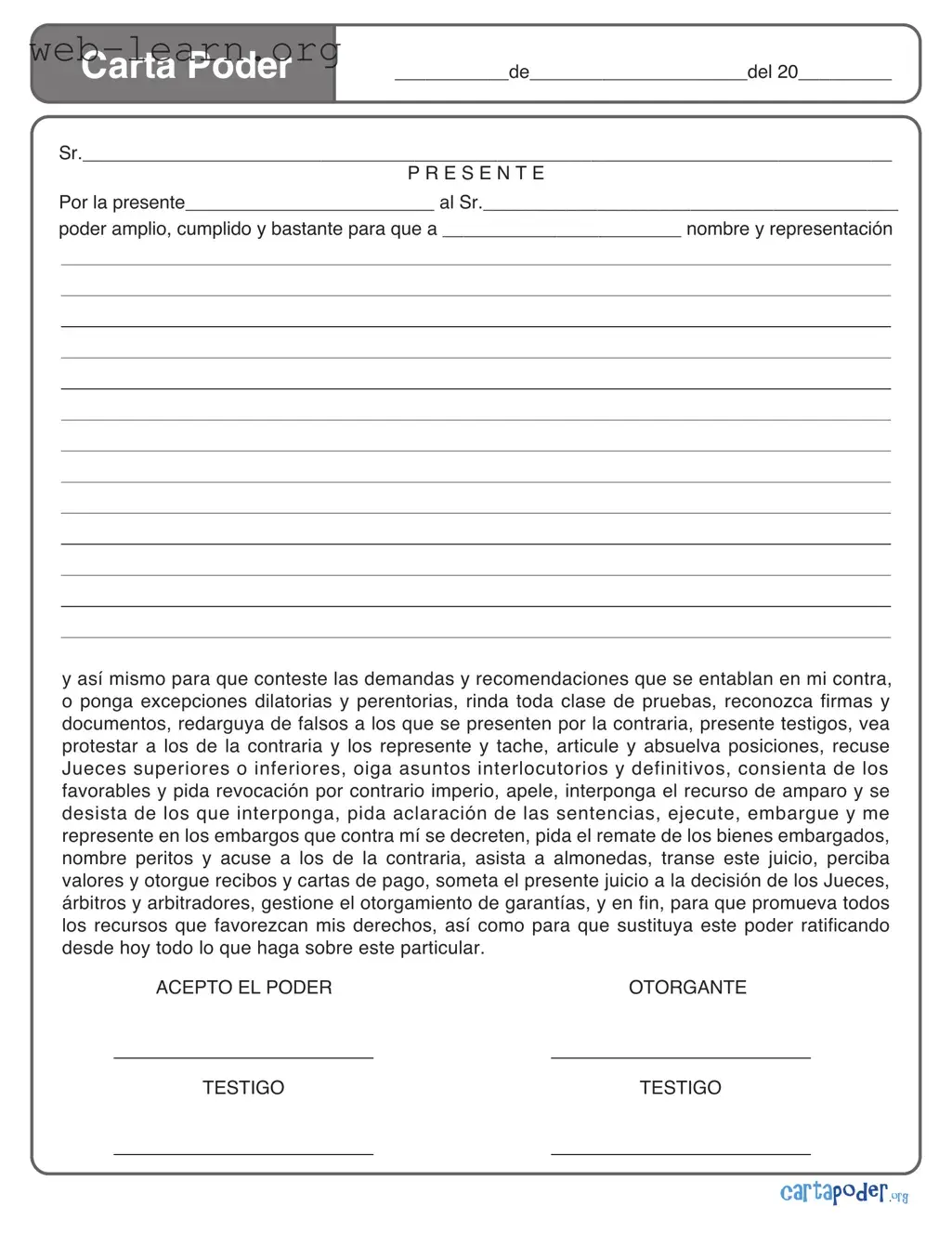
Carta Poder ___________de_____________________del 20_________
Sr.______________________________________________________________________________
P R E S E N T E
Por la presente________________________ al Sr.________________________________________
poder amplio, cumplido y bastante para que a _______________________ nombre y representación
y así mismo para que conteste las demandas y recomendaciones que se entablan en mi contra,
o ponga excepciones dilatorias y perentorias, rinda toda clase de pruebas, reconozca firmas y
documentos, redarguya de falsos a los que se presenten por la contraria, presente testigos, vea
protestar a los de la contraria y los represente y tache, articule y absuelva posiciones, recuse
Jueces superiores o inferiores, oiga asuntos interlocutorios y definitivos, consienta de los
favorables y pida revocación por contrario imperio, apele, interponga el recurso de amparo y se
desista de los que interponga, pida aclaración de las sentencias, ejecute, embargue y me
represente en los embargos que contra mí se decreten, pida el remate de los bienes embargados,
nombre peritos y acuse a los de la contraria, asista a almonedas, transe este juicio, perciba
valores y otorgue recibos y cartas de pago, someta el presente juicio a la decisión de los Jueces,
árbitros y arbitradores, gestione el otorgamiento de garantías, y en fin, para que promueva todos
los recursos que favorezcan mis derechos, así como para que sustituya este poder ratificando
desde hoy todo lo que haga sobre este particular.
ACEPTO EL PODER
TESTIGO TESTIGO
OTORGANTE

Form Information

Fact Name Details
Definition The Carta Poder is a legal document that grants someone the authority to act on behalf of another person in various matters.
Purpose This form allows the designated person to manage legal proceedings, represent the individual in court, and handle other legal responsibilities.
Governing Law The Carta Poder is governed by the laws of the state where it is executed. Each state may have specific requirements.
Signature Requirement The document must be signed by the person granting the power and may also require witnesses depending on state law.
Revocation The person who grants the power can revoke it at any time, as long as they follow the proper legal procedures.

Detailed Guide for Filling Out Carta Poder

After obtaining the Carta Poder form, the next step involves filling it out accurately. This document allows one person to grant another the authority to act on their behalf in legal matters. Follow the steps below to complete the form correctly.

  1. Write the date at the top of the form in the format: day of month of year.
  2. In the first blank line, enter your full name as the person granting the power.
  3. In the second blank line, write the name of the person receiving the power.
  4. In the next blank, specify the purpose for which you are granting this power, such as "to represent me in legal matters."
  5. Carefully read the list of powers being granted. Ensure that it aligns with what you intend to authorize.
  6. Sign the document at the bottom to indicate your acceptance of the powers being granted.
  7. Provide the names and signatures of two witnesses in the designated areas to validate the document.

Obtain Answers on Carta Poder

  1. What is a Carta Poder?

    A Carta Poder is a legal document that grants someone the authority to act on your behalf in various matters. This form is particularly useful in situations where you cannot be present to handle legal issues or transactions. By signing this document, you empower another person, often referred to as your "agent" or "attorney-in-fact," to represent you in legal proceedings, manage your affairs, and make decisions in your name.

  2. Who can I appoint as my agent using a Carta Poder?

    You can appoint any adult individual you trust as your agent. This person could be a family member, friend, or legal professional. It is crucial to choose someone who understands your wishes and can act in your best interest. Remember, the authority you grant is significant, so select someone responsible and reliable.

  3. What powers can I grant through a Carta Poder?

    The Carta Poder allows you to grant a wide range of powers to your agent. These may include:

    • Representing you in court or legal matters
    • Managing your financial affairs
    • Signing documents on your behalf
    • Making decisions regarding your property
    • Handling any legal disputes that may arise

    It's essential to clearly outline the specific powers you wish to grant in the document to avoid any confusion later on.

  4. Is a Carta Poder legally binding?

    Yes, a Carta Poder is a legally binding document, provided it is executed correctly. For it to be valid, it typically needs to be signed by you and may require witnesses or notarization, depending on your state’s laws. Always check local regulations to ensure compliance. Once executed, your agent can act within the scope of the powers you have granted, making it crucial to understand the implications of this document.

Common mistakes

Filling out the Carta Poder form can be straightforward, but there are common mistakes that people often make. These errors can lead to confusion or even invalidate the document. Here are five mistakes to watch out for.

First, many individuals forget to include their full name and identification details. This information is crucial as it identifies the person granting the power. Without these details, the document may not be recognized legally. Always double-check that your name is spelled correctly and that you provide any necessary identification numbers.

Second, people often neglect to specify the exact powers being granted. The form includes a section for detailing the authority given to the representative. Leaving this blank or using vague language can create ambiguity about what the representative is allowed to do. Be specific about the powers you want to grant.

Another common mistake is failing to sign the form. While it may seem obvious, some individuals overlook this step. A signature is essential for the document to be valid. Ensure that all necessary parties sign the form where indicated, and consider having witnesses if required.

Additionally, many individuals do not date the document correctly. The date is important as it establishes when the power of attorney takes effect. Make sure to fill in the date clearly and accurately to avoid any potential issues later on.

Lastly, people sometimes forget to keep a copy of the completed form. After filling it out, it’s wise to make copies for your records. This can be helpful if any disputes arise or if you need to reference the document in the future. Keeping a copy ensures that you have access to the details of the powers granted.

Documents used along the form

The Carta Poder form is an important document that grants someone the authority to act on your behalf in various legal matters. When using this form, several other documents may also be required to ensure that the process runs smoothly. Below is a list of these commonly used forms and documents.

  • Power of Attorney (POA): This document allows an individual to appoint another person to make decisions on their behalf, typically in financial or medical matters.
  • Affidavit: A written statement confirmed by oath or affirmation, used as evidence in court. It often supports claims made in legal proceedings.
  • Notice of Representation: This document informs relevant parties that someone is representing another individual in legal matters, ensuring all communications are directed appropriately.
  • Client Agreement: A contract between a lawyer and a client that outlines the terms of the legal representation, including fees and services provided.
  • Legal Complaint: A formal document filed with the court that initiates a lawsuit. It outlines the plaintiff's claims and the relief sought.
  • Summons: A document issued by the court that notifies a defendant that they are being sued and provides instructions on how to respond.
  • Settlement Agreement: A contract that outlines the terms of a settlement between parties, resolving a dispute without going to trial.
  • Release of Liability: A document that releases one party from liability for certain actions, often used in settlements or agreements to protect against future claims.

Understanding these documents can help in navigating legal processes more effectively. Each plays a crucial role in ensuring that your rights and interests are protected throughout any legal proceedings.

Similar forms

The Carta Poder form is a legal document that grants authority to another person to act on your behalf. It has similarities with several other documents. Here are five documents that share characteristics with the Carta Poder:

  • Power of Attorney (POA): Like the Carta Poder, a Power of Attorney allows someone to make decisions and take actions on behalf of another person. It can cover a wide range of matters, from financial to legal issues.
  • Durable Power of Attorney: This document remains effective even if the person granting it becomes incapacitated. Similar to the Carta Poder, it empowers someone to act in various situations, ensuring that the grantor's wishes are respected.
  • Healthcare Proxy: A healthcare proxy designates someone to make medical decisions for another person. While it focuses specifically on health-related matters, it shares the same principle of granting authority as the Carta Poder.
  • Letter of Authorization: This document allows someone to perform specific tasks on behalf of another, such as accessing bank accounts or managing property. Like the Carta Poder, it provides a clear outline of the powers granted.
  • Agency Agreement: An agency agreement establishes a relationship where one party acts on behalf of another. It often details the scope of authority, similar to how the Carta Poder specifies the powers granted to the representative.

Dos and Don'ts

When filling out the Carta Poder form, there are important dos and don’ts to keep in mind. Here’s a straightforward list to guide you:

  • Do ensure that all names and details are accurate and clearly written.
  • Do specify the exact powers you are granting to the representative.
  • Do sign the form in the presence of witnesses to validate the document.
  • Do keep a copy of the completed form for your records.
  • Don’t leave any sections blank; incomplete forms may be rejected.
  • Don’t use vague language; be specific about the powers you are granting.
  • Don’t forget to date the form correctly.
  • Don’t rush through the process; take your time to ensure everything is correct.

Misconceptions

Understanding the Carta Poder form can be challenging due to various misconceptions. Below is a list of ten common misunderstandings about this legal document, along with explanations to clarify each point.

  1. It is only used in Mexico. Many people believe that the Carta Poder is exclusive to Mexico. However, similar forms exist in various countries, including the United States, where they serve a comparable purpose in granting authority.
  2. It can only be used for legal matters. While the Carta Poder is often associated with legal representation, it can also be used for financial transactions, property management, and other personal affairs.
  3. It must be notarized. Some think that a Carta Poder must always be notarized to be valid. In many cases, a simple signature from the grantor is sufficient, although notarization can provide additional legal weight.
  4. It is a permanent document. Many assume that once a Carta Poder is issued, it cannot be revoked. In reality, the grantor can revoke the power at any time, as long as they follow the proper procedures.
  5. It grants unlimited power. A common misconception is that the Carta Poder gives the agent unlimited authority. The document should specify the extent of the powers granted, and any limitations can be included.
  6. It is only for individuals. Some people think that only individuals can issue a Carta Poder. In fact, businesses and organizations can also use this form to designate representatives.
  7. It requires multiple witnesses. There is a belief that a Carta Poder needs several witnesses to be valid. Typically, one or two witnesses are sufficient, depending on the jurisdiction.
  8. It is the same as a power of attorney. While a Carta Poder and a power of attorney serve similar functions, they are not identical. The terminology and specific legal implications may differ based on local laws.
  9. It can only be used for one specific purpose. Some think that a Carta Poder can only be issued for a single transaction or task. In reality, it can cover multiple actions, as long as they are outlined in the document.
  10. It is difficult to create. Many believe that drafting a Carta Poder is a complicated process. In truth, it can be straightforward, especially when using templates or seeking assistance from legal professionals.

By addressing these misconceptions, individuals can better understand the Carta Poder form and its applications in various contexts.

Key takeaways

Here are key takeaways for filling out and using the Carta Poder form:

  1. The form must be filled out completely, including the names and dates.
  2. Clearly identify the person granting the power and the person receiving it.
  3. Specify the extent of the powers being granted; be detailed to avoid confusion.
  4. Ensure that the document is signed by both the grantor and two witnesses.
  5. The date of the document is crucial; it must be accurate and complete.
  6. Keep a copy of the completed form for your records.
  7. Understand that the Carta Poder allows the representative to act on your behalf in legal matters.
  8. Review the document periodically to ensure it reflects your current intentions.
  9. Consult a legal professional if you have questions about the powers being granted.

Using the Carta Poder form correctly can streamline legal processes and ensure your interests are represented effectively.