Homepage Blank Caregiver Daily Log Form
Outline

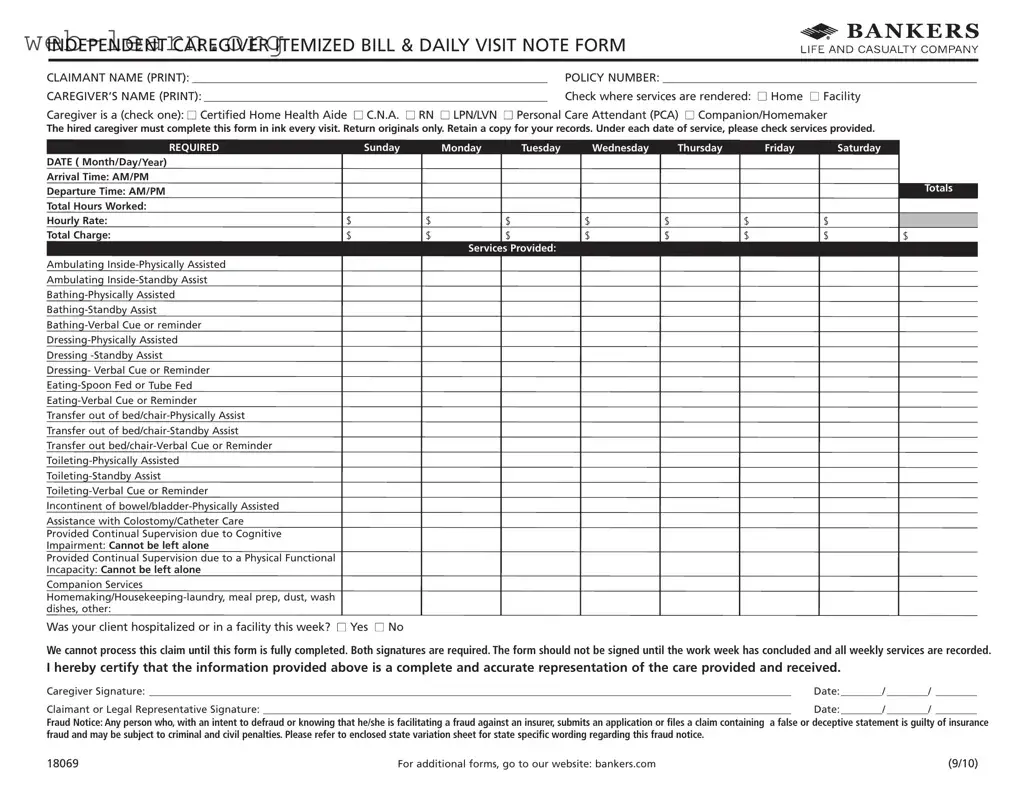
The Caregiver Daily Log form serves as an essential tool for documenting the services provided by caregivers to their clients. This form captures vital information such as the caregiver's name, the policy number, and the claimant's name, ensuring that all parties involved have a clear record of care. It requires caregivers to check the location of service, whether it be at home or in a facility, and to identify their qualifications, such as Certified Home Health Aide or RN. Each visit necessitates the completion of this form in ink, with caregivers instructed to retain a copy for their records. The log includes a detailed breakdown of services rendered, including assistance with bathing, dressing, and toileting, as well as supervision for clients with cognitive impairments. Caregivers must document the date of service, arrival and departure times, total hours worked, and the corresponding charges. A section also inquires whether the client was hospitalized during the week, which is critical for processing claims. Both the caregiver and the claimant or legal representative must sign the form to certify that the information is accurate and complete, underscoring the importance of honesty in the caregiving process. Lastly, a fraud notice alerts users to the serious implications of submitting false information, reinforcing the integrity of the claims process.
Sample - Caregiver Daily Log Form

INDEPENDENT CAREGIVER ITEMIZED BILL & DAILY VISIT NOTE FORM
REQUIRED Sunday Monday Tuesday Wednesday
Thursday Friday
Saturday
DATE ( Month/Day/Year)
Arrival Time: AM/PM
Departure Time: AM/PM
Totals
Total Hours Worked:
Hourly Rate: $ $ $ $ $ $ $
Total Charge:
$ $
$ $ $ $ $ $
Services Provided:
Ambulating Inside-Physically Assisted
Ambulating Inside-Standby Assist
Bathing-Physically Assisted
Bathing-Standby Assist
Bathing-Verbal Cue or reminder
Dressing-Physically Assisted
Dressing -Standby Assist
Dressing- Verbal Cue or Reminder
Eating-Spoon Fed or Tube Fed
Eating-Verbal Cue or Reminder
Transfer out of bed/chair-Physically Assist
Transfer out of bed/chair-Standby Assist
Transfer out bed/chair-Verbal Cue or Reminder
Toileting-Physically Assisted
Toileting-Standby Assist
Toileting-Verbal Cue or Reminder
Incontinent of bowel/bladder-Physically Assisted
Assistance with Colostomy/Catheter Care
Provided Continual Supervision due to Cognitive
Impairment: Cannot be left alone
Provided Continual Supervision due to a Physical Functional
Incapacity: Cannot be left alone
Companion Services
Homemaking/Housekeeping-laundry, meal prep, dust, wash
dishes, other:
CLAIMANT NAME (PRINT): _____________________________________________________________ POLICY NUMBER: ______________________________________________________
CAREGIVER’S NAME (PRINT): ___________________________________________________________ Check where services are rendered:
n
Home
n
Facility
Caregiver is a (check one):
n
Certified Home Health Aide
n
C.N.A.
n
RN
n
LPN/LVN
n
Personal Care Attendant (PCA)
n
Companion/Homemaker
The hired caregiver must complete this form in ink every visit. Return originals only. Retain a copy for your records. Under each date of service, please check services provided.
Was your client hospitalized or in a facility this week?
n
Yes
n
No
We cannot process this claim until this form is fully completed. Both signatures are required. The form should not be signed until the work week has concluded and all weekly services are recorded.
I hereby certify that the information provided above is a complete and accurate representation of the care provided and received.
Caregiver Signature: ____________________________________________________________________________________________________________________________ Date:________/ ________/ ________
Claimant or Legal Representative Signature: ______________________________________________________________________________________________________ Date:________/ ________/ ________
Fraud Notice: Any person who, with an intent to defraud or knowing that he/she is facilitating a fraud against an insurer, submits an application or files a claim containing a false or deceptive statement is guilty of insurance
fraud and may be subject to criminal and civil penalties. Please refer to enclosed state variation sheet for state specific wording regarding this fraud notice.
18069 For additional forms, go to our website: bankers.com (9/10)

Form Information

Fact Name Details
Purpose of the Form The Caregiver Daily Log form is designed to document the services provided by caregivers to clients, ensuring accurate billing and care tracking.
Required Signatures Both the caregiver and the claimant or legal representative must sign the form. This requirement ensures accountability and verifies that the information is accurate.
Services Documentation Caregivers must check off the specific services provided during each visit. This detailed documentation helps in assessing the care delivered and in processing claims.
Completion Guidelines The form must be completed in ink and returned as an original. Caregivers are advised to retain a copy for their records, which is crucial for personal documentation.
Fraud Notice The form includes a fraud notice, warning that submitting false information can lead to criminal and civil penalties. This notice serves to protect both insurers and caregivers.

Detailed Guide for Filling Out Caregiver Daily Log

Completing the Caregiver Daily Log form accurately is essential for ensuring that all services provided are documented and that claims can be processed smoothly. Follow the steps outlined below to fill out the form correctly.

  1. Claimant Information: In the designated area, print the claimant's name clearly.
  2. Policy Number: Write the policy number associated with the claimant.
  3. Caregiver’s Name: Print your name as the caregiver in the provided space.
  4. Service Location: Check the box indicating where the services were rendered: either "Home" or "Facility."
  5. Caregiver Type: Mark the appropriate box to indicate your role (e.g., Certified Home Health Aide, RN, etc.).
  6. Date of Service: Under the "REQUIRED DATE" section, fill in the date of service using the Month/Day/Year format.
  7. Arrival and Departure Times: Record the arrival and departure times using AM/PM notation.
  8. Total Hours Worked: Calculate and write down the total hours worked for that day.
  9. Hourly Rate: Enter the hourly rate for your services.
  10. Total Charge: Multiply the total hours worked by the hourly rate and write the total charge.
  11. Service Checkboxes: Under each day of the week, check all services provided to the client.
  12. Hospitalization Status: Indicate whether the client was hospitalized or in a facility during the week by checking "Yes" or "No."
  13. Signatures: At the end of the form, both the caregiver and the claimant or legal representative must sign and date the form. Ensure that the form is signed only after all services for the week have been recorded.

Once completed, retain a copy for your records and return the original form as instructed. This ensures that all details are accurately documented for processing claims.

Obtain Answers on Caregiver Daily Log

  1. What is the purpose of the Caregiver Daily Log form?

    The Caregiver Daily Log form is designed to document the services provided by caregivers to individuals receiving care. It serves as an official record of the caregiver's activities during each visit, including the types of services rendered, the time spent, and the total charges incurred. This form is essential for ensuring accurate billing and for maintaining transparency between caregivers, clients, and insurance providers.

  2. Who is required to complete the Caregiver Daily Log form?

    The caregiver hired to provide services must complete the Caregiver Daily Log form. This includes a variety of professionals, such as Certified Home Health Aides, CNAs, RNs, LPNs/LVNs, Personal Care Attendants, and Companions/Homemakers. Each caregiver is responsible for accurately filling out the form in ink after every visit to ensure that all relevant details are captured.

  3. What information needs to be included on the form?

    The Caregiver Daily Log form requires several key pieces of information:

    • Claimant's name and policy number
    • Caregiver's name and type of caregiver
    • Date of service, arrival and departure times, total hours worked, hourly rate, and total charge
    • Checkboxes for services provided, such as bathing, dressing, toileting, and supervision
    • Confirmation of whether the client was hospitalized or in a facility during the week
    • Signatures of both the caregiver and the claimant or legal representative

    Completing all sections of the form is crucial for processing claims accurately and efficiently.

  4. What happens if the form is not completed correctly?

    If the Caregiver Daily Log form is not filled out completely or accurately, it may delay the processing of claims. Insurance providers require that all sections are properly completed before they can approve any reimbursements. Incomplete forms can lead to additional requests for information, which can prolong the payment process. Therefore, it is vital for caregivers to double-check their entries and ensure that both signatures are present before submitting the form.

Common mistakes

Completing the Caregiver Daily Log form accurately is essential for ensuring proper processing of claims. However, several common mistakes can lead to delays or denials. Awareness of these errors can help caregivers submit a complete and correct form.

One frequent mistake is failing to fill out the claimant name and policy number sections. These details are crucial for identifying the client and verifying coverage. Omitting this information can result in significant delays in processing the claim.

Another common error is not signing the form. Both the caregiver and the claimant or legal representative must sign the document. Without these signatures, the form is incomplete and cannot be processed. Caregivers should ensure that signatures are obtained only after all services for the week have been recorded.

Inaccurate recording of service dates is also a prevalent mistake. Each date of service must be clearly indicated in the required format (Month/Day/Year). Errors in this section can lead to confusion regarding the days services were provided.

Caregivers often overlook the arrival and departure times. These times must be documented accurately to calculate total hours worked. If this information is missing or incorrect, it can affect the total charge and cause issues with payment.

Another mistake is not checking the appropriate services provided. Each service rendered during the visit should be marked clearly. Failing to do so can lead to underreporting of care provided, which may impact reimbursement.

Caregivers sometimes forget to include the hourly rate and total charge. This information is necessary for calculating the payment due. Without it, the claim may be rejected or delayed.

Another error occurs when caregivers do not retain a copy of the completed form. Keeping a copy is essential for record-keeping and can be helpful if questions arise about the claim later.

Additionally, caregivers may neglect to indicate whether the client was hospitalized or in a facility during the week. This information is important for the insurance company to understand the context of the care provided.

Lastly, caregivers sometimes submit the form without reviewing it for accuracy. Taking a moment to double-check all entries can prevent mistakes that may lead to delays or denials. Thoroughness is key to ensuring a smooth claims process.

Documents used along the form

The Caregiver Daily Log form is essential for documenting the services provided by caregivers. However, several other forms and documents may accompany it to ensure a comprehensive record of care. Below is a list of these related documents, each serving a specific purpose in the caregiving process.

  • Independent Caregiver Itemized Bill: This document details the charges for services rendered by the caregiver. It includes the total hours worked, hourly rate, and total charges for the billing period.
  • Service Agreement: A written contract between the caregiver and the client or their family. It outlines the terms of service, including the scope of care, payment terms, and responsibilities of both parties.
  • Client Intake Form: This form collects essential information about the client, including medical history, care needs, and emergency contacts. It helps caregivers understand the specific requirements of the individual they are assisting.
  • Medication Administration Record (MAR): A log that tracks the medications administered to the client. It includes details such as dosage, frequency, and any adverse reactions, ensuring proper medication management.
  • Incident Report: Used to document any accidents or unusual occurrences during caregiving. This form helps maintain safety standards and provides a record for future reference or legal purposes.
  • Care Plan: A comprehensive document that outlines the client’s care needs and goals. It serves as a guide for caregivers to provide consistent and effective care tailored to the client's specific situation.
  • Time Sheet: A record of hours worked by the caregiver, including arrival and departure times. This document helps ensure accurate billing and compliance with labor regulations.

These documents work together to create a clear picture of the caregiving process, ensuring that all parties involved have a thorough understanding of the services provided and the needs of the client. Keeping accurate records is crucial for effective communication and quality care.

Similar forms

The Caregiver Daily Log form serves a specific purpose in documenting the services provided by caregivers. However, there are several other documents that share similar characteristics in terms of structure and function. Here are seven documents that are comparable:

  • Home Health Aide Service Log: This document tracks the daily activities and services provided by a home health aide. Like the Caregiver Daily Log, it includes sections for dates, times, and specific services rendered, ensuring accurate record-keeping for billing and care assessment.
  • Patient Care Record: A Patient Care Record is used to document ongoing patient care in various settings. Similar to the Caregiver Daily Log, it captures essential information about services provided, times, and caregiver signatures to confirm the accuracy of the information.
  • Daily Activity Log for Personal Care Assistants: This log is designed for personal care assistants to record daily activities and assistance given to clients. It includes details about services, arrival and departure times, mirroring the structure of the Caregiver Daily Log.
  • In-Home Care Service Agreement: This document outlines the terms and conditions of care services. While it serves a different purpose, it shares a focus on documenting the services to be provided and the responsibilities of the caregiver, similar to the daily log.
  • Medication Administration Record (MAR): The MAR is used to track medications given to patients. Like the Caregiver Daily Log, it requires precise documentation of dates, times, and signatures to ensure accountability and accuracy in care.
  • Weekly Care Summary Report: This report provides an overview of care provided over a week. It includes summaries of daily activities, much like the Caregiver Daily Log, but offers a broader perspective on the care experience.
  • Client Progress Notes: These notes document the progress and changes in a client's condition. They often include details about the services provided, similar to the Caregiver Daily Log, and are essential for ongoing assessment and care planning.

Dos and Don'ts

When filling out the Caregiver Daily Log form, attention to detail is crucial. Here are five important do's and don'ts to keep in mind:

  • Do fill out the form in ink to ensure clarity and permanence.
  • Do check the appropriate boxes to indicate the services provided during each visit.
  • Do record the arrival and departure times accurately to reflect the total hours worked.
  • Do retain a copy of the completed form for your records before submitting the original.
  • Do ensure both signatures are obtained at the end of the work week, after all services have been documented.
  • Don't forget to complete all sections of the form, as incomplete forms may delay processing.
  • Don't sign the form until all services for the week are recorded, as this can lead to inaccuracies.
  • Don't use pencil or erasable ink, as these can lead to legibility issues.
  • Don't provide false information, as this can result in serious legal consequences.
  • Don't submit the form without ensuring that the fraud notice has been acknowledged.

Misconceptions

Misconceptions about the Caregiver Daily Log form can lead to confusion and potential issues in processing claims. Here are five common misunderstandings:

  • It’s Optional to Complete the Form: Many believe that filling out the Caregiver Daily Log form is optional. In reality, it is a required document that must be completed for each visit to ensure proper billing and record-keeping.
  • Any Writing Tool is Acceptable: Some caregivers think they can use any pen or pencil to fill out the form. However, the form must be completed in ink to ensure that the information is clear and permanent.
  • Only One Signature is Needed: A common misconception is that only the caregiver’s signature is necessary. Both the caregiver and the claimant or legal representative must sign the form to validate the services rendered.
  • It Can Be Signed Before the Week Ends: Many caregivers assume they can sign the form at any time. The form should only be signed after the work week has concluded, ensuring that all services provided are accurately recorded.
  • All Services Provided are Automatically Covered: Some caregivers believe that all services listed on the form will be reimbursed without question. It’s important to note that claims will only be processed if the form is fully completed and accurately reflects the care provided.

Understanding these misconceptions can help caregivers navigate the claims process more effectively, ensuring that they receive timely and accurate compensation for their services.

Key takeaways

Filling out the Caregiver Daily Log form accurately is essential for ensuring that caregivers receive proper compensation for their services. Here are some key takeaways to consider:

  • The form must be completed in ink during each visit to maintain clarity and prevent alterations.
  • It is crucial to retain a copy of the completed form for your records before submitting the originals.
  • Clearly indicate the date of service, arrival and departure times, total hours worked, and the hourly rate.
  • Check all services provided under the appropriate date to give a comprehensive overview of care rendered.
  • Both the caregiver and the claimant must sign the form to validate the information provided.
  • Do not sign the form until the entire week of services has concluded to ensure accuracy.
  • Be aware that the claim cannot be processed until the form is fully completed, including all required signatures.
  • Understand the fraud notice included on the form, which highlights the seriousness of submitting false information.

By following these guidelines, caregivers can help ensure a smooth process for billing and reimbursement, ultimately supporting the well-being of those they care for.