Homepage Blank Car Show Judging Form
Outline

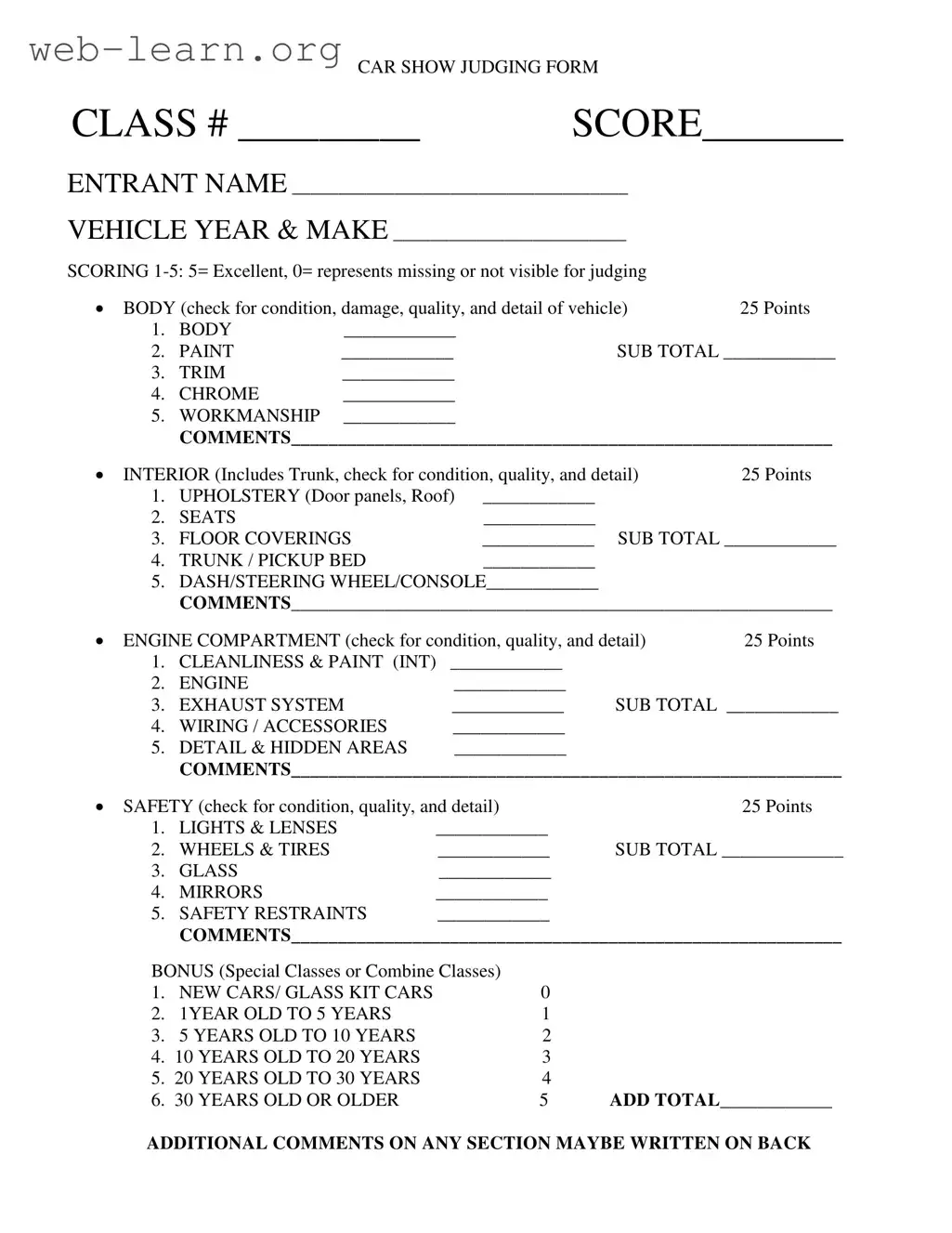
The Car Show Judging Form serves as a comprehensive tool for evaluating vehicles at car shows, ensuring a fair and organized judging process. This form is divided into several key sections, each focusing on different aspects of the vehicle. Judges assess the body, interior, engine compartment, and safety features, with each category allowing for a maximum score of 25 points. Specific criteria within these sections include the condition and detail of the bodywork, the quality of upholstery, and the cleanliness of the engine compartment. Additionally, safety checks cover lights, tires, and mirrors. Each section includes space for comments, allowing judges to provide feedback on their evaluations. A bonus scoring section rewards vehicles based on their age, recognizing the unique qualities of newer and classic cars alike. This structured approach not only facilitates a thorough assessment but also enhances the overall experience for both participants and judges.

Sample - Car Show Judging Form

CAR SHOW JUDGING FORM
CLASS # _________ SCORE_______
ENTRANT NAME ____________________________________
VEHICLE YEAR & MAKE _________________________
SCORING 1-5: 5= Excellent, 0= represents missing or not visible for judging
BODY (check for condition, damage, quality, and detail of vehicle) 25 Points
1. BODY ____________
2. PAINT ____________ SUB TOTAL ____________
3. TRIM ____________
4. CHROME ____________
5. WORKMANSHIP ____________
COMMENTS__________________________________________________________
INTERIOR (Includes Trunk, check for condition, quality, and detail) 25 Points
1. UPHOLSTERY (Door panels, Roof) ____________
2. SEATS ____________
3. FLOOR COVERINGS ____________ SUB TOTAL ____________
4. TRUNK / PICKUP BED ____________
5. DASH/STEERING WHEEL/CONSOLE____________
COMMENTS__________________________________________________________
ENGINE COMPARTMENT (check for condition, quality, and detail) 25 Points
1. CLEANLINESS & PAINT (INT) ____________
2. ENGINE ____________
3. EXHAUST SYSTEM ____________ SUB TOTAL ____________
4. WIRING / ACCESSORIES ____________
5. DETAIL & HIDDEN AREAS ____________
COMMENTS___________________________________________________________
SAFETY (check for condition, quality, and detail) 25 Points
1. LIGHTS & LENSES ____________
2. WHEELS & TIRES ____________ SUB TOTAL _____________
3. GLASS ____________
4. MIRRORS ____________
5. SAFETY RESTRAINTS ____________
COMMENTS___________________________________________________________
BONUS (Special Classes or Combine Classes)
1. NEW CARS/ GLASS KIT CARS 0
2. 1YEAR OLD TO 5 YEARS 1
3. 5 YEARS OLD TO 10 YEARS 2
4. 10 YEARS OLD TO 20 YEARS 3
5. 20 YEARS OLD TO 30 YEARS 4
6. 30 YEARS OLD OR OLDER 5 ADD TOTAL____________
ADDITIONAL COMMENTS ON ANY SECTION MAYBE WRITTEN ON BACK

Form Information

Fact Name Details
Judging Criteria The Car Show Judging Form evaluates vehicles based on four main categories: Body, Interior, Engine Compartment, and Safety, each worth 25 points.
Scoring System Judges score each category on a scale from 0 to 5, with 5 indicating excellence and 0 indicating that a feature is missing or not visible.
Bonus Points Additional points can be earned based on the age of the vehicle, with specific categories for new cars and those over 30 years old.
Comments Section Each category includes a comments section where judges can provide feedback or notes about the vehicle's condition and quality.
Entrant Information The form requires detailed information about the entrant, including name, vehicle year, and make, to ensure accurate identification.
State-Specific Forms Some states may have specific laws governing car shows, including safety standards and vehicle eligibility criteria. Always check local regulations.

Detailed Guide for Filling Out Car Show Judging

Completing the Car Show Judging form requires attention to detail and a systematic approach. Each section of the form focuses on different aspects of the vehicle being judged. Accurate scoring and comments will help ensure a fair evaluation.

  1. Locate the CLASS # section at the top of the form and enter the appropriate class number.
  2. Fill in the SCORE section with the total score you assign to the vehicle.
  3. In the ENTRANT NAME field, write the name of the vehicle owner or entrant.
  4. In the VEHICLE YEAR & MAKE field, specify the year and make of the vehicle.
  5. For the BODY section, evaluate each item and enter scores from 0 to 5:
    • BODY
    • PAINT
    • TRIM
    • CHROME
    • WORKMANSHIP
  6. Calculate the SUB TOTAL for the BODY section and write it in the provided space.
  7. In the INTERIOR section, score the following items:
    • UPHOLSTERY (Door panels, Roof)
    • SEATS
    • FLOOR COVERINGS
    • TRUNK / PICKUP BED
    • DASH/STEERING WHEEL/CONSOLE
  8. Calculate the SUB TOTAL for the INTERIOR section and write it down.
  9. In the ENGINE COMPARTMENT section, evaluate and score the following:
    • CLEANLINESS & PAINT (INT)
    • ENGINE
    • EXHAUST SYSTEM
    • WIRING / ACCESSORIES
    • DETAIL & HIDDEN AREAS
  10. Calculate the SUB TOTAL for the ENGINE COMPARTMENT section and enter it.
  11. For the SAFETY section, score the following items:
    • LIGHTS & LENSES
    • WHEELS & TIRES
    • GLASS
    • MIRRORS
    • SAFETY RESTRAINTS
  12. Calculate the SUB TOTAL for the SAFETY section and write it in the designated area.
  13. Review the BONUS section and assign points based on the age of the vehicle:
    • NEW CARS/ GLASS KIT CARS: 0
    • 1 YEAR OLD TO 5 YEARS: 1
    • 5 YEARS OLD TO 10 YEARS: 2
    • 10 YEARS OLD TO 20 YEARS: 3
    • 20 YEARS OLD TO 30 YEARS: 4
    • 30 YEARS OLD OR OLDER: 5
  14. Add the total from the BONUS section to the overall score.
  15. Provide any ADDITIONAL COMMENTS on the back of the form if necessary.

Obtain Answers on Car Show Judging

  1. What is the purpose of the Car Show Judging Form?

    The Car Show Judging Form is designed to evaluate and score vehicles based on specific criteria. Judges assess the body, interior, engine compartment, and safety features of each vehicle. This structured approach ensures a fair and consistent judging process for all entrants.

  2. How are points awarded on the judging form?

    Points are awarded on a scale from 0 to 5 for each category. A score of 5 indicates excellence, while a score of 0 means the feature was missing or not visible for judging. Each main category, including body, interior, engine compartment, and safety, has a maximum score of 25 points, allowing for a comprehensive assessment of the vehicle.

  3. What categories are included in the judging process?

    • Body
    • Interior
    • Engine Compartment
    • Safety

    Each category includes specific criteria that judges must evaluate. For example, the body section looks at condition, damage, and workmanship, while the interior section assesses upholstery and cleanliness.

  4. Can judges provide additional comments?

    Yes, judges can write additional comments on the back of the judging form. This section allows for personalized feedback and insights that may not fit into the scoring criteria, enhancing the overall evaluation of the vehicle.

  5. What are the bonus points for?

    Bonus points are awarded for special classes or for vehicles based on their age. For instance, new cars and glass kit cars receive no bonus points, while vehicles older than 30 years can earn up to 5 bonus points. This encourages participation from a diverse range of vehicles.

  6. How is the total score calculated?

    The total score is calculated by adding the scores from each category along with any bonus points. Judges will tally the points from the body, interior, engine compartment, and safety sections, then add the bonus points to arrive at a final score. This score determines the vehicle's standing in the competition.

Common mistakes

Filling out the Car Show Judging form can be an exciting yet challenging task. Many entrants want to showcase their vehicles in the best light possible, but mistakes can happen. One common error is neglecting to fill in the class number and score at the top of the form. These details are crucial for organizing and evaluating each entry properly. Without them, judges may struggle to keep track of the vehicles, leading to confusion during the judging process.

Another frequent mistake is not providing the complete entrant name. This information is vital for identifying the owner of the vehicle. An incomplete name can result in miscommunication and may even affect the overall scoring. It's important to double-check that all fields are filled out clearly and accurately.

Many entrants also overlook the vehicle year and make. This detail helps judges understand the context of the vehicle's condition and modifications. Without this information, judges may not be able to assess the vehicle fairly, which could impact the scoring.

When it comes to the scoring sections, some people may forget to include a subtotal for each category. Each section has a maximum of 25 points, and failing to provide a subtotal can lead to errors in the final score. It's essential to calculate and write down these subtotals to ensure a smooth judging process.

Another common issue is providing vague or insufficient comments in the designated areas. Comments are an opportunity for judges to understand the nuances of each vehicle. If comments are too brief or unclear, judges may miss important details that could influence their scoring decisions.

Entrants sometimes misinterpret the scoring system. For example, they may give a high score for a category that clearly does not meet the criteria for that score. Understanding that a score of 5 indicates excellence while a score of 0 signifies missing or unjudged elements is crucial. Misunderstanding this can lead to inflated scores that do not accurately reflect the vehicle's condition.

Additionally, failing to check the bonus section can be a missed opportunity for extra points. Each vehicle may qualify for additional points based on its age and category. Not taking advantage of this section can mean a lower overall score than deserved.

Finally, some entrants forget to utilize the back of the form for additional comments. This space can be invaluable for providing context or details that may not fit within the standard sections. Taking the time to elaborate can enhance the judges' understanding and appreciation of the vehicle.

Documents used along the form

When organizing a car show, several forms and documents can enhance the experience for both participants and judges. Each of these documents serves a unique purpose, helping to streamline the judging process and ensure everything runs smoothly. Here’s a brief overview of some key forms you might need alongside the Car Show Judging Form.

  • Participant Registration Form: This form collects essential information from entrants, including their name, contact details, and vehicle specifications. It helps organizers keep track of all participants and ensures that each vehicle is properly accounted for.
  • Event Schedule: A detailed schedule outlines the timing of various activities throughout the car show. This document helps participants and spectators know when to expect judging, awards, and other events, creating a seamless experience.
  • Judging Criteria Sheet: This sheet provides judges with a clear outline of the criteria they will use to evaluate vehicles. It ensures consistency in scoring and helps judges focus on the key aspects of each vehicle during the evaluation process.
  • Score Summary Sheet: After judging, this sheet compiles the scores from all judges for each vehicle. It allows for easy comparison and helps determine winners in various categories, ensuring transparency in the results.
  • Award Certificates: These certificates are presented to winners and participants, recognizing their achievements in the car show. They add a personal touch and serve as a keepsake for entrants to remember their experience.

Having these forms on hand can greatly enhance the organization of your car show. They contribute to a professional atmosphere and ensure that every participant feels valued and acknowledged. With the right documentation, you can focus on celebrating the passion for automobiles and the community that comes together to appreciate them.

Similar forms

The Car Show Judging form shares similarities with various other evaluation and scoring documents used in different contexts. Below is a list of ten such documents, highlighting their similarities.

  • Performance Evaluation Form: Both documents assess specific criteria to determine quality, such as condition and detail. Each uses a scoring system to quantify performance.
  • Event Scoring Sheet: Similar to the Car Show Judging form, this sheet evaluates participants based on predetermined categories, assigning scores to each aspect of performance.
  • Inspection Report: An inspection report checks for quality and compliance, much like the Car Show Judging form examines various aspects of a vehicle.
  • Quality Control Checklist: This checklist evaluates products against set standards. Like the judging form, it uses a point system to assess quality and condition.
  • Contest Judging Sheet: In contests, judges score participants based on specific criteria. This process mirrors the structured scoring found in the Car Show Judging form.
  • Project Evaluation Form: Both forms assess projects or entries based on defined criteria, including quality, detail, and overall performance.
  • Grading Rubric: A grading rubric outlines specific criteria for evaluation, similar to how the Car Show Judging form lists categories for scoring vehicles.
  • Product Review Template: This template evaluates items based on quality and features, akin to how the judging form assesses various components of a vehicle.
  • Customer Satisfaction Survey: Both documents gather feedback on specific attributes, using a scoring system to quantify satisfaction or quality.
  • Service Evaluation Form: This form rates the quality of service provided, similar to how the Car Show Judging form rates the quality of vehicle features and presentation.

Dos and Don'ts

Filling out the Car Show Judging form accurately is essential for ensuring a fair evaluation of each vehicle. Here are seven important dos and don’ts to keep in mind.

  • Do read the entire form carefully before starting to fill it out.
  • Do provide clear and legible information for all sections.
  • Do be honest about the condition of the vehicle; integrity matters.
  • Do use the scoring system as intended, understanding what each score represents.
  • Don’t leave any section blank; every area should be filled out to ensure complete judging.
  • Don’t rush through the form; take your time to provide accurate details.
  • Don’t forget to add any additional comments on the back of the form if necessary.

By following these guidelines, you can help ensure that your vehicle is judged fairly and accurately, reflecting its true value and condition.

Misconceptions

Misconceptions about the Car Show Judging form can lead to confusion among participants and judges alike. Here are eight common misunderstandings:

  • The scoring system is too complicated. Many believe that the scoring from 1 to 5 is complex. In reality, it is straightforward: 5 represents excellent condition, while 0 indicates something is missing or not visible for judging.
  • Only the exterior matters. Some think that only the body and paint are important. However, the form emphasizes the interior, engine compartment, and safety features equally.
  • Judges only consider the vehicle's age. While age can influence scoring, it is not the sole factor. Condition, quality, and detail are heavily weighted in the judging process.
  • Comments are optional. Many entrants assume that comments are not necessary. In fact, comments provide valuable insights that can enhance the judging experience.
  • All judges have the same criteria. Some participants think all judges will score the same way. Each judge may have their own perspective, but they will follow the same form to guide their evaluations.
  • Bonus points are guaranteed. It's a misconception that entrants will automatically receive bonus points. Bonus points are awarded based on specific criteria outlined in the form.
  • Judging is only about aesthetics. While appearance is important, the form also assesses functionality and safety features, which are crucial for a well-rounded evaluation.
  • Entrants can’t provide additional information. Some think that the form is all-inclusive. However, entrants can write additional comments on the back of the form to clarify or highlight specific aspects of their vehicle.

Key takeaways

When participating in a car show, understanding the judging form is essential for both entrants and judges. Here are some key takeaways for effectively filling out and using the Car Show Judging form:

  • Class Identification: Clearly write the class number on the form. This helps judges categorize vehicles accurately.
  • Entrant Information: Provide your name and vehicle details, including year and make, to ensure proper identification.
  • Scoring System: Familiarize yourself with the scoring scale of 0 to 5. A score of 5 indicates excellence, while a score of 0 means the item is missing or not visible.
  • Body Section: Assess the body condition, paint quality, trim, chrome, and workmanship. Each aspect contributes to the total score.
  • Interior Evaluation: Pay attention to upholstery, seats, floor coverings, trunk or pickup bed, and dashboard components for a comprehensive assessment.
  • Engine Compartment Check: Cleanliness, engine condition, exhaust system, wiring, and detail in hidden areas are crucial for a high score.
  • Safety Considerations: Evaluate lights, lenses, wheels, tires, glass, mirrors, and safety restraints to ensure the vehicle meets safety standards.
  • Bonus Points: Understand the bonus scoring for special classes or age categories. These can significantly impact your total score.

Additional comments can be made on the back of the form, allowing for further insights or observations. This can enhance the judging process and provide valuable feedback.