Homepage Blank Car Consignment Form
Outline

The Car Consignment form is a vital document that facilitates the sale of a vehicle through a consignment arrangement between two parties: the Consignor and the Consignee. The Consignor, typically the vehicle owner, entrusts the Consignee, often a dealership, with the responsibility of selling the vehicle on their behalf. This agreement outlines essential details such as the vehicle's make, model, and condition, as well as the minimum selling price and the commission structure for the sale. It also specifies the duration of the consignment period, during which the Consignee must maintain the vehicle's title in the Consignor's name and ensure that appropriate insurance coverage is in place. Additionally, the form addresses critical aspects like any existing liens on the vehicle, the condition of the vehicle, and any necessary repairs that may arise during the consignment period. With clear terms regarding advertising costs, potential repairs, and the process for vehicle removal, the Car Consignment form serves as a comprehensive guide for both parties, ensuring transparency and protection throughout the consignment process.
Sample - Car Consignment Form

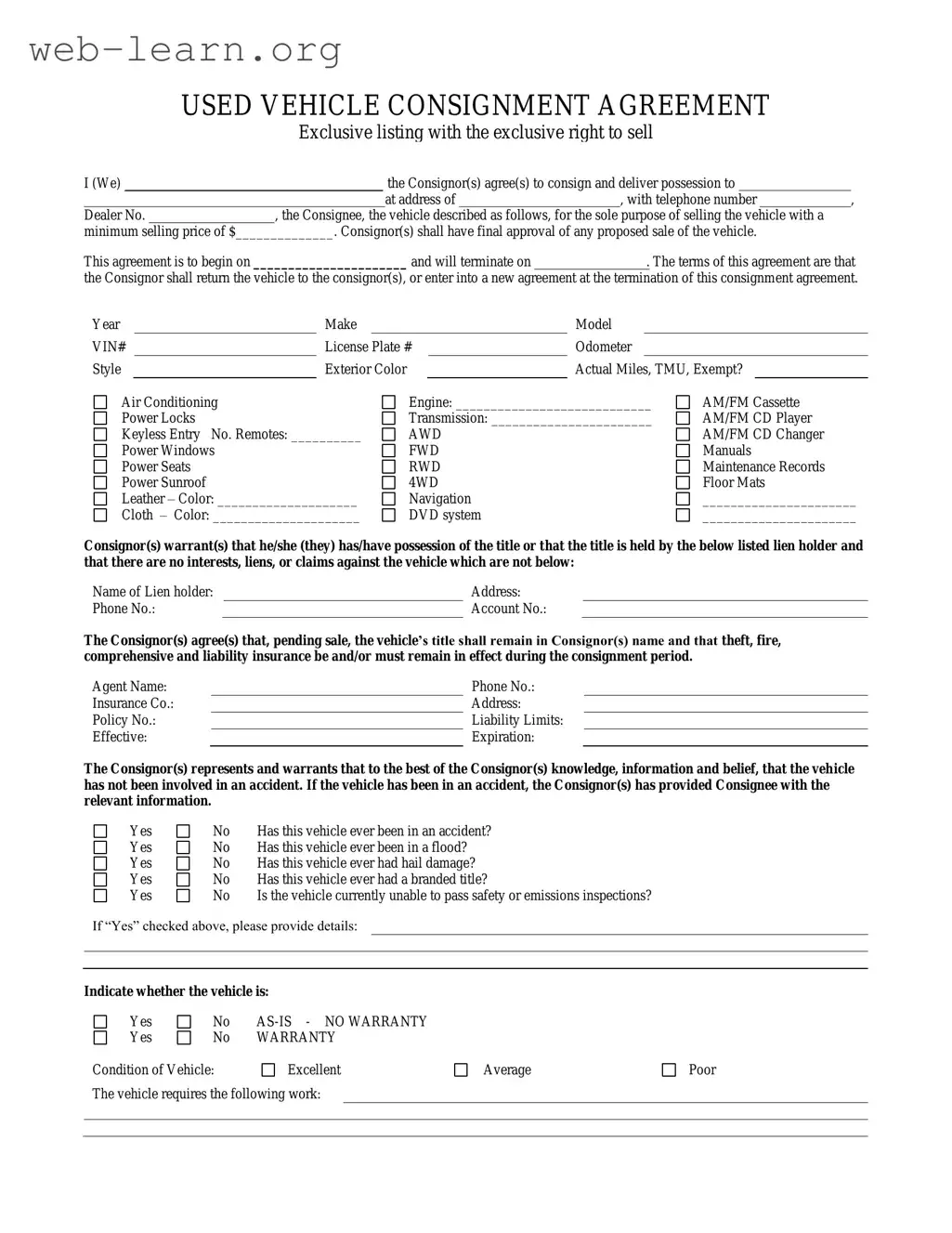
USED VEHICLE CONSIGNMENT AGREEMENT
Exclusive listing with the exclusive right to sell
I (We) _____________________________________ the Consignor(s) agree(s) to consign and deliver possession to ________________
___________________________________________at address of _______________________, with telephone number _____________,
Dealer No. __________________, the Consignee, the vehicle described as follows, for the sole purpose of selling the vehicle with a
minimum selling price of $______________. Consignor(s) shall have final approval of any proposed sale of the vehicle.
This agreement is to begin on ______________________ and will terminate on ________________. The terms of this agreement are that
the Consignor shall return the vehicle to the consignor(s), or enter into a new agreement at the termination of this consignment agreement.
Year
Make
Model
VIN#
License Plate #
Odometer
Style
Exterior Color
Actual Miles, TMU, Exempt?
Air Conditioning
Engine: ____________________________
AM/FM Cassette
Power Locks
Transmission: _______________________
AM/FM CD Player
Keyless Entry No. Remotes: __________
AWD
AM/FM CD Changer
Power Windows
FWD
Manuals
Power Seats
RWD
Maintenance Records
Power Sunroof
4WD
Floor Mats
Leather Color: ____________________
Navigation
Cloth Color: _____________________
DVD system
Consignor(s) warrant(s) that he/she (they) has/have possession of the title or that the title is held by the below listed lien holder and
that there are no interests, liens, or claims against the vehicle which are not below:
Name of Lien holder:
Address:
Phone No.:
Account No.:
The Consignor(s) agree(s) that, pending sale, the vehicle’s title shall remain in Consignor(s) name and that theft, fire,
comprehensive and liability insurance be and/or must remain in effect during the consignment period.
Agent Name:
Phone No.:
Insurance Co.:
Address:
Policy No.:
Liability Limits:
Effective:
Expiration:
The Consignor(s) represents and warrants that to the best of the Consignor(s) knowledge, information and belief, that the vehicle
has not been involved in an accident. If the vehicle has been in an accident, the Consignor(s) has provided Consignee with the
relevant information.
Yes
No
Has this vehicle ever been in an accident?
Yes
No
Has this vehicle ever been in a flood?
Yes
No
Has this vehicle ever had hail damage?
Yes
No
Has this vehicle ever had a branded title?
Yes
No
Is the vehicle currently unable to pass safety or emissions inspections?
If “Yes” checked above, please provide details:
Indicate whether the vehicle is:
Yes
No
AS-IS - NO WARRANTY
Yes
No
WARRANTY
Condition of Vehicle:
Excellent
Average
Poor
The vehicle requires the following work:
The delivery of this vehicle is on consignment and is not a sale of the vehicle to the Consignee. The Consignee agrees to receive the vehicle
in trust and not to permit its use for any other purposes than what is contained in this agreement without express written consent of the
Consignor(s).
Consignor(s) hereby agree(s) to the following commission rates as set forth by the Consignee:
Sale Price of Vehicle Commission/Costs
Sale Price of Vehicle
Commission/Costs
$0-$_______ $_______
$_______-$_______
$_______
$_______ - $_______ $_______
$_______ and up
___%
Carfax & NADA reports are included in commission cost. Advertising on Autotrader, KBB, CarGurus, TrueCar, Vast, Edmunds &
CarFax Online are included in commission cost. Cars.Com, Craigslist, Ebay and any other specialty ad site are extra on cars under
$_______. Complete detailing, safety inspection, repair work, financing and offered warranty plans are available at an extra cost and are
not included in the commission fee.
Additional Fees If Applicable:
Safety Inspection/Emission $___ + Sales Tax (cars/lt trucks) Finance Facilitation Fee:
$_______
Labor Rate $_____/hour, plus parts
Professional Detail
$_______ & Up
Warranty Plans: $_____ & up
Upon completion of sale and receipt of a good, negotiable title, the net amount due to the Consignor(s) from the Consignee shall be the
gross sale amount less any costs for repairs or detailing previously agreed to by Consignor(s), and commission rate as set forth in this
agreement, and further agrees that the Consignee will pay off any existing encumbrances against said vehicle and deduct the same from the
net amount due.
If repairs are required before or during the period of consignment, Consignee shall notify the Consignor(s) and shall secure Consignor(s)
approval before any work shall commence. All repair costs will be deducted from the Consignor(s) net. If the vehicle is not sold during the
specified agreement term, Consignor(s) agree(s) to pay repairs before vehicle is returned to Consignor(s).
In the event the vehicle is sold by someone other than the Consignee during the period of agreement, the Consignor(s) agree(s) to pay the
Consignee _____ percent ( ___%) of the price received. In the event a sale is made to a buyer who discussed the vehicle with the
Consignee, then the Consignor(s) agree(s) to pay the Consignee _____ percent ( ___%) of the vehicle’s selling price.
Should the Consignor(s) wish to remove the vehicle from Consignee’s premises, Consignee shall require a minimum of _________ ( __ )
hours notice. The vehicle can then be removed between the hours of ______ and ______ pm on weekdays or subject to appointment. All
advertising, detail, repair, inspection, and any other costs incurred while the vehicle was on the Consignor’s premises will be due at the
time of removal.
If the vehicle remains unsold and a new agreement is not considered, or if the vehicle has been sold but not removed from Consignee’s
premises or if the Consignor(s) or buyer(s) are delinquent in paying fees, Consignee may have the vehicle impounded at the Consignor(s)
or buyer(s) expense without prior notice to the Consignor(s) or buyer(s). Additionally, Consignee may, at any time, demand that the vehicle
be removed from Consignee’s premises upon _________ ( __ ) hour notice to Consignor(s).
Consignor(s) hereby promise(s) to defend, indemnify and hold harmless Consignee, its employees agents and assigns from any and all
demands, judgments, claims, including reasonable legal and all other expenses actually incurred and paid, incident to any claim whether
baseless or well founded by any third party in connection with any automobile taken by Consignee on consignment, including without
limitation any claim for taxes by any State of the United States, territory or political subdivision thereof. The indemnification language
contained herein shall survive the termination of this agreement,
It is further agreed that the Consignee, its agents or assigns are not responsible for any damage to the vehicle due to fire, accident, theft,
vandalism or any cause whatsoever.
Consignor:
Email:
Address:
Home Phone
Work Phone:
Signature:
Date:
Consignee on behalf of ________________________:
NOTICE TO CONSIGNOR: Failure of the Consignee to comply with the terms of this agreement may be a violation of stature
which could result in criminal or administrative sanctions, or both. If you feel the Consignee has not complied with the terms of
this agreement, please contact the Department of Motor Vehicles, Division of Investigations and Occupational Licensing Bureau of
Investigations, via the local Department of Motor Vehicles office. The Consignee is the person(s) or dealer who is selling the
vehicle(s) on behalf of the Consignor. The Consignor is the person(s) who has given the vehicle to the Consignee to be sold.

Form Information

Fact Name Details
Parties Involved The Consignor is the person consigning the vehicle, while the Consignee is the dealer selling the vehicle.
Exclusive Listing This agreement grants the Consignee the exclusive right to sell the vehicle.
Minimum Selling Price A minimum selling price must be established by the Consignor before the sale.
Agreement Duration The agreement specifies a start and end date for the consignment period.
Title Ownership The vehicle’s title remains with the Consignor during the consignment period.
Insurance Requirement The Consignor must maintain insurance on the vehicle throughout the consignment.
Accident Disclosure The Consignor must disclose if the vehicle has been involved in any accidents.
Commission Rates Commission rates are outlined based on the sale price of the vehicle.
Additional Fees Fees for services like inspections and detailing may apply and are not included in the commission.
Indemnification Clause The Consignor agrees to indemnify the Consignee against claims related to the consigned vehicle.

Detailed Guide for Filling Out Car Consignment

After you complete the Car Consignment form, you will move forward with the consignment process. This includes handing over your vehicle to the dealer and agreeing on the terms of sale. Make sure all details are accurate to avoid any complications later.

  1. Fill in your name(s) in the space for the Consignor(s).
  2. Provide the name and address of the Consignee.
  3. Enter the telephone number and dealer number of the Consignee.
  4. Describe the vehicle by filling in the year, make, model, VIN, license plate number, and odometer reading.
  5. Check the appropriate boxes for vehicle features like air conditioning, power locks, and sunroof.
  6. Specify the engine type and transmission.
  7. Indicate the condition of the vehicle by selecting "Excellent," "Average," or "Poor."
  8. Answer the questions regarding the vehicle's accident history and check the corresponding boxes.
  9. Fill in the minimum selling price for the vehicle.
  10. Provide the start and end dates of the consignment agreement.
  11. List any lien holders, including their name, address, phone number, and account number.
  12. Include your insurance details, such as agent name, insurance company, and policy number.
  13. Agree to the commission rates and additional fees by filling in the required amounts.
  14. Sign and date the form as the Consignor.
  15. Have the Consignee sign on behalf of their dealership.

Obtain Answers on Car Consignment

  1. What is a Car Consignment Agreement?

    A Car Consignment Agreement is a contract between a vehicle owner, known as the Consignor, and a dealer or individual, referred to as the Consignee, who agrees to sell the vehicle on behalf of the owner. This document outlines the terms of the sale, including the minimum selling price, the duration of the agreement, and the commission structure for the Consignee.

  2. How does the commission structure work?

    The commission structure is clearly defined in the agreement. It specifies the percentage of the sale price that the Consignee will receive as payment for their services. Different sale price ranges may have different commission rates. Additionally, any costs for repairs, detailing, or advertising may also be deducted from the sale proceeds before the remaining amount is paid to the Consignor.

  3. What happens if my vehicle does not sell?

    If the vehicle remains unsold by the end of the consignment period, the Consignor has a couple of options. They can either choose to renew the consignment agreement or have the vehicle returned to them. However, it is important to note that any repairs or costs incurred during the consignment period will need to be settled before the vehicle is returned.

  4. What responsibilities does the Consignor have during the consignment period?

    The Consignor is responsible for ensuring that the vehicle is insured and that the title is clear of any liens or claims, except those disclosed in the agreement. They must also provide accurate information regarding the vehicle's condition and history, including any past accidents. If any repairs are needed, the Consignor must approve these before work begins. Lastly, the Consignor should communicate with the Consignee regarding any changes or decisions related to the sale of the vehicle.

Common mistakes

Filling out a Car Consignment form can seem straightforward, but mistakes are common. One frequent error is failing to provide complete contact information for both the Consignor and the Consignee. Missing phone numbers or addresses can lead to communication issues later on. Always double-check that all fields are filled in accurately.

Another common mistake is neglecting to specify the minimum selling price of the vehicle. This information is crucial as it sets the expectations for the sale. Without a clear price, misunderstandings can arise, leading to potential disputes. Ensure this detail is clear and agreed upon by both parties.

Many individuals also overlook the importance of accurately describing the vehicle's condition. Whether the vehicle is in excellent, average, or poor condition should be stated clearly. Failing to do so can result in complications during the sale process, especially if the vehicle requires repairs or has undisclosed issues.

Additionally, some people forget to disclose any existing liens on the vehicle. This information is vital as it affects the title transfer process. If there are liens, they must be listed on the form. Not doing so can create legal complications and delay the sale.

Another mistake involves the warranty section. Some consignors may forget to indicate whether the vehicle is being sold "as-is" or with a warranty. This decision impacts buyer expectations and liability. Be sure to clarify this point to avoid confusion later.

Failing to sign and date the form is a common oversight. Without signatures, the agreement is not legally binding. Both the Consignor and Consignee must sign and date the form to ensure it is valid and enforceable.

Lastly, individuals often neglect to keep a copy of the completed form. This document serves as a record of the agreement and can be important if disputes arise. Always retain a copy for your records to ensure you have the necessary documentation in case of any issues.

Documents used along the form

When engaging in a vehicle consignment, several additional documents may be required to ensure a smooth transaction. Below is a list of commonly used forms that complement the Car Consignment form. Each document serves a specific purpose in the process.

  • Title Transfer Form: This document is essential for officially transferring ownership of the vehicle from the Consignor to the new buyer once a sale is made. It includes details such as the vehicle's VIN and the names of both the seller and buyer.
  • Bill of Sale: A Bill of Sale is a legal document that records the sale transaction. It outlines the sale price, vehicle details, and the date of sale, providing proof of purchase for the buyer.
  • Vehicle History Report: Often obtained through services like Carfax, this report provides potential buyers with information about the vehicle's past, including accidents, title status, and service history. It helps build trust in the sale.
  • Insurance Verification: This document confirms that the vehicle is insured during the consignment period. It protects both the Consignor and Consignee from potential liabilities arising from accidents or damages.
  • Inspection Report: If the vehicle requires a safety or emissions inspection, this report details the vehicle's condition and compliance with local regulations. It can be a selling point for potential buyers.

Having these documents prepared and organized can facilitate a more efficient consignment process. Each form plays a crucial role in protecting the interests of all parties involved and ensuring compliance with legal requirements.

Similar forms

  • Sales Agreement: Similar to a Car Consignment form, a sales agreement outlines the terms and conditions under which a vehicle will be sold. It specifies the parties involved, the vehicle details, and the agreed-upon sale price, ensuring clarity and mutual understanding.
  • Lease Agreement: A lease agreement details the terms under which one party (the lessee) can use a vehicle owned by another party (the lessor) for a specified period. Both documents establish rights and responsibilities, including maintenance and insurance obligations.
  • Power of Attorney: This document grants one person the authority to act on behalf of another in legal matters. In the context of vehicle transactions, it may allow the agent to sell or manage the vehicle, similar to how a consignee operates under a consignment agreement.
  • Title Transfer Document: This document is used to officially transfer ownership of a vehicle from one party to another. It shares similarities with the Car Consignment form in that it requires information about the vehicle and the parties involved, ensuring proper legal transfer.
  • Bill of Sale: A bill of sale serves as proof of purchase for a vehicle. Like the consignment form, it includes details about the vehicle and the transaction, providing essential information for both the buyer and seller.
  • Vehicle Registration Form: This form is necessary for registering a vehicle with the state. Similar to a consignment agreement, it requires specific information about the vehicle and the owner, ensuring that all legal obligations are met.
  • Insurance Policy Document: This document outlines the terms of coverage for a vehicle. Like the consignment agreement, it specifies responsibilities regarding insurance coverage during the period the vehicle is being sold or leased.

Dos and Don'ts

When filling out the Car Consignment form, there are several important dos and don'ts to keep in mind. Following these guidelines can help ensure a smooth process and protect your interests.

  • Do provide accurate and complete information about the vehicle, including the make, model, and VIN.
  • Do clearly state the minimum selling price for the vehicle.
  • Do ensure that you have possession of the vehicle's title or provide details of any lien holder.
  • Do disclose any accidents or damages the vehicle has previously sustained.
  • Do keep a copy of the completed form for your records.
  • Don't leave any sections of the form blank; incomplete information can lead to misunderstandings.
  • Don't forget to review the commission rates and additional fees associated with the consignment.
  • Don't underestimate the importance of insurance; ensure it remains active during the consignment period.
  • Don't agree to terms you do not fully understand; ask for clarification if needed.
  • Don't neglect to sign and date the form; an unsigned form may not be considered valid.

Misconceptions

  • Misconception 1: The consignment agreement is a sale.
  • This agreement is not a sale. It allows the Consignee to sell the vehicle on behalf of the Consignor while the title remains with the Consignor.

  • Misconception 2: The Consignee owns the vehicle during consignment.
  • The Consignee does not own the vehicle. They are acting as an agent to sell the vehicle for the Consignor.

  • Misconception 3: The Consignor has no control over the sale.
  • The Consignor retains final approval over any proposed sale of the vehicle. They can decide whether to accept or reject an offer.

  • Misconception 4: Insurance is not necessary during consignment.
  • Insurance must remain in effect during the consignment period. The Consignor is responsible for maintaining coverage.

  • Misconception 5: There are no fees involved in the consignment process.
  • There may be various fees for advertising, repairs, and other services. These should be clearly outlined in the agreement.

  • Misconception 6: The vehicle can be removed at any time without notice.
  • The Consignor must provide notice before removing the vehicle. The agreement specifies how much notice is required.

  • Misconception 7: The Consignee is liable for any damage to the vehicle.
  • The Consignee is not responsible for damages due to fire, theft, or other causes. The Consignor must be aware of this risk.

Key takeaways

Key Takeaways for Filling Out and Using the Car Consignment Form:

  • The Consignor must provide accurate personal information, including names, addresses, and contact details.
  • Clearly state the minimum selling price for the vehicle to ensure both parties understand expectations.
  • Ensure the vehicle's title is in the Consignor's name or note any lien holders to avoid legal complications.
  • Indicate any known issues with the vehicle, including past accidents or damages, to maintain transparency.
  • Understand the commission structure; fees vary based on the sale price of the vehicle.
  • Insurance must remain active during the consignment period to protect against potential damages.
  • Notify the Consignee about any repairs needed before or during the consignment process.
  • Be aware of the terms regarding vehicle removal and any associated costs if the vehicle does not sell.