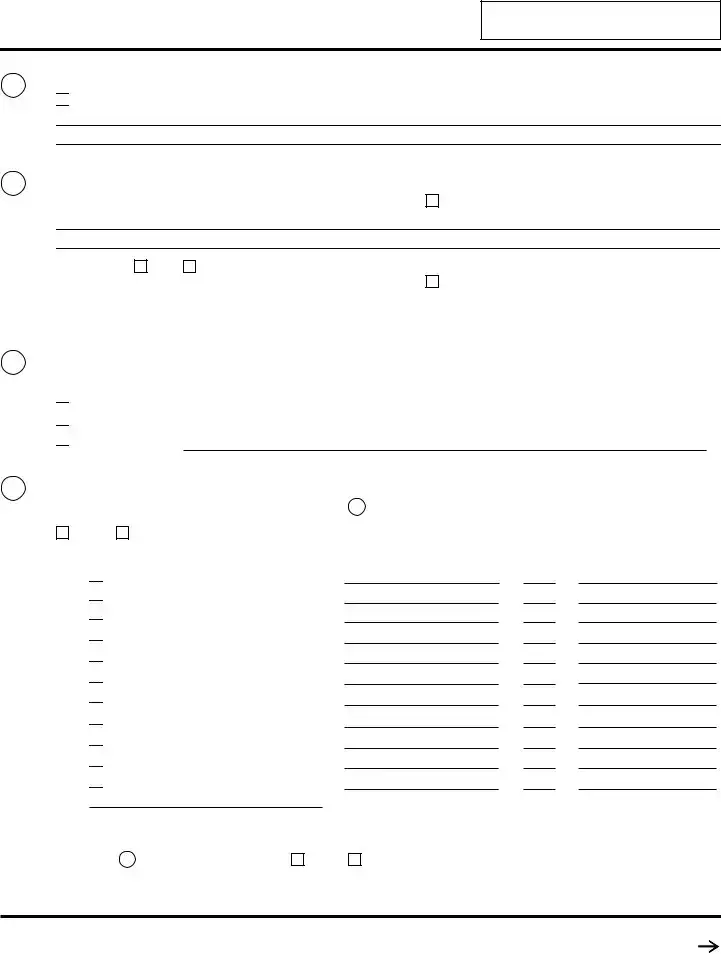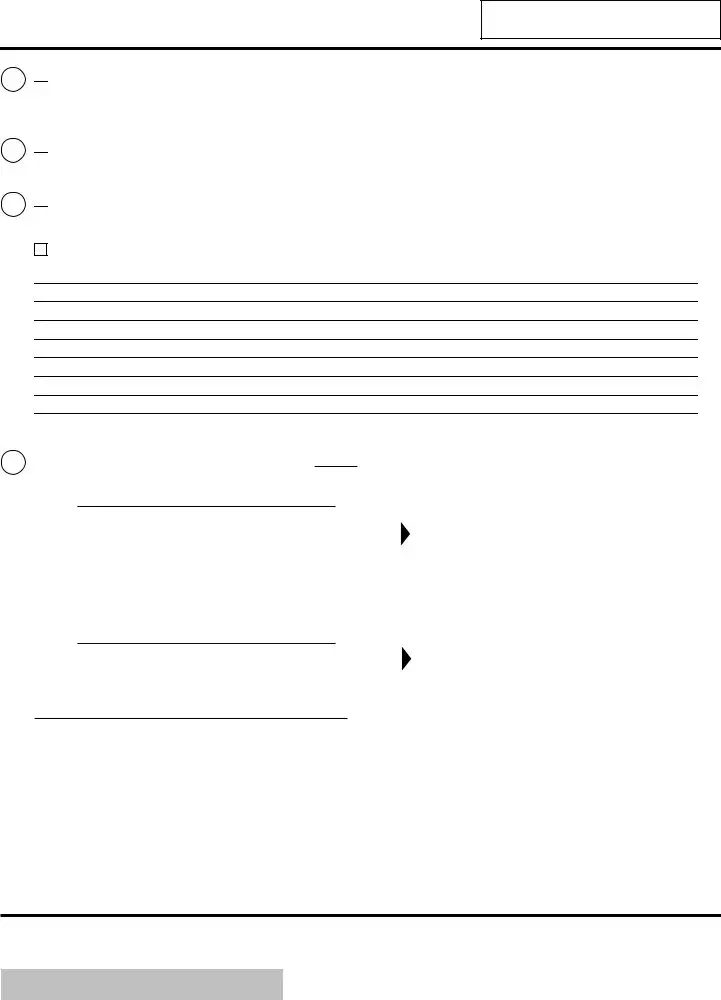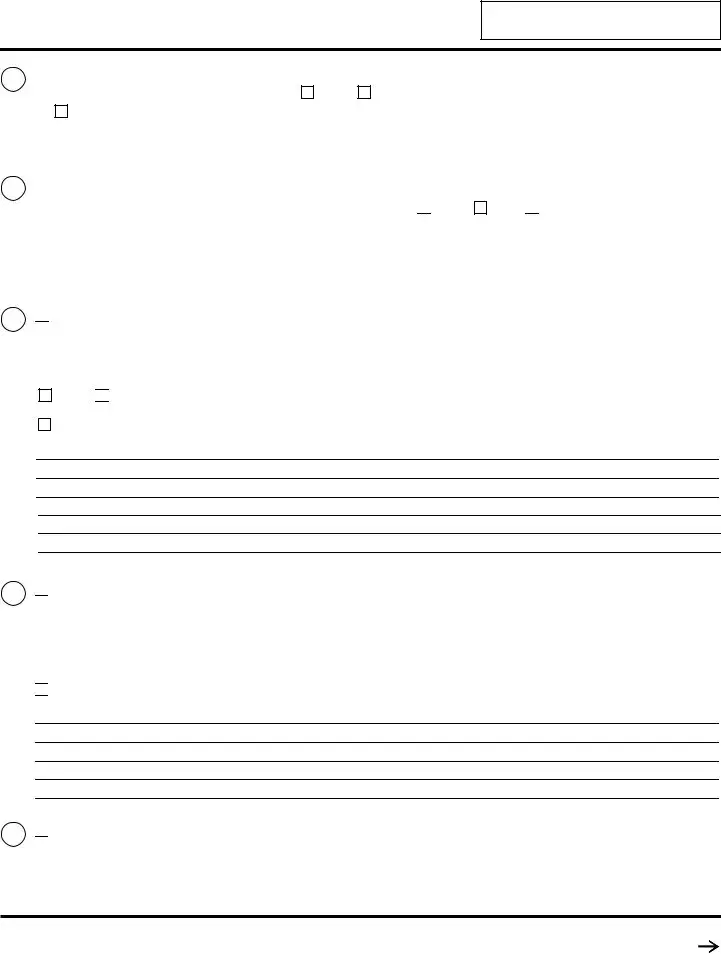
Homepage Blank California Wv 100 Form
Outline

The California Wv 100 form serves as a crucial tool for employers seeking to protect their employees from workplace violence. This petition allows employers to request restraining orders against individuals who pose a threat to their employees' safety. The form requires detailed information, including the names and addresses of both the employee in need of protection and the respondent from whom protection is sought. It also necessitates the identification of any additional individuals who may require protection. Employers must demonstrate their standing to file the petition under California's Code of Civil Procedure section 527.8. Alongside the Wv 100, a Confidential CLETS Information form must be completed, providing vital background information on the situation. The form includes sections to describe the nature of the threat, any prior incidents, and the relationship between the employee and the respondent. Furthermore, it allows employers to request temporary restraining orders and to specify the desired distance the respondent must maintain from the employee and other protected persons. By utilizing this form, employers can take proactive steps to ensure a safer workplace environment.
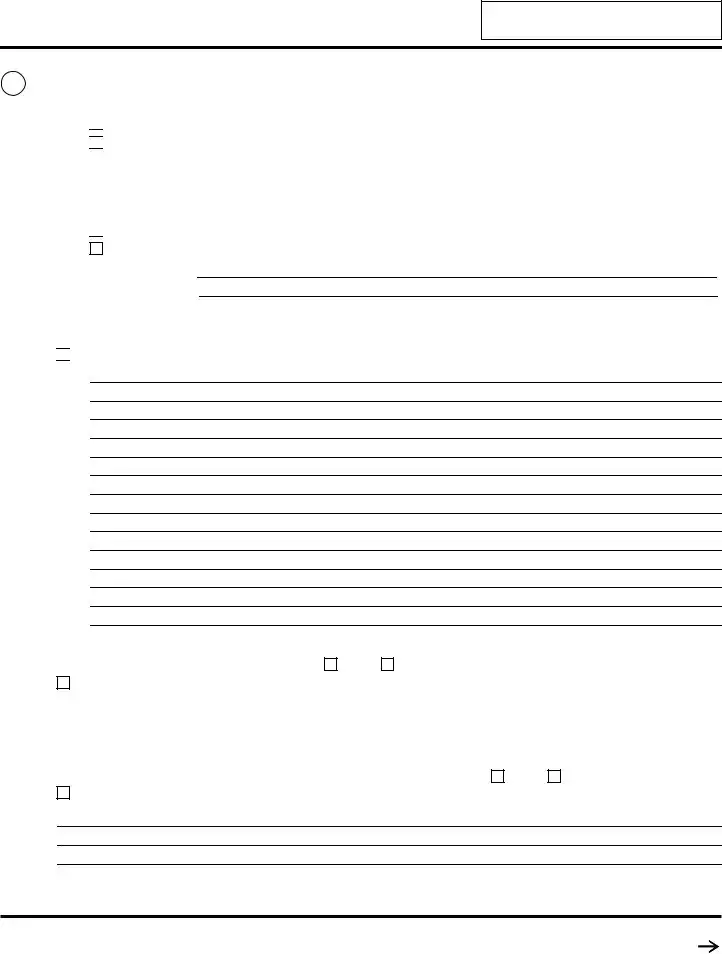
Sample - California Wv 100 Form

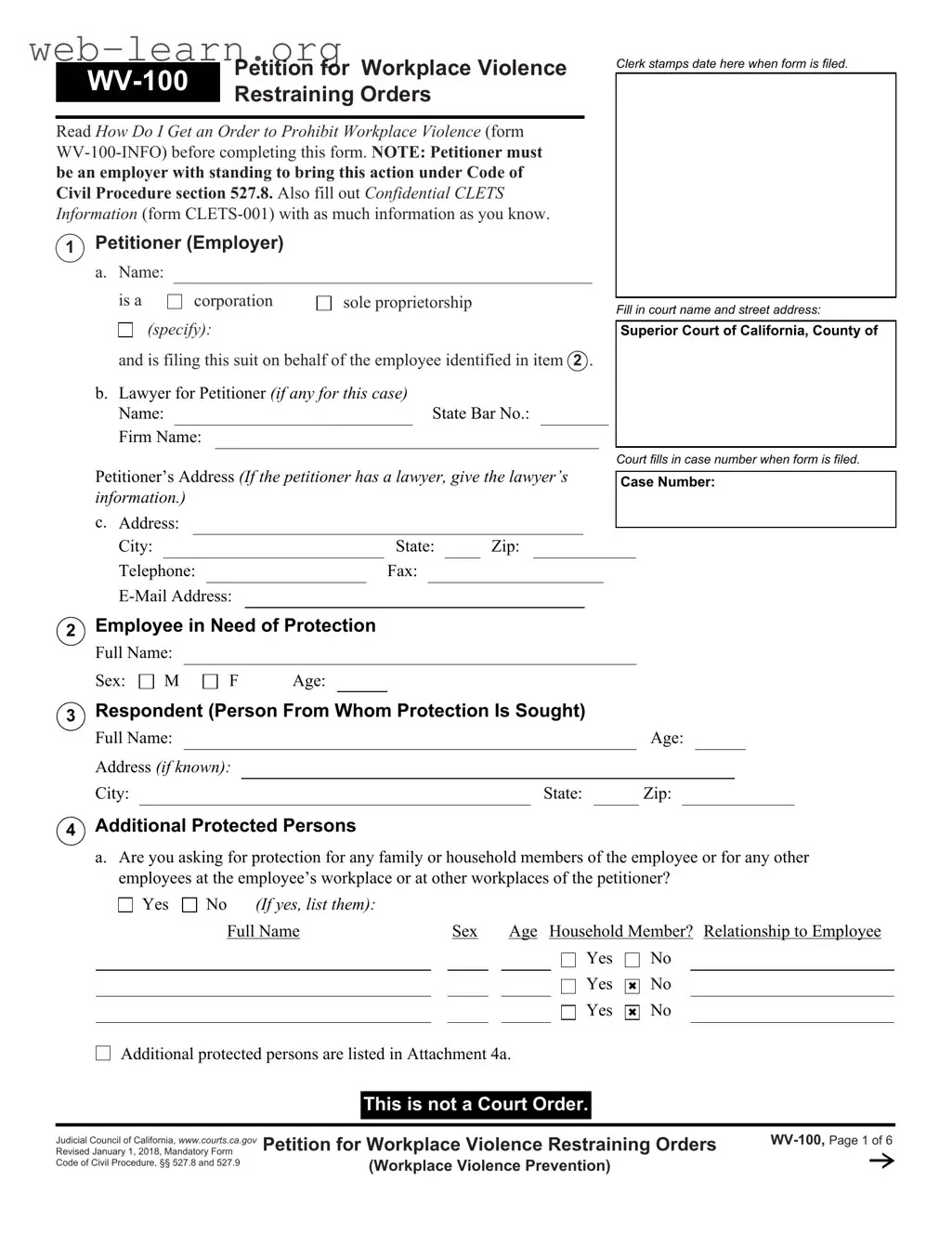
Petition for Workplace Violence
Restraining Orders
WV-100
Petition for Workplace Violence Restraining Orders
(Workplace Violence Prevention)
WV-100, Page 1 of 6
Judicial Council of California, www.courts.ca.gov
Revised January 1, 2018, Mandatory Form
Code of Civil Procedure, §§ 527.8 and 527.9
1
Petitioner (Employer)
is a
and is filing this suit on behalf of the employee identified in item .
2
Read How Do I Get an Order to Prohibit Workplace Violence (form
WV-100-INFO) before completing this form. NOTE: Petitioner must
be an employer with standing to bring this action under Code of
Civil Procedure section 527.8. Also fill out Confidential CLETS
Information (form CLETS-001) with as much information as you know.
a.
Lawyer for Petitioner (if any for this case)
Name: State Bar No.:
Firm Name:
b.
Address:
City: State: Zip:
Telephone: Fax:
E-Mail Address:
Petitioner’s Address (If the petitioner has a lawyer, give the lawyer’s
information.)
c.
Name:
(specify):
sole proprietorship
corporation
Respondent (Person From Whom Protection Is Sought)
Full Name: Age:
Address (if known):
City: State: Zip:
Additional Protected Persons
a. Are you asking for protection for any family or household members of the employee or for any other
employees at the employee’s workplace or at other workplaces of the petitioner?
Yes
No
Full Name Sex Age Household Member? Relationship to Employee
Yes
No
Additional protected persons are listed in Attachment 4a.
NoYes
No
Yes
This is not a Court Order.
3
4
Employee in Need of Protection
Full Name:
2
M
F
Sex:
Age:
(If yes, list them):
Clerk stamps date here when form is filed.
Fill in court name and street address:
Superior Court of California, County of
Court fills in case number when form is filed.
Case Number:
Case Number:
Response is stated in Attachment 4b.
b. Why do these people need protection? (Explain):
Are any restraining orders or criminal protective orders now in effect relating to the employee or any of the
persons in and the respondent?
4
4
b.
Other Court Cases
a.
Has the employee or any of the persons named in been involved in another court case with the respondent?
(If yes, attach a copy if you have one.)
Yes
No
(1) Workplace Violence
Civil Harassment
Domestic Violence
Divorce, Nullity, Legal Separation
Paternity, Parentage, Child Support
Eviction
Guardianship
Small Claims
Postsecondary School Violence
Criminal
Other (specify):
(3)
(4)
(5)
(6)
(7)
(8)
(9)
(10)
(11)
(2)
Kind of Case Filed in (County/State)
If yes, check each kind of case and indicate where and when each was filed:
No
Yes
Year Filed
Case Number (if known)
7
Respondent a current employee of petitioner. (Explain any decision to retain, terminate,
or otherwise discipline the respondent):
The respondent lives in this county.
The respondent has caused physical or emotional injury to the petitioner’s employee in this county.
Other
(specify):
How does the employee know the respondent? (Describe):
Relationship of Employee and Respondent
Why are you filing in this county? (Check all that apply):
b.
c.
a.
Venue
5
6
Response is stated in Attachment 5a.a.
Response is stated in Attachment 5b.
b. is notis
This is not a Court Order.
Petition for Workplace Violence Restraining Orders
(Workplace Violence Prevention)
WV-100, Page 2 of 6
Revised January 1, 2018
4
c.
Describe what happened. (Provide details; include the dates of all incidents beginning with the most recent; tell
who did what to whom; identify any witnesses):
d.
Was the employee harmed or injured?
Yes
No
(If yes, describe harm or injuries):
Case Number:
e. Did the respondent use or threaten to use a gun or any other weapon?
NoYes
(If yes, describe):
8
Description of Respondent's Conduct
Respondent has (check one or more):a.
(1)
Assaulted, battered, or stalked the employee
(2)
Made a credible threat of violence against the employee by making knowing or willful statements or
engaging in a course of conduct that would place a reasonable person in fear for his or her safety or the
safety of his or her immediate family.
One or more of these acts (check either or both):b.
(1)
Took place at the employee’s workplace
(2)
Can reasonably be construed to be carried out in the future at the employee’s workplace
Response is stated in Attachment 8c.
Address of workplace:
Response is stated in Attachment 8e.
Response is stated in Attachment 8d.
This is not a Court Order.
Petition for Workplace Violence Restraining Orders
(Workplace Violence Prevention)
WV-100, Page 3 of 6
Revised January 1, 2018
Check the orders you want
Case Number:
For any of the incidents described above, did the police come?
I don’t knowNoYes
If yes, did the employee or the respondent receive an Emergency Protective Order?
If yes, the order protects (check all that apply):
the employee
the respondent
one or more of the persons in .
4
(Attach a copy of the order if you have one.)
f.
f.
a.
d.
Other (specify):
Harass, intimidate, molest, attack, strike, stalk, threaten, assault (sexually or otherwise), hit, abuse, destroy
personal property of, or disturb the peace of the person.
Contact the person, either directly or indirectly, by any means, including, but not limited to, in person, by
telephone, in writing, by public or private mail, by interoffice mail, by e-mail, by text message, by fax, or by
other electronic means.
b.
Commit acts of unlawful violence on or make threats of violence to the person.
c.
Follow or stalk the person during work hours or to or from the place of work.
e.
Enter the person’s workplace.
I ask the court to order the respondent not to do any of the following things to the employee or to any person to
be protected listed in :
As stated in Attachment 9f.
The respondent will be ordered not to take any action to get the addresses or locations of any protected person
unless the court finds good cause not to make the order.
9
4
Stay-Away Order
a.
I ask the court to order the respondent to stay at least yards away from (check all that apply):
4
The other persons listed in .
(1)
(2)
(3)
(5)
(6)
(8)
The employee’s workplace.
The employee’s school.
The school of the employee’s
children.
The employee’s vehicle.
(9)
Other (specify):
The employee.
(4)
The employee’s home.
10
Personal Conduct Orders
(7) The place of child care of the employee’s
children.
This is not a Court Order.
Petition for Workplace Violence Restraining Orders
(Workplace Violence Prevention)
WV-100, Page 4 of 6
Revised January 1, 2018
8
I don’t knowNoYes
13
Request for Less Than Five Days' Notice of Hearing
Reasons are stated in Attachment 13.
14
No Fee for Filing
You must have your papers personally served on the respondent at least five days before the hearing, unless the
court orders a shorter time for service. (Form WV-200-INFO explains what is proof of personal service. Form
WV-200, Proof of Personal Service, may be used to show the court that the papers have been served.)
If you want there to be fewer than five days between service and the hearing, explain why:
Case Number:
If the court orders the respondent to stay away from all the places listed above, will he or she still be able to get
to his or her home, school, or job?
(If no, explain):
b.
Response is stated on Attachment 10b.
11
If the judge grants a protective order, the respondent will be prohibited from owning, possessing, purchasing,
receiving, or attempting to purchase or receive a gun, other firearm, and ammunition while the protective order is
in effect. The respondent will also be ordered to turn in to law enforcement, or sell to or store with a licensed gun
dealer, any guns or firearms within his or her immediate possession or control.
Does the respondent own or possess any guns or other firearms?
Guns or Other Firearms and Ammunition
I ask that there be no filing fee because the respondent has threatened violence against the employee, or stalked
the employee, or acted or spoken in a manner that has placed the employee in reasonable fear of violence.
This is not a Court Order.
Has the Respondent been told that you were going to go to court to seek a TRO against him/her?
12
(If you answered no, explain why below):
Temporary Restraining Order
I request that a Temporary Restraining Order (TRO) be issued against the Respondent to last until the hearing. I am
presenting form WV-110, Temporary Restraining Order, for the court’s signature together with this Petition.
Reasons are stated in Attachment 12.
Petition for Workplace Violence Restraining Orders
(Workplace Violence Prevention)
WV-100, Page 5 of 6
Revised January 1, 2018
10
NoYes
I don’t knowNoYes
Yes No
17
Additional Orders Requested
Additional orders requested are stated in Attachment 17.
18
Number of pages attached to this form, if any:
Date:
Lawyer’s name (if any)
Lawyer’s signature
Signature
I declare under penalty of perjury under the laws of the State of California that the information above and on
all attachments is true and correct.
I ask the court to make the following additional orders (specify):
Date:
Name of petitioner
Case Number:
15
No Fee to Serve Orders
I ask the court to order the sheriff or marshal to serve the respondent with the others for free because this request
for orders is based on a credible threat of violence or stalking.
16
Court Costs
I ask the court to order the respondent to pay my court costs.
Title
This is not a Court Order.
Petition for Workplace Violence Restraining Orders
(Workplace Violence Prevention)
WV-100, Page 6 of 6
Revised January 1, 2018

Form Information

Fact Name Details
Form Purpose The WV-100 is used to petition for workplace violence restraining orders in California.
Governing Law This form is governed by California Code of Civil Procedure sections 527.8 and 527.9.
Petitioner Requirements Only an employer can file this petition on behalf of an employee.
Confidential Information Petitioners must also complete form CLETS-001 with known information.
Filing Process The court will stamp the date when the form is filed.
Employee Protection Protection can be requested for family members or other employees at the workplace.
Respondent Information Details about the person from whom protection is sought must be provided.
Incident Description Petitioners must describe the respondent's conduct and any incidents that occurred.
Temporary Restraining Order A Temporary Restraining Order can be requested to last until the hearing.
Filing Fee Waiver No filing fee is required if the employee is in reasonable fear of violence.

Detailed Guide for Filling Out California Wv 100

Filling out the California Wv 100 form is a crucial step for employers seeking protection for their employees from workplace violence. This form requires specific information about the petitioner, the employee in need of protection, and the respondent from whom protection is sought. After completing the form, it must be filed with the appropriate court.

  1. Begin by entering the Petitioner (Employer) details in section 1. Provide the name of the corporation or sole proprietorship and indicate if you are filing on behalf of the employee.
  2. If applicable, fill in the Lawyer for Petitioner section with the lawyer's name, State Bar number, and firm name.
  3. Complete the Court Information section with the name and address of the Superior Court of California where you will file the form.
  4. Provide the Petitioner’s Address and contact information, including telephone, fax, and email address.
  5. In section 2, enter the Employee in Need of Protection details, including full name, sex, and age.
  6. Fill out section 3 with the Respondent information, including full name, age, and address if known.
  7. In section 4, indicate if you are asking for protection for any additional persons. If yes, list their names, sex, age, and relationship to the employee.
  8. Provide reasons for the need for protection in section 4b.
  9. In section 5, describe the Relationship of Employee and Respondent, including how they know each other and the respondent's employment status.
  10. Complete section 6 by explaining why you are filing in this county, checking all applicable reasons.
  11. In section 7, indicate if there have been other court cases involving the employee or any listed persons. If yes, provide details about each case.
  12. Section 8 requires you to describe the Respondent's Conduct. Check any applicable behaviors and provide details about incidents, including dates and witnesses.
  13. Indicate if the employee was harmed in section 8d and describe any injuries if applicable.
  14. In section 8e, state whether the respondent used or threatened to use a weapon.
  15. Answer whether police were involved in section 8f and provide details about any Emergency Protective Orders.
  16. In section 9, request specific Personal Conduct Orders that you want the court to impose on the respondent.
  17. Section 10 asks for a Stay-Away Order. Specify the distances the respondent must maintain from the employee and other protected persons.
  18. Indicate in section 11 whether the respondent owns or possesses any firearms.
  19. Request a Temporary Restraining Order in section 12, indicating if the respondent has been informed about the court visit.
  20. In section 13, explain if you are requesting less than five days' notice for the hearing.
  21. Finally, in section 14, request that there be no filing fee due to the circumstances surrounding the case.

Obtain Answers on California Wv 100

  1. What is the purpose of the California WV-100 form?

    The California WV-100 form is used to petition for a restraining order to prevent workplace violence. It allows an employer to seek legal protection for an employee who has experienced or is at risk of violence in the workplace. The form must be completed carefully to ensure that all necessary information is provided.

  2. Who can file the WV-100 form?

    Only an employer with standing under California Code of Civil Procedure section 527.8 can file the WV-100 form. This means that the employer must have a legitimate basis to seek protection on behalf of an employee who has faced threats or acts of violence.

  3. What information is required on the form?

    The form requires detailed information, including:

    • The name and address of the employer.
    • The name and details of the employee in need of protection.
    • Information about the respondent, the person from whom protection is sought.
    • A description of the incidents that led to the request for protection.
    • Any additional protected persons, if applicable.
  4. What happens after the form is filed?

    Once the form is filed, the court will review the information. If the court finds sufficient grounds, it may issue a temporary restraining order (TRO) to provide immediate protection until a hearing can be held. The respondent will be notified of the hearing and has the opportunity to respond.

  5. Is there a fee to file the WV-100 form?

    No, there is typically no filing fee for the WV-100 form if the petitioner can demonstrate that the employee has faced threats or violence. This provision helps ensure that victims can seek protection without financial barriers.

  6. What should I do if I need immediate protection?

    If immediate protection is necessary, you should request a Temporary Restraining Order (TRO) along with the WV-100 form. The court can grant a TRO quickly to ensure safety while the full case is processed. Ensure that you provide all relevant details to support your request.

Common mistakes

Filling out the California WV-100 form can be a daunting task, and mistakes can lead to delays or even rejections. One common error is failing to identify the correct petitioner. The form requires that the petitioner be an employer with standing under the relevant legal code. If this section is not filled out correctly, the court may dismiss the petition outright.

Another frequent mistake involves incomplete information about the employee in need of protection. It is crucial to provide the full name, age, and sex of the employee. Omitting any of these details can create confusion and may hinder the court's ability to process the request efficiently.

Respondent information is equally important. Many people neglect to provide the complete address of the person from whom protection is sought. If the court cannot locate the respondent, it may be impossible to serve them with the necessary documents, rendering the entire process ineffective.

Additionally, applicants often overlook the section regarding additional protected persons. If you are seeking protection for family members or other employees, this must be clearly indicated. Failing to list these individuals can leave them unprotected and may affect the outcome of the petition.

Another common error is not providing adequate details about the incidents that prompted the request for protection. The form asks for specific descriptions, including dates and witnesses. Vague or incomplete descriptions can weaken the case and may result in a denial of the request.

Many also fail to check for existing court cases involving the respondent. This information is crucial for the court to understand the context of the situation. If there are related cases, they should be listed accurately to ensure that the court has a complete picture.

Furthermore, applicants sometimes neglect to indicate whether the police were involved in any incidents. This information can be vital for establishing the seriousness of the situation. If police reports exist, attaching them can bolster the case significantly.

Lastly, not requesting a Temporary Restraining Order (TRO) when necessary can be a critical oversight. If there is an immediate threat, it is essential to indicate this on the form. Delaying this request could leave the employee vulnerable to further harm.

Taking the time to carefully fill out the WV-100 form can make a significant difference in the outcome. Double-checking each section and ensuring all required information is included will help facilitate a smoother process and provide the necessary protection for those in need.

Documents used along the form

The California Wv 100 form is a crucial document for employers seeking restraining orders to protect employees from workplace violence. Alongside this form, several other documents are often required to support the petition and ensure legal compliance. Here’s a list of these documents, each with a brief description.

  • WV-110, Temporary Restraining Order: This document requests a temporary order to protect the employee until a hearing can be held. It is often submitted along with the Wv 100 form.
  • CLETS-001, Confidential CLETS Information: This form collects confidential information about the respondent and is necessary for the California Law Enforcement Telecommunications System (CLETS) database.
  • WV-200, Proof of Personal Service: This form serves as evidence that the respondent has been personally served with the restraining order papers, which is a legal requirement.
  • WV-200-INFO: This informational guide explains the proof of personal service and outlines the process for serving the restraining order.
  • Attachment Forms: Various attachments may be used to provide additional details about the incidents of violence or threats, including witness statements and descriptions of the respondent's conduct.
  • Request for Less Than Five Days' Notice of Hearing: This request allows for a shorter notice period for the hearing if immediate action is necessary due to the nature of the threats.
  • Declaration of Petitioner: This document provides a sworn statement from the employer detailing the reasons for seeking the restraining order and the circumstances surrounding the situation.
  • Notice of Hearing: This form notifies the respondent of the date and time of the hearing regarding the restraining order, ensuring they have the opportunity to respond.
  • Application for Waiver of Court Fees: If the petitioner cannot afford the filing fees, this application requests a waiver based on financial hardship.
  • Any existing restraining orders: If there are prior orders against the respondent, copies should be attached to the petition for the court's consideration.

These documents work together to create a comprehensive case for workplace violence protection. Properly completing and submitting these forms can significantly impact the outcome of the petition. Always ensure that all necessary paperwork is filed accurately and on time to facilitate a smooth legal process.

Similar forms

  • WV-110 Temporary Restraining Order: Similar to the WV-100, this form is used to request immediate protection from the court. It provides a temporary order that lasts until a hearing can be held.
  • CLETS-001 Confidential CLETS Information: This document collects personal information about the parties involved, ensuring that the court has necessary details while maintaining confidentiality.
  • WV-200 Proof of Personal Service: This form is used to confirm that the respondent has been properly served with the petition. It ensures that the respondent is aware of the proceedings against them.
  • WV-200-INFO: This information sheet explains the proof of personal service. It guides petitioners on how to properly serve the respondent.
  • Form FL-300 Request for Order: This form is similar in that it requests a court order to protect individuals from harassment or violence, typically in family law cases.
  • Form DV-100 Domestic Violence Prevention Act: Like the WV-100, this form is used to request protection from domestic violence, focusing on personal relationships rather than workplace settings.
  • Form CH-100 Civil Harassment Restraining Order: This document serves a similar purpose in civil harassment cases, allowing individuals to seek protection from harassment outside of the workplace.
  • Form GV-100 Gun Violence Restraining Order: This form is used to prevent individuals from possessing firearms when there is a risk of gun violence, paralleling the protective measures of the WV-100.
  • Form JV-200 Juvenile Restraining Order: Similar in function, this form is used to protect minors from harassment or violence, ensuring their safety in situations involving youth.

Dos and Don'ts

Filling out the California Wv 100 form can be a crucial step in seeking protection against workplace violence. To ensure your application is completed correctly, here are some essential dos and don’ts to consider:

  • Do read the instructions carefully before starting. Understanding the requirements can save you time and confusion.
  • Don’t leave any fields blank unless specified. Incomplete forms may lead to delays or rejection.
  • Do provide accurate and detailed information about the employee in need of protection. This clarity is vital for the court's understanding.
  • Don’t use vague language when describing incidents of violence. Specific details help strengthen your case.
  • Do include any additional protected persons if applicable. This ensures comprehensive protection for all involved.
  • Don’t forget to attach any supporting documents, such as police reports or previous court orders, if available.
  • Do check your contact information for accuracy. The court needs to reach you for any follow-up.
  • Don’t hesitate to seek legal advice if you are unsure about any part of the form. Professional guidance can be invaluable.
  • Do file the form in the correct county based on the respondent's location or where the incidents occurred.

By following these guidelines, you can enhance your chances of a successful application and ensure that the necessary protections are put in place efficiently.

Misconceptions

  • Misconception 1: Only employees can file the WV-100 form.
  • In fact, the form must be filed by an employer who has standing under California law. The employer acts on behalf of the employee in need of protection.

  • Misconception 2: The WV-100 form is only for physical violence.
  • The form addresses various forms of workplace violence, including emotional abuse and credible threats. It is essential to recognize all forms of intimidation.

  • Misconception 3: You can file the form without any evidence.
  • Supporting evidence is crucial. The court requires detailed descriptions of incidents, including dates and any witnesses, to substantiate the claims.

  • Misconception 4: There are no fees associated with filing the WV-100.
  • While there is a provision to request a fee waiver, it is not automatic. The petitioner must demonstrate that the situation warrants a waiver due to the threat of violence.

  • Misconception 5: The court will automatically grant a restraining order upon filing.
  • A hearing is typically required to determine if a restraining order is appropriate. The judge will evaluate the evidence presented before making a decision.

  • Misconception 6: The respondent must be a current employee for the form to be valid.
  • The form can be used against former employees or individuals who are not employees but pose a threat to current employees.

  • Misconception 7: All protected persons must be family members.
  • Protection can extend to any employees at the workplace, not just family members. Employers can seek protection for multiple individuals.

  • Misconception 8: You do not need to inform the respondent before filing.
  • While it is not always required to notify the respondent prior to filing, the court may ask for an explanation if the petitioner chooses not to do so.

  • Misconception 9: Once filed, the WV-100 form is a permanent solution.
  • The form initiates a process but does not provide permanent protection. The court must issue a final order after a hearing for lasting effects.

Key takeaways

Filling out and using the California Wv 100 form requires careful attention to detail. Here are ten key takeaways to consider:

  • Understand Eligibility: Only an employer with standing under Code of Civil Procedure section 527.8 can file this petition.
  • Complete Required Information: Include the employer's name, address, and contact details, as well as the employee's information.
  • Additional Protected Persons: Specify if protection is needed for family members or other employees at the workplace.
  • Detail Respondent's Conduct: Clearly describe any incidents of violence or threats made by the respondent against the employee.
  • Explain Relationship: Provide context on how the employee knows the respondent, including employment status.
  • Document Other Court Cases: Disclose any prior court cases involving the employee and the respondent.
  • Request Specific Orders: Indicate what personal conduct orders are being sought, such as harassment or stalking prohibitions.
  • Stay-Away Orders: Specify the distances the respondent should maintain from the employee and other protected persons.
  • Firearm Restrictions: Note if the respondent possesses firearms and request relevant prohibitions if applicable.
  • No Filing Fee: Request a waiver for the filing fee if the situation involves threats or violence against the employee.

Each section of the form must be filled out accurately to ensure the protection of the employee and any additional individuals involved. It is advisable to refer to the accompanying instructions for guidance on completing the form effectively.