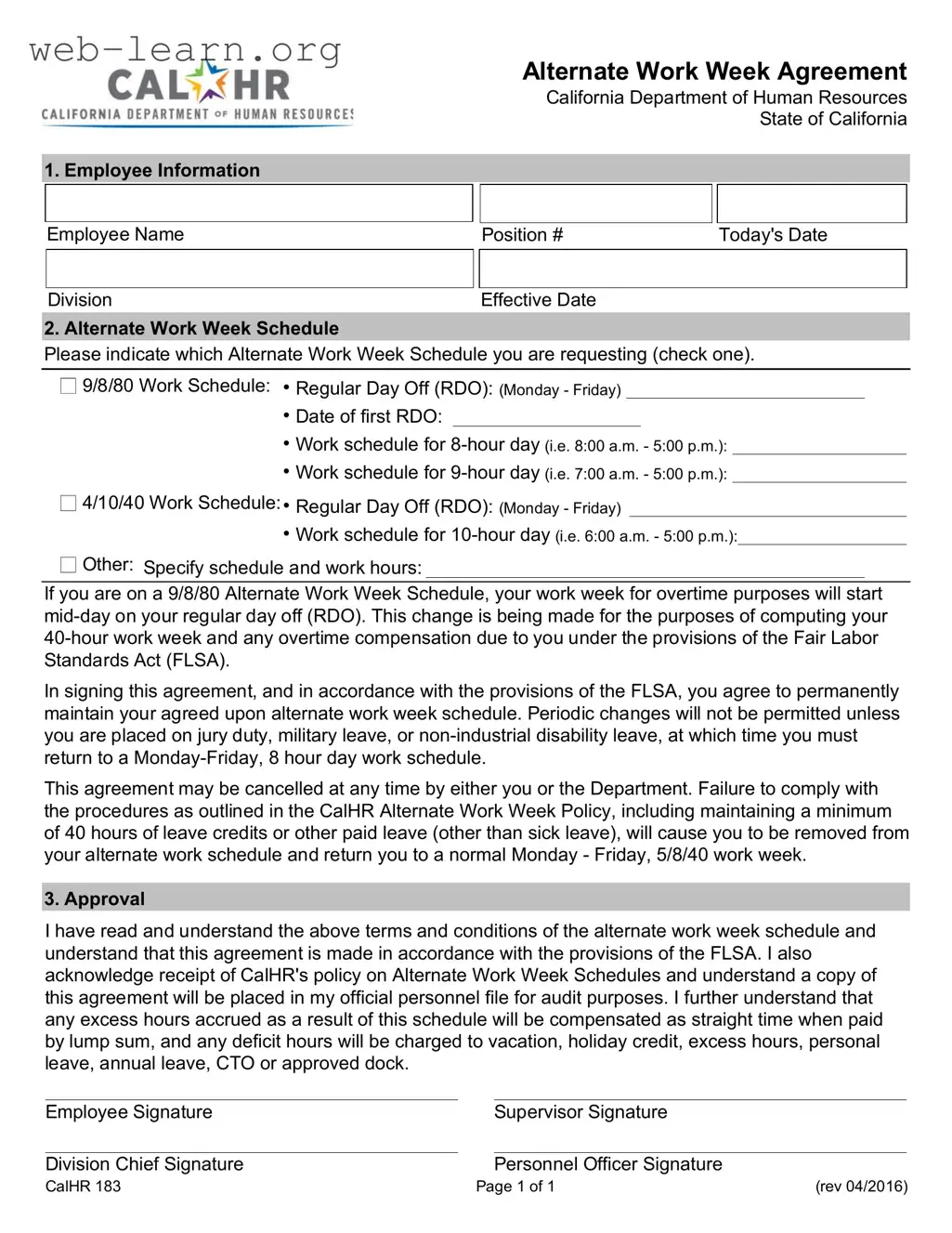
Homepage Blank California Work Week Agreement Form
Outline

The California Work Week Agreement form is a crucial document for employees seeking flexibility in their work schedules. This form allows employees to propose an alternate work week schedule, which can include options such as a 9/8/80 or a 4/10/40 work arrangement. Employees must provide their name, division, position number, and relevant dates, along with their preferred schedule and regular day off. The agreement outlines how overtime is calculated, specifying that for those on a 9/8/80 schedule, the work week for overtime purposes begins mid-day on the regular day off. Importantly, once signed, employees commit to maintaining their chosen schedule permanently, with limited exceptions for jury duty, military leave, or non-industrial disability leave. The agreement also includes provisions for cancellation by either party and stipulates the consequences of failing to adhere to the outlined procedures, including a potential return to a standard Monday-Friday schedule. By signing the form, employees acknowledge their understanding of the terms and the implications for their work hours and compensation.
Sample - California Work Week Agreement Form

(rev 04/2016)CalHR 183
Page 1 of 1
1. Employee Information
2. Alternate Work Week Schedule
Employee Name
Alternate Work Week Agreement
California Department of Human Resources
State of California
Today's DatePosition #
Division Effective Date
Please indicate which Alternate Work Week Schedule you are requesting (check one).
9/8/80 Work Schedule:
Regular Day Off (RDO):
(Monday - Friday)
Date of first RDO:
Regular Day Off (RDO):
(Monday - Friday)
4/10/40 Work Schedule:
Specify schedule and work hours:
Other:
If you are on a 9/8/80 Alternate Work Week Schedule, your work week for overtime purposes will start
mid-day on your regular day off (RDO). This change is being made for the purposes of computing your
40-hour work week and any overtime compensation due to you under the provisions of the Fair Labor
Standards Act (FLSA).
In signing this agreement, and in accordance with the provisions of the FLSA, you agree to permanently
maintain your agreed upon alternate work week schedule. Periodic changes will not be permitted unless
you are placed on jury duty, military leave, or non-industrial disability leave, at which time you must
return to a Monday-Friday, 8 hour day work schedule.
This agreement may be cancelled at any time by either you or the Department. Failure to comply with
the procedures as outlined in the CalHR Alternate Work Week Policy, including maintaining a minimum
of 40 hours of leave credits or other paid leave (other than sick leave), will cause you to be removed from
your alternate work schedule and return you to a normal Monday - Friday, 5/8/40 work week.
3. Approval
I have read and understand the above terms and conditions of the alternate work week schedule and
understand that this agreement is made in accordance with the provisions of the FLSA. I also
acknowledge receipt of CalHR's policy on Alternate Work Week Schedules and understand a copy of
this agreement will be placed in my official personnel file for audit purposes. I further understand that
any excess hours accrued as a result of this schedule will be compensated as straight time when paid
by lump sum, and any deficit hours will be charged to vacation, holiday credit, excess hours, personal
leave, annual leave, CTO or approved dock.
Work schedule for 8-hour day
(i.e. 8:00 a.m. - 5:00 p.m.):
Work schedule for 9-hour day
(i.e. 7:00 a.m. - 5:00 p.m.):
Work schedule for 10-hour day
(i.e. 6:00 a.m. - 5:00 p.m.):
Employee Signature Supervisor Signature
Division Chief Signature Personnel Officer Signature

Form Information

Fact Name Fact Description
Purpose The California Work Week Agreement form allows employees to request an alternate work schedule, providing flexibility in work hours while ensuring compliance with labor laws.
Governing Law This agreement is governed by the Fair Labor Standards Act (FLSA), which outlines the regulations for overtime and work hours.
Work Schedule Options Employees can choose between a 9/8/80 schedule or a 4/10/40 schedule, allowing for variations in workdays and hours.
Cancellation Policy Either the employee or the Department can cancel the agreement at any time, ensuring that both parties have the ability to adjust as needed.
Compliance Requirements Employees must maintain a minimum of 40 hours of leave credits or other paid leave to remain on the alternate schedule; otherwise, they revert to a standard work week.

Detailed Guide for Filling Out California Work Week Agreement

Completing the California Work Week Agreement form is a straightforward process that requires careful attention to detail. This form is essential for establishing an alternate work schedule, which can impact your work hours and compensation. Follow the steps below to ensure that you fill out the form correctly.

  1. Gather Required Information: Before starting, collect all necessary information, including your name, division, position number, and today's date.
  2. Fill Out Employee Information: In the designated fields, enter your Employee Name and Division.
  3. Specify Dates: Enter the Today's Date and the Effective Date for the alternate work schedule.
  4. Select Work Schedule: Indicate which alternate work week schedule you are requesting by checking one of the options: 9/8/80, 4/10/40, or Other.
  5. Detail Work Hours: Depending on your selected schedule, provide the required work hours and regular day off (RDO). For example, if you choose the 9/8/80 schedule, include your work hours for both 8-hour and 9-hour days.
  6. Read Terms and Conditions: Carefully read the terms regarding overtime, compliance, and cancellation of the agreement.
  7. Sign the Agreement: Once you understand the terms, sign the form. Ensure that your Division Chief, Supervisor, and Personnel Officer also sign the document.

After completing the form, it will be submitted for approval and will be kept in your official personnel file. This process ensures that all parties involved are aware of the agreed-upon schedule and its implications for your work hours and compensation.

Obtain Answers on California Work Week Agreement

  1. What is the purpose of the California Work Week Agreement form?

    The California Work Week Agreement form is designed to formalize an employee's request for an alternate work week schedule. This agreement allows employees to work different hours than the traditional Monday to Friday, 8-hour day format. Options include a 9/8/80 schedule or a 4/10/40 schedule, among others. The form ensures that both the employee and the department understand the terms and conditions associated with this change in work hours.

  2. What are the different alternate work week schedules available?

    Employees can choose from several alternate work week schedules:

    • 9/8/80 Work Schedule: This schedule allows employees to work 9 hours for 8 days and have one regular day off (RDO). For overtime purposes, the work week starts mid-day on the RDO.
    • 4/10/40 Work Schedule: Under this schedule, employees work 10 hours a day for 4 days, with one RDO. This schedule is beneficial for those seeking longer weekends.
    • Other: Employees may specify a different schedule and work hours if the standard options do not meet their needs.
  3. Can the alternate work week schedule be changed after it is established?

    Once an alternate work week schedule is approved, it is considered permanent unless certain conditions arise. Changes are only permitted if the employee is placed on jury duty, military leave, or non-industrial disability leave. In such cases, the employee must revert to a standard Monday-Friday, 8-hour work schedule. Otherwise, any changes to the schedule are not allowed.

  4. What happens if an employee fails to comply with the alternate work week policy?

    If an employee does not adhere to the procedures outlined in the CalHR Alternate Work Week Policy, they may be removed from their alternate work schedule. This includes failing to maintain a minimum of 40 hours of leave credits or other paid leave, excluding sick leave. In such cases, the employee will revert to the standard Monday-Friday, 5/8/40 work week format.

Common mistakes

Filling out the California Work Week Agreement form may seem straightforward, but many people make common mistakes that can lead to complications later on. Understanding these pitfalls can help ensure a smoother process. Here are eight mistakes to avoid when completing this important document.

One frequent error is failing to clearly indicate the chosen alternate work week schedule. Whether opting for the 9/8/80 or 4/10/40 schedule, it’s essential to check the appropriate box. Neglecting this step can create confusion and delays in processing the agreement.

Another common mistake involves not providing accurate work hours. For instance, if you select the 9-hour day option, you must specify the correct start and end times. Inaccurate or incomplete information can lead to misunderstandings about your work hours and compensation.

Many individuals also overlook the importance of including their Regular Day Off (RDO). This detail is crucial as it affects how your work week is structured. Omitting this information can result in scheduling conflicts and potential overtime issues.

Additionally, some people forget to sign the form. The agreement requires signatures from both the employee and the division chief. Without these signatures, the agreement is not valid, and you may not receive the intended benefits of the alternate work week schedule.

Another mistake is not reading the terms and conditions carefully. The form outlines important information regarding overtime calculations and the permanence of the agreed-upon schedule. Ignoring these details can lead to unexpected consequences, such as being reverted to a standard work schedule.

It’s also important to be aware of the leave requirements. Failing to maintain a minimum of 40 hours of leave credits can result in removal from the alternate work schedule. Many people overlook this requirement, thinking it won’t affect them, only to find themselves back on a regular schedule unexpectedly.

Moreover, some individuals neglect to keep a copy of the signed agreement for their records. While the form will be placed in your personnel file, having a personal copy can be beneficial for future reference, especially if questions arise regarding your work schedule.

Lastly, not communicating with supervisors or HR about any changes can create issues. If circumstances change—such as needing to adjust your schedule due to personal reasons—failing to discuss these changes can lead to misunderstandings and complications in maintaining compliance with the agreement.

By being aware of these common mistakes and taking the time to fill out the California Work Week Agreement form accurately, you can help ensure a seamless transition to your new work schedule.

Documents used along the form

The California Work Week Agreement form is often accompanied by several other documents that help clarify terms and conditions related to work schedules. Below is a list of commonly used forms and documents that may be relevant when establishing or modifying work week agreements.

  • Employee Handbook: This document outlines the company's policies and procedures, including information on work hours, leave, and employee rights.
  • Time Off Request Form: Employees use this form to formally request time off, ensuring that their absence is documented and approved by management.
  • Overtime Authorization Form: This form is necessary for employees who need to work beyond their scheduled hours. It helps ensure that overtime is pre-approved and documented.
  • Payroll Deduction Authorization Form: Employees may need to complete this form to authorize deductions from their paychecks for various reasons, such as benefits or retirement contributions.
  • Performance Review Form: This document is used to evaluate an employee's performance, which may impact work schedule decisions and promotions.
  • Leave of Absence Request Form: Employees can use this form to request extended time off for personal reasons, medical issues, or family emergencies.
  • Job Description: A clear outline of an employee's duties and responsibilities. This document helps clarify expectations and can influence work schedules.
  • Work Schedule Change Request Form: Employees may need this form to formally request changes to their work hours or days, ensuring that such changes are documented and approved.
  • Exit Interview Form: When an employee leaves the organization, this form is used to gather feedback about their experience, including aspects related to work schedules.
  • Employee Agreement Form: This form outlines the terms of employment, including work hours, benefits, and other essential conditions of employment.

These documents collectively help maintain clarity and compliance regarding work schedules and employee rights. Having them in place ensures that both employees and employers understand their responsibilities and rights in relation to work hours and conditions.

Similar forms

The California Work Week Agreement form shares similarities with several other documents related to work schedules and employee agreements. Here are six such documents:

  • Alternate Work Week Agreement: This document allows employees to choose a different work schedule, similar to the California Work Week Agreement. Both forms outline the terms for alternative hours, ensuring compliance with labor laws.
  • Flexible Work Arrangement Agreement: This agreement provides employees with the option to adjust their work hours or location. Like the California Work Week Agreement, it emphasizes mutual consent and outlines the responsibilities of both the employee and employer.
  • Overtime Agreement: An Overtime Agreement specifies how overtime will be calculated and compensated. This is similar to the California Work Week Agreement, which also addresses overtime calculations based on alternate work schedules.
  • Telecommuting Agreement: This document allows employees to work from home or another location. It shares similarities with the California Work Week Agreement in that both require clear terms and conditions for how work hours will be managed.
  • Leave of Absence Agreement: This agreement outlines the terms for taking a leave of absence from work. It is similar in that it addresses changes to an employee's regular schedule and the conditions that must be met for approval.
  • Job Sharing Agreement: This document allows two employees to share the responsibilities of one full-time position. Like the California Work Week Agreement, it requires clear communication and agreement on work hours and duties.

Understanding these documents can help employees navigate their rights and responsibilities regarding work schedules. Each agreement serves a unique purpose while ensuring that both employees and employers are aligned on expectations.

Dos and Don'ts

When filling out the California Work Week Agreement form, it’s important to follow specific guidelines to ensure a smooth process. Here’s a list of things you should and shouldn’t do:

  • Do provide accurate employee information, including your name and division.
  • Do clearly indicate the alternate work week schedule you are requesting.
  • Do specify your regular day off (RDO) correctly.
  • Do ensure that your work schedule aligns with the hours you intend to work.
  • Do read and understand the terms and conditions outlined in the agreement.
  • Don't forget to sign the agreement; your signature confirms your understanding and acceptance.
  • Don't submit the form without reviewing it for any errors or omissions.
  • Don't assume you can change your schedule later without following proper procedures.
  • Don't neglect to keep track of your leave credits to avoid being removed from your alternate work schedule.

By following these guidelines, you can help ensure that your request for an alternate work week schedule is processed efficiently and correctly.

Misconceptions

Understanding the California Work Week Agreement form is essential for employees considering alternative work schedules. However, several misconceptions can cloud this understanding. Here are eight common myths, debunked for clarity:

  • Myth 1: The agreement is optional and can be ignored.
  • This is false. Signing the agreement is necessary if you wish to participate in an alternate work week schedule. Without it, you remain on a standard schedule.

  • Myth 2: Employees can change their schedule whenever they want.
  • In reality, changes to the schedule are not allowed unless specific conditions are met, such as jury duty or military leave.

  • Myth 3: Overtime calculations are the same as a regular work week.
  • This is misleading. For those on a 9/8/80 schedule, the work week for overtime starts mid-day on the regular day off, affecting how overtime is calculated.

  • Myth 4: The agreement guarantees a permanent alternative schedule.
  • While you may prefer an alternate schedule, the agreement can be canceled at any time by either party, so it is not permanent.

  • Myth 5: Employees are not responsible for maintaining leave credits.
  • This is incorrect. Employees must maintain a minimum of 40 hours of leave credits; failing to do so will result in a return to a standard work week.

  • Myth 6: Sick leave counts toward the required leave credits.
  • This is a misconception. Sick leave does not count towards the minimum leave credits required to maintain an alternate schedule.

  • Myth 7: All excess hours worked will automatically be paid as overtime.
  • This is not true. Any excess hours accrued will be compensated as straight time when paid by lump sum, not as overtime.

  • Myth 8: The agreement is not part of the employee's official record.
  • This is false. A copy of the agreement is placed in the employee's official personnel file for audit purposes, making it an important document.

By dispelling these myths, employees can make informed decisions about their work schedules and ensure compliance with the requirements set forth in the California Work Week Agreement form.

Key takeaways

Filling out the California Work Week Agreement form requires careful attention to detail. Here are some key takeaways to consider:

  • Understand Your Options: Familiarize yourself with the different alternate work week schedules available, such as the 9/8/80 and 4/10/40 formats. Each option has specific work hour arrangements and regular days off.
  • Accurate Information: Ensure that all employee information, including name, division, and position number, is filled out correctly. Any inaccuracies can delay the approval process.
  • Significance of the Regular Day Off: Clearly indicate your Regular Day Off (RDO) as it plays a crucial role in how your work week is structured and how overtime is calculated.
  • Compliance with FLSA: By signing the agreement, you are committing to adhere to the Fair Labor Standards Act (FLSA) provisions regarding your alternate work week schedule.
  • Understand the Consequences: Be aware that failure to maintain a minimum of 40 hours of leave credits or other paid leave can result in being reverted to a standard work week schedule.
  • Documentation: A copy of the signed agreement will be placed in your personnel file. This is important for audit purposes, so keep your own records as well.