Homepage Blank California Ud 105 Form
Outline

The California UD-105 form serves as a critical document in the unlawful detainer process, commonly known as eviction proceedings. This form is utilized by defendants to formally respond to a complaint filed against them by a landlord or property owner. It requires the defendant to provide their name, contact information, and details about the court handling the case. The form allows defendants to either admit or deny the claims made in the complaint, with specific instructions on how to articulate their responses. Notably, defendants can assert various affirmative defenses, such as claims of nonpayment of rent due to the landlord's failure to maintain habitable living conditions, or allegations of retaliatory eviction. The form also provides space for defendants to outline additional statements regarding their situation, including requests for the court to deny the landlord's claims or to seek damages and attorney fees. Ultimately, the UD-105 is a vital tool for defendants to assert their rights and present their case in a structured manner, ensuring that their responses are formally recognized by the court.
Sample - California Ud 105 Form

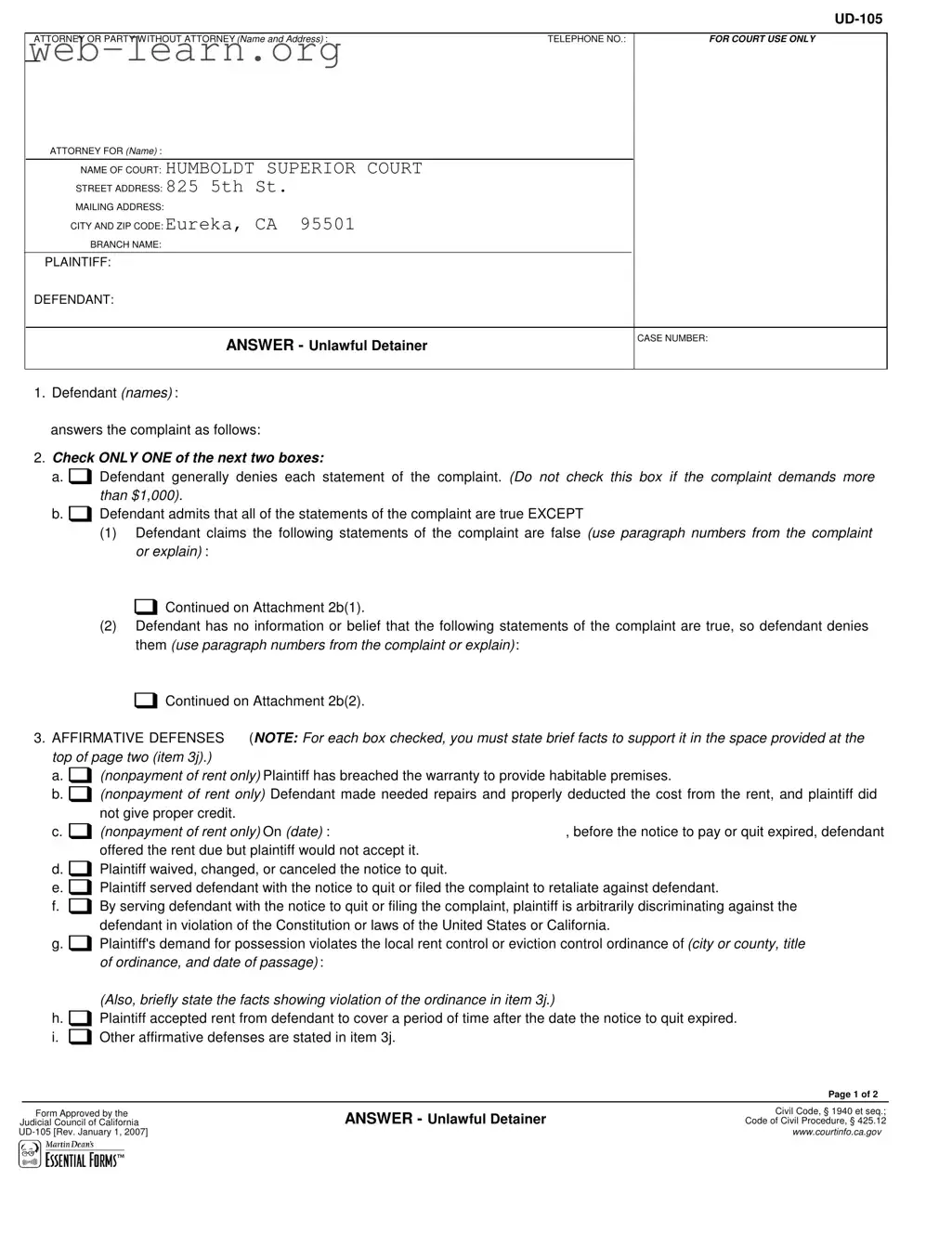
UD-105
ATTORNEY OR PARTY WITHOUT ATTORNEY (Name and Address) : TELEPHONE NO.: FOR COURT USE ONLY
ATTORNEY FOR (Name) :
NAME OF COURT:
STREET ADDRESS:
MAILING ADDRESS:
CITY AND ZIP CODE:
BRANCH NAME:
PLAINTIFF:
DEFENDANT:
CASE NUMBER:
ANSWER -
Unlawful Detainer
1. Defendant (names) :
answers the complaint as follows:
2. Check ONLY ONE of the next two boxes:
a. Defendant generally denies each statement of the complaint. (Do not check this box if the complaint demands more
than $1,000).
b. Defendant admits that all of the statements of the complaint are true EXCEPT
(1) Defendant claims the following statements of the complaint are false (use paragraph numbers from the complaint
or explain) :
Continued on Attachment 2b(1).
(2) Defendant has no information or belief that the following statements of the complaint are true, so defendant denies
them (use paragraph numbers from the complaint or explain) :
Continued on Attachment 2b(2).
3. AFFIRMATIVE DEFENSES (NOTE: For each box checked, you must state brief facts to support it in the space provided at the
top of page two (item 3j).)
a. (nonpayment of rent only) Plaintiff has breached the warranty to provide habitable premises.
b. (nonpayment of rent only) Defendant made needed repairs and properly deducted the cost from the rent, and plaintiff did
not give proper credit.
c. (nonpayment of rent only) On (date) : , before the notice to pay or quit expired, defendant
offered the rent due but plaintiff would not accept it.
d. Plaintiff waived, changed, or canceled the notice to quit.
e. Plaintiff served defendant with the notice to quit or filed the complaint to retaliate against defendant.
f. By serving defendant with the notice to quit or filing the complaint, plaintiff is arbitrarily discriminating against the
defendant in violation of the Constitution or laws of the United States or California.
g. Plaintiff's demand for possession violates the local rent control or eviction control ordinance of (city or county, title
of ordinance, and date of passage) :
(Also, briefly state the facts showing violation of the ordinance in item 3j.)
h. Plaintiff accepted rent from defendant to cover a period of time after the date the notice to quit expired.
i. Other affirmative defenses are stated in item 3j.
Form Approved by the
Civil Code, § 1940 et seq.;
Judicial Council of California
ANSWER -
Unlawful Detainer
Code of Civil Procedure, § 425.12
UD-105 [Rev. January 1, 2007]
Page 1 of 2
www.courtinfo.ca.gov
HUMBOLDT SUPERIOR COURT
825 5th St.
Eureka, CA 95501
PLAINTIFF (Name) :
CASE NUMBER:
DEFENDANT (Name) :
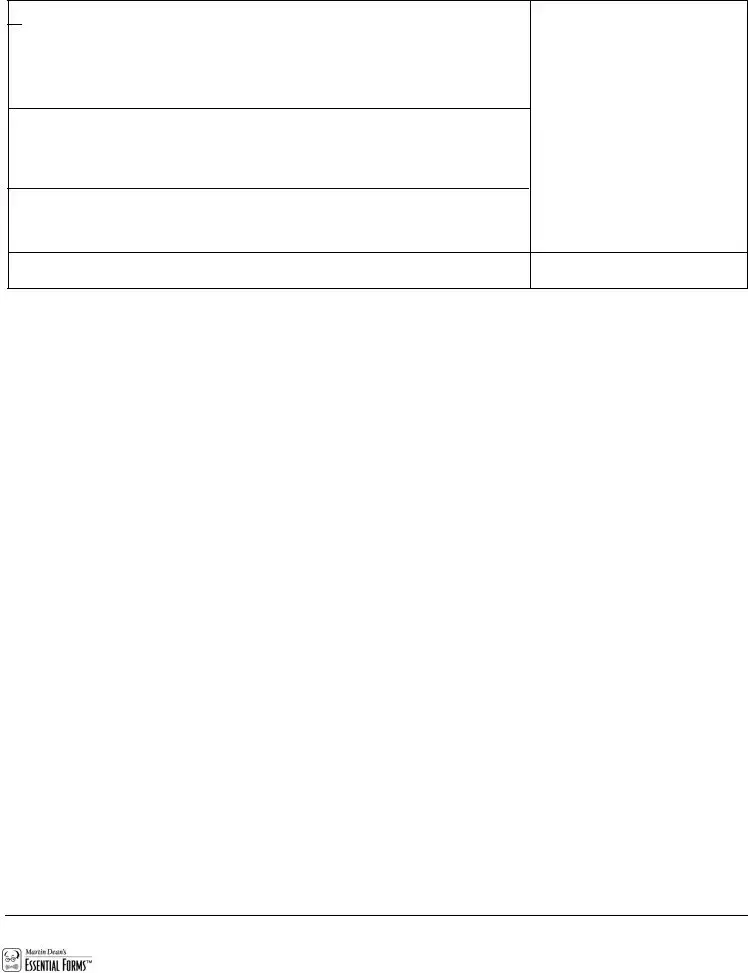
3. AFFIRMATIVE DEFENSES (cont'd)
j. Facts supporting affirmative defenses checked above (identify each item separately by its letter from page one) :
(1) All the facts are stated in Attachment 3j. (2) Facts are continued in Attachment 3j.
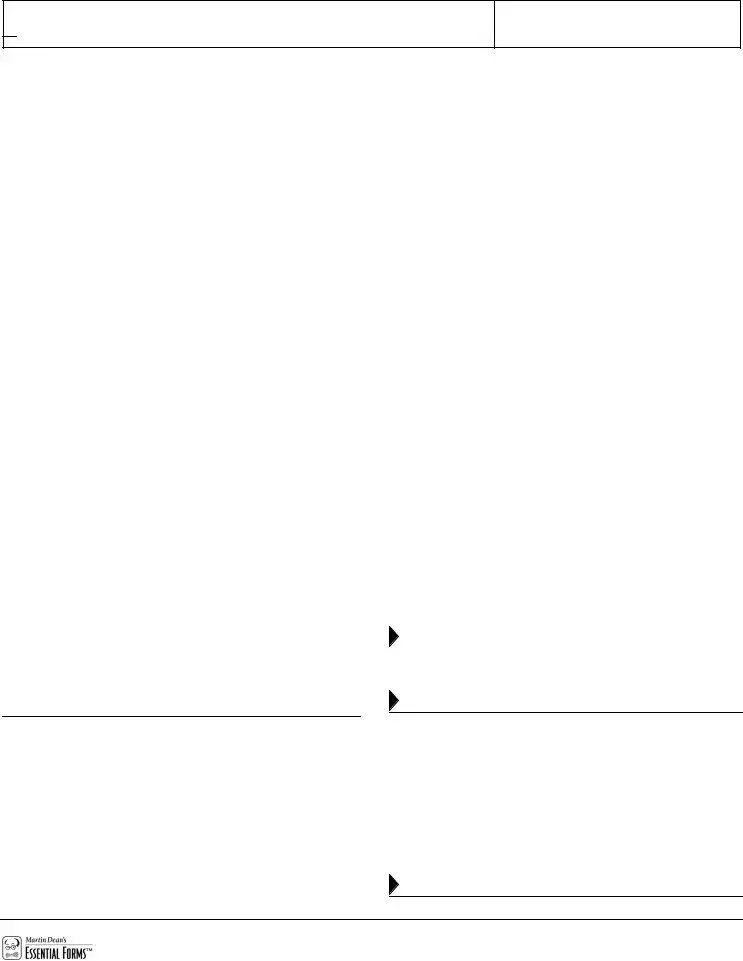
4. OTHER STATEMENTS
a. Defendant vacated the premises on (date) :
b. The fair rental value of the premises alleged in the complaint is excessive (explain) :
c. Other (specify) :
5. DEFENDANT REQUESTS
a. that plaintiff take nothing requested in the complaint.
b. costs incurred in this proceeding.
c. reasonable attorney fees.
d. that plaintiff be ordered to (1) make repairs and correct the conditions that constitute a breach of the warranty to provide
habitable premises and (2) reduce the monthly rent to a reasonable rental value until the conditions are corrected.
e. other (specify) :
6. Number of pages attached (specify) :
UNLAWFUL DETAINER ASSISTANT (Business and Professions Code sections 6400-6415)
7. (Must be completed in all cases) An unlawful detainer assistant did not did for compensation give advice or
assistance with this form. (If defendant has received any help or advice for pay from an unlawful detainer assistant, state) :
a. Assistant's name: b. Telephone No.:
c. Street address, city, and ZIP:
d. County of registration: e. Registration No.: f. Expires on (date) :
(TYPE OR PRINT NAME) (SIGNATURE OF DEFENDANT OR ATTORNEY)
(Each defendant for whom this answer is filed must be named in item 1 and must sign this answer unless his or her attorney signs.)
VERIFICATION
(Use a different verification form if the verification is by an attorney or for a corporation or partnership.)
I am the defendant in this proceeding and have read this answer. I declare under penalty of perjury under the laws of the State of California
that the foregoing is true and correct.
Date:
.................................................................................................................................................................
(TYPE OR PRINT NAME) (SIGNATURE OF DEFENDANT)
UD-105 [Rev. January 1, 2007] Page 2 of 2
ANSWER -
Unlawful Detainer
UD-105

Form Information

Fact Name Details
Form Title UD-105: Answer - Unlawful Detainer
Governing Laws Civil Code, § 1940 et seq.; Code of Civil Procedure, § 425.12
Purpose This form is used by defendants to respond to an unlawful detainer complaint.
Defendant's Options Defendants can either deny the allegations or admit to some while contesting others.
Affirmative Defenses Defendants can claim breaches of warranty, improper eviction, or discrimination, among others.
Attachments Additional facts supporting affirmative defenses must be attached and referenced.
Request for Relief Defendants can request costs, attorney fees, and repairs to the premises.
Unlawful Detainer Assistant Information about any assistance received must be disclosed, including the assistant's details.
Verification Requirement Defendants must sign to verify the truthfulness of the information provided under penalty of perjury.

Detailed Guide for Filling Out California Ud 105

After completing the California UD-105 form, the next steps involve filing it with the appropriate court and serving it to the plaintiff. It is essential to ensure that all information is accurate and complete to avoid delays in the legal process.

  1. At the top of the form, fill in your name and address as the defendant. Include your telephone number.
  2. For court use only, leave the section blank as it will be filled out by the court.
  3. Provide the name of the court, which is Humboldt Superior Court, and the street address: 825 5th St, Eureka, CA 95501.
  4. Write your name in the "Plaintiff" section and the name of the opposing party in the "Defendant" section.
  5. Enter the case number as provided in the complaint.
  6. In section 1, list the names of all defendants answering the complaint.
  7. In section 2, check only one box to either deny or admit the statements in the complaint. If admitting, specify any false statements or those you deny in the provided spaces.
  8. In section 3, check any affirmative defenses that apply. Provide brief facts to support each checked item in the space at the top of page two.
  9. In section 4, provide any additional statements, such as the date you vacated the premises or any other relevant information.
  10. In section 5, indicate any requests you have, such as costs incurred or repairs needed.
  11. In section 6, specify the number of pages attached, if any.
  12. In section 7, indicate whether an unlawful detainer assistant provided help. If so, fill in the assistant's details.
  13. Sign and print your name at the bottom of the form. If there are multiple defendants, ensure each one signs.
  14. Complete the verification section, declaring that the information provided is true and correct. Include the date and your signature.

Obtain Answers on California Ud 105

  1. What is the California UD-105 form?

    The California UD-105 form is a legal document used in unlawful detainer actions, which are eviction proceedings. It serves as the defendant's answer to the complaint filed by the plaintiff. This form allows the defendant to respond to the allegations made against them in the eviction notice.

  2. Who should use the UD-105 form?

    The UD-105 form should be used by defendants who have been served with an unlawful detainer complaint. It is essential for anyone facing eviction to respond formally to the court using this document to ensure their rights are protected.

  3. What information is required to complete the form?

    To complete the UD-105 form, defendants must provide:

    • Their name and address.
    • The name and address of the plaintiff.
    • The case number.
    • Responses to the allegations in the complaint, including any admissions or denials.
    • Any affirmative defenses they wish to assert.
    • Additional statements regarding the case.
  4. What are affirmative defenses?

    Affirmative defenses are legal reasons that a defendant can present to challenge the eviction. In the UD-105 form, defendants can check specific boxes to assert defenses such as nonpayment of rent due to habitability issues or retaliatory actions by the landlord. Each checked defense must be supported by brief facts.

  5. What should I do if I disagree with the complaint?

    If a defendant disagrees with the allegations in the complaint, they can choose to deny the statements. They must check the appropriate box on the form and provide details about which statements they believe are false or for which they lack information.

  6. How does the form address costs and repairs?

    In the UD-105 form, defendants can request that the court order the plaintiff to make necessary repairs or reduce the rent if the premises are not habitable. Additionally, defendants can request reimbursement for costs incurred during the proceedings.

  7. What happens if I do not respond to the complaint?

    Failure to respond to the unlawful detainer complaint using the UD-105 form can result in a default judgment against the defendant. This means that the court may automatically rule in favor of the plaintiff, allowing them to proceed with the eviction without the defendant's input.

  8. Is legal assistance required to complete the UD-105 form?

    While it is not mandatory to have legal assistance to complete the UD-105 form, it is highly recommended. Understanding the legal implications and ensuring that the form is filled out correctly can significantly impact the outcome of the case.

  9. Where can I obtain the UD-105 form?

    The UD-105 form can be obtained from the California Courts website or directly from the courthouse where the case is filed. It is essential to use the most current version of the form to ensure compliance with court requirements.

Common mistakes

Completing the California UD-105 form can be a daunting task, especially for those unfamiliar with legal documents. Many individuals make common mistakes that can lead to complications in their unlawful detainer cases. Awareness of these pitfalls is crucial for ensuring that your response is both accurate and effective.

One frequent error is failing to provide complete information about the parties involved. It is essential to include the full names of both the plaintiff and defendant in the designated areas. Omitting or misspelling names can cause delays and may even result in the dismissal of your case.

Another common mistake is neglecting to check the appropriate box in section 2. This section requires you to indicate whether you generally deny the complaint or admit to its statements with exceptions. Failing to check one of these boxes can lead to confusion about your stance and may affect the court's understanding of your case.

Additionally, many individuals forget to provide supporting facts for their affirmative defenses in section 3j. Each box checked in the affirmative defenses section must be accompanied by a brief explanation. Without this information, the court may not fully consider your defenses, weakening your position.

Inaccuracies in dates can also pose significant issues. For example, if you state a date when you vacated the premises or when rent was offered, ensure that it is correct. Incorrect dates can undermine your claims and may raise questions about your credibility.

People often overlook the requirement to specify the number of attached pages. This detail is crucial, as it informs the court of any additional information you are providing. Failing to include this can lead to misunderstandings about the completeness of your submission.

Another mistake is not signing the form correctly. Each defendant listed must sign the answer unless an attorney is signing on their behalf. A missing signature can render the form invalid and delay proceedings.

Some individuals also neglect to seek assistance from a qualified unlawful detainer assistant when needed. If you have received help, it is important to disclose this information accurately in the designated section. Failing to do so can lead to complications regarding the legitimacy of your submission.

Lastly, remember to review the entire form for clarity and coherence. Typos or unclear language can confuse the court and may weaken your argument. Taking the time to proofread can make a significant difference in how your case is perceived.

By being mindful of these common mistakes, you can enhance the likelihood of a favorable outcome in your unlawful detainer case. Attention to detail is vital, and ensuring that your form is complete and accurate can save you time and stress in the long run.

Documents used along the form

The California UD-105 form is used by defendants in unlawful detainer actions, often referred to as eviction cases. Alongside this form, several other documents may be required or helpful in the process. Understanding these documents can provide clarity and assist in navigating the legal landscape surrounding eviction proceedings.

  • UD-104: Answer - Unlawful Detainer - This form is similar to the UD-105 but is specifically designed for defendants who wish to file a response to an unlawful detainer complaint. It allows defendants to present their side of the case and assert any defenses they may have.
  • UD-100: Complaint - Unlawful Detainer - This document is filed by the landlord to initiate the eviction process. It outlines the reasons for the eviction and the specific relief sought, such as possession of the property or unpaid rent.
  • UD-150: Request to Set Case for Trial - If the case proceeds to trial, this form is used to request a court date. It is essential for ensuring that the case is heard in a timely manner.
  • UD-200: Judgment - Unlawful Detainer - After the trial, this form is used to record the court's decision. It details whether the landlord or the tenant prevails and outlines any orders made by the court.
  • UD-110: Notice of Motion and Motion to Quash - This document is filed if a defendant believes that the service of the complaint was not properly executed. It requests the court to dismiss the case based on improper service.
  • UD-120: Notice of Entry of Judgment - After a judgment is entered, this form notifies the parties involved that the judgment has been filed with the court. It is important for tracking the status of the case.
  • UD-145: Stipulation for Entry of Judgment - This form is used when both parties agree to a judgment without going to trial. It simplifies the process and can save time and resources for both the landlord and tenant.
  • Form FL-300: Request for Order - If there are additional issues to be resolved, such as requests for repairs or rent reductions, this form allows the tenant to formally request the court's intervention.
  • Form MC-050: Application to Waive Court Fees - If the defendant cannot afford court fees, this form can be submitted to request a waiver, ensuring that financial constraints do not prevent access to justice.

Each of these documents plays a crucial role in the unlawful detainer process. Understanding their purposes can empower defendants to effectively respond to eviction actions and protect their rights. It is advisable to consult with a legal professional to ensure all forms are completed accurately and submitted on time.

Similar forms

The California UD-105 form is an important document used in unlawful detainer actions. It shares similarities with several other legal forms used in similar contexts. Below is a list of eight documents that are comparable to the UD-105 form, along with a brief explanation of how they are similar.

  • UD-100 - Complaint - Unlawful Detainer: This form initiates the unlawful detainer process, outlining the plaintiff's claims against the defendant, similar to how the UD-105 allows the defendant to respond to those claims.
  • UD-120 - Judgment - Unlawful Detainer: This document is used to finalize the court's decision in an unlawful detainer case, similar to the UD-105 in that it addresses the outcome of the case based on the responses provided.
  • UD-140 - Request for Default Judgment: This form is filed when a defendant does not respond to the complaint, akin to the UD-105, which is the defendant's formal response to the claims made against them.
  • UD-150 - Request for Order to Show Cause: This document requests a court hearing to address specific issues, similar to how the UD-105 allows defendants to raise affirmative defenses and other requests.
  • FL-320 - Response to Petition: Used in family law cases, this form allows a party to respond to a petition, similar to how the UD-105 enables a defendant to answer a complaint in an unlawful detainer action.
  • PLD-050 - Answer - Contractual Dispute: This form is used to respond to a breach of contract claim, paralleling the UD-105's function of allowing a defendant to answer claims made in an unlawful detainer case.
  • SC-120 - Answer to Unlawful Detainer: This is a simplified version for small claims court, providing a similar purpose as the UD-105 but tailored for less complex cases.
  • MC-030 - Attachment to Judicial Council Form: This form allows for additional information to be submitted, similar to how the UD-105 includes attachments for further explanations of defenses and claims.

Dos and Don'ts

When filling out the California UD 105 form, keep these important tips in mind:

  • Do read the entire form carefully before starting. Understanding what is required will help you provide accurate information.
  • Do fill in all required fields completely. Incomplete forms can lead to delays or rejections.
  • Do check only one box for the response to the complaint. Selecting more than one can confuse your intent.
  • Do provide specific details in the affirmative defenses section. This strengthens your position.
  • Do sign and date the form before submitting it. An unsigned form is not valid.
  • Don't use vague language. Be clear and precise in your answers to avoid misunderstandings.
  • Don't forget to attach any additional pages needed for explanations. Ensure these are labeled correctly.
  • Don't ignore deadlines. Submit the form on time to avoid penalties or loss of rights.
  • Don't assume the court knows your situation. Provide all relevant facts and details.
  • Don't leave out your contact information. Ensure the court can reach you if necessary.

Misconceptions

Understanding the California UD-105 form is essential for anyone involved in an unlawful detainer action. However, several misconceptions can lead to confusion. Here are five common misconceptions about the UD-105 form, along with clarifications:

  • The UD-105 form is only for tenants who are being evicted. Many believe this form is solely for tenants facing eviction. In reality, it can also be used by landlords to assert their rights in the eviction process.
  • Filing the UD-105 form automatically stops the eviction process. Some individuals think that submitting this form halts all eviction proceedings. This is not true; the filing of the form is just one step in the legal process and does not guarantee a stop to eviction.
  • You cannot include affirmative defenses on the UD-105 form. There is a common belief that the form does not allow for any defenses. However, the UD-105 specifically provides sections for defendants to state affirmative defenses, which can be crucial for their case.
  • The UD-105 form is the same as a rental agreement. Some may confuse the UD-105 with rental agreements or leases. The UD-105 is a legal response to a complaint regarding unlawful detainer, while a rental agreement outlines the terms of tenancy.
  • Once the UD-105 is filed, you do not need to attend court. Many assume that filing the form means they can skip court appearances. However, attending court is often necessary to present your case and support your claims.

By understanding these misconceptions, individuals can better navigate the legal landscape surrounding unlawful detainer actions in California.

Key takeaways

Here are some key takeaways about filling out and using the California UD-105 form:

  • Understand the Purpose: The UD-105 form is used to respond to an unlawful detainer complaint, which typically involves eviction proceedings.
  • Identify the Parties: Clearly state the names of the plaintiff and defendant at the top of the form. This ensures the court knows who is involved.
  • Choose Your Response: You must check one of the two boxes regarding your stance on the complaint. Either deny all claims or admit to some while disputing others.
  • Affirmative Defenses: If applicable, list any affirmative defenses. These are reasons why the eviction should not proceed, such as improper notice or retaliatory actions by the landlord.
  • Provide Supporting Facts: For each affirmative defense you check, you must provide brief facts to support your claims. This information is crucial for your case.
  • Request Relief: Indicate what you want from the court. This could include costs, attorney fees, or specific orders for the landlord to make repairs.
  • Verification Requirement: Don’t forget to sign and date the form. This verifies that the information you provided is true to the best of your knowledge.

Completing the UD-105 form accurately can significantly impact the outcome of your case. Take your time to ensure all information is correct and complete.