The California Transfer-on-Death Deed (TOD) form provides a straightforward way for property owners to transfer real estate to their beneficiaries upon their passing, without the need for probate. This legally binding document allows individuals to maintain full control of their property during their lifetime while ensuring a smooth transition of ownership after death. By completing the TOD form, property owners can specify who will inherit their property, simplifying the process for their loved ones and potentially reducing costs associated with estate management. Importantly, this form can be revoked or changed at any time, offering flexibility to the property owner as their circumstances evolve. Understanding the nuances of the TOD deed is essential for anyone considering this option, as it ensures that their wishes are honored and provides peace of mind for both the owner and their beneficiaries.
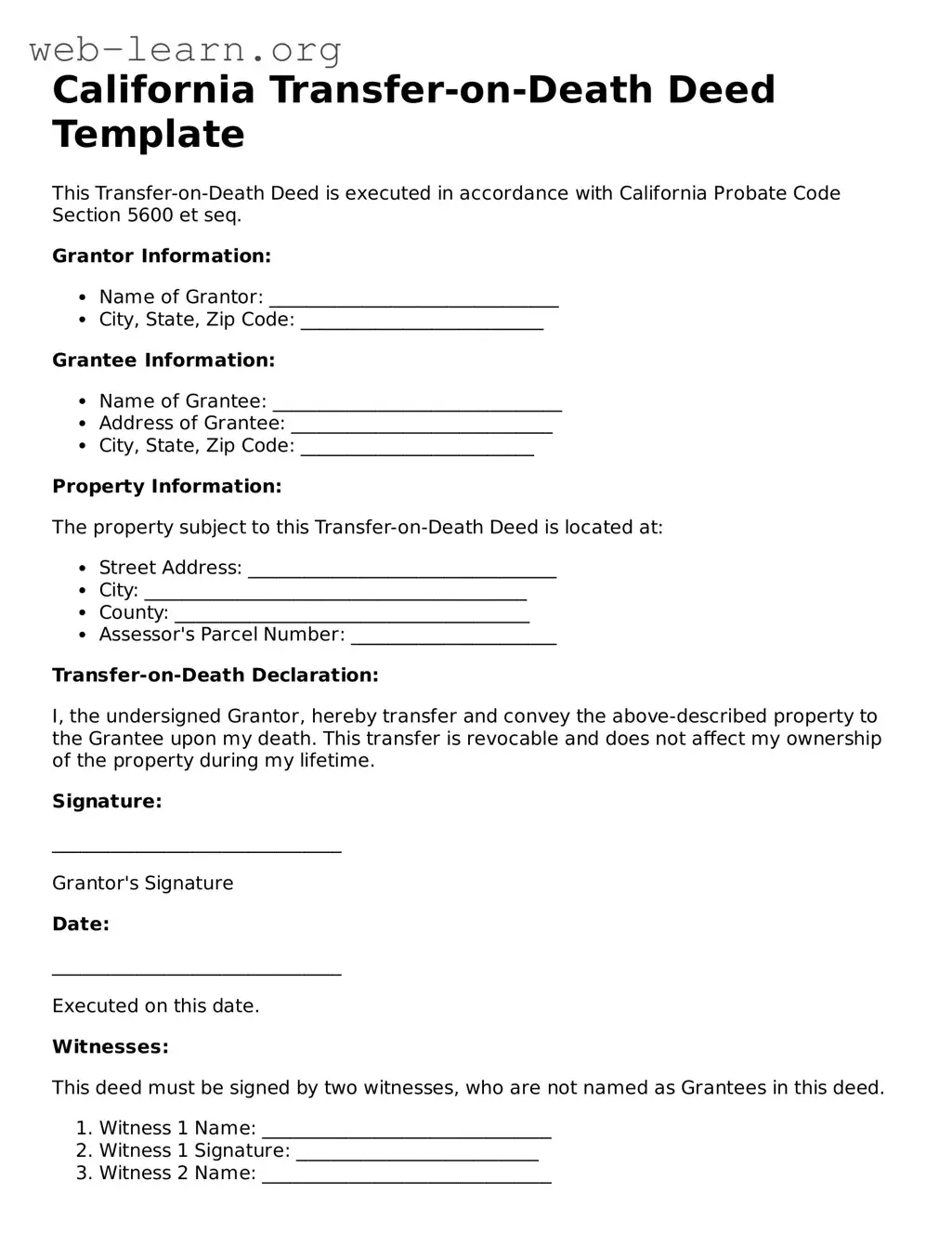
California Transfer-on-Death Deed Template
This Transfer-on-Death Deed is executed in accordance with California Probate Code Section 5600 et seq.
Grantor Information:
Grantee Information:
Property Information:
The property subject to this Transfer-on-Death Deed is located at:
Transfer-on-Death Declaration:
I, the undersigned Grantor, hereby transfer and convey the above-described property to the Grantee upon my death. This transfer is revocable and does not affect my ownership of the property during my lifetime.
Signature:
_______________________________
Grantor's Signature
Date:
_______________________________
Executed on this date.
Witnesses:
This deed must be signed by two witnesses, who are not named as Grantees in this deed.
Notary Public:
State of California, County of ______________________
On this ____ day of ____________, 20__, before me, ______________________, a Notary Public, personally appeared ______________________, known to me (or proved to me on the basis of satisfactory evidence) to be the person whose name is subscribed to the within instrument and acknowledged to me that he/she executed the same.
Witness my hand and official seal.
_______________________________
Notary Public Signature
My Commission Expires: ________________________
| Fact Name | Description |
|---|---|
| Definition | A Transfer-on-Death Deed allows property owners in California to transfer real estate to beneficiaries upon their death without going through probate. |
| Governing Law | The Transfer-on-Death Deed is governed by California Probate Code Sections 5600-5694. |
| Eligibility | Any individual who owns real property in California can create a Transfer-on-Death Deed. |
| Revocation | The deed can be revoked at any time before the property owner’s death, allowing for flexibility in estate planning. |
| Beneficiary Designation | Property owners can name one or more beneficiaries, who will receive the property directly upon the owner’s death. |
| Recording Requirement | The deed must be recorded with the county recorder’s office where the property is located to be effective. |
After you have gathered all necessary information, it’s time to fill out the California Transfer-on-Death Deed form. Make sure to have your property details and personal information ready. Follow these steps to complete the form accurately.
What is a Transfer-on-Death (TOD) Deed in California?
A Transfer-on-Death Deed is a legal document that allows a property owner to designate a beneficiary who will receive the property upon the owner's death. This deed is effective immediately upon signing but does not transfer ownership until the owner's death. It provides a way to avoid probate, simplifying the transfer process for heirs.
Who can create a Transfer-on-Death Deed?
Any individual who holds title to real property in California can create a Transfer-on-Death Deed. This includes sole owners, joint tenants, and tenants in common. However, the deed must be executed according to California law to be valid.
What properties can be transferred using a TOD Deed?
Generally, a Transfer-on-Death Deed can be used for residential real estate, including single-family homes, condominiums, and certain types of multi-family properties. It cannot be used for commercial properties, timeshares, or properties held in a trust.
How do I create a Transfer-on-Death Deed?
To create a TOD Deed, the property owner must complete the appropriate form, which includes details such as the property description and the beneficiary's information. The deed must then be signed and notarized. Finally, it must be recorded with the county recorder's office where the property is located to be effective.
Can I change or revoke a Transfer-on-Death Deed?
Yes, the property owner can change or revoke a Transfer-on-Death Deed at any time before their death. This can be done by creating a new deed or by formally revoking the existing deed. It is important to follow the same recording process to ensure that the changes are legally recognized.
What happens if the beneficiary predeceases the owner?
If the designated beneficiary dies before the property owner, the TOD Deed does not automatically transfer to the beneficiary's heirs. The owner may need to create a new deed to designate a different beneficiary. If no new beneficiary is named, the property will be distributed according to the owner's will or, if there is no will, according to state intestacy laws.
Are there any tax implications associated with a Transfer-on-Death Deed?
Generally, the transfer of property through a TOD Deed does not trigger immediate tax consequences. The property is included in the deceased owner's estate for tax purposes. Beneficiaries may be subject to capital gains taxes based on the property's value at the time of the owner's death, but they may also benefit from a step-up in basis.
Is legal assistance necessary to create a Transfer-on-Death Deed?
While it is possible to create a Transfer-on-Death Deed without legal assistance, consulting with an attorney is advisable. An attorney can ensure that the deed complies with all legal requirements and can help address any specific concerns regarding the property or beneficiaries.
Filling out a California Transfer-on-Death Deed form can be a straightforward process, but many people make common mistakes that can lead to complications down the line. Understanding these pitfalls can help ensure that the deed is executed correctly and serves its intended purpose.
One frequent error is failing to include the full legal name of the property owner. It’s essential to use the name as it appears on the property title. Omitting a middle name or using a nickname can create confusion and may invalidate the deed.
Another mistake involves not properly identifying the property being transferred. The form requires a complete legal description of the property, not just the address. This description can usually be found on the property’s title deed. Skipping this step can lead to issues with the transfer process.
Many individuals also overlook the importance of signing the deed in front of a notary public. While the form may seem complete, without a proper notarization, it may not be recognized as valid. This step is crucial for ensuring the deed is legally binding.
Additionally, people often forget to inform their beneficiaries about the existence of the Transfer-on-Death Deed. Without this communication, beneficiaries may be unaware of their rights and responsibilities, which can lead to disputes or confusion after the property owner’s passing.
Another common oversight is neglecting to review the deed after filling it out. Errors in the document can lead to legal challenges later on. Taking the time to double-check all information can save a lot of trouble in the future.
Some individuals may also fail to consider changes in their circumstances. Life events such as marriage, divorce, or the birth of a child can impact the intended beneficiaries. Updating the deed to reflect these changes is vital for ensuring that the property is transferred according to the owner’s wishes.
Moreover, people sometimes assume that a Transfer-on-Death Deed will automatically transfer all property interests. This is not always the case. If there are multiple owners, all must agree to the transfer, and any existing liens or debts may affect the transfer process.
Lastly, many individuals do not seek legal advice when filling out the deed. While the form may seem simple, consulting with an attorney can provide valuable insights and help avoid mistakes that could complicate the transfer process. Taking this step can provide peace of mind and ensure that all legal requirements are met.
The California Transfer-on-Death Deed allows property owners to transfer their real estate to beneficiaries upon their death without going through probate. To ensure a smooth transfer and to address related legal matters, several other forms and documents may be needed. Below is a list of commonly used documents that complement the Transfer-on-Death Deed.
These documents play important roles in the estate planning process. They help ensure that property transfers occur smoothly and that the wishes of the property owner are honored. Understanding these forms can simplify the transition for beneficiaries and help avoid potential disputes or complications.
The Transfer-on-Death Deed form shares similarities with several other legal documents. Here are four documents that are comparable:
When filling out the California Transfer-on-Death Deed form, it is important to approach the process with care. Here are seven essential do's and don'ts to keep in mind:
Understanding the California Transfer-on-Death Deed (TOD) can be confusing. Here are ten common misconceptions about this form, along with explanations to clarify them.
The Transfer-on-Death Deed specifically applies to real property, such as land or buildings. However, it does not cover personal property like cars or bank accounts.
While both a TOD deed and a will deal with the transfer of assets after death, a TOD deed allows for direct transfer of property without going through probate, whereas a will must go through probate.
Both individuals and married couples can use a Transfer-on-Death Deed. However, if a couple owns property jointly, they may need to consider how they want to designate beneficiaries.
The TOD deed is relatively straightforward. It requires basic information about the property and the beneficiaries, making it accessible for many people.
In California, you can revoke or change a Transfer-on-Death Deed at any time before your death. This flexibility allows you to adjust beneficiaries as needed.
The property does not transfer until the owner passes away. Until that time, the owner retains full control over the property.
A TOD deed does not eliminate estate taxes. The value of the property may still be included in the taxable estate, depending on the overall value of the estate.
Beneficiaries will need to wait until the owner's death to take possession. They may also need to file certain documents to formally claim the property.
The Transfer-on-Death Deed can benefit anyone who owns real estate and wants to simplify the transfer process for their loved ones, regardless of wealth.
While it is wise to consult a legal professional, many people can complete a TOD deed on their own using the proper forms, as long as they understand the requirements.
By clearing up these misconceptions, individuals can better understand how a Transfer-on-Death Deed works and how it might benefit their estate planning efforts.
When filling out and using the California Transfer-on-Death Deed form, it is essential to understand several key points. Here are some important takeaways:
Understanding these key aspects can help ensure that the Transfer-on-Death Deed is filled out correctly and serves its intended purpose effectively.
Transfer on Death Deed Kansas - A Transfer-on-Death Deed allows you to transfer property to a beneficiary upon your death.
Problems With Transfer on Death Deeds Ohio - Properly executed, the deed can provide a hassle-free transition for heirs.