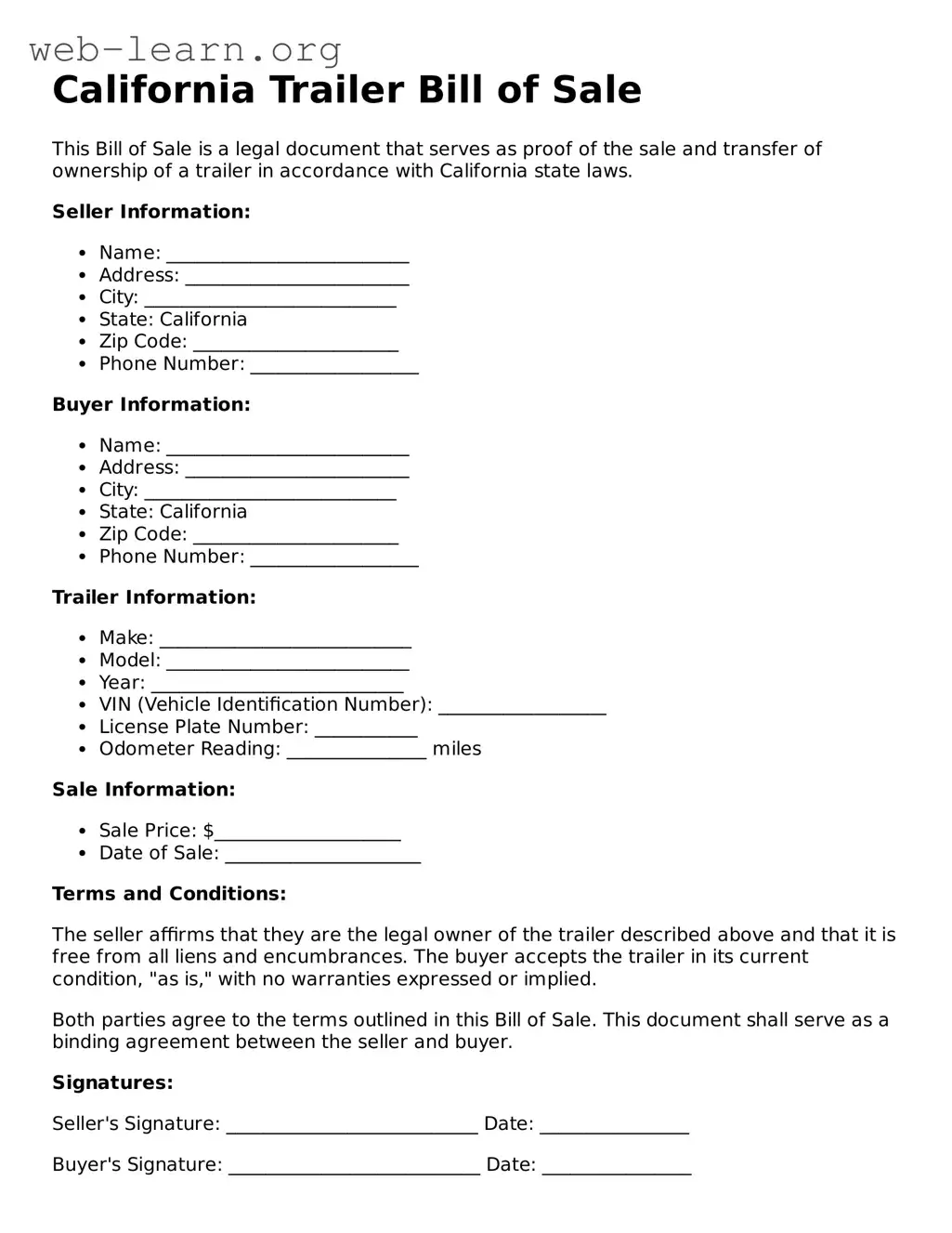
The California Trailer Bill of Sale form serves as a crucial document in the process of transferring ownership of a trailer from one party to another. This form is designed to provide a clear record of the transaction, ensuring that both the seller and buyer have a mutual understanding of the terms involved. Key elements of the form include the identification details of the trailer, such as its make, model, year, and vehicle identification number (VIN). Additionally, it captures the names and addresses of both the seller and buyer, along with the sale price and date of the transaction. The form may also include a section for the seller's signature, which is essential for validating the sale. By documenting these details, the California Trailer Bill of Sale not only facilitates a smooth transfer of ownership but also helps protect the interests of both parties in future disputes or claims. Properly filling out this form can aid in the registration process with the Department of Motor Vehicles (DMV), ensuring that the new owner can legally operate the trailer on public roads.
California Trailer Bill of Sale
This Bill of Sale is a legal document that serves as proof of the sale and transfer of ownership of a trailer in accordance with California state laws.
Seller Information:
Buyer Information:
Trailer Information:
Sale Information:
Terms and Conditions:
The seller affirms that they are the legal owner of the trailer described above and that it is free from all liens and encumbrances. The buyer accepts the trailer in its current condition, "as is," with no warranties expressed or implied.
Both parties agree to the terms outlined in this Bill of Sale. This document shall serve as a binding agreement between the seller and buyer.
Signatures:
Seller's Signature: ___________________________ Date: ________________
Buyer's Signature: ___________________________ Date: ________________
This Bill of Sale is governed by the laws of the State of California.
| Fact Name | Description |
|---|---|
| Purpose | The California Trailer Bill of Sale form is used to document the sale of a trailer between a buyer and a seller. |
| Governing Law | The form is governed by California Vehicle Code Section 5901. |
| Information Required | It requires details such as the trailer's make, model, year, Vehicle Identification Number (VIN), and the sale price. |
| Signatures | Both the seller and buyer must sign the form to validate the transaction. |
| Notarization | While notarization is not mandatory, it is recommended to add an extra layer of authenticity. |
| Transfer of Ownership | The form facilitates the transfer of ownership and can be presented to the Department of Motor Vehicles (DMV) for registration purposes. |
| Record Keeping | Both parties should keep a copy of the completed form for their records after the sale. |
Once you have the California Trailer Bill of Sale form ready, you can begin the process of filling it out. This form serves as a record of the sale and includes essential information about the buyer, seller, and the trailer being sold. Accurate completion is important for both parties involved in the transaction.
What is a California Trailer Bill of Sale form?
The California Trailer Bill of Sale form is a document used to record the sale of a trailer in the state of California. It serves as proof of ownership transfer from the seller to the buyer. This form includes essential details about the trailer, such as its make, model, year, and Vehicle Identification Number (VIN).
Why do I need a Bill of Sale for my trailer?
A Bill of Sale is important for several reasons. It protects both the buyer and seller by providing a legal record of the transaction. This document can help prevent disputes over ownership and can be required for registration with the California Department of Motor Vehicles (DMV).
What information is required on the form?
The form should include:
Do I need to have the form notarized?
No, notarization is not required for the California Trailer Bill of Sale. However, having it notarized can add an extra layer of security and verification to the transaction.
Can I use a Bill of Sale for a trailer purchased out of state?
Yes, you can use a Bill of Sale for a trailer purchased out of state. Just ensure that the document meets California's requirements for registration and includes all necessary information.
What if the trailer has a lien on it?
If there is a lien on the trailer, it must be resolved before the sale. The seller should provide proof that the lien has been satisfied, or the buyer should be aware of it and agree to take responsibility for it.
Is there a specific format I need to follow for the Bill of Sale?
While there is no strict format, the California DMV provides a standard Bill of Sale form that is recommended. Using this form can help ensure that all required information is included and that it meets state guidelines.
How do I register my trailer after completing the Bill of Sale?
After completing the Bill of Sale, take it to your local DMV office along with any other required documents, such as proof of insurance and payment for registration fees. The DMV will process the registration and issue new title documents.
What if I lose my Bill of Sale?
If you lose your Bill of Sale, you can request a duplicate from the seller, provided they are willing to provide one. It's a good practice to keep multiple copies of important documents like this.
Can I create my own Bill of Sale?
Yes, you can create your own Bill of Sale as long as it includes all necessary information. However, using the standard form provided by the DMV can simplify the process and ensure compliance with state requirements.
When filling out the California Trailer Bill of Sale form, individuals often encounter a variety of common mistakes that can lead to complications down the line. One frequent error is neglecting to include all necessary information about the trailer. Details such as the Vehicle Identification Number (VIN), make, model, and year are crucial. Omitting any of these can create confusion and may delay the transfer of ownership.
Another common mistake is failing to provide accurate seller and buyer information. It is essential to include full names, addresses, and contact information for both parties. Incomplete or incorrect details can hinder communication and may result in legal issues regarding ownership transfer.
Many people overlook the importance of signatures. Both the seller and the buyer must sign the document to validate the transaction. Without these signatures, the Bill of Sale may not be recognized as a legal document. Additionally, some individuals forget to date the form. Including the date is vital, as it establishes when the sale took place and can be important for record-keeping purposes.
Another mistake involves not providing a clear description of the trailer's condition. It is beneficial to note any existing damage or repairs. This transparency can prevent disputes later on, as it sets clear expectations regarding the trailer's state at the time of sale.
Some individuals also fail to indicate the purchase price. Leaving this section blank can create ambiguity and may lead to misunderstandings about the terms of the sale. Clearly stating the amount ensures both parties are on the same page regarding the financial aspect of the transaction.
In addition, people sometimes do not check for any outstanding liens on the trailer. If there are existing liens, the seller must address them before completing the sale. Failing to do so can result in legal ramifications for the buyer, who may unknowingly purchase a trailer that is not free and clear of debt.
Another frequent oversight is not making copies of the completed Bill of Sale. Both the buyer and seller should retain a copy for their records. This documentation serves as proof of the transaction and can be useful in future dealings or disputes.
Some individuals may also neglect to follow local regulations regarding the sale of trailers. Each county or city may have specific requirements that must be adhered to, and failing to comply can lead to penalties or complications with registration.
Lastly, many people do not seek assistance when needed. If there are uncertainties about how to fill out the form correctly, it is wise to consult a knowledgeable source. Taking the time to ensure accuracy can save significant trouble in the future.
The California Trailer Bill of Sale form serves as an essential document in the transfer of ownership for trailers. However, several other forms and documents are often utilized in conjunction with this bill of sale to ensure a smooth transaction and compliance with state regulations. Below is a list of these documents, each playing a significant role in the process.
Utilizing these documents alongside the California Trailer Bill of Sale form ensures that all aspects of the transaction are legally sound and that both parties are protected. Proper documentation simplifies the process and minimizes potential disputes in the future.
The Trailer Bill of Sale form serves a specific purpose in the sale of trailers. However, several other documents share similarities in structure and function. Here’s a list of those documents and how they relate to the Trailer Bill of Sale:
When filling out the California Trailer Bill of Sale form, it is important to follow certain guidelines to ensure the process goes smoothly. Here are ten things you should and shouldn't do:
Misconception 1: The Trailer Bill of Sale is only needed for new trailers.
This is incorrect. The Trailer Bill of Sale is required for both new and used trailers. It serves as proof of ownership transfer regardless of the trailer's age.
Misconception 2: A verbal agreement is sufficient for the sale of a trailer.
While verbal agreements can be made, they are not legally binding in the same way that a written bill of sale is. A written document provides clear evidence of the transaction and protects both parties.
Misconception 3: The Trailer Bill of Sale does not need to be notarized.
Notarization is not always necessary for a Trailer Bill of Sale. However, having the document notarized can add an extra layer of authenticity and may be required by some states for registration purposes.
Misconception 4: Once the bill of sale is signed, the seller has no further obligations.
This is misleading. While the bill of sale signifies the transfer of ownership, the seller may still have obligations related to warranties or disclosures about the trailer's condition, depending on state laws.
When filling out and using the California Trailer Bill of Sale form, it's important to keep several key points in mind. This document serves as proof of ownership transfer and can help avoid potential disputes in the future.
Understanding these key takeaways can help ensure a smooth transaction when buying or selling a trailer in California.
Registering a Trailer in Arkansas - Provides a straightforward way to handle trailer sales without needing a lawyer.
Michigan Trailer Towing Laws - Includes essential information about the trailer being sold.