Homepage Blank California Tr 0106 Form
Outline

The California TR 0106 form serves as a crucial document for individuals seeking to install and remove tire chains on motor vehicles during the snow season on designated State Routes. This application not only facilitates the permit process but also includes a release of liability, ensuring that applicants understand the risks involved in chain installation. The form requires applicants to provide personal information, such as their name, mailing address, and driver’s license number, along with details about any existing permits. A fee of $164.00 is associated with the application, which must be paid to process the request. The form emphasizes the importance of compliance with various conditions, including the conduct and workmanship expected from permit holders. Applicants must attend a mandatory orientation class, pass a written test, and demonstrate proficiency in tire chain installation before receiving their permit. Moreover, the document outlines the responsibilities of permit holders, including the need to display a sign indicating their fees and to issue receipts for services rendered. Violations can lead to penalties, including suspension or revocation of the permit. Overall, the TR 0106 form is designed to promote safety and professionalism among chain installers while ensuring that they adhere to state regulations.

Sample - California Tr 0106 Form

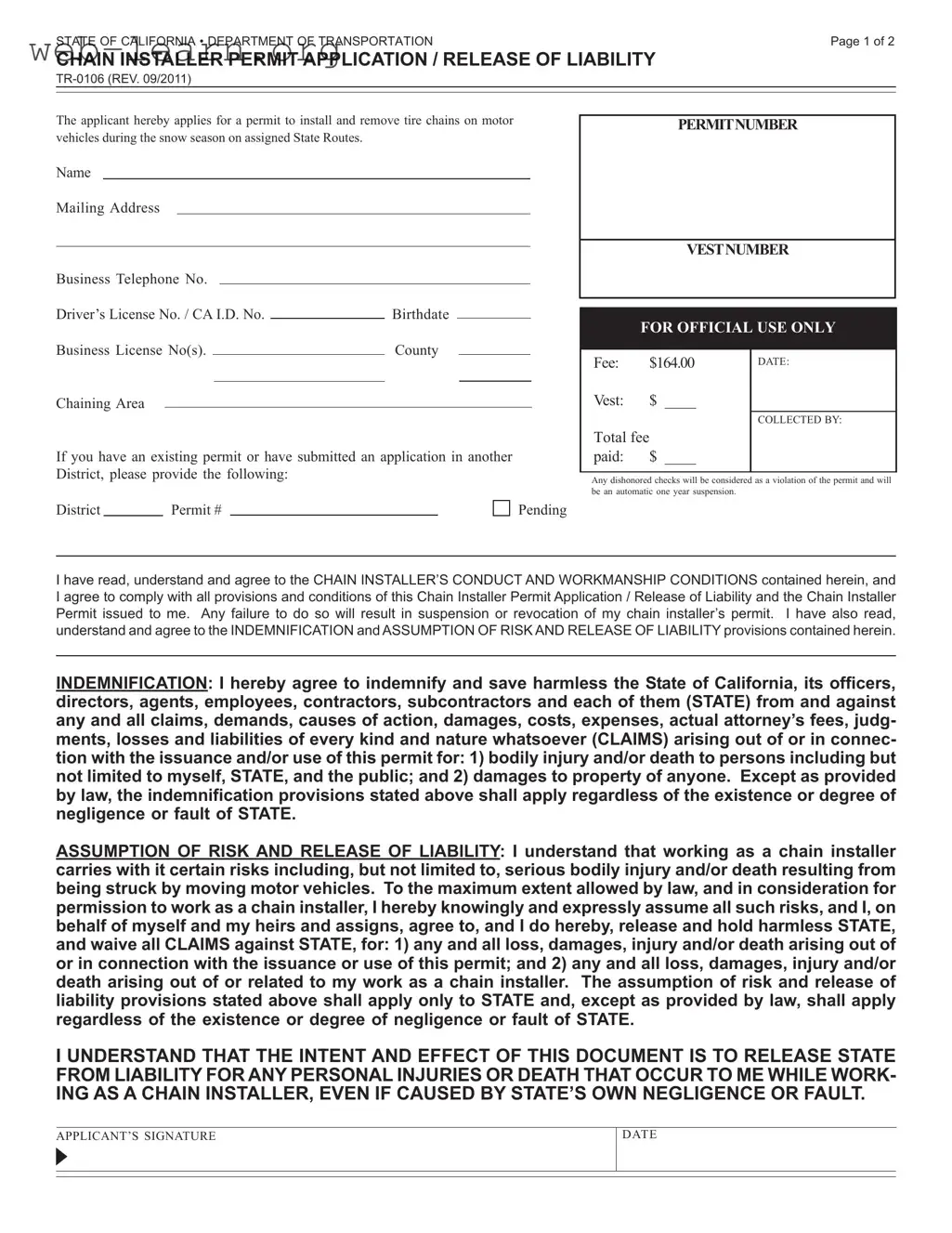
The applicant hereby applies for a permit to install and remove tire chains on motor
vehicles during the snow season on assigned State Routes.
Name
Mailing Address
Business Telephone No.
Drivers License No. / CA I.D. No. Birthdate
Business License No(s). County
Chaining Area
If you have an existing permit or have submitted an application in another
District, please provide the following:
District Permit # Pending
I have read, understand and agree to the CHAIN INSTALLER’S CONDUCT AND WORKMANSHIP CONDITIONS contained herein, and
I agree to comply with all provisions and conditions of this Chain Installer Permit Application / Release of Liability and the Chain Installer
Permit issued to me. Any failure to do so will result in suspension or revocation of my chain installer’s permit. I have also read,
understand and agree to the INDEMNIFICATION and ASSUMPTION OF RISK AND RELEASE OF LIABILITY provisions contained herein.
INDEMNIFICATION: I hereby agree to indemnify and save harmless the State of California, its officers,
directors, agents, employees, contractors, subcontractors and each of them (STATE) from and against
any and all claims, demands, causes of action, damages, costs, expenses, actual attorney’s fees, judg-
ments, losses and liabilities of every kind and nature whatsoever (CLAIMS) arising out of or in connec-
tion with the issuance and/or use of this permit for: 1) bodily injury and/or death to persons including but
not limited to myself, STATE, and the public; and 2) damages to property of anyone. Except as provided
by law, the indemnification provisions stated above shall apply regardless of the existence or degree of
negligence or fault of STATE.
ASSUMPTION OF RISK AND RELEASE OF LIABILITY: I understand that working as a chain installer
carries with it certain risks including, but not limited to, serious bodily injury and/or death resulting from
being struck by moving motor vehicles. To the maximum extent allowed by law, and in consideration for
permission to work as a chain installer, I hereby knowingly and expressly assume all such risks, and I, on
behalf of myself and my heirs and assigns, agree to, and I do hereby, release and hold harmless STATE,
and waive all CLAIMS against STATE, for: 1) any and all loss, damages, injury and/or death arising out of
or in connection with the issuance or use of this permit; and 2) any and all loss, damages, injury and/or
death arising out of or related to my work as a chain installer. The assumption of risk and release of
liability provisions stated above shall apply only to STATE and, except as provided by law, shall apply
regardless of the existence or degree of negligence or fault of STATE.
I UNDERSTAND THAT THE INTENT AND EFFECT OF THIS DOCUMENT IS TO RELEASE STATE
FROM LIABILITY FOR ANY PERSONAL INJURIES OR DEATH THAT OCCUR TO ME WHILE WORK-
ING AS A CHAIN INSTALLER, EVEN IF CAUSED BY STATE’S OWN NEGLIGENCE OR FAULT.
PERMIT NUMBER
FOR OFFICIAL USE ONLY
Fee: $164.00
Vest: $ ____
Total fee
paid: $ ____
DATE:
COLLECTED BY:
STATE OF CALIFORNIA • DEPARTMENT OF TRANSPORTATION Page 1 of 2
CHAIN INSTALLER PERMIT APPLICATION / RELEASE OF LIABILITY
TR-0106 (REV. 09/2011)
APPLICANT’S SIGNATURE
Any dishonored checks will be considered as a violation of the permit and will
be an automatic one year suspension.
DATE
VEST NUMBER
STATE OF CALIFORNIA DEPARTMENT OF TRANSPORTATION Page 2 of 2
CHAIN INSTALLER PERMIT APPLICATION / RELEASE OF LIABILITY
TR-0106 (REV. 09/2011)
DEPARTMENT OF TRANSPORTATION ENCROACHMENT PERMIT
CHAIN INSTALLER’S CONDUCT AND WORKMANSHIP CONDITIONS
In accordance with Section 670 of the Streets and Highways Code, permission is hereby granted to install and remove tire chains for compensation within the State’s Highway rights-of-way when required by the Department,
relating to the safe and orderly movement of traffic, for the safe operation of the highways. The permittee shall operate in compliance with Section 670 of the Streets and Highways Code and all provisions of this Encroachment
Permit and the Chain Installer Permit Application/Release of Liability he/she executed including the Conduct and Workmanship Conditions stated herein, and shall conform to all other applicable State and local laws. If the
county or other political subdivision within which the permittee intends to install chains requires the permittee to have a business license in order to collect fees for doing this work, such business license shall be obtained
by the permittee and the license must be presented before this Encroachment Permit will become valid for use. This Permit may be suspended or revoked as provided in these Conduct and Workmanship Conditions, for non-
compliance with any of the provisions of this Encroachment Permit or the Chain Installer Permit Application/Release of Liability executed to obtain this permit, at any time by any Departmental representative or the California
Highway Patrol. The permittee shall surrender, upon demand by any Departmental representative or the California Highway Patrol, their chain installer permit and chain installer identification vest. Failure to comply shall
be cause for denial of any future chain installer permits.
Prior to issuance of a permit, all chain installer applicants shall attend a mandatory chain installer orientation class, pass a written test, and demonstrate knowledge of snow tire identification and proficiency in tire chain
installation. Failure to attend the mandatory chain installer orientation class, shall result in permanent revocation. The number of permits available for issuance is limited. First consideration shall be given to prior applicants
of the previous winter season, providing their permits were not suspended for more than 30 days or revoked during the previous winter season.
Any permits suspended near the end of the winter season, and/or if the suspension is found to be ineffective at the time so ordered in the opinion of the District Permit Engineer, may be applied to the next winter season if so
stated in the letter of suspension to the permitee.
Appeals of any punitive action taken against a chain installer permittee, shall be submitted in writing within 5 business days to the District Permit Engineer at:
____________________________________________________________________________________________________________________________________________________________________________________
A written decision shall be rendered within 10 business days from the receipt of the written appeal. The District Permit Engineer’s written decision may be appealed in writing within 5 business days, to the District Director
in which the permit was issued. The District Director’s decision shall be rendered in writing within 10 working days from the receipt of the appeal, and this decision is final. (There are no further administrative rights
of appeal.)
Penalties noted in this permit are minimums. Severe penalties may be imposed for any infraction of Permit Conditions if warranted by the circumstances, or by the permittee’s conduct.
All permit fees paid to the Department of Transportation are nonrefundable
1. When installing, removing, repairing or modifying tire chains, the permittee shall display a sign (measuring a minimum of 12” x 24” up to a maximum of 18” x 36”) advising motorists in advance of their fee for providing
these services, and their vest number. The letters shall be a minimum of four inches high with a minimum brush stroke of 5/8”. A permittee failing to display this sign, and/or display of any other type of advertising sign other
than this required sign will be issued a warning, and shall cease work until the unauthorized display is removed.
2. The permittee shall be in possession of a receipt book and shall issue one when requested by a motorist. The receipt shall show the permittee’s name, vest number, the type of work performed (installing, removing, repairing,
modifying tire chains), and the fee charged for the work. A permittee failing to issue a receipt for services provided when requested, shall be suspended for 7 days.
3. This Permit is non-transferable, only the person to whom it was issued is to perform the services authorized herein, and shall have it in their possession at all times when performing said services. This Permit shall be
presented for inspection upon demand by any departmental representative, the California Highway Patrol, or any local law enforcement personnel. A warning will be issued to any permittee found to be working without their
permit in their immediate possession, they shall cease work immediately, and surrender their identifying vest, until their permit can be produced to regain their identifying vest.
4. Any person found working under a permit not issued to them, and any permittee allowing such use, shall immediately surrender the permit. And, neither individual will be eligible for issuance of a chain installer permit for
a minimum of one year.
5. A colored vest containing the permittee’s identifying number will be issued along with this permit. THIS VEST IS THE PROPERTY OF THE DEPARTMENT. The vest shall be worn in plain sight in a legible manner at
all times by the permittee while performing the services specified herein. A permittee found to be working without their vest being clearly legible, shall be issued a warning, and shall cease all work until their vest and identifying
number are made clearly visible.
6. Loss of a permittee’s permit or identification vest shall be immediately reported to the Department’s district office that issued the permit. Application for a duplicate permit or identification vest may be made during normal
business hours. A duplicate permit will be issued upon payment of the administrative fee (equal to one hour multiplied by the Standard Hourly Rate). A replacement vest will be issued upon payment of the administrative fee
plus the cost of the vest itself.
7. A permittee may only park a single vehicle within the State’s highway rights-of-way in the area designated by the Department or the California Highway Patrol, and only during the time the permittee is engaged in activities
authorized by this permit. Parking on State conventional highways in similarly designated areas shall conform with the applicable provision of the Vehicle Code. If a permittee’s vehicle is parked in a location or manner that
interferes or impedes with highway traffic, snow removal equipment, or parked on any freeway ramp or taper, the permittee shall be suspended for 7 days.
8. Permittees are not allowed in the lanes maintained for through traffic. A permittee shall remain in the area designated for installation or removal of tire chains. Any interference, stopping, or controlling of traffic by flagging,
signs, arm movements, the waving of signs or lights, etc., impeding the orderly movement of traffic caused by a permittee shall result in a suspension for 7 days.
9. Vending or renting of tire chains, tire chain accessories, or other items or products upon any State highway rights-of-way by a permittee is strictly prohibited. A permittee offering to sell or rent tire chains or other items,
or who accepts money for the sale or rental of tire chains or other items, shall immediately surrender his/her permit and identification vest and shall be ineligible for issuance of a chain installer permit for a minimum of one
year. Such a permittee may be subject to prosecution for violation of the law (Streets and Highways Code Section 731) prohibiting vending on State highways.
10. Permittees shall conduct their business in a professional and courteous manner. A permittee found to display poor workmanship in installing chains, giving misleading statements concerning the necessity for altering
chains, misrepresenting any conditions or requirements regarding chain regulations, or causing complaints relative to his/her conduct shall be issued a warning. These violations may result in suspension or revocation
of permit privileges, depending on the circumstances of the incident and the conduct of the permittee. A permittee presenting any form of threat of violence toward any person or property while involved in the activities related
to this permit shall immediately surrender his/her permit and identification vest and he/she shall be permanently ineligible for issuance of a chain installer permit.
11. Permittees shall wear yellow, orange or lime colored raingear (rain suit or jacket and class E pants). Personal protective safety clothing shall meet the Performance Class 3 requirements of the ANSI/ISEA 107-2004
entitled "American National Standard for Safety Apparel and Headwear". A permittee found working without proper rain gear will be issued a warning, and shall immediately cease work, surrender his/her permit, and identification
vest. Work may resume when the permittee is equipped with the proper rain gear and has regained their permit and identification vest.
12. Permittees shall only work in established chain installing areas. A permittee found working in an area other than the established area will be suspended for the winter season and shall immediately surrender his/her permit
and identification vest.
13. Permittees shall be 18 years of age or older. A permittee found to have obtained his/her permit by falsifying their age shall immediately surrender their permit and identification vest. And, shall not be eligible for issuance
of a chain installer permit for a period of one-year extending beyond the date they attain 18 years of age.
14. A permittee maintaining an open fire or littering on the highway right of way shall be issued a warning.
15. A permittee may apply for a second chain installer permit in another district, provided there is no established waiting list.
16. Unless surrendered, suspended or revoked as provided in the Permit package conditions, a permit shall expire on June 30 in the year following its issuance.
17. A permittee shall not use any work lights in a manner that would impact motorists on the highway or the snow clearing equipment operators.
For individuals with sensory disabilities, this document is available in alternate formats. For information call (916) 654-6410 or TDD (916) 654-3880 or write Records and Forms Management,
1120 N Street, MS-89, Sacramento, CA 95814.
ADA NOTICE

Form Information

Fact Name Fact Description
Form Purpose The TR 0106 form is used to apply for a permit to install and remove tire chains on motor vehicles during the snow season on designated State Routes.
Governing Law This form is governed by Section 670 of the Streets and Highways Code of California.
Application Fee The application fee for the permit is $164.00.
Indemnification Clause Applicants agree to indemnify the State of California against any claims related to the use of the permit.
Assumption of Risk Applicants acknowledge the risks involved in working as a chain installer and assume all associated risks.
Mandatory Orientation All applicants must attend a mandatory orientation class before receiving the permit.
Non-Transferable The permit is non-transferable and can only be used by the individual to whom it was issued.
Expiration Date The permit will expire on June 30 of the year following its issuance unless surrendered or revoked.

Detailed Guide for Filling Out California Tr 0106

Filling out the California TR 0106 form is an essential step for those seeking a permit to install and remove tire chains during the snow season. The following steps will guide you through the process, ensuring that you provide all necessary information accurately.

  1. Obtain the Form: Download the TR 0106 form from the California Department of Transportation website or request a physical copy from your local office.
  2. Fill in Your Personal Information: Start by entering your full name, mailing address, business telephone number, and driver's license or California ID number.
  3. Add Your Birthdate: Include your date of birth in the specified format.
  4. Business License Information: If applicable, provide your business license number(s) and the county where you will operate.
  5. Chaining Area: Specify the chaining area where you plan to work.
  6. Existing Permit Details: If you have an existing permit or have submitted an application in another district, include the permit number and vest number.
  7. Fee Payment: Prepare to pay the required fee of $164.00. Indicate the total fee paid on the form.
  8. Read the Conduct and Workmanship Conditions: Carefully read the conditions outlined in the form. Acknowledge your understanding by signing and dating the application.
  9. Submit the Form: Once completed, submit your application to the appropriate district office. Make sure to keep a copy for your records.

After submitting the form, you will await further instructions regarding the next steps in the permit process. This may include attending a mandatory orientation class and passing a written test to ensure you are prepared for the responsibilities of a chain installer.

Obtain Answers on California Tr 0106

  1. What is the California TR 0106 form?

    The California TR 0106 form is an application for a Chain Installer Permit. This permit allows individuals to install and remove tire chains on motor vehicles during the snow season on designated State Routes. The form includes a release of liability, which means that applicants agree to certain terms and conditions regarding their work as chain installers.

  2. Who needs to fill out the TR 0106 form?

    Anyone who wishes to work as a chain installer on California's highways must complete the TR 0106 form. This includes individuals who plan to install or remove tire chains for compensation during the snow season. It's important for applicants to ensure they meet all requirements before applying.

  3. What are the fees associated with the TR 0106 form?

    The application fee for the Chain Installer Permit is $164. This fee must be paid at the time of application. Additionally, any dishonored checks will lead to a violation of the permit, resulting in a one-year suspension.

  4. What is required to obtain a Chain Installer Permit?

    To obtain a Chain Installer Permit, applicants must attend a mandatory orientation class, pass a written test, and demonstrate their proficiency in tire chain installation. Additionally, applicants must comply with all local and state laws, including obtaining any necessary business licenses.

  5. What happens if a permit is suspended or revoked?

    If a permit is suspended or revoked, the individual must surrender their permit and identification vest. They may be ineligible for future permits for a minimum of one year, depending on the circumstances surrounding the suspension or revocation.

  6. Can I transfer my Chain Installer Permit to someone else?

    No, the Chain Installer Permit is non-transferable. Only the person to whom it was issued is authorized to perform the services specified in the permit. Attempting to allow someone else to use the permit can result in suspension or revocation.

  7. What should I do if I lose my permit or identification vest?

    If a permittee loses their permit or identification vest, they must report the loss to the district office that issued the permit immediately. A duplicate permit or vest can be obtained during normal business hours, but administrative fees may apply.

  8. What are the conduct and workmanship conditions for chain installers?

    Chain installers must conduct their work in a professional manner, adhere to safety guidelines, and comply with all applicable laws. Violations can lead to warnings, suspensions, or even permanent revocation of the permit, depending on the severity of the infraction.

  9. How long is the Chain Installer Permit valid?

    The Chain Installer Permit is valid until June 30 of the year following its issuance, unless it is surrendered, suspended, or revoked. If the permit is not renewed or reissued, it will expire at that time.

Common mistakes

When filling out the California TR-0106 form, applicants often make several common mistakes that can lead to delays or even denials of their permit applications. One frequent error is failing to provide complete personal information. This includes not filling in the name, mailing address, or business telephone number. Incomplete information can cause the application to be returned for correction, wasting time for both the applicant and the reviewing agency.

Another mistake is neglecting to include the correct driver’s license or CA ID number. This number is essential for identifying the applicant and confirming their eligibility. If this information is missing or incorrect, it may result in a rejection of the application.

Many applicants also forget to include their birthdate or business license number. These details are crucial for verifying the identity and legality of the business. Omitting them can lead to unnecessary complications in the application process.

Additionally, applicants sometimes overlook the requirement to provide their permit number and vest number if they have previously applied or hold an existing permit. This information helps streamline the application process and ensures that all relevant records are updated accurately.

Another common error involves the payment section. Applicants may forget to include the total fee or miscalculate the amount due. The form clearly states the fee is $164.00, and any discrepancies can lead to processing delays.

Some individuals fail to read and understand the Chain Installer’s Conduct and Workmanship Conditions. Ignoring these provisions can lead to non-compliance issues, which may result in suspension or revocation of the permit. It is crucial to acknowledge these conditions to avoid future problems.

Another mistake is not signing and dating the application. The signature indicates that the applicant agrees to all terms and conditions laid out in the document. Without a signature, the application is considered incomplete.

Applicants may also neglect to attend the mandatory orientation class or pass the required written test before applying. This step is vital for ensuring that all chain installers are knowledgeable about their responsibilities and safety protocols.

Finally, failing to keep a copy of the submitted application can be a significant oversight. Having a record of what was submitted is essential for tracking the application status and addressing any issues that may arise.

Documents used along the form

The California Tr 0106 form is essential for those applying for a permit to install and remove tire chains during the snow season. However, several other documents and forms often accompany this application. Understanding these additional documents can help streamline the application process and ensure compliance with all regulations. Below is a list of these related forms.

  • Encroachment Permit: This document grants permission to work within the state’s highway rights-of-way. It outlines the conditions under which chain installers can operate and ensures compliance with local laws.
  • Business License: Required by some counties, this license allows individuals to legally operate a business that charges for tire chain installation services. It must be presented before the encroachment permit is valid.
  • Receipt Book: Chain installers must carry a receipt book to issue receipts to motorists. This document verifies the type of service provided and the fee charged.
  • Orientation Class Certificate: Applicants must attend a mandatory class to learn about tire chain installation and safety procedures. A certificate of completion is often required for permit issuance.
  • Indemnification Agreement: This form outlines the applicant's agreement to indemnify the state against any claims arising from their activities as a chain installer, ensuring legal protection for the state.
  • Assumption of Risk Acknowledgment: This document confirms that the applicant understands the risks involved in chain installation and waives certain rights to claim damages against the state.
  • Traffic Control Plan: Depending on the location, a plan may be required to manage traffic safely while performing chain installation. This ensures that motorists are not endangered during operations.
  • Insurance Certificate: Proof of insurance may be required to protect against potential liabilities arising from accidents or injuries during the installation process.
  • Application for Duplicate Permit: In case of loss or damage, this form is used to request a duplicate of the original permit, ensuring that the installer can continue working legally.
  • Compliance Checklist: This document helps applicants ensure they meet all necessary requirements before submitting their application, preventing delays or rejections.

Being aware of these additional forms and documents can significantly enhance your application experience. Each document serves a specific purpose, ensuring that all activities related to tire chain installation are conducted safely and legally. Make sure to gather all necessary paperwork before proceeding with your application to avoid any complications.

Similar forms

The California TR 0106 form serves as a Chain Installer Permit Application and Release of Liability. It is important to understand that this document shares similarities with several other forms and permits within California's regulatory framework. Below is a list of documents that are comparable to the TR 0106 form, along with a brief explanation of how they relate:

  • Business License Application: Like the TR 0106, a business license application requires the applicant to provide personal information and agree to certain conditions to operate legally within a jurisdiction.
  • Contractor's License Application: This form is similar in that it also requires applicants to demonstrate knowledge of their trade and agree to comply with safety and conduct regulations.
  • Vehicle Registration Application: Both documents necessitate personal identification and include fees that must be paid for processing, ensuring compliance with state laws.
  • Occupational Safety and Health Administration (OSHA) Training Certification: Similar to the TR 0106, this certification involves an understanding of safety protocols and assumes liability for risks associated with specific work environments.
  • Environmental Impact Assessment (EIA): This document, like the TR 0106, involves a formal application process that requires an understanding of regulations and potential liabilities associated with environmental impacts.
  • Permit for Temporary Road Closures: This permit shares similarities in that it regulates activities affecting public safety and requires compliance with specific conduct guidelines.
  • Food Vendor Permit: Much like the TR 0106, this permit requires vendors to adhere to health and safety regulations while operating in public spaces, emphasizing liability and compliance.
  • Public Event Permit Application: This document, similar to the TR 0106, requires organizers to acknowledge risks and liabilities associated with hosting events in public areas, ensuring public safety.

Understanding these similarities can help clarify the purpose and requirements of the TR 0106 form. Each of these documents is designed to ensure compliance with state regulations while protecting both the individuals involved and the public at large.

Dos and Don'ts

When filling out the California TR-0106 form, there are several important guidelines to follow. Here’s a helpful list of what you should and shouldn’t do:

  • Do double-check all personal information for accuracy, including your name, address, and contact details.
  • Do ensure you have the correct fee amount ready, as any dishonored checks can lead to permit suspension.
  • Do read and understand the terms and conditions outlined in the application before signing.
  • Do keep a copy of the completed form for your records after submission.
  • Don't forget to provide your business license number if required for your area.
  • Don't leave any sections blank; incomplete applications may delay processing.

Following these guidelines will help ensure a smoother application process for your Chain Installer Permit. Being thorough and attentive to detail is key!

Misconceptions

Understanding the California TR 0106 form can be challenging, especially with the various misconceptions surrounding it. Here are some common misunderstandings that people often have:

  • It’s just a simple application. Many believe the TR 0106 is merely a straightforward application. In reality, it involves a comprehensive understanding of liability, conduct, and safety regulations.
  • Anyone can apply for a permit. Some think that anyone can obtain a chain installer permit. However, applicants must meet specific qualifications, including age and completion of mandatory training.
  • The permit is transferable. A common myth is that the permit can be transferred to another individual. In fact, the permit is non-transferable and must be used solely by the person to whom it was issued.
  • There are no fees associated with the application. Many assume that applying for the TR 0106 is free. However, there is a fee of $164.00 that must be paid upon application.
  • Once you have the permit, you can work anywhere. Some individuals think they can work anywhere on the highway once they have the permit. In truth, there are designated areas for chain installation, and working outside these areas can lead to penalties.
  • Liability is not a concern. A misconception is that liability concerns are minimal. However, the form includes extensive indemnification clauses, meaning applicants assume significant responsibility for any incidents that may occur.
  • All permits last indefinitely. Many believe that once a permit is issued, it lasts forever. In reality, permits expire on June 30 of the year following their issuance unless surrendered, suspended, or revoked.
  • Working without proper gear is acceptable. Some think they can work without the required safety gear. However, failure to wear proper raingear or safety clothing can result in immediate suspension of the permit.
  • Complaints do not affect the permit. Lastly, there’s a belief that complaints about a permittee's conduct will not impact their permit status. In fact, poor conduct or workmanship can lead to warnings, suspensions, or even revocation of the permit.

By understanding these misconceptions, applicants can navigate the process more effectively and ensure compliance with the regulations surrounding the California TR 0106 form.

Key takeaways

Key Takeaways for Filling Out and Using the California TR 0106 Form:

  • The application fee is $164.00, and any dishonored checks will result in a one-year suspension of the permit.
  • Applicants must attend a mandatory orientation class and pass a written test to obtain the permit.
  • The permit is non-transferable and must be kept in possession while performing services related to chain installation.
  • Failure to comply with the permit conditions can lead to suspension or revocation of the permit.