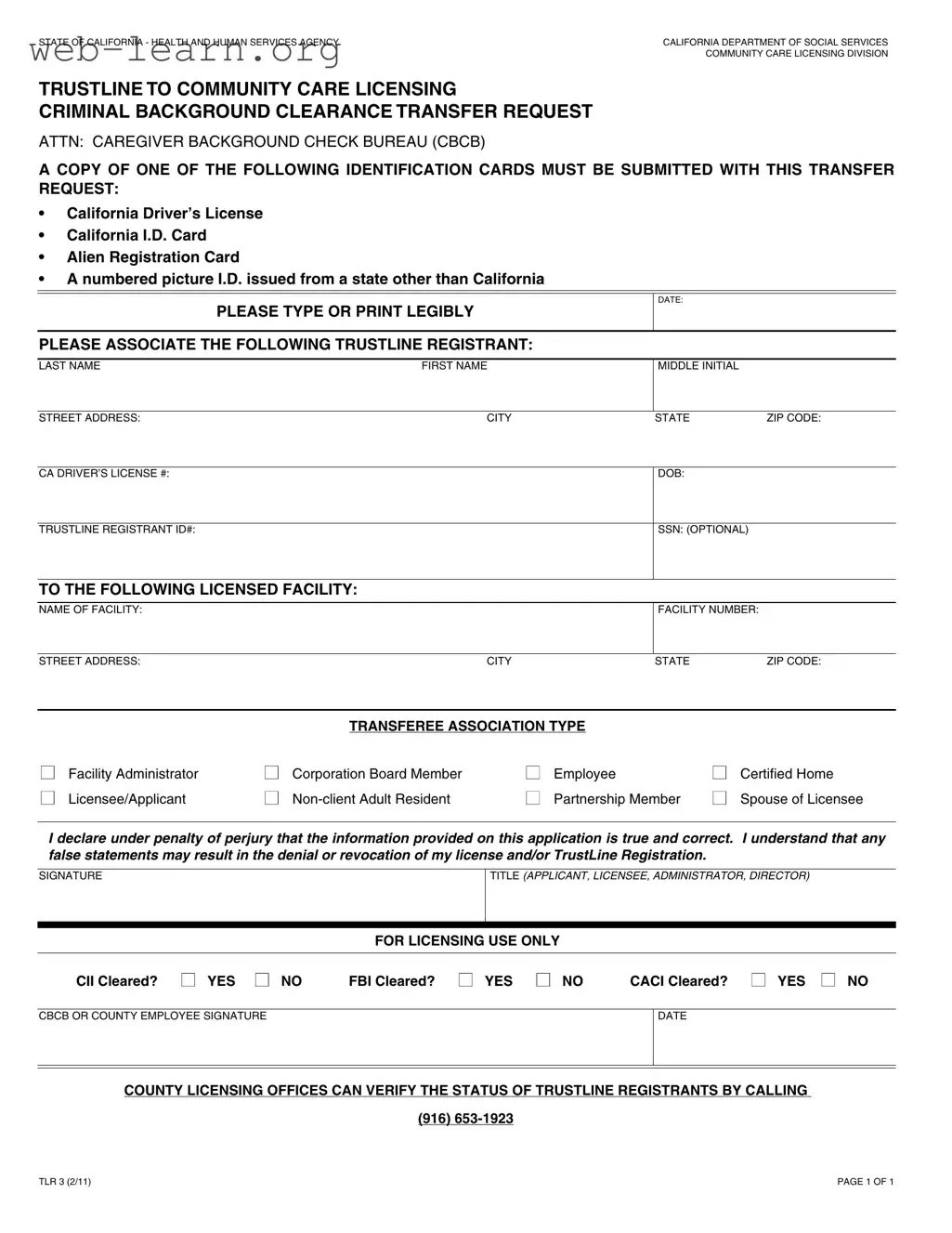
The California TLR 3 form serves as a critical document for individuals seeking to transfer their TrustLine registration to a licensed facility within the state. This form is specifically designed for caregivers and other individuals associated with community care licensing, requiring detailed information about the registrant and the facility to which they are transferring. Key elements include the registrant's personal identification, such as a California Driver's License or another form of ID, along with their TrustLine registrant ID and social security number, although the latter is optional. The form also necessitates the identification of the licensed facility, including its name, facility number, and address. Additionally, the TLR 3 form captures the nature of the relationship between the registrant and the facility, categorizing roles such as employee, administrator, or board member. By signing the form, the applicant affirms the accuracy of the provided information and acknowledges the potential consequences of any false statements. This form is essential for ensuring that all caregivers meet the necessary background clearance requirements before working in licensed facilities, thus promoting safety and compliance within California's community care system.
| Fact Name | Details |
|---|---|
| Governing Law | This form is governed by California Health and Safety Code, Sections 1500-1560. |
| Purpose | The TLR 3 form is used for transferring a criminal background clearance for caregivers in licensed facilities. |
| Identification Requirements | A copy of a valid identification card must be submitted, such as a California Driver’s License or an Alien Registration Card. |
| Trustline Registrant Information | Applicants must provide personal details, including last name, first name, and Trustline Registrant ID. |
| Facility Information | The form requires information about the licensed facility, including its name and facility number. |
| Declaration Statement | Applicants must declare that the information provided is true, with potential penalties for false statements. |
| Licensing Verification | County licensing offices can verify Trustline registrant status by calling (916) 653-1923. |
Filling out the California TLR 3 form requires attention to detail. Gather the necessary identification and ensure that all information is accurate. Once completed, this form can be submitted to the appropriate licensing authority.
What is the California TLR 3 form?
The California TLR 3 form is a request for transferring a criminal background clearance for caregivers within the state. This form is specifically used by individuals who are registered with TrustLine and wish to associate themselves with a licensed facility, such as a daycare or care home.
Who needs to fill out the TLR 3 form?
Anyone who is a TrustLine registrant and is seeking to work or reside in a licensed facility must complete the TLR 3 form. This includes facility administrators, employees, board members, and even spouses of licensees. It is crucial for these individuals to ensure their background clearance is properly transferred to maintain compliance with California regulations.
What identification is required when submitting the TLR 3 form?
When submitting the TLR 3 form, you must include a copy of one of the following identification cards:
Providing proper identification is essential for verifying your identity and ensuring a smooth transfer process.
What happens if the information provided is incorrect?
It is critical to provide accurate information on the TLR 3 form. If any false statements are made, it may lead to the denial or revocation of your license and/or TrustLine registration. Always double-check your entries to avoid any complications.
How can I verify the status of a TrustLine registrant?
If you need to verify the status of a TrustLine registrant, you can do so by calling the California Department of Social Services at (916) 653-1923. This step can help you confirm that the individual has the necessary background clearance before proceeding with any employment or residency arrangements.
Filling out the California TLR 3 form requires attention to detail, and mistakes can lead to delays or even denials in processing. One common error is failing to submit the required identification. The form specifies that a copy of a valid ID, such as a California driver’s license or a state-issued ID, must accompany the request. Omitting this crucial document can halt the application process.
Another frequent mistake involves providing incomplete or inaccurate personal information. Applicants often overlook the necessity of typing or printing legibly. Illegible handwriting can lead to misunderstandings or misprocessing of the application. Additionally, inaccuracies in the name, address, or other identifying details can create significant issues, potentially resulting in the application being returned.
People sometimes neglect to indicate the correct association type on the form. The TLR 3 includes multiple options for the relationship to the licensed facility, such as "Facility Administrator" or "Employee." Failing to select the appropriate category can confuse the reviewers and complicate the background check process.
Another error occurs when applicants do not sign the form. The declaration at the end of the application requires a signature, affirming that the information provided is true. A missing signature can lead to automatic rejection of the application, as it is essential for verifying the applicant's commitment to honesty.
Some individuals mistakenly believe that providing their Social Security Number is mandatory. However, the form clearly states that this information is optional. Not understanding this can lead to unnecessary anxiety or hesitation when filling out the application.
Finally, applicants often overlook the importance of checking the licensing use section. This area is meant for internal use by the licensing office, but ensuring that it is filled out correctly can help streamline the processing of the application. Any discrepancies here could result in additional follow-up or delays.
The California TLR 3 form is essential for transferring a TrustLine registration to a licensed facility. However, several other documents often accompany this form to ensure a smooth process. Below is a list of these documents, each serving a specific purpose in the background clearance and licensing process.
Each of these documents plays a vital role in the transfer process. Ensuring that all necessary paperwork is submitted correctly can help facilitate a quicker and more efficient transition for caregivers entering licensed facilities.
The California TLR 3 form is a document used for transferring criminal background clearance requests related to caregivers. It shares similarities with several other documents. Below is a list of these similar documents and how they relate to the TLR 3 form.
When filling out the California TLR 3 form, it’s important to follow specific guidelines to ensure your application is processed smoothly. Here’s a list of things you should and shouldn’t do:
Following these guidelines will help ensure that your form is processed without unnecessary delays. If you have questions, don’t hesitate to reach out for assistance.
Understanding the California TLR 3 form can be a bit tricky, and there are several misconceptions that often arise. Here are five common myths along with clarifications to help you navigate this important document.
This is not true. The TLR 3 form is used for transferring existing TrustLine registrants to a licensed facility. It's essential for both new and current caregivers to understand their obligations.
Identification is mandatory. A copy of a valid ID, such as a California Driver’s License or a state-issued picture ID, must accompany the transfer request. This helps ensure that the identity of the registrant is verified.
Actually, providing the TrustLine registrant ID number is crucial. It helps streamline the processing of your request and ensures that the correct individual is associated with the transfer.
This is a serious misconception. The form requires you to declare that the information provided is true and correct. False statements can lead to significant consequences, including denial or revocation of your license.
A signature is a vital part of the TLR 3 form. It confirms that you, as the applicant or authorized individual, are responsible for the information provided. Submitting the form without a signature may result in delays or rejection.
When filling out the California TLR 3 form, it’s important to keep several key points in mind: