Homepage Blank California Std 830 Form
Outline

The California Std 830 form is an essential document for businesses seeking to participate in state contracts under the Target Area Contract Preference Act (TACPA). This form allows eligible California-based firms to request bidding preferences when responding to solicitations for goods and services, provided the contract value exceeds $100,000. The TACPA aims to stimulate economic growth in distressed areas by offering a 5% preference for worksite eligibility and an additional 1% to 4% preference for hiring eligible employees from these areas. To qualify, bidders must certify that a significant portion of the labor hours will be performed within designated TACPA zones. The form requires detailed information about the firms involved in the contract, including their addresses and projected labor hours. It also necessitates a clear identification of the Census Tract and Block Group numbers, which can be obtained from local planning offices or the U.S. Census Bureau. Completing this form accurately is crucial, as incomplete or incorrect information may lead to the denial of preference requests. Additionally, bidders must acknowledge the legal ramifications of providing false information, which can include penalties and ineligibility for future contracts.

Sample - California Std 830 Form

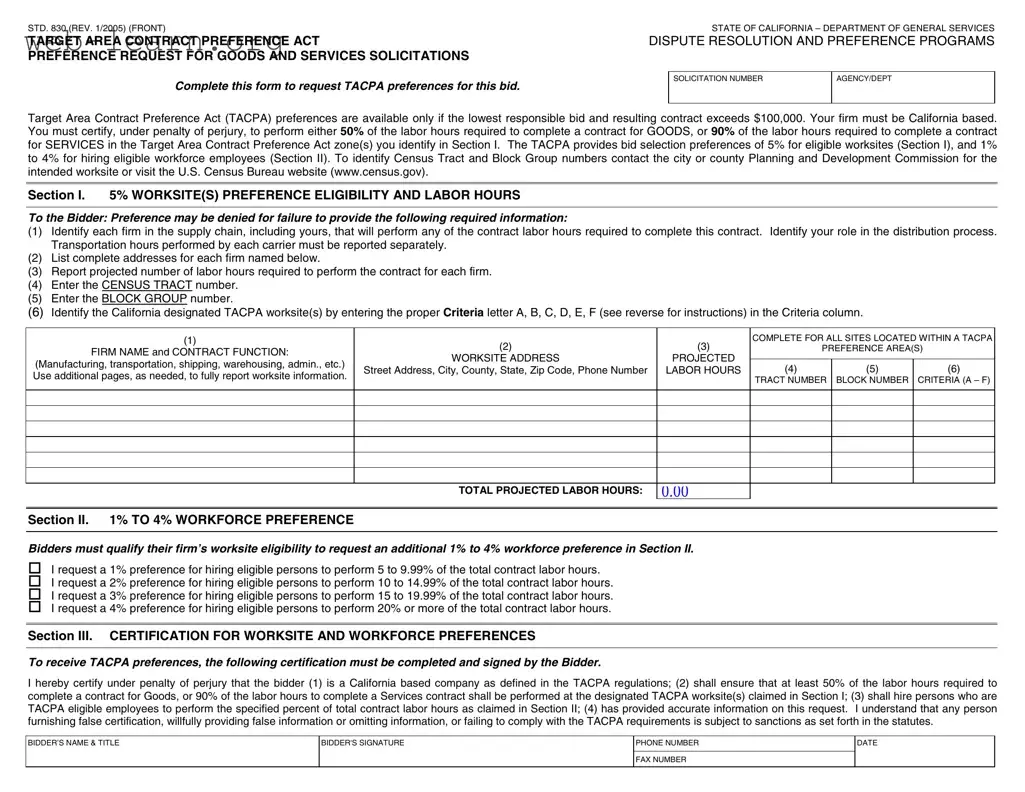
STD. 830 (REV. 1/2005) (FRONT) STATE OF CALIFORNIA – DEPARTMENT OF GENERAL SERVICES
TARGET AREA CONTRACT PREFERENCE ACT DISPUTE RESOLUTION AND PREFERENCE PROGRAMS
PREFERENCE REQUEST FOR GOODS AND SERVICES SOLICITATIONS
Complete this form to request TACPA preferences for this bid.
Target Area Contract Preference Act (TACPA) preferences are available only if the lowest responsible bid and resulting contract exceeds $100,000. Your firm must be California based.
You must certify, under penalty of perjury, to perform either 50% of the labor hours required to complete a contract for GOODS, or 90% of the labor hours required to complete a contract
for SERVICES in the Target Area Contract Preference Act zone(s) you identify in Section I. The TACPA provides bid selection preferences of 5% for eligible worksites (Section I), and 1%
to 4% for hiring eligible workforce employees (Section II). To identify Census Tract and Block Group numbers contact the city or county Planning and Development Commission for the
intended worksite or visit the U.S. Census Bureau website (www.census.gov).
SOLICITATION NUMBER AGENCY/DEPT
Section I. 5% WORKSITE(S) PREFERENCE ELIGIBILITY AND LABOR HOURS
To the Bidder: Preference may be denied for failure to provide the following required information:
(1) Identify each firm in the supply chain, including yours, that will perform any of the contract labor hours required to complete this contract. Identify your role in the distribution process.
Transportation hours performed by each carrier must be reported separately.
(2) List complete addresses for each firm named below.
(3) Report projected number of labor hours required to perform the contract for each firm.
(4) Enter the CENSUS TRACT
number.
(5) Enter the BLOCK GROUP
number.
(6) Identify the California designated TACPA worksite(s) by entering the proper Criteria letter A, B, C, D, E, F (see reverse for instructions) in the Criteria column.
COMPLETE FOR ALL SITES LOCATED WITHIN A TACPA
PREFERENCE AREA(S)
(1)
FIRM NAME and CONTRACT FUNCTION:
(Manufacturing, transportation, shipping, warehousing, admin., etc.)
Use additional pages, as needed, to fully report worksite information.
(2)
WORKSITE ADDRESS
Street Address, City, County, State, Zip Code, Phone Number
(3)
PROJECTED
LABOR HOURS
(4)
TRACT NUMBER
(5)
BLOCK NUMBER
(6)
CRITERIA (A – F)
TOTAL PROJECTED LABOR HOURS:
Section II. 1% TO 4% WORKFORCE PREFERENCE
Bidders must qualify their firm’s worksite eligibility to request an additional 1% to 4% workforce preference in Section II.
I request a 1% preference for hiring eligible persons to perform 5 to 9.99% of the total contract labor hours.
I request a 2% preference for hiring eligible persons to perform 10 to 14.99% of the total contract labor hours.
I request a 3% preference for hiring eligible persons to perform 15 to 19.99% of the total contract labor hours.
I request a 4% preference for hiring eligible persons to perform 20% or more of the total contract labor hours.
Section III. CERTIFICATION FOR WORKSITE AND WORKFORCE PREFERENCES
To receive TACPA preferences, the following certification must be completed and signed by the Bidder.
I hereby certify under penalty of perjury that the bidder (1) is a California based company as defined in the TACPA regulations; (2) shall ensure that at least 50% of the labor hours required to
complete a contract for Goods, or 90% of the labor hours to complete a Services contract shall be performed at the designated TACPA worksite(s) claimed in Section I; (3) shall hire persons who are
TACPA eligible employees to perform the specified percent of total contract labor hours as claimed in Section II; (4) has provided accurate information on this request. I understand that any person
furnishing false certification, willfully providing false information or omitting information, or failing to comply with the TACPA requirements is subject to sanctions as set forth in the statutes.
BIDDER’S NAME & TITLE BIDDER'S SIGNATURE PHONE NUMBER DATE
FAX NUMBER
0.00
STD. 830 (REV. 1/2005) (REVERSE)
TARGET AREA CONTRACT PREFERENCE ACT
PREFERENCE REQUEST FOR GOODS AND SERVICES SOLICITATIONS
Target Area Contract Preference Act References and Instructions
The Target Area Contract preference Act (TACPA), GC §4530 et seq., and 2 CCR §1896.30
et seq., promotes employment and economic development at designated distressed areas by
offering 5% worksite and 1% to 4% workforce bidding preferences in specified state
contracts. The TACPA preferences do not apply to contracts where the worksite is fixed by
the contract terms. These preferences only apply to bidders who are California based firms,
and only when the lowest responsible bid and resulting contract exceed $100,000. Bidders
must certify, under penalty of perjury to perform either 50% (for GOODS contracts) or 90%
(for SERVICES contracts) of the labor hours required to complete this contract in the eligible
TACPA area worksite(s) identified in Section I on the reverse side of this page. TACPA
preferences are limited to 9%, or a maximum of $50,000 per bid. In combination with any
other preferences, the maximum limit is 15% of the lowest responsible bid; and, in no case
more than $100,000 per bid.
Section I
Worksite Preference Eligibility and Labor Hours
Bidders must identify at least one eligible TACPA worksite by entering the criteria letter A, B,
C, D, E or F in the “Criteria” column and enter the “Census Tract” and “Block Group”
Numbers to be eligible for the preference. You must name each and every firm or site where
contract labor hours will be worked. Preference requests may be denied if an eligible
California TACPA worksite is not identified, or all firms performing contract labor hours are
not identified. Enter one of the following “Criteria” letters to identify each TACPA worksite on
the reverse page:
A. The firm is located in a California eligible distressed area(s).
B. The firm will establish a worksite(s) in a California eligible distressed area(s).
C. The firm is in a census tract with a contiguous boundary adjacent to a California eligible
distressed area.
D. The firm will establish a worksite(s) located directly adjoining a valid TACPA census
tract/block group that when attached to the California eligible distressed area(s) forms a
contiguous boundary.
E. The bidder will purchase the contract goods from a manufacturer(s) in a California
eligible distressed area(s). This option applies to solicitations for GOODS only.
F. The bidder will purchase contract goods from a manufacturer(s) in directly adjoining
census tract blocks that when attached to the California eligible distressed area(s) forms
a contiguous boundary. This option applies to solicitations for GOODS only.
Enter labor hours for each listed firm and site. The hours shall be reasonable and shall only
include the labor hours necessary and required to complete the contract activities. Artificially
increasing hours at a claimed TACPA worksite, or understating labor hours worked outside
the eligible worksite may result in a denied preference request. Do not include machine time
and non-labor time when projecting contract labor hours. Report all bidder work hours and
those of any subcontractor performing this contract. All transportation hours must be reported
for each carrier separately and must not be combined or included with hours for
manufacturing, processing, or administration, or at any eligible TACPA site. Failure to list all
the labor hours to be performed at the reportable sites will result in a denial of this preference
request.
The bidder must explain, by activity, their firm's projected contract labor hours by completing
and signing the
Bidder’s Summary
form (included with this solicitation).
STATE OF CALIFORNIA – DEPARTMENT OF GENERAL SERVICES
DISPUTE RESOLUTION AND PREFERENCE PROGRAMS
If supplying goods, the bidder must also provide a completed and signed
Manufacturer’s
Summary
form (included with this solicitation) that specifies the number of projected labor
hours necessary to make the product(s).
Section II
Workforce Preference
Eligibility to request a workforce preference is based on the bidder first claiming and receiving
approval of the 5% TACPA worksite preference. The workforce preferences are only awarded
if the bidder hires and employs the TACPA qualified individuals. Workforce preferences will
not be approved for another firm's employees. By claiming a workforce preference
percentage, the bidder must have its eligible employees perform the specified percentage of
the total contract workforce labor hours. See Section I, “Total Projected Labor Hours,”
STD. 830. To claim the workforce preferences select or check the appropriate box for percent
of requested bid preferences in Section II.
Section III
Certification for Worksite and Workforce Preferences
Bidder must sign, under penalty of perjury, the certification contained in Section III to be
eligible for any of the preferences requested pursuant to this form. The penalties associated
with the TACPA statute are: GC §4535.1, a business which requests and is given the
preference by reason of having furnished a false certification, and which by reason of that
certification has been awarded a contract to which it would not otherwise have been entitled,
shall be subject to all of the following:
(a) Pay to the State any difference between the contract amount and what the State's cost
would have been if the contract had been properly awarded.
(b) In addition to the amount specified in subdivision (a), be assessed a penalty in an
amount of not more than 10 percent of the amount of the contract involved.
(c) Be ineligible to directly or indirectly transact any business with the State for a period of
not less than six months and not more than 36 months.
Prior to the imposition of any sanction under this chapter, the contractor or vendor shall be
entitled to a public hearing and to five days notice of the time and place thereof. The notice
shall state the reasons for the hearing.
If you receive an award based on these preferences you will be required to report
monthly on your contract performance, labor hours, and TACPA compliance.
For questions concerning preferences and calculations, or if a bid solicitation does not include
preference request forms, please call the awarding Department's contract administrator. Only
another California certified small business can use TACPA, EZA or LAMBRA preferences to
displace a California certified small business bidder.
To identify TACPA distressed worksites contact the local city or county Planning/Economic
Development offices of the proposed worksite, or go to http://factfinder.census.gov
and click
on “Enter a street address” to find a Census Tract and Block Group. Verify the Census Tract
and Block numbers for TACPA sites by calling the DGS, Procurement Division preference line
at (916) 375-4609.

Form Information

Fact Name Details
Governing Law The Target Area Contract Preference Act is governed by GC §4530 et seq. and 2 CCR §1896.30 et seq.
Eligibility Criteria Bidders must be California-based and the contract amount must exceed $100,000 to qualify for TACPA preferences.
Labor Hour Requirements For goods contracts, at least 50% of labor hours must be performed at the TACPA worksite; for services, it’s 90%.
Preference Percentages Bidders can receive a 5% worksite preference and an additional 1% to 4% workforce preference based on hiring eligible employees.

Detailed Guide for Filling Out California Std 830

Filling out the California Std 830 form is a crucial step for businesses seeking preferences under the Target Area Contract Preference Act (TACPA). This form requires specific information about your business, worksite, and labor hours. Follow these steps to ensure you complete the form accurately.

  1. Obtain the form: Download the California Std 830 form from the appropriate state website or request a hard copy.
  2. Fill in the solicitation number: At the top of the form, enter the solicitation number associated with your bid.
  3. Identify your agency or department: Write the name of the agency or department you are submitting the bid to.
  4. Section I – Worksite Preference:
    • List each firm in your supply chain that will perform contract labor hours.
    • Provide complete addresses for each firm listed.
    • Report the projected number of labor hours required for each firm.
    • Enter the Census Tract number for each worksite.
    • Enter the Block Group number for each worksite.
    • Identify the TACPA worksite criteria by entering the appropriate letter (A-F).
  5. Section II – Workforce Preference: Indicate your request for workforce preferences by checking the appropriate box for the percentage of total labor hours you plan to hire eligible persons.
  6. Section III – Certification: Complete the certification statement, ensuring that you affirm your compliance with TACPA requirements. Sign and date the form.
  7. Review: Double-check all entries for accuracy and completeness before submitting the form.
  8. Submit the form: Send the completed form to the designated agency or department as instructed in the bid solicitation.

After submitting the form, keep a copy for your records. You may need to provide additional documentation or reports regarding your contract performance and compliance with TACPA requirements in the future.

Obtain Answers on California Std 830

  1. What is the California Std 830 form?

    The California Std 830 form is a document used to request preferences under the Target Area Contract Preference Act (TACPA) for bids related to goods and services. This form is essential for California-based firms aiming to secure bidding preferences when the contract amount exceeds $100,000. It facilitates the identification of eligible worksite and workforce preferences that can enhance a bidder's competitive edge.

  2. Who is eligible to use the Std 830 form?

    Eligibility to use the Std 830 form is limited to California-based firms. To qualify for TACPA preferences, the firm must certify that it will perform a significant portion of the labor hours required for the contract within designated TACPA areas. Specifically, this means performing at least 50% of labor hours for goods contracts and 90% for services contracts.

  3. What are the preferences available through TACPA?

    The TACPA provides two main types of preferences: worksite preferences and workforce preferences. The worksite preference offers a 5% bidding advantage for contracts performed in eligible distressed areas. Additionally, workforce preferences can range from 1% to 4%, depending on the percentage of labor hours performed by eligible employees. The specific percentage is determined by the amount of labor hours these employees contribute to the total contract.

  4. What information is required on the Std 830 form?

    To complete the Std 830 form, bidders must provide detailed information including:

    • The names and addresses of all firms involved in the contract.
    • The projected number of labor hours for each firm.
    • The Census Tract and Block Group numbers for the worksite.
    • The specific criteria that qualify the worksite for TACPA preferences.

    Failure to provide this information can result in the denial of the preference request.

  5. What are the consequences of providing false information?

    Providing false information on the Std 830 form carries serious penalties. If a bidder is found to have submitted false certifications or omitted information, they may face sanctions. These can include being required to pay the difference between the awarded contract amount and what it would have cost the state had the contract been properly awarded. Additional penalties may also apply, including a potential ban from conducting business with the state for a specified period.

  6. How can bidders ensure compliance with TACPA requirements?

    Bidders must carefully complete the Std 830 form and ensure that all information is accurate. They should maintain documentation of labor hours and workforce participation, as compliance will be monitored through monthly reporting after the contract is awarded. Consulting with local planning or economic development offices can also provide guidance on identifying eligible TACPA worksite locations.

  7. Where can additional information about TACPA and the Std 830 form be found?

    For further details regarding the TACPA and the Std 830 form, bidders can visit the California Department of General Services website or contact the awarding department's contract administrator. Additionally, the U.S. Census Bureau website can be a valuable resource for identifying Census Tract and Block Group numbers necessary for completing the form.

Common mistakes

Completing the California Std 830 form can be straightforward, but several common mistakes can lead to complications. One frequent error is failing to identify all firms involved in the supply chain. Each firm that will perform contract labor hours must be listed. Omitting any firm can result in a denial of the preference request.

Another mistake is not providing complete addresses for each firm. Each address must include the street address, city, county, state, and zip code. Incomplete information can create delays and hinder the processing of the form.

Reporting projected labor hours inaccurately is also a common issue. Bidders should ensure that the hours reported are realistic and necessary for completing the contract. Overstating or understating these hours can lead to a denial of the request.

Some individuals forget to enter the required Census Tract and Block Group numbers. This information is crucial for determining eligibility for TACPA preferences. Without these numbers, the request may be considered incomplete.

Additionally, bidders often fail to select the appropriate Criteria letters for their worksite. Each worksite must be identified correctly by entering the corresponding letter from A to F in the Criteria column. Incorrect selections can jeopardize the preference request.

Another mistake involves not certifying under penalty of perjury. Bidders must complete and sign the certification in Section III. Failing to do so can invalidate the entire request.

Some bidders neglect to provide accurate information regarding the labor hours required for contract activities. All labor hours, including those of subcontractors, must be reported. Incomplete reporting can lead to a denial of the preference request.

Lastly, not understanding the maximum limits for TACPA preferences can lead to complications. Bidders should be aware that the maximum preference is 9%, or $50,000 per bid. Exceeding these limits can result in disqualification from receiving preferences.

Documents used along the form

The California Std 830 form is essential for businesses seeking preferences under the Target Area Contract Preference Act (TACPA). However, several other forms and documents often accompany it to ensure compliance and facilitate the bidding process. Below is a list of these documents, each serving a specific purpose.

  • Manufacturer’s Summary Form: This form details the projected labor hours necessary to produce the goods being supplied. It is crucial for bidders supplying products to provide accurate information about their manufacturing process.
  • Bidder’s Summary Form: This document outlines the projected contract labor hours for each activity involved in the contract. It helps clarify how labor will be distributed across different tasks and ensures transparency in the bidding process.
  • Certification of Eligibility: This certification verifies that the bidder meets the criteria to request TACPA preferences. It includes a declaration under penalty of perjury, confirming the company’s compliance with TACPA requirements.
  • Workforce Preference Request Form: This form is used to request additional preferences based on hiring eligible individuals. Bidders must qualify for worksite preferences before applying for workforce preferences.
  • Contractor Performance Report: Awarded contractors must submit this report monthly to demonstrate compliance with TACPA requirements. It includes details on contract performance, labor hours, and adherence to preferences claimed.
  • Subcontractor Information Form: This form collects information about any subcontractors involved in the project. It ensures that all parties contributing to the contract are identified and compliant with TACPA regulations.
  • Tax Identification Number (TIN) Form: This document provides the contractor’s tax identification number, which is necessary for processing payments and ensuring tax compliance throughout the contract duration.

Each of these documents plays a vital role in the bidding process under the TACPA. Ensuring that all forms are completed accurately and submitted on time will help facilitate a smoother application process and increase the chances of receiving the desired preferences.

Similar forms

The California Std 830 form is similar to several other documents used in public contracting and procurement processes. Here’s a list of nine documents that share similarities with the Std 830 form:

  • California Std 831: This form is used for requesting preferences under the Small Business Preference Program. Like the Std 830, it requires bidders to demonstrate eligibility based on their business location and labor hour commitments.
  • California Std 832: This document pertains to the Disabled Veteran Business Enterprise (DVBE) program. It similarly requires certification of eligibility and outlines the percentage of work that must be performed by DVBE firms.
  • California Std 833: This form is for the Small Business Participation Plan. It emphasizes the need for bidders to include small businesses in their supply chain, mirroring the labor hour reporting requirements of the Std 830.
  • California Std 834: This document is used for the Local Business Preference Program. It allows local businesses to receive bidding preferences, similar to the geographical focus of the Std 830.
  • California Std 835: This form is related to the Environmental Preference Program. It requests information on how bidders will meet environmental standards, paralleling the Std 830’s focus on specific performance criteria.
  • California Std 836: This document serves as a certification form for bidders to verify their compliance with various state contracting regulations, much like the certification section of the Std 830.
  • California Std 837: This form is used for reporting contract labor hours and expenditures. It requires detailed reporting, similar to the labor hour requirements in the Std 830.
  • California Std 838: This document is for the Economic Development Program, which also provides preferences based on specific criteria, akin to the preferences outlined in the Std 830.
  • California Std 839: This form is related to the Job Order Contracting program. It requires bidders to provide information about their workforce and project commitments, similar to the labor hour commitments in the Std 830.

Dos and Don'ts

When filling out the California Std 830 form, attention to detail is crucial. Here are eight important dos and don’ts to keep in mind:

  • Do ensure that your firm is California-based, as this is a requirement for TACPA preferences.
  • Do accurately report all firms in your supply chain that will perform contract labor hours.
  • Do provide complete addresses for each firm listed in the form.
  • Do enter the correct Census Tract and Block Group numbers for the designated worksite.
  • Don't omit any required information, as this may lead to a denial of your preference request.
  • Don't artificially inflate the number of labor hours claimed for the TACPA worksite.
  • Don't combine transportation hours with hours for manufacturing or other functions; report them separately.
  • Don't forget to sign the certification in Section III, as it is essential for eligibility.

Misconceptions

Misconceptions about the California Std 830 form can lead to confusion and missed opportunities for businesses seeking contract preferences. Below are some common misunderstandings clarified.

  • Only large companies can apply for TACPA preferences. This is not true. Any California-based firm, regardless of size, can request TACPA preferences as long as they meet the eligibility criteria.
  • The TACPA preferences apply to all contracts. This is a misconception. TACPA preferences are only available for contracts exceeding $100,000 and do not apply to contracts where the worksite is predetermined.
  • All labor hours can be counted towards the TACPA preferences. In reality, only labor hours performed at eligible TACPA worksites can be counted. Non-labor time and machine hours do not qualify.
  • Submitting the form guarantees a preference. Not necessarily. The request can be denied if required information is incomplete or inaccurate, or if eligible worksites are not properly identified.
  • Transportation hours can be combined with other labor hours. This is incorrect. Transportation hours must be reported separately from manufacturing or other labor hours.
  • All firms in the supply chain must be California-based. While the primary bidder must be California-based, subcontractors or suppliers do not necessarily have to be based in California.
  • Workforce preferences can be claimed without a worksite preference. This is misleading. Bidders must first qualify for the 5% worksite preference before they can request additional workforce preferences.
  • Once the form is submitted, no further reporting is required. This is false. Awardees must report monthly on contract performance, labor hours, and compliance with TACPA requirements.
  • False certifications have minimal consequences. This is a serious misconception. Providing false information can lead to significant penalties, including financial repercussions and ineligibility to do business with the state for a period of time.

Key takeaways

Here are some key takeaways about filling out and using the California Std 830 form:

  • Eligibility Requirements: To qualify for TACPA preferences, your firm must be based in California and the contract must exceed $100,000.
  • Labor Hours Certification: You must certify that at least 50% of labor hours for goods or 90% for services will be performed at designated TACPA worksites.
  • Worksite Identification: Clearly identify each firm involved in the contract and provide complete addresses. Include Census Tract and Block Group numbers.
  • Preference Percentages: Eligible bidders can receive a 5% worksite preference and an additional 1% to 4% workforce preference based on hiring practices.
  • False Information Penalties: Providing false information can lead to significant penalties, including financial repercussions and ineligibility for future contracts.
  • Monthly Reporting: If awarded a contract based on TACPA preferences, you will need to report monthly on contract performance and compliance.