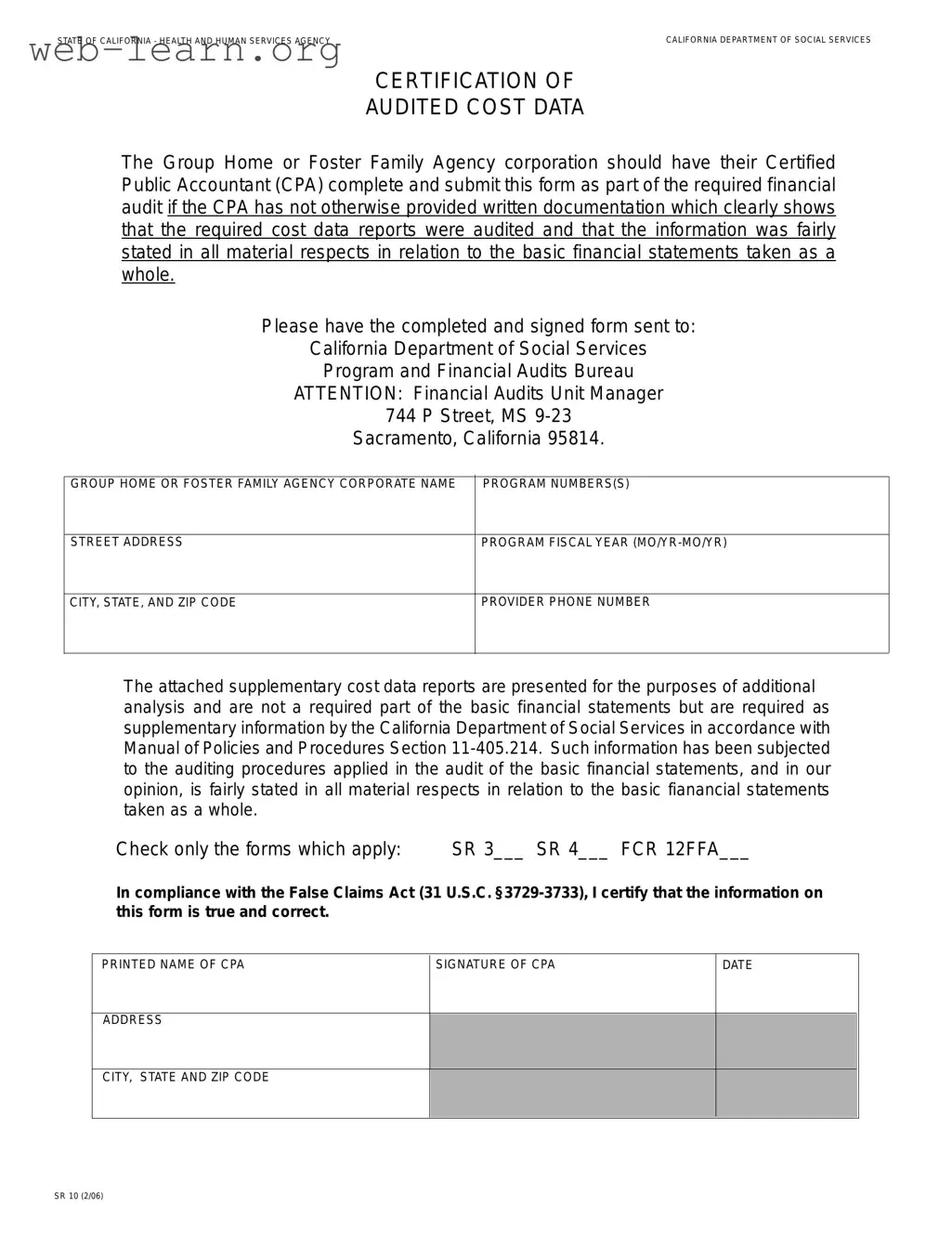
The California SR 10 form plays a crucial role in the financial auditing process for group homes and foster family agencies. This form must be completed by a Certified Public Accountant (CPA) and submitted as part of the required financial audit. If the CPA has already provided written documentation verifying that the necessary cost data reports were audited and accurately represented, the SR 10 may not be needed. The completed form should be sent to the California Department of Social Services, specifically to the Program and Financial Audits Bureau. It includes essential details such as the corporate name of the group home or foster family agency, program numbers, and fiscal year. Additionally, supplementary cost data reports accompany the SR 10, providing further insights for analysis, although they are not mandatory for the basic financial statements. The California Department of Social Services requires this supplementary information in accordance with their policies. The CPA must certify the accuracy of the information on the form, affirming compliance with the False Claims Act. This certification ensures transparency and accountability in the financial practices of these agencies.

| Fact Name | Details |
|---|---|
| Purpose of the SR 10 Form | The SR 10 form is used to certify audited cost data for Group Homes or Foster Family Agencies in California, ensuring compliance with financial auditing requirements. |
| Governing Law | This form is governed by the California Department of Social Services Manual of Policies and Procedures, specifically Section 11-405.214. |
| Submission Requirements | The completed SR 10 form must be submitted by a Certified Public Accountant (CPA) as part of the financial audit, along with any necessary supplementary cost data reports. |
| Compliance Certification | By signing the SR 10 form, the CPA certifies that the information provided is true and correct, in compliance with the False Claims Act. |
Completing the California SR 10 form is a crucial step in ensuring compliance with state regulations. This form must be filled out accurately and submitted promptly to avoid any delays in your financial audit process. Below are the steps to guide you through filling out the form correctly.
Once the form is completed, ensure that it is submitted to the California Department of Social Services at the address provided. This step is essential for maintaining compliance and facilitating the financial audit process.
What is the California SR 10 form?
The California SR 10 form is a document used by Group Homes or Foster Family Agencies to certify audited cost data. It must be completed by a Certified Public Accountant (CPA) as part of the financial audit process. This form ensures that the cost data has been reviewed and accurately represents the financial status of the organization.
Who is required to submit the SR 10 form?
Any Group Home or Foster Family Agency that undergoes a financial audit must submit the SR 10 form. This requirement applies unless the CPA has provided other written documentation confirming that the necessary cost data reports were audited and that they are fairly stated in relation to the overall financial statements.
Where should the completed SR 10 form be sent?
The completed and signed SR 10 form should be mailed to the California Department of Social Services, specifically to the Program and Financial Audits Bureau. The address is:
What additional information is included with the SR 10 form?
The SR 10 form is accompanied by supplementary cost data reports. While these reports are not part of the basic financial statements, they are required by the California Department of Social Services for additional analysis. The CPA will ensure that this supplementary information has been subjected to the same auditing procedures as the basic financial statements.
What is the significance of the False Claims Act certification on the SR 10 form?
The certification under the False Claims Act is a crucial element of the SR 10 form. By signing this certification, the CPA asserts that the information provided is true and correct. This helps to maintain integrity and accountability in financial reporting, ensuring that any fraudulent claims are addressed seriously.
What should be checked on the SR 10 form?
When filling out the SR 10 form, the CPA must check the applicable forms that relate to the audit. These may include SR 3, SR 4, and FCR 12FFA. It is essential to ensure that the correct forms are indicated, as this aids in the clarity and completeness of the audit process.
Completing the California SR 10 form can be straightforward, but several common mistakes can lead to issues. One frequent error is failing to provide the correct corporate name of the group home or foster family agency. It is essential to ensure that the name matches exactly with what is registered with the California Department of Social Services. Any discrepancies can cause delays or even rejections of the submission.
Another mistake often made is neglecting to fill in the program numbers. This information is crucial for identifying the specific programs associated with the agency. Omitting this detail can lead to confusion and may hinder the processing of the audit.
People also frequently forget to include the program fiscal year. This section must be completed accurately, indicating the correct months and years. Without this information, the auditors may not have a clear understanding of the timeframe being audited, which can affect the overall assessment.
Providing an incomplete or incorrect address is another common issue. The street address, city, state, and ZIP code should all be filled out correctly to ensure that correspondence reaches the appropriate party. Missing or incorrect information can delay communication and the audit process.
Additionally, some individuals fail to check the appropriate forms that apply, such as SR 3, SR 4, or FCR 12FFA. This oversight can lead to submitting an incomplete application. Each form serves a specific purpose, and checking the wrong boxes can cause complications.
Lastly, forgetting to include the CPA’s signature and date is a critical mistake. The form must be signed by the Certified Public Accountant to validate the information provided. Without this signature, the submission is incomplete and will not be processed.
The California SR 10 form is essential for group homes and foster family agencies, serving as a certification of audited cost data. It is important to understand that this form often accompanies various other documents that are crucial for compliance and financial reporting. Below is a list of related forms and documents commonly used alongside the SR 10 form.
Understanding these documents and their purposes can streamline the auditing process and ensure compliance with California regulations. Properly completing and submitting all necessary forms is crucial for maintaining operational integrity and financial accountability in group homes and foster family agencies.
The California SR 10 form is essential for financial audits of Group Homes or Foster Family Agencies. It serves as a certification of audited cost data, ensuring compliance with state regulations. Several other documents share similarities with the SR 10 form, primarily in their purpose and requirements. Below is a list of nine such documents:
Each of these forms plays a critical role in maintaining transparency and accountability in the financial operations of agencies serving vulnerable populations in California.
When filling out the California SR 10 form, it’s important to follow specific guidelines to ensure accuracy and compliance. Here are six essential do's and don'ts:
Following these guidelines will help streamline the process and ensure compliance with California regulations.
Misconceptions about the California SR 10 form can lead to confusion and potential compliance issues. Here are six common misunderstandings, along with clarifications:
This is not true. The SR 10 form is required for Group Homes or Foster Family Agencies as part of their financial audit process. It must be completed and submitted by a Certified Public Accountant (CPA).
While basic financial statements are crucial, supplementary cost data reports also need to be audited. The SR 10 form ensures that these additional reports are fairly stated in relation to the overall financial statements.
This is incorrect. A CPA must complete and sign the SR 10 form. Their signature certifies that the information provided is accurate and complies with auditing standards.
In reality, the SR 10 form is just one part of the financial audit process. Agencies must also provide the necessary supplementary cost data reports and any other required documentation.
This is misleading. All Group Homes and Foster Family Agencies, regardless of size, must adhere to the same requirements regarding the SR 10 form and the auditing process.
This is false. The information provided on the SR 10 form can be verified through the auditing process, and any discrepancies can lead to compliance issues.
Filling out and using the California SR 10 form is an important step for Group Homes and Foster Family Agencies. Here are some key takeaways to keep in mind:
By understanding these key points, you can navigate the SR 10 form process more confidently and ensure compliance with state requirements.