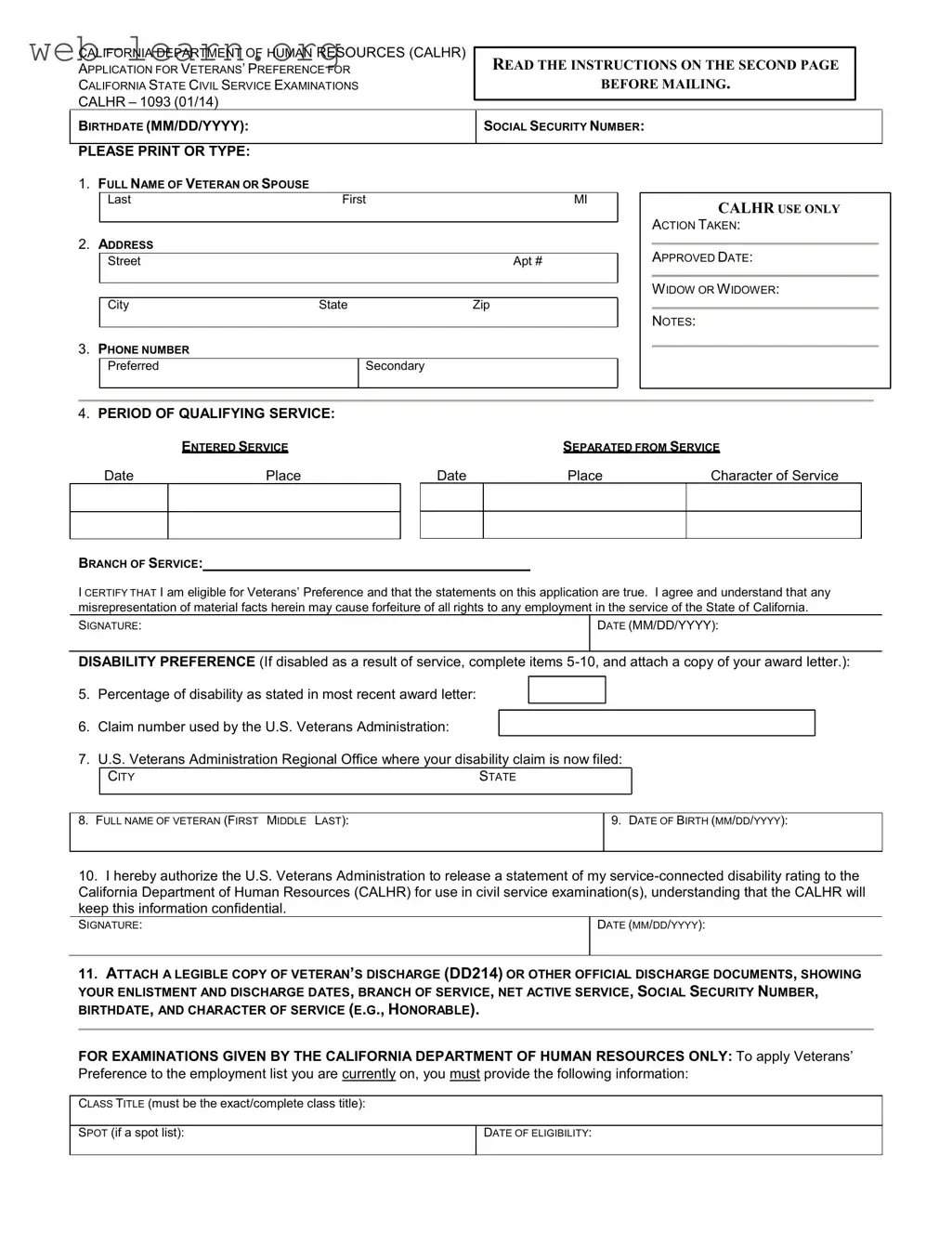
Homepage Blank California Spb 1093 Form
Outline

The California SPB 1093 form is an essential document for veterans seeking employment within the California state civil service system. This application allows eligible veterans and, in certain cases, their spouses to claim Veterans’ Preference during civil service examinations. The form requires personal information such as the applicant's full name, address, and social security number, along with details about their military service, including dates of entry and separation, branch of service, and character of service. Veterans who qualify can receive preference in the hiring process, which is reflected in their rank placement on eligibility lists. Additionally, disabled veterans can provide information about their disability status to receive further consideration. The application process includes submitting a copy of discharge documents, such as the DD214, to verify service details. Understanding the requirements and completing the SPB 1093 form accurately is crucial for veterans looking to enhance their chances of securing state employment.
Sample - California Spb 1093 Form

CALIFORNIA DEPARTMENT OF HUMAN RESOURCES (CALHR)
%
APPLICATION FOR VETERANS’ PREFERENCE FOR
CALIFORNIA STATE CIVIL SERVICE EXAMINATIONS
CALHR – 1093 (01/14)
READ THE INSTRUCTIONS ON THE SECOND PAGE
BEFORE MAILING.
BIRTHDATE (MM/DD/YYYY): SOCIAL SECURITY NUMBER:
PLEASE PRINT OR TYPE:
1. FULL NAME OF VETERAN OR SPOUSE
Last First MI
2. ADDRESS
Street Apt #
CALHR USE ONLY
ACTION TAKEN:
APPROVED DATE:
City State Zip
3. PHONE NUMBER
Preferred Secondary
WIDOW OR WIDOWER:
NOTES:
4. PERIOD OF QUALIFYING SERVICE:
ENTERED SERVICE SEPARATED FROM SERVICE
Date Place Date Place Character of Service


B
RANCH
OF
S
ERVICE
:
I CERTIFY THAT I am eligible for VeteransPreference and that the statements on this application are true. I agree and understand that any
misrepresentation of material facts herein may cause forfeiture of all rights to any employment in the service of the State of California.
S
IGNATURE
: DATE (MM/DD/YYYY):
DISABILITY PREFERENCE (If disabled as a result of service, complete items 5-10, and attach a copy of your award letter.):
5. Percentage of disability as stated in most recent award letter:
6. Claim number used by the U.S. Veterans Administration:
7. U.S. Veterans Administration Regional Office where your disability claim is now filed:
CITY STATE
8. FULL NAME OF VETERAN (FIRST MIDDLE LAST): 9. DATE OF BIRTH (MM/DD/YYYY):
10. I hereby authorize the U.S. Veterans Administration to release a statement of my service-connected disability rating to the
California Department of Human Resources (CALHR) for use in civil service examination(s), understanding that the CALHR will
keep this information confidential.
SIGNATURE: DATE (MM/DD/YYYY):
11. ATTACH A LEGIBLE COPY OF VETERANS DISCHARGE (DD214) OR OTHER OFFICIAL DISCHARGE DOCUMENTS, SHOWING
YOUR ENLISTMENT AND DISCHARGE DATES, BRANCH OF SERVICE, NET ACTIVE SERVICE, SOCIAL SECURITY NUMBER,
BIRTHDATE, AND CHARACTER OF SERVICE (E.G., HONORABLE).
FOR EXAMINATIONS GIVEN BY THE CALIFORNIA DEPARTMENT OF HUMAN RESOURCES ONLY: To apply Veterans’
Preference to the employment list you are currently on, you must provide the following information:
CLASS TITLE (must be the exact/complete class title):
SPOT (if a spot list): DATE OF ELIGIBILITY:
CALIFORNIA DEPARTMENT OF HUMAN RESOURCES (CALHR)
APPLICATION FOR VETERANS’ PREFERENCE FOR
CALIFORNIA STATE CIVIL SERVICE EXAMINATIONS
CALHR – 1093 (01/14)
ELIGIBILITY REQUIREMENTS
Competitors in State civil service open* and open, non-promotional entrance examinations who:
(1) Have never achieved permanent civil service status; AND
(2) Have served in the U.S. Armed Forces as defined in Government Code Section 18540; AND
(3) Qualify as veterans,
are entitled to have Veterans’ Preference (VP) applied to their list placement as described below, provided that they
achieve a passing score in the overall examination.
*Any member of the armed forces who takes an open entrance examination while still on active duty and achieves a place on an
eligible list may have Veterans’ Preference applied if qualification for such preference is active within twelve (12) months of
eligibility being established.
OPEN AND OPEN, NON-PROMOTIONAL ENTRANCE EXAMINATIONS:
Effective January 1, 2014, Veterans’ Preference will be awarded to qualifying Veterans who are successful in the examination in
the form of Rank placement rather than points. All individuals awarded Veterans’ Preference will be certified in Rank 1 of the
eligibility list, regardless of score. All open exams/eligible lists will award Veterans’ Preference, regardless of the classification.
“Veteran” means any person who has served full-time for 30 days or more in the armed forces in time of war or in time of peace
in a campaign or expedition for service in which a medal has been authorized by the government of the United States, or during
the period September 16, 1940 to January 31, 1955, or who has served at least 181 consecutive days since January 31, 1955,
AND who has been discharged or released under conditions other than dishonorable, but does not include any person who
served only in auxiliary or reserve components of the armed forces whose service therein did not exempt him or her from the
operation of the Selective Training and Service Act of 1940.
“Disabled veteran” means any veteran as defined above who is currently declared by the United States Veterans Administration
to be 10 percent or more disabled as a result of his or her service; and “100 percent disabled veteran” means any veteran as
defined above who is currently declared by the United States Veterans Administration to be 100 percent disabled as a result of
his or her service. Proof of disability shall be deemed conclusive if it is of record with the United States Veterans
Administration.
Individuals who received VP are not eligible for Career Credits pursuant to Sections 18950.1, 18951, and 18951.5.
“Permanent civil service status” is the status of an employee who is lawfully retained in his or her position after completion of the
applicable probationary period. This includes permanent intermittent, part-time, and full-time appointments. In addition,
individuals who, at any time, achieved permanent civil service status and subsequently resigned or were dismissed from civil
service are not eligible to receive Veterans’ Preference.
The bulletin for an examination states whether or not Veterans’ Preference will be awarded.
Instructions:
1. You must include a legible copy of your discharge (DD214), or other official discharge documents, showing your
enlistment and discharge dates, net active service, branch of service, Social Security Number, birthdate, and your
Character of Service (e.g., Honorable).
2. If you have a current, service-incurred disability of 10 percent or more, please fill out the section entitled “Disability
Preference”. If your disability was determined to be “temporary”, you are required to file for disability preference on
each examination for which Veterans’ Preference Points are applicable.
3. If you are the un-remarried, surviving spouse of a veteran, please submit copies of your marriage certificate,
spouse’s discharge papers, and spouse’s death certificate or other documentary evidence of death.
4. If you are the spouse of a 100 percent disabled veteran, please submit copies of your marriage certificate, spouse’s
discharge papers, and a document provided by the United States Veterans Administration substantiating the 100
percent disablement.
5. Mail this form, copy of discharge papers, and other documents to:
California Department of Human Resources
Attn: Exam Services
1515 “S” St., North Building, Suite 400
Sacramento, CA 95811
How Veterans’ Preference is applied to your examination
Effective January 1, 2014, Veterans’ Preference will be awarded to qualifying Veterans who are successful in the
examination in the form of Rank placement rather than points. All individuals awarded Veterans’ Preference will be certified in
Rank 1 of the eligibility list, regardless of score. All open exams/eligible lists will award Veterans’ Preference, regardless of
the classification. If you are currently competing in a State civil service examination which allows Veterans’ Preference, you
will automatically be added to the top rank if your eligibility is approved before the eligible list is processed. If you are
currently on a State civil service employment list which allows Veterans’ Preference, you must provide a copy of your
approval letter to the testing office that administered your examination.
Questions? Please call (866) 844-8671.

Form Information

Fact Name Details
Form Purpose The California SPB 1093 form is used to apply for Veterans’ Preference in California State civil service examinations.
Governing Law This form is governed by the California Government Code Section 18540.
Eligibility Criteria Applicants must not have permanent civil service status, must have served in the U.S. Armed Forces, and must qualify as veterans.
Disability Preference Disabled veterans may receive additional preference if they have a disability rating of 10% or more from the U.S. Veterans Administration.
Submission Instructions Applicants must mail the completed form along with required documents, including a copy of the veteran’s discharge papers, to the California Department of Human Resources.

Detailed Guide for Filling Out California Spb 1093

Filling out the California SPB 1093 form is a straightforward process that requires accurate information about your military service and personal details. After completing the form, you will need to submit it along with any required documents to the California Department of Human Resources. Ensure that all information is complete to avoid delays in processing your application.

  1. Obtain the form: Download or print the California SPB 1093 form from the California Department of Human Resources website.
  2. Provide your birthdate: Fill in your birthdate in the format MM/DD/YYYY.
  3. Enter your Social Security number: Write your Social Security number clearly.
  4. Complete personal information: In section 1, provide the full name of the veteran or spouse, including last name, first name, and middle initial.
  5. Fill in your address: In section 2, enter your complete address, including street, apartment number (if applicable), city, state, and zip code.
  6. Provide your phone number: Write your contact phone number in section 3.
  7. Detail your military service: In section 4, fill in the period of qualifying service, including the date and place you entered service, the branch of service, and the date and place you separated from service.
  8. Certify your eligibility: Sign and date the certification statement at the bottom of the form, confirming the accuracy of your information.
  9. If applicable, complete the disability section: If you are a disabled veteran, fill out items 5-10, including your percentage of disability and claim number.
  10. Attach required documents: Include a legible copy of your veteran’s discharge document (DD214) or other official discharge documents.
  11. Mail your application: Send the completed form and attachments to the California Department of Human Resources at the specified address.

Obtain Answers on California Spb 1093

  1. What is the California SPB 1093 form?

    The California SPB 1093 form is an application for Veterans’ Preference for individuals applying to California State civil service examinations. This form allows eligible veterans and certain family members to receive preference in the hiring process. It is essential to complete this form accurately and submit it along with required documents to ensure eligibility for Veterans’ Preference.

  2. Who is eligible to apply for Veterans’ Preference?

    To qualify for Veterans’ Preference, you must meet several criteria:

    • You must have never achieved permanent civil service status.
    • You must have served in the U.S. Armed Forces, as defined in Government Code Section 18540.
    • You must qualify as a veteran, which typically means serving at least 30 days in the armed forces during specific time periods or campaigns.

    Additionally, if you are a disabled veteran, you must have a disability rating of 10% or more from the U.S. Veterans Administration to qualify for disability preference.

  3. What documents do I need to submit with the SPB 1093 form?

    When submitting the SPB 1093 form, you must include a legible copy of your discharge documents, such as the DD214. This document should show your enlistment and discharge dates, branch of service, character of service, and other relevant details. If you are applying for disability preference, you must also attach your most recent award letter from the U.S. Veterans Administration.

  4. How is Veterans’ Preference applied to the examination process?

    As of January 1, 2014, Veterans’ Preference is awarded in the form of Rank placement rather than points. If you qualify for Veterans’ Preference and pass the examination, you will be placed in Rank 1 on the eligibility list, regardless of your examination score. This means that you will have a higher chance of being selected for employment compared to other candidates.

  5. Where do I send my completed SPB 1093 form?

    You should mail your completed SPB 1093 form, along with all required documents, to the following address:

    California Department of Human Resources
    Attn: Exam Services
    1515 “S” St., North Building, Suite 400
    Sacramento, CA 95811

    Make sure to send your application well before the examination date to ensure that your preference is applied.

Common mistakes

When completing the California SPB 1093 form, individuals often make several common mistakes that can hinder their application for Veterans’ Preference. One frequent error involves incomplete personal information. Applicants sometimes forget to fill in critical details such as their full name, birthdate, or Social Security number. Omitting this information can delay processing or result in outright rejection of the application.

Another mistake is providing inaccurate service dates. Applicants must enter the correct dates for both entering and separating from service. Failing to match these dates with the discharge documents can lead to complications in verifying eligibility. It is essential to ensure that the information aligns with official military records.

Many applicants also neglect to attach the required documentation. A common oversight is failing to include a legible copy of the veteran's discharge documents, such as the DD214. Without this documentation, the application cannot be processed, and the individual may miss out on their Veterans’ Preference rights.

Lastly, misunderstanding the disability preference section can lead to errors. Individuals with service-connected disabilities must provide specific details, including their percentage of disability and claim number. Failing to complete this section accurately or omitting it altogether can result in a loss of potential benefits. It is crucial to read the instructions carefully and ensure that all relevant information is provided.

Documents used along the form

The California SPB 1093 form is essential for veterans seeking preference in state civil service examinations. Along with this form, several other documents and forms may be required to ensure a complete application. Below is a list of commonly associated forms and documents that may be needed.

  • DD Form 214: This document serves as the official discharge certificate from the U.S. Armed Forces. It details the veteran's service dates, branch, and character of service.
  • VA Disability Award Letter: This letter from the U.S. Veterans Administration confirms the percentage of disability for veterans who are applying for disability preference.
  • Marriage Certificate: Required for spouses of veterans or surviving spouses applying for preference. It verifies the relationship between the applicant and the veteran.
  • Death Certificate: This document is necessary for un-remarried surviving spouses to prove the veteran's death when applying for benefits.
  • Service-Connected Disability Documentation: Additional proof may be needed to establish a service-connected disability, especially for veterans claiming 100% disability status.
  • Application for Veterans’ Preference: This is a general form used to apply for veterans’ preference in various contexts, including employment and educational opportunities.
  • Eligibility Verification Form: This form may be used to confirm eligibility for veterans’ preference based on service history and other criteria.
  • Employment Application: A standard application form for employment that may need to accompany the SPB 1093 when applying for state positions.
  • Proof of Residency: Documents such as utility bills or rental agreements may be required to establish the applicant's current address.

Submitting the correct forms and supporting documents is crucial for a successful application process. Ensuring that all necessary information is included can help veterans secure their rightful preference in California state civil service examinations.

Similar forms

The California SPB 1093 form, used for applying for Veterans’ Preference in California state civil service examinations, shares similarities with several other important documents. Each of these documents serves a specific purpose related to veterans' benefits, employment, or eligibility verification. Below is a list of documents that are comparable to the SPB 1093 form:

  • DD Form 214: This document serves as a Certificate of Release or Discharge from Active Duty. It provides essential information about a veteran's service, including dates of enlistment and discharge, which is crucial for validating eligibility for Veterans’ Preference.
  • VA Form 21-526EZ: This is an application for disability compensation and related benefits. It allows veterans to claim benefits based on their service-connected disabilities, similar to how the SPB 1093 form addresses disability preferences.
  • VA Form 21-534EZ: This form is used by surviving spouses of veterans to apply for Dependency and Indemnity Compensation (DIC). It provides a pathway for families to receive benefits, akin to how the SPB 1093 accommodates spouses of veterans.
  • SF-15: The Application for 10-Point Veteran Preference is used by veterans to claim additional points in federal hiring processes. It parallels the SPB 1093 in its aim to provide preference in employment based on military service.
  • VA Form 22-1990: This form is for applying for education benefits under the GI Bill. It supports veterans in pursuing education, similar to how the SPB 1093 supports their employment opportunities.
  • Form N-400: This is the Application for Naturalization. Veterans can receive expedited processing for citizenship applications, which relates to their service and can enhance their employment prospects.
  • Form 10-10EZ: This is the Application for Health Benefits from the VA. It allows veterans to access health care services, which is a crucial aspect of their overall well-being, similar to the employment support provided by the SPB 1093.
  • Form 21-4138: This is a Statement in Support of Claim. Veterans use it to provide additional evidence for their claims, similar to how the SPB 1093 requires documentation to support eligibility for Veterans’ Preference.
  • Form 22-5490: This is the Application for Survivors' and Dependents' Educational Assistance. It provides educational benefits to dependents of veterans, paralleling the support for families found in the SPB 1093.

Each of these documents plays a vital role in ensuring that veterans and their families receive the benefits and preferences they deserve. Understanding their similarities can help streamline the application process for various benefits.

Dos and Don'ts

When filling out the California SPB 1093 form, it's important to follow certain guidelines to ensure your application is processed smoothly. Here are seven things you should and shouldn't do:

  • Do read the instructions carefully before starting the form.
  • Do print or type your information clearly to avoid any confusion.
  • Do include all required documents, such as your discharge papers.
  • Do double-check your Social Security number and birthdate for accuracy.
  • Don't leave any sections blank; fill out every part of the form.
  • Don't submit the form without signing and dating it.
  • Don't forget to mail your application to the correct address.

Misconceptions

Understanding the California SPB 1093 form can be challenging, and there are several misconceptions that often arise. Here’s a list of ten common misunderstandings, along with clarifications for each.

  1. Veterans’ Preference is automatic. Many believe that simply being a veteran guarantees preference. However, you must apply and meet specific eligibility criteria to receive this benefit.
  2. Only disabled veterans can apply. Some think that only those with disabilities can apply for Veterans’ Preference. In reality, any qualifying veteran can apply, regardless of disability status.
  3. All military service qualifies for preference. Not all military service counts. Only those who served full-time for a minimum period and were discharged under honorable conditions are eligible.
  4. The form is only for veterans. This form can also be used by un-remarried spouses of veterans. They can apply for preference based on their spouse’s service.
  5. Submitting the form guarantees a job. While the form helps in securing Veterans’ Preference, it does not guarantee employment. You must still pass the examination and meet other job requirements.
  6. Veterans’ Preference applies to all job applications. This preference is specifically for California state civil service examinations. It does not apply to private sector jobs.
  7. All exams offer Veterans’ Preference. Not every examination provides this benefit. Always check the bulletin for specific information regarding Veterans’ Preference for each exam.
  8. Proof of service is not necessary. You must provide documentation, such as a DD214, to prove your military service and eligibility for preference.
  9. Once awarded, Veterans’ Preference lasts forever. If you achieve permanent civil service status, you are no longer eligible for Veterans’ Preference in future applications.
  10. Disability preference is the same as Veterans’ Preference. Disability preference is a separate consideration. If you are a disabled veteran, you need to complete additional sections of the form to apply for this specific preference.

By understanding these misconceptions, you can better navigate the application process and ensure that you meet all necessary requirements for Veterans’ Preference in California.

Key takeaways

Here are key takeaways for filling out and using the California SPB 1093 form:

  • Eligibility Verification: Ensure you meet the eligibility requirements for Veterans' Preference, including having served in the U.S. Armed Forces and not having permanent civil service status.
  • Accurate Information: Fill out all sections of the form accurately, including your full name, address, phone number, and service details.
  • Disability Preference: If applicable, complete the disability preference section and attach your most recent award letter from the U.S. Veterans Administration.
  • Required Documentation: Attach a legible copy of your discharge documents (DD214) that show enlistment and discharge dates, branch of service, and character of service.
  • Submission Process: Mail the completed form and all required documents to the California Department of Human Resources at the specified address.
  • Rank Placement: Understand that Veterans' Preference will result in Rank 1 placement on the eligibility list, regardless of your examination score.
  • Contact Information: If you have questions, reach out to the provided phone number for assistance.