Homepage Blank California Soc 295 Form
Outline

The California SOC 295 form is a crucial document for individuals seeking In-Home Supportive Services (IHSS). This application must be filled out completely, as each section plays a vital role in determining eligibility. Applicants are required to provide personal information, including their name, address, and Social Security number, which is essential for verification purposes. The form also includes optional sections for sexual orientation and gender identity, allowing applicants to share information confidentially. Veterans and their families can indicate their status, while past IHSS recipients can provide details about their previous services. Additional sections gather information about household members, ethnic background, and preferred languages. Furthermore, accommodations for those who are blind or visually impaired are available, ensuring accessibility for all applicants. Completing this form accurately and promptly is important, as it directly impacts the support and services individuals may receive.

Sample - California Soc 295 Form

Name of Applicant: Social Security Number:
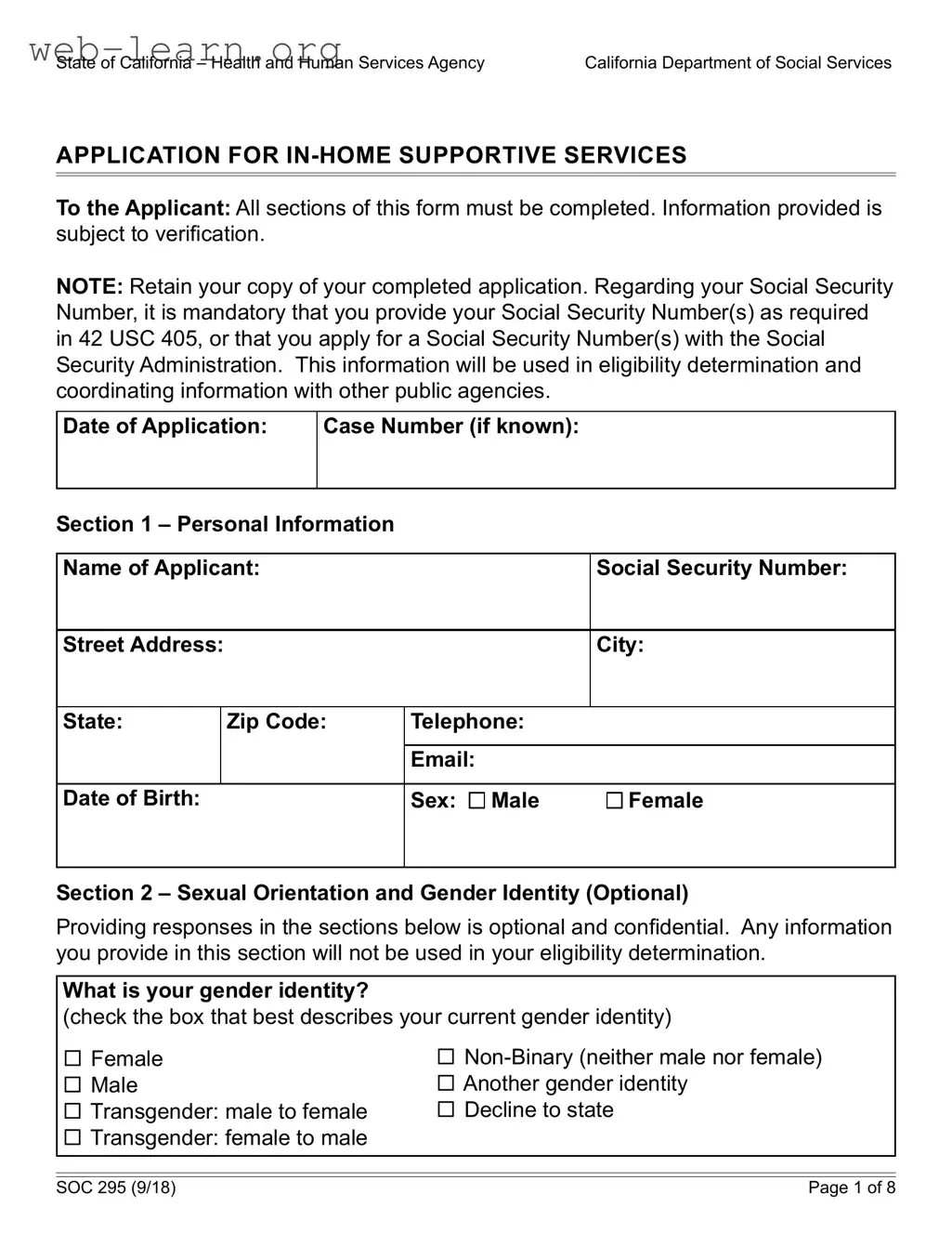
State of California – Health and Human Services Agency California Department of Social Services
APPLICATION FOR IN-HOME SUPPORTIVE SERVICES
SOC 295 (9/18) Page 1 of 8
To the Applicant: All sections of this form must be completed. Information provided is
subject to verication.
NOTE: Retain your copy of your completed application. Regarding your Social Security
Number, it is mandatory that you provide your Social Security Number(s) as required
in 42 USC 405, or that you apply for a Social Security Number(s) with the Social
Security Administration. This information will be used in eligibility determination and
coordinating information with other public agencies.
Date of Application: Case Number (if known):
Section 1 – Personal Information
Street Address: City:
State: Zip Code: Telephone:
Email:
Date of Birth:
Sex:
Male Female
Section 2 – Sexual Orientation and Gender Identity (Optional)
Providing responses in the sections below is optional and condential. Any information
you provide in this section will not be used in your eligibility determination.
What is your gender identity?
(check the box that best describes your current gender identity)
Female
Male
Transgender: male to female
Transgender: female to male
Non-Binary (neither male nor female)
Another gender identity
Decline to state
State of California – Health and Human Services Agency California Department of Social Services
SOC 295 (9/18) Page 2 of 8
What sex was listed on your original birth certicate? Female Male
Section 3 – Veteran Information
Are you a Veteran?
Yes No
Are you a Spouse/Child of a Veteran?
Yes No
If YES, give Veteran name and Claim Number:
Section 4 – SSI/SSP Information
Do you receive SSI/SSP benets? Yes No
If yes, check your type of living arrangement:
Independent Living Board and Care Home of Another
Services being requested:
Section 5 – Past IHSS Information
Have you received In-Home Supportive Services (IHSS) in the past? Yes No
If Yes, complete the following.
Date and county where service was last received:
Total Monthly Hours: Name Used (if di󰀨erent from above):
How do you describe your sexual orientation?
Select one answer.
Straight/heterosexual
Gay or lesbian
Bisexual
Queer
Another sexual orientation
Unknown
Decline to state
State of California – Health and Human Services Agency California Department of Social Services
SOC 295 (9/18) Page 3 of 8
Section 6 – Household Information
Name of Spouse:
Birthdate: Social Security Number:
Name of:
Parent Child Other Relative Non-Relative
Birthdate: Social Security Number:
Name of:
Parent Child Other Relative Non-Relative
Birthdate: Social Security Number:
Name of:
Parent Child Other Relative Non-Relative
Birthdate: Social Security Number:
Name of:
Parent Child Other Relative Non-Relative
Birthdate: Social Security Number:
Name of:
Parent Child Other Relative Non-Relative
Birthdate: Social Security Number:
List Household Members:
Section 7 – Ethnic and Language Information
The law requires that information on ethnic origin and primary language be collected.
If you do not complete this section, social service sta󰀨 will make a determination. The
information will not a󰀨ect your eligibility for service.
A. My Ethnic Origin is:
(See Page 8 for a list of Ethnicities
and Codes)
B1. What language do you prefer to read?
B2. What language do you prefer to speak?
(Please choose one from the list of Languages
and Codes on Page 8)
Please choose one
Please choose one
Please choose one
State of California – Health and Human Services Agency California Department of Social Services
SOC 295 (9/18) Page 4 of 8
Section 8 – Communication Accommodations
I am Blind: Yes No
To accommodate blind or visually-impaired applicants, IHSS information is available
in the following alternative formats. Please indicate which format you would prefer,
if applicable. Providing information in this section will not a󰀨ect your eligibility for
services.
If yes, please choose one of the following for each of the three types of Department of
Social Services (DSS) documents listed.
For Notices of Action: No accommodation is needed Braille Documents
Audio CD Data CD County Support
(If County Support, describe requested support)
For IHSS Required forms:
No accommodation is needed Braille Documents
Audio CD Data CD County Support
(If County Support, describe requested support)
For Timesheets: No accommodation is needed
Telephonic System (4 Digit RAN: ) County Support
Electronic Timesheet System (ETS) (Applicants and providers must rst register at
https://www.etimesheets.ihss.ca.gov)
(If County Support, describe requested support)
I am Visually Impaired: Yes No
If yes, please choose one of the following for each of the three types of Department of
Social Services (DSS) documents listed.
State of California – Health and Human Services Agency California Department of Social Services
SOC 295 (9/18) Page 5 of 8
For Notices of Action: No accommodation is needed
18 point font documents Audio CD Data CD County Support
(If County Support, describe requested support)
For IHSS Required forms:
No accommodation is needed
18 point font documents Audio CD Data CD County Support
(If County Support, describe requested support)
For Timesheets: No accommodation is needed
Telephonic System (4 Digit RAN: )
18 point font documents County Support
Electronic Timesheet System (ETS) (Applicants and providers must rst register at
https://www.etimesheets.ihss.ca.gov)
(If County Support, describe requested support, including blind-only services)
Section 9 – A󰀩rmation
I a󰀩rm that the above information is true to the best of my knowledge and belief. I
agree to cooperate fully if verication of the above statements is required in the future.
I also understand that as the employer of my IHSS provider(s) I am responsible for:
1. Hiring, training, supervising, scheduling and, when necessary, ring my provider(s).
2. Ensuring the total hours reported by all providers who work for me do not exceed
my IHSS authorized hours each month.
3. Referring any individual I want to hire to the County IHSS o󰀩ce to complete the
provider eligibility process.
4. Notifying the County IHSS o󰀩ce within 10 days when I hire or re a provider.
State of California – Health and Human Services Agency California Department of Social Services
SOC 295 (9/18) Page 6 of 8
In addition, I understand and agree to the following terms and limitations regarding
payment for services by the IHSS program:
1. In order for any individual to be paid by the IHSS program, they must be approved
as an IHSS eligible provider.
2. If I choose to have an individual work for me who has not yet been approved as
an eligible IHSS provider, I will be responsible for paying him/her if he/she is not
approved.
3. The IHSS program will not pay for any services provided to me until my application
for services is approved and then will only pay for those services that are authorized
for me to receive by the IHSS Program.
4. I will be responsible for paying for any services I receive that are not included in my
IHSS authorization.
5. I will be responsible for paying my Share-of-Cost (SOC) and informing my individual
provider(s) of that SOC.
I also understand and agree to cooperate with the following as a part of my eligibility for
IHSS:
To promote program integrity and quality assurance, I may be subject to
(un)announced visits to my home and that I or my provider(s) may receive letters
identifying program requirement concerns from the State Department of Health Care
Services (DHCS), California Department of Social Services (CDSS) and/or the County
in which I receive services.
The purpose of the visits and letters is to ensure that program requirements are being
followed and that the authorized services are necessary for you to remain safely in
your home. The visit will also verify that the authorized services are being provided,
that the quality of those services is acceptable, and that your well-being is protected.
If it is found that IHSS services are not required or not being properly provided, you
and/or your provider may be subject to a Medi-Cal fraud investigation. If fraud is
substantiated, you and/or your provider will be prosecuted for Medi-Cal fraud.
State of California – Health and Human Services Agency California Department of Social Services
SOC 295 (9/18) Page 7 of 8
Section 10 – Signature(s)
Signature of Applicant: Date:
Signature of Applicant’s Representative (only if applicable): Date:
Representative’s Relationship to Applicant
(only if applicable):
Representative’s Telephone
Number (only if applicable):
Representative’s Address (only if applicable):
To report suspected fraud or abuse in the provision or receipt of IHSS services, please
call the fraud hotline at 1-800-822-6222, email at [email protected], or go
to http://www.dhcs.ca.gov/individuals/Pages/StopMedi-CalFraud.aspx.
FOR AGENCY USE ONLY
Income Eligible:
Yes No
Status Eligible:
Yes No
Medi-Cal Aid Code:
MAGI Eligible Recipient:
Disabled 12 months or longer
At risk without IHSS
Verication:
Notes:
Signature of Social Worker or Agency
Representative:
Telephone Number:
State of California – Health and Human Services Agency California Department of Social Services
SOC 295 (9/18) Page 8 of 8
Ethnic Codes:
A. White.
B. Hispanic.
C. Black.
D. Other Asian or Pacic Islander.
E. American Indian or Alaskan Native.
F. Filipino.
G. Chinese.
H. Cambodian.
I. Japanese.
J. Korean.
K. Samoan.
L. Asian Indian.
M. Hawaiian.
N. Guamanian.
O. Laotian.
P. Vietnamese.
Q. Other.
R. Mixed Ethnicity.
Language Codes:
1. American Sign Language
(AMISLAN or ASL).
2. Spanish - NOA will be issued
in Spanish.
3. Cantonese.
4. Japanese.
5. Korean.
6. Tagalog.
7. Other non-English.
8. English.
9. Spanish - NOA will be issued
in English.
10. Other Sign Language.
11. Mandarin.
12. Other Chinese Languages.
13. Cambodian.
14. Armenian.
15. Ilacano.
16. Mien.
17. Hmong.
18. Lao.
19. Turkish.
20. Hebrew.
21. French.
22. Polish.
23. Russian.
24. Portuguese.
25. Italian.
26. Arabic.
27. Samoan.
28. Thai.
29. Farsi.
30. Vietnamese.

Form Information

Fact Name Description
Governing Law The California Soc 295 form is governed by state laws related to social services, including regulations under the California Welfare and Institutions Code.
Purpose This form is used to apply for In-Home Supportive Services (IHSS), which assist individuals who need help with daily living activities.
Mandatory Information Applicants must provide their Social Security Number as required by federal law, specifically 42 USC 405.
Optional Sections Sections regarding sexual orientation and gender identity are optional. Responses are confidential and do not affect eligibility.
Veteran Information The form includes questions about veteran status, allowing applicants to identify themselves or their family members as veterans.
SSI/SSP Benefits Applicants must indicate if they receive SSI/SSP benefits, which can impact the type of support they may receive.
Communication Accommodations The form offers options for communication accommodations for individuals who are blind or visually impaired, ensuring accessibility to IHSS information.

Detailed Guide for Filling Out California Soc 295

After completing the California SOC 295 form, the next steps involve submitting the application to the appropriate county office. Ensure that all sections are filled out accurately, as the information will be verified. Retain a copy of the completed form for your records.

  1. Enter the Date of Application and, if known, the Case Number.
  2. In Section 1, provide your personal information, including your Name, Social Security Number, Street Address, City, State, Zip Code, Telephone, Email, Date of Birth, and Sex.
  3. In Section 2, answer the optional questions regarding Sexual Orientation and Gender Identity. Indicate your gender identity, the sex listed on your birth certificate, and your sexual orientation.
  4. In Section 3, indicate if you are a Veteran or a Spouse/Child of a Veteran. If yes, provide the Veteran's name and Claim Number.
  5. In Section 4, specify if you receive SSI/SSP benefits and select your type of living arrangement.
  6. In Section 5, indicate if you have received In-Home Supportive Services (IHSS) in the past. If yes, provide the last date and county of service, total monthly hours, and any name used that differs from your current name.
  7. In Section 6, list all household members, including their names, birthdates, and Social Security Numbers.
  8. In Section 7, provide your Ethnic Origin and preferred languages for reading and speaking.
  9. In Section 8, indicate any Communication Accommodations needed, particularly if you are blind or visually impaired.
  10. In Section 9, read the affirmation statement and sign to confirm that the information provided is accurate to the best of your knowledge.

Obtain Answers on California Soc 295

  1. What is the California SOC 295 form?

    The California SOC 295 form is an application for In-Home Supportive Services (IHSS). It is used by individuals who need assistance with daily activities due to age, disability, or illness. Completing this form is the first step in applying for these essential services that can help individuals maintain their independence at home.

  2. Who needs to fill out the SOC 295 form?

    Anyone seeking In-Home Supportive Services in California must complete the SOC 295 form. This includes individuals who may have received IHSS in the past, as well as new applicants. It is crucial that all sections of the form are filled out completely to ensure proper processing of the application.

  3. What information is required on the SOC 295 form?

    The form requires personal information, such as your name, address, and Social Security Number. Additionally, you will need to provide details about your living situation, household members, and any past IHSS services you may have received. There are also optional sections regarding sexual orientation and gender identity, which will not affect your eligibility.

  4. Is it mandatory to provide my Social Security Number?

    Yes, it is mandatory to provide your Social Security Number on the SOC 295 form. This requirement is in accordance with federal law (42 USC 405). If you do not have a Social Security Number, you must apply for one with the Social Security Administration.

  5. What if I have a disability or need accommodations?

    The SOC 295 form includes sections for individuals who may need communication accommodations. If you are blind or visually impaired, you can request documents in alternative formats, such as Braille or audio. Indicating your needs will help ensure you receive the appropriate support throughout the application process.

  6. How will my information be used?

    Your information will be used to determine your eligibility for IHSS and to coordinate with other public agencies. It is important to provide accurate information, as it may be subject to verification. Additionally, any optional information regarding sexual orientation or gender identity will remain confidential and will not impact your eligibility.

  7. What happens after I submit the SOC 295 form?

    After submitting the SOC 295 form, your application will be reviewed by the county's IHSS office. They may contact you for additional information or clarification. If approved, you will receive details about the services you are eligible for and the next steps in the process.

  8. Can I retain a copy of my completed SOC 295 form?

    Yes, it is highly recommended that you keep a copy of your completed SOC 295 form for your records. This can be helpful for reference in future communications with the IHSS office or if you need to follow up on your application status.

Common mistakes

Filling out the California SOC 295 form can be a straightforward process, but many applicants make common mistakes that can lead to delays or complications in receiving services. One frequent error is the omission of the Social Security Number. This number is mandatory for eligibility determination, and failing to provide it can result in an incomplete application. Ensure that you include your Social Security Number as required, or indicate that you are in the process of applying for one.

Another mistake involves not fully completing all sections of the form. Each section is crucial for the assessment of your eligibility for In-Home Supportive Services. Leaving any part blank can lead to unnecessary follow-ups from the county office, which could slow down the processing of your application. Take the time to review each section and confirm that all required fields are filled out accurately.

Many applicants also misinterpret the optional sections, particularly regarding sexual orientation and gender identity. While these questions are not used in eligibility determinations, providing accurate information can help in tailoring services to better meet your needs. Misunderstanding that these sections are optional can lead to incomplete applications or confusion about the purpose of this information.

Additionally, individuals often forget to retain a copy of their completed application. Keeping a copy is essential for your records and can be invaluable if there are any questions or issues that arise later in the process. Without a copy, you may find it challenging to reference what you submitted or to follow up effectively.

Lastly, failing to affirm the accuracy of the information provided can be a critical oversight. The affirmation section is not just a formality; it indicates your understanding of your responsibilities as an employer of IHSS providers. Neglecting to sign or affirm this section can lead to complications in your application. Always double-check that you have completed this affirmation before submitting your form.

Documents used along the form

When applying for In-Home Supportive Services (IHSS) in California, you may find that several other forms and documents are commonly used alongside the California SOC 295 form. Each of these documents serves a specific purpose and helps streamline the application process. Below is a list of these forms, along with a brief description of each.

  • California SOC 321 Form: This form is used to designate a provider for IHSS services. It includes information about the chosen provider, ensuring they meet eligibility requirements and can be compensated for their services.
  • California SOC 342 Form: This document is necessary for reporting changes in the applicant's circumstances. Changes may include income, living arrangements, or household composition, which can affect eligibility for IHSS.
  • California SOC 825 Form: This form is utilized to request a reassessment of IHSS hours. If an applicant feels their needs have changed, they can submit this form to have their hours reviewed and potentially adjusted.
  • Verification of Income Documentation: Applicants are often required to provide proof of income, such as pay stubs or tax returns. This documentation helps determine eligibility and the level of support needed.
  • Medical Verification Form: In some cases, a medical professional may need to complete a form verifying the applicant's health conditions. This information can be crucial in assessing the level of care required.

Understanding these forms can help you navigate the application process more effectively. Each document plays a vital role in ensuring that you receive the appropriate support and services. If you have any questions about these forms or need assistance, resources are available to guide you through the process.

Similar forms

The California SOC 295 form is an application for In-Home Supportive Services (IHSS). Several other documents share similarities with this form, particularly in their purpose and the information they collect. Below is a list of nine such documents:

  • California SOC 821: This form is used for the IHSS Provider Enrollment process. Like the SOC 295, it collects personal information and details about the applicant's qualifications to ensure they meet the necessary criteria for providing care.
  • California SOC 873: This document is a Request for a Change in IHSS Services. It requires similar personal and household information to assess changes in the applicant's needs, much like the SOC 295 gathers for initial applications.
  • California SOC 2271: This is the IHSS Provider Timesheet. It tracks hours worked by the provider. While it focuses on service delivery, it also requires information about the recipient, akin to the personal data collected in the SOC 295.
  • California SOC 181: This form is the IHSS Needs Assessment. It evaluates the specific needs of the applicant, similar to how the SOC 295 assesses eligibility based on personal circumstances and living arrangements.
  • California SOC 295A: This is the IHSS Provider Notice. It informs applicants about their rights and responsibilities, paralleling the educational aspect of the SOC 295 regarding the responsibilities of the applicant.
  • California SOC 700: This is the Request for IHSS Services for Children. It gathers similar information to the SOC 295 but is tailored for families seeking services for minors, maintaining the focus on personal and household details.
  • California SOC 211: This document is for the IHSS Provider Registration. It collects personal and background information about potential providers, much like the SOC 295 gathers information about the applicant.
  • California SOC 157: This form is used for reporting changes in circumstances for IHSS recipients. It requires updated personal information, similar to the ongoing requirements of the SOC 295 for maintaining eligibility.
  • California SOC 426: This is the IHSS Provider Application. It collects information about individuals applying to be providers, paralleling the SOC 295's focus on the applicant's background and needs.

Dos and Don'ts

When filling out the California SOC 295 form, it’s important to be thorough and accurate. Here’s a list of five essential do's and don'ts to keep in mind:

  • Do complete all sections of the form. Each part is crucial for processing your application.
  • Do provide your Social Security Number as required. This is mandatory for eligibility determination.
  • Do retain a copy of your completed application. You may need it for future reference.
  • Don't leave any required fields blank. Incomplete forms can delay your application.
  • Don't forget to review your information before submitting. Errors can lead to complications.

By following these guidelines, you can ensure a smoother application process. Take the time to fill out the form carefully; your attention to detail can make a significant difference.

Misconceptions

Misconceptions about the California SOC 295 form can lead to confusion and frustration. Here are eight common misunderstandings, along with clarifications to help applicants navigate the process more easily.

  • Misconception 1: The SOC 295 form is optional.
  • This form is mandatory for applying for In-Home Supportive Services (IHSS). All sections must be completed to ensure eligibility.

  • Misconception 2: Providing a Social Security Number is not necessary.
  • It is essential to provide your Social Security Number as required by law. This information is crucial for determining eligibility and coordinating with other agencies.

  • Misconception 3: Information about sexual orientation and gender identity affects eligibility.
  • Responses in these sections are optional and confidential. They do not influence eligibility for services.

  • Misconception 4: Past IHSS recipients do not need to provide additional information.
  • If you have received IHSS in the past, you must complete the relevant section regarding your previous services.

  • Misconception 5: Ethnic and language information is not required.
  • While this information must be collected, it will not affect your eligibility. If not completed, social service staff will make a determination based on available data.

  • Misconception 6: Communication accommodations are only for individuals who are completely blind.
  • Accommodations are available for both blind and visually impaired applicants. You can choose the format that best suits your needs.

  • Misconception 7: The form can be submitted without a signature.
  • The applicant must affirm that the information provided is true and complete. A signature is required to validate the application.

  • Misconception 8: You can submit the form without retaining a copy.
  • It is important to keep a copy of your completed application for your records. This can help you track your application status and provide information if needed.

Key takeaways

When filling out the California SOC 295 form, it’s essential to keep a few key points in mind. This form is used for applying for In-Home Supportive Services (IHSS). Here are some important takeaways:

  • Complete All Sections: Ensure that every section of the form is filled out. Incomplete applications may delay the processing of your request.
  • Provide Your Social Security Number: It is mandatory to include your Social Security Number. This information helps determine your eligibility and coordinate with other agencies.
  • Optional Information: Sections regarding sexual orientation and gender identity are optional. You can choose to decline to state this information without affecting your application.
  • Retain a Copy: Keep a copy of your completed application for your records. This can be useful for future reference or if you need to follow up on your application status.