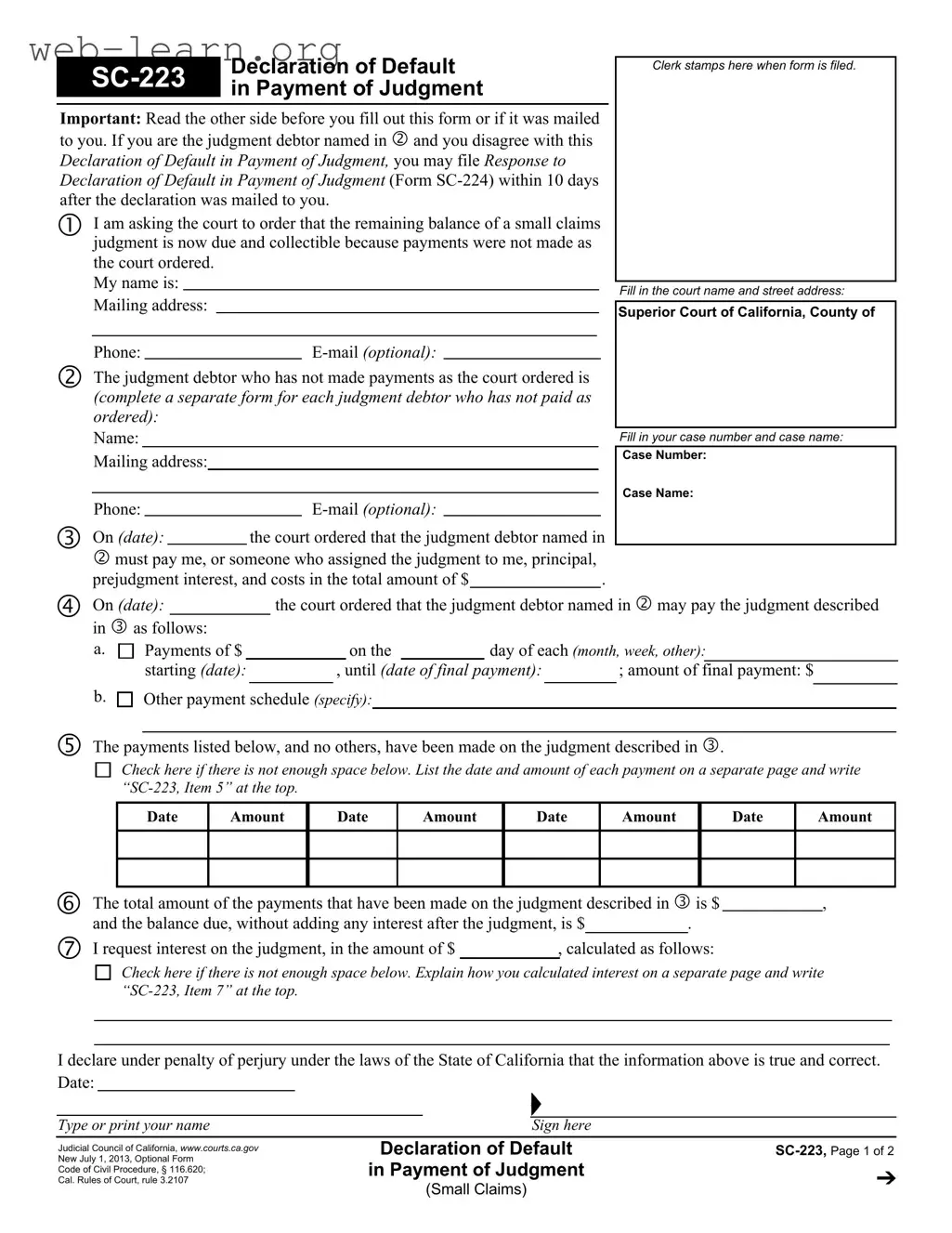
The California SC-223 form plays a crucial role in the small claims court process, specifically when a judgment debtor fails to make payments as ordered by the court. This form allows the judgment creditor to request that the court declare the entire remaining balance of a judgment due and collectible. To initiate this process, the creditor must provide specific details, including the name of the judgment debtor, the case number, and the payment history. The form outlines the payments that have been made, the total amount due, and any interest that may be applicable. If the judgment debtor disagrees with the declaration, they have ten days to respond using Form SC-224. This system ensures that both parties have an opportunity to present their case, maintaining fairness in the judicial process. Understanding the SC-223 form is essential for anyone involved in small claims, as it directly impacts the enforcement of judgments and the collection of owed amounts.

| Fact Name | Fact Description |
|---|---|
| Purpose | The SC-223 form is used to declare that a judgment debtor has failed to make payments as ordered by the court. |
| Governing Law | This form is governed by the California Code of Civil Procedure, § 116.620 and Cal. Rules of Court, rule 3.2107. |
| Response Time | If the judgment debtor disagrees with the declaration, they have 10 days to file a Response using Form SC-224. |
| Payment Schedule | The form allows for the specification of a payment schedule, including the amount and dates of payments. |
| Interest Calculation | Interest on the judgment can be requested, typically at a rate of 10 percent per year, and must be calculated and explained on a separate page. |
| Filing Process | To initiate the process, the completed SC-223 form must be filed with the small claims court clerk. |
| Notification | After filing, the court will notify all parties involved, providing them with copies of the declaration and a blank Response form. |
Filling out the California SC-223 form is a straightforward process. This form is used to notify the court that a judgment debtor has failed to make the required payments. Once completed, the form needs to be filed with the small claims court clerk, which will initiate further proceedings.
What is the California SC-223 form?
The California SC-223 form, also known as the Declaration of Default in Payment of Judgment, is a legal document that a judgment creditor can file when a judgment debtor has failed to make the payments ordered by the court. This form requests the court to declare that the full amount of the judgment is now due and collectible due to the debtor's non-compliance with the payment schedule.
When is a judgment considered due?
Generally, small claims judgments are due immediately unless the court specifies otherwise. If the judgment debtor does not pay the full amount within 30 days, the judgment creditor can initiate legal actions to recover the unpaid balance. However, if an appeal or a request to vacate the judgment is filed, collection efforts may be temporarily halted.
Can a judgment debtor make payments?
A judgment debtor can request permission from the court to pay the judgment in installments. If the court approves this request, the judgment creditor must refrain from taking further collection actions as long as the debtor adheres to the agreed payment schedule. If payments are missed, the creditor can then seek to have the entire balance declared due.
Is interest added to the judgment amount?
Yes, interest is typically added to the unpaid balance of the judgment at a rate of 10 percent per year. This interest accrues from the date the judgment is entered until it is fully paid. Importantly, interest is only charged on the principal amount owed, not on any accrued interest. If partial payments are made, they are first applied to any outstanding interest before being applied to the principal balance.
How is interest calculated?
To calculate interest, a creditor must provide details regarding the unpaid principal balance, the duration for which interest is claimed, and the total interest amount for that period. The interest rate is 10 percent per year, or approximately 0.0274 percent per day. If payments have been made, separate calculations must be performed for the reduced principal balance after each payment.
What should I do if I disagree with the SC-223 declaration?
If you are a judgment debtor and disagree with the Declaration of Default in Payment of Judgment, you have the right to file a response using Form SC-224. This response must be submitted within 10 days of receiving the declaration. It is important to serve the response to the judgment creditor and all other parties involved in the case.
What happens after filing the SC-223 form?
Once the SC-223 form is filed, the court will notify all parties involved in the case. This notification will include a copy of the declaration and a blank Form SC-224 for the judgment debtor to respond. The court will then either issue a decision based on the declaration or schedule a hearing to address the matter.
How can I get help with the SC-223 form?
If you need assistance with the SC-223 form or the process surrounding it, you can contact your county's small claims advisor. They can provide guidance and answer any questions you may have. For additional resources, you can also visit the California courts website at www.courts.ca.gov/smallclaims/advisor.
What if there is not enough space on the form?
If you find that there is not enough space on the SC-223 form to list all necessary information, you can attach a separate page. Be sure to label this page appropriately, indicating which item it corresponds to on the form. This ensures that your submission remains organized and clear for the court.
Filling out the California SC-223 form can be straightforward, but many people make common mistakes that can lead to delays or complications in their cases. One frequent error is failing to include the correct case number and case name. This information is crucial for the court to identify your case. Omitting or miswriting these details can cause your form to be rejected or processed incorrectly.
Another mistake is not providing complete payment history. When listing the payments made, it’s essential to include the date and amount for each payment accurately. If there isn’t enough space on the form, individuals should attach a separate page. Neglecting to do this can result in confusion and may hinder the court's ability to assess the situation properly.
Many people also overlook the importance of calculating interest correctly. The form requires you to request interest on the judgment and explain how it was calculated. Failing to provide a clear breakdown of how you arrived at the interest amount can lead to disputes or delays in the court’s decision.
Additionally, some individuals forget to sign the form. This might seem like a minor detail, but without a signature, the form is not valid. Always double-check that you have signed and dated the form before submission.
Another common error is not reading the instructions on the back of the form. The guidelines contain essential information about the filing process and the rights of both the judgment creditor and debtor. Ignoring these instructions can lead to misunderstandings about the next steps.
People often make the mistake of submitting multiple SC-223 forms for different judgment debtors without realizing that a separate form is required for each debtor. This can complicate the filing process and result in additional paperwork that may confuse the court.
Lastly, some individuals fail to file the form in a timely manner. The court requires that certain actions be taken within specific timeframes, such as filing a response within 10 days if you disagree with the declaration. Missing these deadlines can have serious consequences, including losing the right to contest the judgment.
The California SC-223 form is an important document used in small claims court when a judgment debtor fails to make payments as ordered. Along with this form, there are several other documents that may be required to effectively manage the process. Here’s a brief overview of five key forms often used in conjunction with the SC-223.
Using the right forms and documents can help streamline the process and ensure that everyone’s rights are protected. It’s important to understand each document's purpose and how they work together in small claims court.
The California SC-223 form is related to several other legal documents that serve similar purposes in the context of small claims judgments. Here is a list of nine documents that share similarities with the SC-223 form:
When filling out the California SC-223 form, it is crucial to follow specific guidelines to ensure accuracy and compliance. Below are seven important dos and don'ts to consider:
This form is specifically designed for small claims judgments. It helps creditors collect amounts due when payments are not made as ordered by the court.
If you disagree with the Declaration of Default, you have the right to file a response using Form SC-224 within 10 days of receiving it. This allows you to present your case to the court.
Interest is typically added at a rate of 10 percent per year, but it may not apply if the court has allowed a payment plan and all payments are made on time.
A separate SC-223 form must be completed for each judgment debtor who has not made payments as ordered. This ensures clarity in the court's records.
When filling out the SC-223 form, you may need to provide details about previous payments made and how interest is calculated. This information supports your request.
The court reviews all submitted information, including any responses from the debtor. A decision will be made based on the evidence provided by both parties.
When dealing with the California SC-223 form, clarity and precision are crucial. Here are some key takeaways to keep in mind:
Filling out the SC-223 form correctly is an important step in the collection process. Take the time to read through the instructions and ensure all information is accurate to avoid unnecessary complications.