Homepage Blank California Sc 152 Form
Outline

The California SC-152 form plays a crucial role in the small claims court process, specifically when a party needs to postpone a trial. This form is used to formally request a delay in the proceedings, allowing individuals to present valid reasons for their request. The court evaluates these reasons and issues an order based on its decision. If approved, the form will indicate the new date and time for the trial. However, if the request is denied, the court may provide specific reasons, such as insufficient justification, late filing, or failure to pay the required fee. Additionally, the form addresses accommodations for individuals with disabilities, ensuring that everyone has access to necessary services during the trial. Once completed, the clerk will send copies of the order to all relevant parties, keeping everyone informed of the trial's status. This form is essential for maintaining fairness and transparency in the small claims process, providing a structured way to handle postponements.
Sample - California Sc 152 Form

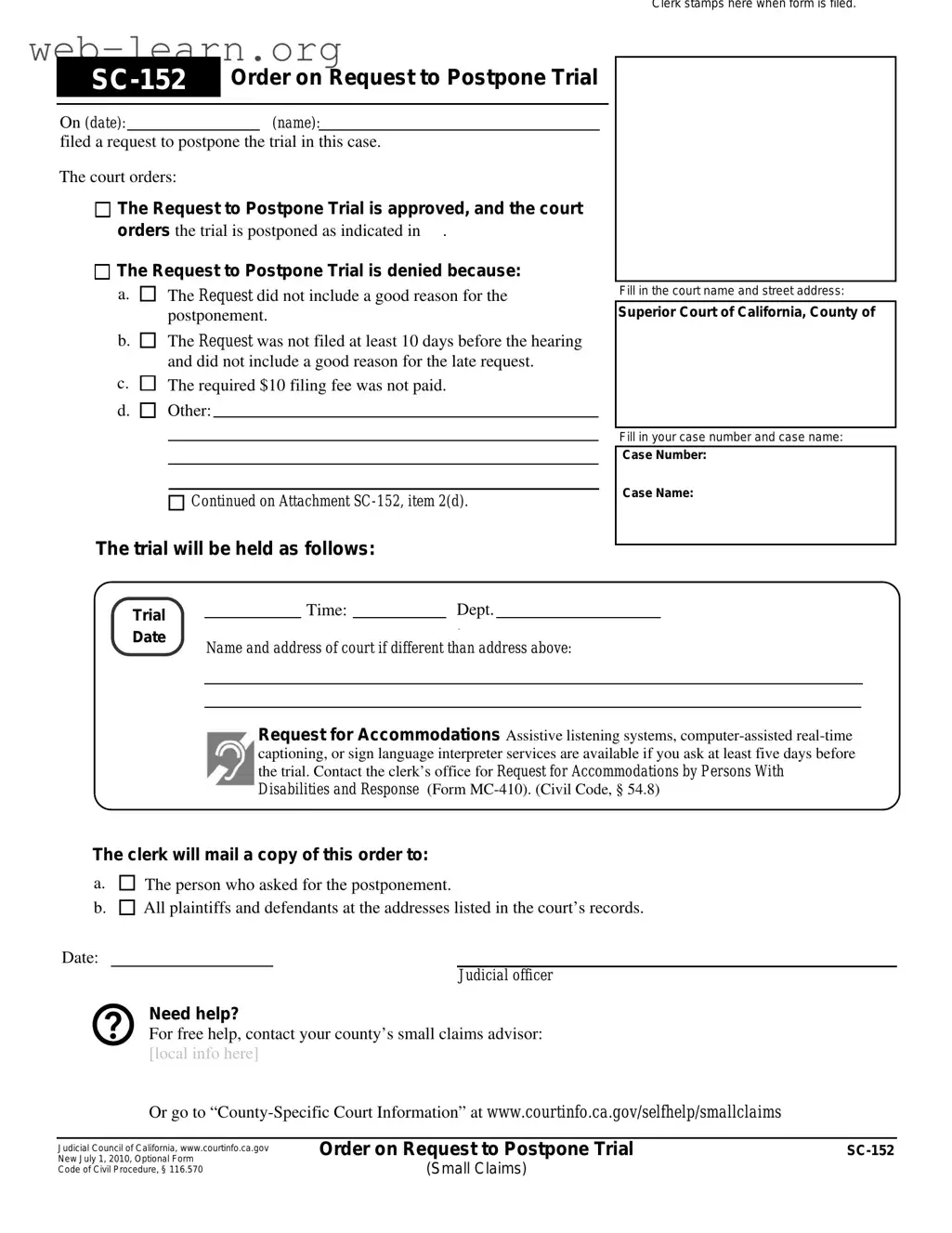
On (date): (name):
filed a request to postpone the trial in this case.
SC-152
Judicial Council of California, www.courtinfo.ca.gov
New July 1, 2010, Optional Form
Code of Civil Procedure, § 116.570
SC-152
Order on Request to Postpone Trial
(Small Claims)
The Request to Postpone Trial is approved, and the court
orders the trial is postponed as indicated in ¡.
All plaintiffs and defendants at the addresses listed in the court’s records.
b.
Judicial officer
|
~
¢
Clerk stamps here when form is filed.
Case Number:
Fill in your case number and case name:
Fill in the court name and street address:
Superior Court of California, County of
Case Name:
The clerk will mail a copy of this order to:
The person who asked for the postponement.
a.
3
The court orders:
The Request to Postpone Trial is denied because:
The Request was not filed at least 10 days before the hearing
and did not include a good reason for the late request.
b.
c.
The required $10 filing fee was not paid.
The Request did not include a good reason for the
postponement.
a.
d.
Other:
Continued on Attachment SC-152, item 2(d).
Need help?
For free help, contact your county’s small claims advisor:
[local info here]
Or go to “County-Specific Court Information” at www.courtinfo.ca.gov/selfhelp/smallclaims
Date:
¡
3
The trial will be held as follows:
Time:
Dept.
:
Name and address of court if different than address above:
3
Hearing
Date
î
Trial
Date
î
Request for Accommodations Assistive listening systems, computer-assisted real-time
captioning, or sign language interpreter services are available if you ask at least five days before
the trial. Contact the clerk’s office for Request for Accommodations by Persons With
Disabilities and Response (Form MC-410). (Civil Code, § 54.8)

Form Information

Fact Name Description
Purpose of SC-152 The SC-152 form is used to request a postponement of a trial in small claims cases in California.
Approval Criteria A request to postpone is approved if it meets the court's requirements and is submitted on time.
Denial Reasons Common reasons for denial include lack of a valid reason, late filing, or failure to pay the required fee.
Filing Fee A $10 filing fee is required when submitting the request for postponement.
Governing Law The SC-152 form is governed by the California Code of Civil Procedure, § 116.570.

Detailed Guide for Filling Out California Sc 152

After you have gathered the necessary information, you can begin filling out the California SC-152 form. This form is essential for requesting a postponement of your trial. Ensure that you have all required details at hand to complete the form accurately.

  1. Start by entering the name of the court at the top of the form. Write "Superior Court of California, County of" followed by the specific county name.
  2. Next, fill in your case number. This is usually assigned to you when you file your case.
  3. Then, write the case name. This typically includes the names of the parties involved in the case.
  4. In the section for "Hearing Trial," specify the date and time of the trial. Also, indicate the department number where the trial will take place.
  5. If the address of the court is different from the one you entered earlier, provide the name and address of that court.
  6. Look for the section regarding accommodations. If you need assistance, note that you should contact the clerk’s office at least five days before the trial.
  7. Finally, ensure that you sign and date the form. This indicates that the information you provided is accurate to the best of your knowledge.

Once you have completed the form, you will need to submit it to the court. The clerk will process your request and mail a copy of the order to all parties involved in the case. It is advisable to keep a copy for your records.

Obtain Answers on California Sc 152

  1. What is the California SC-152 form?

    The California SC-152 form is used to request a postponement of a trial in small claims court. If you need to delay your trial date, this form allows you to formally ask the court for that change. It outlines the reasons for your request and provides the court with the necessary information to make a decision.

  2. How do I know if my request to postpone the trial will be approved?

    The court will approve your request if you provide a good reason for postponement. Additionally, your request must be filed at least 10 days before the scheduled hearing. If you fail to meet these criteria, the court may deny your request. Common reasons for denial include not filing on time, not including a valid reason, or failing to pay the required filing fee.

  3. What happens if my request is denied?

    If your request to postpone the trial is denied, the court will provide a written explanation. This could be due to insufficient reasons, late filing, or other issues. You will need to prepare to attend the trial on the original date unless you take further action.

  4. What should I do if I need accommodations for the trial?

    If you require accommodations, such as assistive listening systems or sign language interpreters, you must request these services at least five days before your trial date. You can contact the clerk’s office to obtain the necessary form, known as Request for Accommodations by Persons With Disabilities and Response (Form MC-410).

  5. Who will receive a copy of the order once it is filed?

    The clerk will mail a copy of the order to the person who requested the postponement, as well as to all plaintiffs and defendants listed in the court’s records. This ensures everyone involved is informed about the status of the trial.

  6. Where can I find help if I have questions about the SC-152 form?

    If you have questions or need assistance, you can contact your county’s small claims advisor for free help. Additionally, you can visit the Judicial Council of California's website for more resources and information related to small claims court procedures.

Common mistakes

Filling out the California SC-152 form can be straightforward, but many people make common mistakes that can lead to delays or denials. Understanding these pitfalls can help ensure a smoother process. Here are eight mistakes to avoid.

One frequent error is failing to provide a valid reason for postponing the trial. The court requires a good reason to approve the request. If the explanation is vague or insufficient, the request may be denied. Always be clear and concise about why you need the postponement.

Another common mistake is submitting the request too late. The form must be filed at least 10 days before the hearing. If you miss this deadline, the court may deny your request unless you can provide a compelling reason for the delay. Planning ahead is crucial.

Many individuals overlook the filing fee. The SC-152 form requires a $10 fee to be paid at the time of submission. Neglecting to include this payment can result in an automatic denial of your request. Always check that you have included the necessary payment before filing.

Some people forget to fill in essential information, such as the court name, case number, and case name. This information is vital for the court to process your request. Double-check that all fields are completed accurately to avoid unnecessary complications.

In addition, failing to include the correct contact information can lead to communication issues. Ensure that your address and contact details are up-to-date so that the court can reach you regarding your request. This will help you stay informed about any updates or decisions made by the court.

Another mistake involves neglecting to request accommodations if needed. If you require assistive services, you must ask at least five days before the trial. This request should be made separately, so be proactive in ensuring your needs are met.

People sometimes forget to check the mailing requirements. The court will mail a copy of the order to all parties involved, including the person who requested the postponement. Make sure that all parties’ addresses are current in the court’s records to avoid any miscommunication.

Lastly, many individuals do not seek assistance when needed. If you have questions or need help, don't hesitate to contact your county’s small claims advisor. Utilizing available resources can clarify any uncertainties and help you navigate the process more smoothly.

Documents used along the form

The California SC-152 form is an essential document used to request a postponement of a trial in small claims court. Alongside this form, several other documents may be relevant to the process. Below is a list of commonly used forms and documents that often accompany the SC-152.

  • Form MC-410: Request for Accommodations by Persons With Disabilities - This form allows individuals with disabilities to request necessary accommodations, such as assistive listening systems or sign language interpreters, to ensure they can participate fully in court proceedings.
  • Form MC-410: Response to Request for Accommodations - This document is used by the court to respond to requests for accommodations. It outlines the court's decision regarding the requested assistance and any arrangements made.
  • SC-100: Plaintiff’s Claim and Order to Go to Small Claims Court - This form initiates a small claims case by allowing the plaintiff to present their claim. It includes details about the parties involved and the nature of the claim.
  • SC-120: Defendant’s Claim and Order to Go to Small Claims Court - This form is used by the defendant to counter a plaintiff’s claim. It allows the defendant to present their side of the case and seek relief.
  • SC-130: Notice of Appeal - This document is filed by a party wishing to appeal a small claims court decision. It serves as a formal notice to the court and the opposing party of the intention to appeal.
  • SC-140: Proof of Service - This form verifies that all parties involved in the case have been properly notified of the proceedings. It is crucial for ensuring that due process is followed.
  • SC-150: Order on Request to Postpone Trial - Similar to SC-152, this form is used to officially document the court’s decision regarding a request to postpone a trial. It includes details about the new trial date if the request is granted.
  • SC-200: Application for Waiver of Court Fees - This form allows individuals to request a waiver for court fees based on their financial situation. It is essential for those who may not be able to afford the costs associated with filing or attending court.

These documents play a significant role in the small claims process, facilitating communication and ensuring that all parties are informed and able to participate effectively in the legal proceedings.

Similar forms

The California SC-152 form, known as the Order on Request to Postpone Trial, shares similarities with several other legal documents. Each of these documents serves a unique purpose but often involves requests or orders related to court proceedings. Below is a list of ten documents that are similar to the SC-152 form:

  • SC-100 Claim Form: This form initiates a small claims case, allowing a plaintiff to formally present their claim to the court.
  • SC-101 Proof of Service: Used to confirm that all parties involved in a small claims case have received the necessary legal documents.
  • SC-120 Notice of Motion: This document is filed to inform the court and other parties about a motion being made, similar to how the SC-152 notifies about a postponement request.
  • SC-200 Request for Default: This form is submitted when a defendant fails to respond, allowing the plaintiff to seek a default judgment, paralleling the need for timely responses in postponement requests.
  • MC-410 Request for Accommodations: Similar in its purpose to the SC-152, this form requests necessary accommodations for individuals with disabilities during court proceedings.
  • SC-130 Judgment: This document outlines the court's decision in a small claims case, often following the proceedings that may have been postponed as per the SC-152.
  • SC-140 Notice of Appeal: Filed to indicate a party's intention to appeal a small claims judgment, this document is also time-sensitive, much like the SC-152.
  • SC-150 Request to Cancel Hearing: This form is used to request the cancellation of a scheduled hearing, reflecting the need for changes in court schedules similar to postponements.
  • MC-030 Declaration: This document allows a party to provide a written statement to the court, which can accompany requests like those made in the SC-152.
  • SC-110 Response to Claim: This form allows defendants to respond to a claim, similar to how the SC-152 allows for responses to postponement requests.

Dos and Don'ts

When filling out the California SC-152 form, it’s important to follow certain guidelines to ensure your request is processed smoothly. Here’s a list of things you should and shouldn’t do:

  • Do fill out the form completely, including your name, case number, and trial date.
  • Do submit your request at least 10 days before the trial date.
  • Do provide a clear and valid reason for the postponement.
  • Do pay the required $10 filing fee when submitting the form.
  • Don't leave any sections of the form blank.
  • Don't wait until the last minute to file your request.
  • Don't forget to check the court’s address and ensure it’s correct.
  • Don't assume your request will be granted without a good reason.

Misconceptions

Understanding the California SC-152 form is essential for anyone involved in a small claims case. However, several misconceptions can lead to confusion. Here are nine common misunderstandings:

  • The SC-152 form is only for defendants. This form can be used by any party involved in a small claims case, whether they are a plaintiff or a defendant.
  • You can postpone a trial for any reason. The court requires a valid reason for postponement. If the request lacks a good reason, it may be denied.
  • The request must be filed at least 30 days in advance. In fact, the request must be filed at least 10 days before the hearing to be considered.
  • There is no fee associated with filing the SC-152 form. A $10 filing fee is required. Failure to pay this fee can result in denial of the request.
  • The court automatically approves all requests to postpone. Each request is reviewed individually, and the court may deny it based on the reasons provided.
  • Once a trial is postponed, it can be rescheduled at any time. The new trial date will be set by the court and must be adhered to.
  • Assistance for disabilities is not available for small claims hearings. Accommodations, such as sign language interpreters, are available if requested at least five days before the trial.
  • Only the person requesting the postponement will receive notification. The court will mail a copy of the order to all parties involved in the case.
  • The SC-152 form is a permanent solution to trial scheduling. This form is only for postponing a specific trial date and does not affect future hearings.

By clarifying these misconceptions, individuals can better navigate the small claims process in California.

Key takeaways

Filling out and using the California SC-152 form is an important step for individuals seeking to postpone a trial. Here are key takeaways to consider:

  • Understand the Purpose: The SC-152 form is used to formally request a postponement of a trial date.
  • Timeliness Matters: Requests must be filed at least 10 days before the scheduled hearing, unless a valid reason is provided for a late request.
  • Good Reason Required: The court requires a good reason for postponement. Without it, the request may be denied.
  • Filing Fee: A $10 filing fee is required. Ensure this fee is paid to avoid denial of your request.
  • Clerk's Role: The clerk will stamp the form upon filing and mail a copy of the order to all relevant parties.
  • Accommodations Available: If you need assistive services, request them at least five days before the trial.
  • Contact Information: For assistance, reach out to your county’s small claims advisor or visit the Judicial Council of California's website.
  • Follow Court Instructions: Make sure to fill in all required information accurately, including the court name, case number, and trial details.

These steps can help ensure a smoother process when seeking to postpone your trial. Be proactive and attentive to the requirements outlined in the SC-152 form.