Homepage Blank California Sc 145 Form
Outline

The California SC-145 form plays a crucial role in the small claims court process, specifically when it comes to managing the payment of judgments. This form allows a judgment debtor to request that their payment be made directly to the court rather than to the creditor. It includes essential information such as the names and addresses of both the plaintiff and defendant, along with the small claims case number. The form also outlines the total amount due, which encompasses the principal amount ordered by the court, any awarded costs, accrued interest, and additional processing fees. Furthermore, if partial payments have already been made, the debtor can indicate this on the form by providing the amount paid and attaching relevant documentation. The SC-145 also informs the debtor that if payment is made by personal check, there will be a 30-day delay in processing the satisfaction of judgment. Once the debtor submits the completed form and payment, the court is responsible for calculating the total amount required and entering the satisfaction of judgment upon receipt of full payment. This process ensures that all parties involved are aware of their rights and responsibilities, and it helps maintain an organized record of payments made in small claims cases.
Sample - California Sc 145 Form

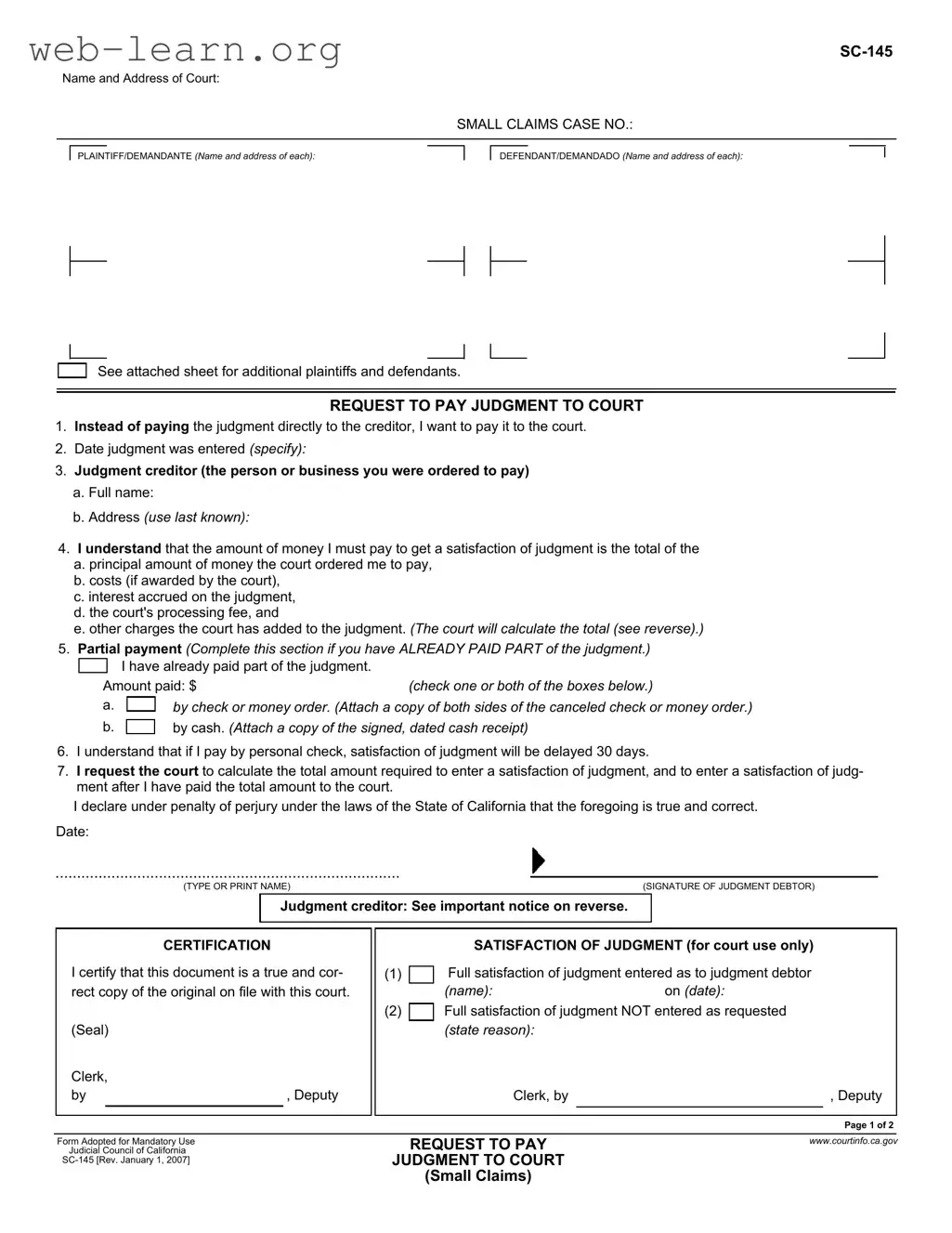
Name and Address of Court:
SMALL CLAIMS CASE NO.:
PLAINTIFF/DEMANDANTE (Name and address of each): DEFENDANT/DEMANDADO (Name and address of each):
See attached sheet for additional plaintiffs and defendants.
REQUEST TO PAY JUDGMENT TO COURT
1. Instead of paying the judgment directly to the creditor, I want to pay it to the court.
2. Date judgment was entered (specify):
3. Judgment creditor (the person or business you were ordered to pay)
a. Full name:
b. Address (use last known):
5. Partial payment (Complete this section if you have ALREADY PAID PART of the judgment.)
I have already paid part of the judgment.
(check one or both of the boxes below.)
by check or money order. (Attach a copy of both sides of the canceled check or money order.)
a.
6. I understand that if I pay by personal check, satisfaction of judgment will be delayed 30 days.
I declare under penalty of perjury under the laws of the State of California that the foregoing is true and correct.
Date:
(TYPE OR PRINT NAME) (SIGNATURE OF JUDGMENT DEBTOR)
Judgment creditor: See important notice on reverse.
CERTIFICATION SATISFACTION OF JUDGMENT (for court use only)
I certify that this document is a true and cor-
rect copy of the original on file with this court.
(1)
(name): on (date):
(2) Full satisfaction of judgment NOT entered as requested
(state reason):
(Seal)
Clerk,
by
Clerk, by
, Deputy
, Deputy
REQUEST TO PAY
JUDGMENT TO COURT
(Small Claims)
Form Adopted for Mandatory Use
Judicial Council of California
SC-145 [Rev. January 1, 2007]
www.courtinfo.ca.gov
4. I understand that the amount of money I must pay to get a satisfaction of judgment is the total of the
a. principal amount of money the court ordered me to pay,
b. costs (if awarded by the court),
c. interest accrued on the judgment,
d. the court's processing fee, and
e. other charges the court has added to the judgment. (The court will calculate the total (see reverse).)
Amount paid: $
b.
by cash. (Attach a copy of the signed, dated cash receipt)
7. I request the court to calculate the total amount required to enter a satisfaction of judgment, and to enter a satisfaction of judg-
ment after I have paid the total amount to the court.
................................................................................
Full satisfaction of judgment entered as to judgment debtor
Page 1 of 2
SC-145
PLAINTIFF:
CASE NUMBER:
DEFENDANT:
FOR COURT USE ONLY
1. Judgment entered on (date):
2. Amount to be paid as of date of request (specify):
a. Unpaid principal --------------------------------------------------------------------------------------------- $
b. Costs ----------------------------------------------------------------------------------------------------------- $
c. Post judgment costs ---------------------------------------------------------------------------------------- $
d. Credits (see receipts) -------------------------------------------------------------------------------------- $
e. Interest accrued (to date in item 2, above) ----------------------------------------------------------- $
f. Processing fee ----------------------------------------------------------------------------------------------- $
g. Other (specify) ----------------------------------------------------------------------------------------------- $
SUBTOTAL $
per day (from date in item 2) ------------------- $Add interest at: $
TOTAL
$
CLERK'S CERTIFICATE OF MAILING
I certify that I am not a party to this action. This Notice to Judgment Creditor was mailed first class, postage prepaid, in a sealed
envelope to the address shown in item 3 on the reverse. The mailing and this certification occurred
California,at (place):
on (date):
Clerk, by , Deputy
NOTICE TO JUDGMENT CREDITOR
2. You may claim this money by
a. presenting this form in person to the court clerk during regular business hours,
-OR-
b. mailing this form to the court.
3. Complete the Judgment Creditor's Request for Funds below.
4. Money not claimed within three years becomes the property of the court (see Government Code sections 50050-50056).
JUDGMENT CREDITOR'S REQUEST FOR FUNDS
I request the court to pay the money to me by mail at my current address (specify):
(Mail or deliver this form to the court clerk Keep a photocopy for yourself.)
Date:
(TYPE OR PRINT NAME)
(SIGNATURE OF JUDGMENT CREDITOR)
Page 2 of 2
SC-145 [Rev. January 1. 2007]
1. The judgment debtor has fully satisfied the judgment entered by making payment to the court in the amount shown above.
................................................................................
....
REQUEST TO PAY
JUDGMENT TO COURT
(Small Claims)
SC-145

Form Information

Fact Name Description
Form Purpose The SC-145 form allows a judgment debtor to request that payment of a judgment be made to the court instead of directly to the creditor.
Governing Law This form is governed by California Code of Civil Procedure Section 116.610, which outlines the procedures for small claims judgments.
Payment Breakdown The form specifies that the total amount owed includes the principal, costs, accrued interest, processing fees, and any additional charges.
Partial Payments If a judgment debtor has already made partial payments, they must indicate the amount paid and provide supporting documentation.
Delay in Processing Payments made by personal check may delay the satisfaction of judgment for 30 days, as stated in the form.
Certification Requirement The form requires the judgment debtor to declare under penalty of perjury that the information provided is true and correct.

Detailed Guide for Filling Out California Sc 145

After gathering the necessary information, you will be ready to fill out the California SC-145 form. This form is used to request payment of a judgment to the court instead of directly to the creditor. Follow the steps below to complete the form accurately.

  1. At the top of the form, fill in the Name and Address of Court where your case was heard.
  2. Enter the Small Claims Case Number in the designated space.
  3. Provide the Name and Address of each plaintiff and defendant. If there are more than one, use the attached sheet.
  4. Check the box indicating you want to pay the judgment to the court.
  5. Specify the Date judgment was entered.
  6. Fill in the details for the Judgment creditor:
    • Full name: Provide the name of the person or business you owe.
    • Address: Use the last known address of the creditor.
  7. Understand the total amount you need to pay. This includes:
    • Principal amount: The original amount ordered by the court.
    • Costs: Any costs awarded by the court.
    • Interest accrued: Interest that has built up on the judgment.
    • Processing fee: Any fees charged by the court.
    • Other charges: Any additional charges added to the judgment.
  8. If you have already made a partial payment, complete the section for Partial payment:
    • Enter the Amount paid: Specify how much you have already paid.
    • Indicate how you made the payment by checking the appropriate box (check, money order, or cash).
  9. Note that if you pay by personal check, the satisfaction of judgment will be delayed for 30 days.
  10. Request the court to calculate the total amount needed for satisfaction of judgment and indicate your understanding by signing and dating the form.

After completing the form, make sure to keep a copy for your records. You will then need to submit the form to the court as instructed. This will initiate the process for the court to handle your payment of the judgment.

Obtain Answers on California Sc 145

  1. What is the purpose of the California SC-145 form?

    The California SC-145 form is used by individuals who wish to pay a judgment to the court instead of directly to the creditor. This form allows the judgment debtor to request the court to calculate the total amount owed and to enter a satisfaction of judgment once payment is made. It provides a structured way to handle payments, ensuring that all parties are properly notified and that the court maintains accurate records.

  2. How do I fill out the SC-145 form?

    To complete the SC-145 form, follow these steps:

    • Enter the name and address of the court.
    • Fill in the small claims case number.
    • Provide the names and addresses of both the plaintiff and the defendant.
    • Indicate the date the judgment was entered and the name and address of the judgment creditor.
    • Calculate the total amount owed, including principal, costs, interest, and any processing fees.
    • If you have already made partial payments, document the amount paid and attach relevant proof.
    • Sign and date the form, declaring that the information is true and correct.

  3. What happens after I submit the SC-145 form?

    Once the SC-145 form is submitted, the court will review your request. The clerk will calculate the total amount you owe based on the information provided. If everything is in order and payment is made, the court will enter a satisfaction of judgment. This means that the judgment will be considered fully paid. If there are any issues, the court may not enter the satisfaction as requested and will provide a reason for this decision.

  4. Can I make partial payments using the SC-145 form?

    Yes, you can indicate if you have already made partial payments on the judgment when filling out the SC-145 form. You will need to specify the amount you have paid and provide documentation, such as a copy of a canceled check or a cash receipt. However, it’s important to note that the total amount must be paid to the court for a satisfaction of judgment to be entered.

  5. What should I do if I have questions about the SC-145 form?

    If you have questions or need assistance with the SC-145 form, it is advisable to contact the court where your case is filed. The court staff can provide guidance on how to fill out the form correctly and explain any specific procedures that may apply. Additionally, consider seeking legal advice if you need more detailed assistance regarding your situation.

Common mistakes

Filling out the California SC-145 form can seem straightforward, but there are common pitfalls that can lead to delays or complications. One frequent mistake is failing to include all necessary information. For instance, the judgment creditor’s full name and last known address must be provided. Omitting this information can result in the court being unable to process the request.

Another common error is not accurately calculating the total amount owed. The form requires you to account for various components, including the principal amount, costs, accrued interest, and any processing fees. If you neglect to include any of these elements, the total may be incorrect, which could delay the satisfaction of the judgment.

Many individuals also forget to attach necessary documentation. If you have made partial payments, you need to provide copies of canceled checks or receipts. Without these attachments, your request may be rejected. It’s crucial to double-check that all required documents are included before submission.

In addition, people often overlook the implications of payment methods. If you choose to pay by personal check, remember that satisfaction of the judgment will be delayed by 30 days. This detail can be easily missed but is essential for understanding the timeline of your payment.

Another mistake involves the declaration section. When you sign the form, you must declare under penalty of perjury that the information provided is true and correct. Failing to sign or misrepresenting any details can lead to serious legal consequences.

Additionally, some individuals forget to keep a copy of the completed form for their records. This can be problematic if there are any disputes or if you need to reference the form later. Always retain a photocopy of everything you submit.

Lastly, people sometimes misinterpret the instructions for the judgment creditor's request for funds. It’s important to follow the guidelines carefully to ensure that the funds are claimed correctly. Misunderstanding this process could result in lost funds or further complications.

Documents used along the form

The California SC-145 form is used to request that a judgment be paid to the court instead of directly to the creditor. Along with this form, there are several other documents that may be necessary in the small claims process. Each of these documents serves a specific purpose in ensuring that the judgment is properly recorded and processed.

  • SC-130: Plaintiff's Claim and Order to Go to Small Claims Court - This form initiates the small claims process. It outlines the plaintiff's claim against the defendant and requests a court hearing to resolve the dispute.
  • SC-140: Defendant's Claim and Order to Go to Small Claims Court - If the defendant believes they have a claim against the plaintiff, they can use this form to file a counterclaim. This ensures that both parties can present their cases in the same hearing.
  • SC-100: Small Claims Appeal - If a party is unhappy with the decision made in small claims court, they can use this form to appeal the judgment. It outlines the reasons for the appeal and requests a review by a higher court.
  • SC-200: Notice of Entry of Judgment - This document serves as official notice that a judgment has been entered in the case. It provides important details about the judgment, including the amount owed and the parties involved.

These forms and documents are essential for navigating the small claims process in California. They help ensure that all parties have a clear understanding of their rights and responsibilities, as well as the status of the case.

Similar forms

The California SC 145 form, used for requesting to pay a judgment to the court, shares similarities with several other legal documents. Here are four documents that have comparable functions or purposes:

  • SC-130: Plaintiff's Claim and Order to Go to Small Claims Court - This form initiates a small claims case by allowing the plaintiff to present their claim against the defendant. Like SC-145, it involves court procedures and requires specific information about the parties involved.
  • SC-135: Defendant's Claim and Order to Go to Small Claims Court - Similar to SC-130, this document is used by defendants who wish to counterclaim against the plaintiff. Both forms facilitate communication between the court and the involved parties regarding claims and judgments.
  • SC-100: Small Claims Court Judgment - This document officially records the court's decision regarding a small claims case. Like SC-145, it outlines the financial obligations resulting from the judgment, detailing amounts owed and payment procedures.
  • SC-150: Request to Set Aside Judgment - This form allows a party to request the court to overturn a judgment. Both SC-145 and SC-150 involve the court's role in managing judgments, although SC-145 focuses on payment, while SC-150 addresses the validity of the judgment itself.

Dos and Don'ts

When filling out the California SC-145 form, it is important to follow specific guidelines to ensure accuracy and compliance. Here are some things you should and shouldn't do:

  • Do double-check all names and addresses for accuracy.
  • Do include the date the judgment was entered.
  • Do clearly specify the total amount required to satisfy the judgment.
  • Do attach copies of any relevant payment receipts.
  • Don't leave any sections of the form blank; complete all required fields.
  • Don't forget to sign and date the form before submission.
  • Don't use abbreviations or shorthand that may confuse the court.
  • Don't assume that the court will calculate amounts for you; ensure all calculations are accurate.

Misconceptions

Misconceptions about the California SC-145 form can lead to confusion and errors in the small claims process. Here are seven common misunderstandings:

  • It is only for full payments. Many believe the SC-145 form is solely for those making complete payments of a judgment. In reality, it can also be used for partial payments, provided the debtor indicates how much has already been paid.
  • Payments must be made in cash. Some think cash is the only acceptable form of payment when using this form. However, payments can also be made by check or money order, as long as the appropriate documentation is attached.
  • The court automatically calculates the total amount due. It is a common misconception that the court will automatically calculate the total amount owed. While the court does provide a calculation, it is the responsibility of the debtor to ensure that all necessary amounts are included in their request.
  • Judgment satisfaction is immediate. Many assume that once they submit the SC-145 form, the judgment satisfaction is processed immediately. In fact, if payment is made by personal check, there is a 30-day delay before satisfaction is recorded.
  • The form is only for individual debtors. Some people think that the SC-145 form is exclusively for individual judgment debtors. In truth, businesses and other entities can also utilize this form to pay judgments.
  • All judgments must be paid to the creditor directly. There is a belief that payments must go directly to the creditor. However, the SC-145 form allows debtors to pay the court instead, which can simplify the process and ensure proper documentation.
  • Funds must be claimed immediately. Some think that judgment creditors must claim their funds as soon as they are available. In fact, creditors have up to three years to claim the money before it becomes property of the court.

Key takeaways

Here are key takeaways regarding the California SC-145 form:

  • The SC-145 form is used to request that a judgment payment be made to the court rather than directly to the creditor.
  • Ensure you provide accurate names and addresses for both the plaintiff and defendant, as well as the court information.
  • Be aware of the total amount required for satisfaction of judgment, which includes principal, costs, interest, and any processing fees.
  • If you have made a partial payment, include documentation such as copies of canceled checks or cash receipts.
  • Understand that paying by personal check will delay the satisfaction of judgment for 30 days.
  • The court will calculate the total amount owed, so ensure all relevant information is provided accurately.
  • Judgment creditors must claim any funds within three years; otherwise, the money will revert to the court.