Homepage Blank California Sc 114 Form
Outline

The California SC-114 form plays a crucial role in the small claims process, particularly when there is a need to amend the names of the parties involved in a case. This form is specifically designed for use before a hearing, allowing plaintiffs or defendants to formally request changes to the party names listed in their claims. It is essential to understand that this request must be communicated to all other parties in the case, ensuring transparency and fairness in the proceedings. The form requires the individual making the request to provide their name, address, and other contact details, while also specifying the changes they wish to make. Furthermore, it emphasizes the importance of serving this request to the other parties and filing the original with the court, while retaining a copy for personal records. In instances where the claim has not yet been served, the SC-114 form should not be filed; instead, the parties must file an amended claim using forms SC-100 or SC-120. The judge will ultimately decide on the request during the hearing, with the possibility of granting, denying, or continuing the request for further consideration. Understanding the nuances of this form can significantly impact the course of a small claims case, making it imperative for individuals to approach this process with diligence and care.
Sample - California Sc 114 Form

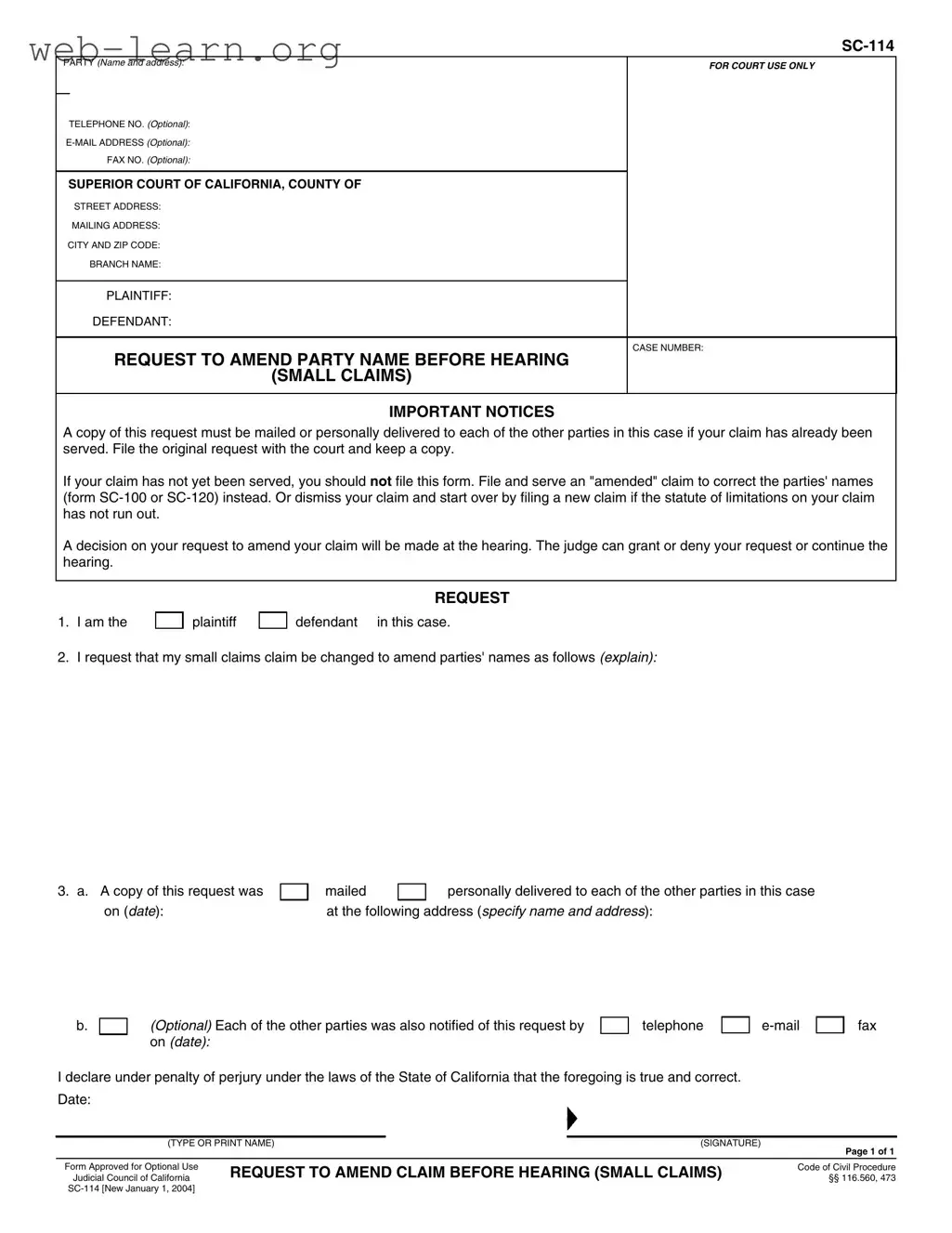
REQUEST TO AMEND PARTY NAME BEFORE HEARING
(SMALL CLAIMS)
FOR COURT USE ONLY
CASE NUMBER:
REQUEST TO AMEND CLAIM BEFORE HEARING (SMALL CLAIMS)
Form Approved for Optional Use
Judicial Council of California
SC-114 [New January 1, 2004]
SC-114
PLAINTIFF:
DEFENDANT:
TELEPHONE NO. (Optional):
E-MAIL ADDRESS (Optional):
1. I am the
2. I request that my small claims claim be changed to amend parties' names as follows
(explain):
STREET ADDRESS:
MAILING ADDRESS:
CITY AND ZIP CODE:
BRANCH NAME:
SUPERIOR COURT OF CALIFORNIA, COUNTY OF
Page 1 of 1
3. a. A copy of this request was mailed personally delivered to each of the other parties in this case
on (
date): at the following address (specify name and address):
plaintiff defendant in this case.
PARTY (Name and address):
FAX NO. (Optional):
REQUEST
b. (Optional) Each of the other parties was also notified of this request by telephone e-mail fax
on
(date):
I declare under penalty of perjury under the laws of the State of California that the foregoing is true and correct.
Date:
(TYPE OR PRINT NAME) (SIGNATURE)
Code of Civil Procedure
§§ 116.560, 473
A copy of this request must be mailed or personally delivered to each of the other parties in this case if your claim has already been
served. File the original request with the court and keep a copy.
If your claim has not yet been served, you should not file this form. File and serve an "amended" claim to correct the parties' names
(form SC-100 or SC-120) instead. Or dismiss your claim and start over by filing a new claim if the statute of limitations on your claim
has not run out.
A decision on your request to amend your claim will be made at the hearing. The judge can grant or deny your request or continue the
hearing.
IMPORTANT NOTICES

Form Information

Fact Name Fact Description
Form Purpose The SC-114 form is used to request an amendment to the names of parties involved in a small claims case before the hearing.
Governing Law This form is governed by California Code of Civil Procedure §§ 116.560 and 473.
Notification Requirement A copy of the request must be mailed or personally delivered to all other parties in the case if the claim has already been served.
Filing Instructions
Alternative Actions If the claim has not been served, the requester should file an amended claim using forms SC-100 or SC-120 instead of SC-114.
Decision Process The judge will decide on the request during the hearing, with the options to grant, deny, or continue the hearing.

Detailed Guide for Filling Out California Sc 114

Filling out the California SC-114 form is a straightforward process that requires attention to detail. After completing this form, you will need to ensure that it is filed with the court and served to the other parties involved in your case. Below are the steps to guide you through the process of filling out the form correctly.

  1. Begin by entering your name and address in the PARTY section at the top of the form.
  2. If you have a telephone number, email address, or fax number, you can include them in the optional fields provided.
  3. Fill in the SUPERIOR COURT OF CALIFORNIA section with the street address, mailing address, city, and zip code of the court where your case is filed.
  4. Indicate the BRANCH NAME of the court if applicable.
  5. In the PLAINTIFF and DEFENDANT sections, write the names of the parties involved in the case.
  6. Enter your CASE NUMBER in the designated field.
  7. State whether you are the plaintiff or defendant by checking the appropriate box in the REQUEST section.
  8. In the next line, explain how you wish to amend the party names in your claim.
  9. For the notification of other parties, fill in the date you mailed or personally delivered a copy of this request. Specify the name and address of each party in the provided space.
  10. If you notified the other parties by telephone, you can optionally include the date of that notification.
  11. Sign and date the form, ensuring that you type or print your name clearly beneath your signature.

Once you have completed the form, make sure to file the original with the court and keep a copy for your records. Remember, it is essential to serve the other parties involved in your case with a copy of this request to ensure compliance with court procedures.

Obtain Answers on California Sc 114

  1. What is the purpose of the California SC-114 form?

    The SC-114 form is used to request an amendment to the names of the parties involved in a small claims case. If you realize that the names of the parties are incorrect or incomplete, this form allows you to officially request a change before the hearing takes place.

  2. Who can file the SC-114 form?

    Either the plaintiff or the defendant in a small claims case can file the SC-114 form. It is essential that the individual filing the request is a party to the case, as they must provide accurate information regarding the case and the parties involved.

  3. What steps must be taken after completing the SC-114 form?

    Once you have filled out the SC-114 form, you must take the following steps:

    • Mail or personally deliver a copy of the request to each of the other parties involved in the case.
    • File the original request with the court.
    • Keep a copy of the request for your records.

  4. What should I do if my claim has not yet been served?

    If your claim has not yet been served, do not file the SC-114 form. Instead, you should file and serve an amended claim using form SC-100 or SC-120 to correct the names of the parties. Alternatively, if the statute of limitations allows, you may choose to dismiss your claim and start fresh with a new claim.

  5. What happens after I file the SC-114 form?

    The judge will review your request during the hearing. They have the authority to grant or deny your request to amend the party names. In some cases, the judge may decide to continue the hearing to gather more information.

  6. What information is required on the SC-114 form?

    The SC-114 form requires the following information:

    • Your name and address.
    • The name and address of the other parties involved.
    • The case number.
    • A clear explanation of how you wish to amend the party names.
    • Details of when and how you notified the other parties about this request.

  7. Is it necessary to notify the other parties about the SC-114 request?

    Yes, it is crucial to notify the other parties about your request to amend the party names. You must either mail or personally deliver a copy of the SC-114 form to each party involved in the case. This ensures that everyone is informed and can respond accordingly during the hearing.

Common mistakes

When filling out the California SC-114 form, one common mistake is failing to provide complete and accurate party information. It is essential to include the full names and addresses of all parties involved. Incomplete information can lead to delays or even rejection of the request.

Another frequent error is neglecting to serve a copy of the request to all other parties. According to the instructions, a copy must be mailed or personally delivered to each party if the claim has already been served. Skipping this step may result in complications during the hearing.

Some individuals mistakenly assume that they can file the SC-114 form if their claim has not yet been served. This is incorrect. Instead, they should file and serve an amended claim using forms SC-100 or SC-120. Failing to follow this guideline can cause unnecessary confusion and may jeopardize the case.

Additionally, people often overlook the importance of including the date when the request was mailed or delivered. This date is crucial for the court's records and for verifying that all parties were properly notified. Omitting this information can lead to questions about compliance with notification requirements.

Finally, individuals sometimes forget to sign the form. A signature is necessary to validate the request and affirm that the information provided is true and correct. Without a signature, the form may be deemed incomplete, which can hinder the process.

Documents used along the form

The California SC-114 form is an essential document for those involved in small claims court proceedings, specifically when a party needs to amend the name of a party involved in a case. However, several other forms and documents often accompany this request to ensure a smooth legal process. Below are some of the key forms that may be used alongside the SC-114.

  • SC-100: Plaintiff's Claim and Order to Go to Small Claims Court - This is the initial form used to file a small claims case. It outlines the plaintiff's claim against the defendant and serves as the foundation for the court proceedings.
  • SC-120: Defendant's Claim and Order to Go to Small Claims Court - Similar to the SC-100, this form is used by defendants who wish to file a counterclaim against the plaintiff. It allows defendants to assert their claims and seek remedies in the same small claims action.
  • SC-105: Proof of Service - This document verifies that the required parties have been properly notified about the claims and any amendments. It is crucial for ensuring that all parties are aware of the proceedings and their rights.
  • SC-140: Request to Postpone Small Claims Hearing - If a party needs more time before the hearing, this form allows them to formally request a postponement. It must be filed with the court and served to all other parties involved in the case.

Understanding these forms and their purposes can greatly enhance your experience in small claims court. Each document plays a vital role in ensuring that the process is fair and that all parties have the opportunity to present their cases effectively. Familiarizing yourself with these forms can help you navigate the legal landscape with confidence.

Similar forms

The California SC-114 form, which is used to request an amendment to party names in small claims cases, shares similarities with several other legal documents. Each of these documents serves a specific function in the legal process, often related to the amendment or correction of information. Below are seven documents that are similar to the SC-114 form:

  • SC-100 - Plaintiff's Claim and ORDER to Go to Small Claims Court: This form initiates a small claims case. Like the SC-114, it requires accurate party information and is essential for proper legal proceedings.
  • SC-120 - Defendant's Claim and ORDER to Go to Small Claims Court: This document allows a defendant to assert a claim against the plaintiff. Similar to the SC-114, it must be served to all parties involved.
  • SC-105 - Proof of Service: This form verifies that documents have been properly served to the parties. It complements the SC-114 by ensuring that all parties are informed of amendments.
  • SC-126 - Request for Dismissal: This form is used to dismiss a small claims case. It is similar to the SC-114 in that it involves the parties and their claims but focuses on ending a case rather than amending it.
  • SC-130 - Small Claims Subpoena: This document compels a witness to appear in court. While it serves a different purpose, it also involves the management of parties and their participation in the case.
  • SC-140 - Application for Waiver of Court Fees: This form requests a waiver for court fees based on financial hardship. Like the SC-114, it requires personal information and must be served to relevant parties.
  • SC-150 - Notice of Appeal: This document is used to appeal a small claims judgment. Similar to the SC-114, it involves notifying other parties of changes in the case status.

Dos and Don'ts

When filling out the California SC-114 form, it is essential to follow specific guidelines to ensure accuracy and compliance. Below is a list of dos and don'ts to keep in mind.

  • Do provide your full name and address clearly at the top of the form.
  • Do include your case number to help the court identify your claim.
  • Do ensure that the names you wish to amend are correctly spelled and formatted.
  • Do mail or personally deliver a copy of the request to all other parties involved in the case.
  • Don't file this form if your claim has not yet been served; instead, use an amended claim form.
  • Don't forget to keep a copy of the completed form for your records.
  • Don't leave out optional contact information, such as your email or fax number, if you want to ensure easier communication.
  • Don't forget to sign and date the form, as this is crucial for its validity.

Misconceptions

Misconceptions about the California SC-114 form can lead to confusion and delays in the small claims process. Below are nine common misconceptions, along with clarifications for each.

  • It can be filed anytime. The SC-114 form should only be filed if your claim has already been served. If it has not been served, you need to file an amended claim instead.
  • All parties must agree to the name change. While it is good practice to notify other parties, the judge will ultimately decide whether to grant your request at the hearing.
  • You do not need to notify other parties. It is mandatory to mail or personally deliver a copy of the request to each of the other parties involved in the case.
  • Filing the SC-114 form is sufficient to amend a claim. You must file the original request with the court and keep a copy for your records. Simply submitting the form does not amend the claim.
  • The judge will automatically grant the request. The judge has the discretion to grant, deny, or continue the hearing regarding your request.
  • You can change the claim after the hearing. Changes to party names should be made prior to the hearing, not after.
  • There is no deadline for filing the SC-114 form. There are specific timelines that must be adhered to, especially in relation to the statute of limitations on your claim.
  • Only the plaintiff can request a name change. Both plaintiffs and defendants can use the SC-114 form to request an amendment to party names.
  • The SC-114 form is only for name changes. This form is specifically designed for amending party names before a hearing in small claims cases.

Key takeaways

Filling out and using the California SC-114 form requires attention to detail. Here are key takeaways to guide you through the process:

  • Understand the Purpose: The SC-114 form is used to request changes to the names of parties involved in a small claims case before the hearing.
  • Eligibility: You must be either the plaintiff or defendant in the case to file this request.
  • Notification Requirement: A copy of the request must be mailed or personally delivered to all other parties involved in the case.
  • Filing Instructions: After completing the form, file the original with the court and keep a copy for your records.
  • Timing Matters: If your claim has not been served, do not file this form. Instead, file an amended claim using form SC-100 or SC-120.
  • Statute of Limitations: If the statute of limitations on your claim has not expired, you can dismiss the current claim and start anew.
  • Hearing Decision: The judge will decide on your request during the hearing, which may result in approval, denial, or a continuance.
  • Signature Requirement: Ensure that you sign the form, as it includes a declaration under penalty of perjury.
  • Optional Information: While providing your telephone number, email address, and fax number is optional, it can facilitate communication regarding your case.