Homepage Blank California Sb 11290 Form
Outline

The California SB 11290 form serves as a critical legal document for grandparents seeking visitation rights with their grandchildren. This petition is specifically designed for situations where a grandparent wishes to establish or maintain a relationship with a minor child, especially in cases where the parents may be divorced, separated, or otherwise unable to facilitate such visits. The form requires the petitioner to provide detailed information, including their relationship to the child, the current custody situation, and the reasons for seeking visitation. Additionally, it prompts the petitioner to describe the existing bond between themselves and the child, as well as to propose a visitation schedule that they believe serves the child's best interests. Importantly, the form also includes a section for parental consent, which is essential in cases where one or both parents are agreeable to the grandparent's request. The legal framework surrounding this petition is grounded in California Family Code sections 3100 through 3104, which outline the rights of grandparents in visitation matters. Furthermore, the form stipulates that personal service is generally required unless the petition is filed within an existing case, emphasizing the importance of proper legal procedures in family law. Understanding the nuances of this form is essential for grandparents navigating the complexities of family dynamics and the legal system.

Sample - California Sb 11290 Form

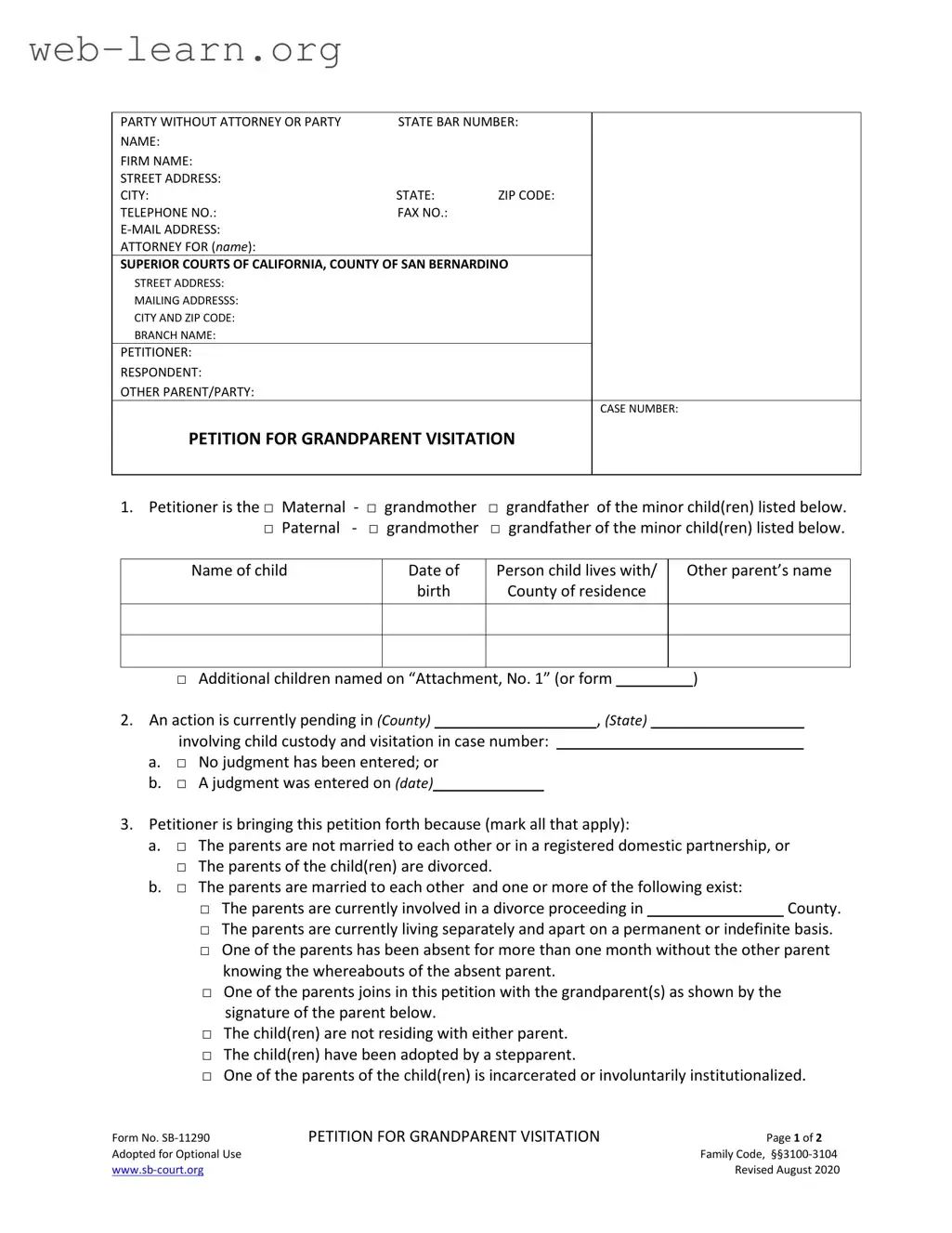
Form No. SB-11290 PETITION FOR GRANDPARENT VISITATION Page 1 of 2
Adopted for Optional Use Family Code, §§3100-3104
www.sb-court.org Revised August 2020
PARTY WITHOUT ATTORNEY OR PARTY STATE BAR NUMBER:
NAME:
FIRM NAME:
STREET ADDRESS:
CITY: STATE: ZIP CODE:
TELEPHONE NO.: FAX NO.:
E-MAIL ADDRESS:
ATTORNEY FOR (name):
SUPERIOR COURTS OF CALIFORNIA, COUNTY OF SAN BERNARDINO
STREET ADDRESS:
MAILING ADDRESSS:
CITY AND ZIP CODE:
BRANCH NAME:
PETITIONER:
RESPONDENT:
OTHER PARENT/PARTY:
PETITION FOR GRANDPARENT VISITATION
CASE NUMBER:
1. Petitioner is the Maternal - grandmother
grandfather of the minor child(ren) listed below.
Paternal - grandmother grandfather of the minor child(ren) listed below.
Name of child
Date of
birth
Person child lives with/
County of residence
Other parent’s name
Additional children named on Attachment, No. 1” (or form _________)
2. An action is currently pending in
(County) ___________________, (State) __________________
involving child custody and visitation in case number: _____________________________
a. No judgment has been entered; or
b. A judgment was entered on
(date)_____________
3. Petitioner is bringing this petition forth because (mark all that apply):
a. The parents are not married to each other or in a registered domestic partnership, or
The parents of the child(ren) are divorced.
b. The parents are married to each other and one or more of the following exist:
The parents are currently involved in a divorce proceeding in ________________
County.
The parents are currently living separately and apart on a permanent or indefinite basis.
One of the parents has been absent for more than one month without the other parent
knowing the whereabouts of the absent parent.
One of the parents joins in this petition with the grandparent(s) as shown by the
signature of the parent below.
The child(ren) are not residing with either parent.
The child(ren) have been adopted by a stepparent.
One of the parents of the child(ren) is incarcerated or involuntarily institutionalized.
Form No. SB-11290 PETITION FOR GRANDPARENT VISITATION Page 2 of 2
Adopted for Optional Use Family Code, §§3100-3104
www.sb-court.org Revised August 2020
4. There is a preexisting relationship and bond between the child(ren) and grandparent(s). Explain
the reason why grandparent visitation is in the best interest of each child: _____________________
__________________________________________________________________________________
__________________________________________________________________________________
See Attachment, No. 4” (or form _________)
5. Describe the proposed visitation schedule:_____
_________________________________________
_________________________________________________________________________________
_________________________________________________________________________________
See Attachment, No. 5” (or form _________)
6. A completed Declaration Under the Uniform Child Custody Jurisdiction and Enforcement Act
(FL-105) form is submitted as there is no existing family law case. This petition shall start a new
matter.
7. Petitioner requests that the Court grant reasonable visitation with the above-named child(ren) and
such other relief as the Court deems appropriate pursuant to Family Code sections 3100 through
3104.
A Request for Order (FL-300 form) is concurrently filed with this petition in order to request a
hearing date. (
Note: A Request for Order cannot be filed until after a party has been joined to the case)
I declare under penalty of perjury under the laws of the State of California that the foregoing and all
attachments are true and correct.
Date:
________________________________
_________________________________________________
TYPE OR PRINT NAME SIGNATURE OF PETITIONER
________________________________ _________________________________________________
TYPE OR PRINT NAME SIGNATURE OF PETITIONER
________________________________ _________________________________________________
TYPE OR PRINT NAME SIGNATURE OF ATTORNEY FOR PETITIONER(S)
PARENT’S CONSENT TO PETITION FOR GRANDPARENT VISITATION
I hereby consent to and join this Petition for Grandparent Visitation.
Date:
________________________________
_________________________________________________
TYPE OR PRINT NAME SIGNATURE OF MOTHER FATHER OF CHILD(REN)
NOTICE: The Court shall balance the interests of the child in having grandparent visits against the rights of the
parents.
A rebuttable presumption against best interests/visitation is created:
1. If the parents agree that visitation is not in the best interests of the child(ren), or
2. If the parent awarded sole legal and physical custody (or with whom the child resides if no custody order)
objects.
SERVICE: Personal service is required unless this petition is filed in an existing case. If filed in an existing case,
service is completed by certified mail, return receipt to the last known address of parents, stepparent or person
with physical custody of the child(ren). (See Family Code sections 3103(c) and 3104(c).)

Form Information

Fact Name Details
Governing Law Family Code sections 3100-3104
Form Purpose This form is used to petition for grandparent visitation rights in California.
Petitioner Types Petitioners can be maternal or paternal grandparents of the minor child.
Preexisting Relationship The petitioner must demonstrate a bond with the child, supporting the visitation request.
Filing Requirements A completed Declaration Under the Uniform Child Custody Jurisdiction and Enforcement Act (FL-105) may be required.
Service Method Personal service is required unless filed in an existing case, then certified mail is acceptable.
Consent Requirement The petition must include consent from at least one parent to proceed.
Judgment Status Petitioners must indicate whether a judgment has been entered in any related custody case.

Detailed Guide for Filling Out California Sb 11290

After completing the California SB 11290 form, you will be ready to submit it to the court. Ensure you have all necessary attachments and information before filing. The next steps will involve serving the petition and possibly attending a hearing.

  1. Begin by filling in your information in the "Party Without Attorney or Party State Bar Number" section. Include your name, firm name (if applicable), address, city, state, zip code, telephone number, fax number, and email address.
  2. Indicate who you are representing in the "Attorney For" section.
  3. Provide the address and mailing address of the Superior Courts of California, County of San Bernardino.
  4. Fill in the branch name where you are filing.
  5. Identify yourself as the Petitioner, and provide the names of the Respondent and the other parent/party involved.
  6. Enter the case number related to the child custody and visitation action that is currently pending.
  7. State your relationship to the minor child(ren) in section 1. Specify whether you are the maternal or paternal grandparent and list the names and dates of birth of the child(ren). Include the name of the person the child lives with and their county of residence.
  8. In section 2, indicate whether a judgment has been entered in the pending case. Check the appropriate box.
  9. In section 3, mark all applicable reasons for bringing this petition forward.
  10. In section 4, explain the existing relationship and bond between the grandparent(s) and the child(ren). You may attach additional information if needed.
  11. Describe the proposed visitation schedule in section 5. You can provide additional details on an attachment if necessary.
  12. If there is no existing family law case, check the box in section 6 to confirm that you are submitting a completed Declaration Under the Uniform Child Custody Jurisdiction and Enforcement Act (FL-105) form.
  13. In section 7, state your request for the court to grant reasonable visitation and any other relief you deem appropriate.
  14. Sign and date the form where indicated. Ensure that you print your name clearly.
  15. If applicable, have the parent(s) consent to the petition by signing in the designated area.
  16. Review the notice regarding service requirements to ensure compliance.

Obtain Answers on California Sb 11290

  1. What is the California SB 11290 form?

    The California SB 11290 form is a legal document used to petition for grandparent visitation rights. It allows grandparents to request visitation with their grandchildren under certain circumstances. The form requires information about the petitioner, the child, and the existing custody arrangements.

  2. Who can file the SB 11290 form?

    Grandparents can file this form if they have a preexisting relationship with their grandchildren. The petitioner must indicate whether they are the maternal or paternal grandparent and provide details about the child or children involved.

  3. What information do I need to provide on the form?

    You will need to fill out personal information such as your name, address, and contact details. Additionally, you must provide information about the child, including their name, date of birth, and who they currently live with. You will also need to explain why visitation is in the child's best interest and propose a visitation schedule.

  4. What happens if the parents do not agree with the visitation?

    If the parents believe that visitation is not in the best interest of the child, it creates a rebuttable presumption against visitation. This means the court will weigh the parents' objections heavily. If one parent has sole custody, their objection will also be taken into account.

  5. Is personal service required when filing this petition?

    Yes, personal service is generally required unless the petition is filed in an existing case. If it is part of an ongoing case, you may serve the documents by certified mail to the last known address of the parents or guardians involved.

  6. What should I do if I have additional questions?

    If you have more questions about the SB 11290 form or the process, consider reaching out to a legal professional or the court clerk's office. They can provide guidance tailored to your situation and help ensure that you complete the form correctly.

Common mistakes

Filling out the California SB 11290 form requires careful attention to detail. One common mistake is failing to provide complete information about the petitioner. The form asks for specific details such as the petitioner’s name, address, and contact information. Omitting any of these details can lead to delays in processing the petition.

Another frequent error involves the selection of the relationship to the child. Petitioners must clearly indicate whether they are the maternal or paternal grandparent. Misidentifying this relationship can create confusion and may result in the petition being rejected. It is crucial to check the appropriate boxes accurately.

People often neglect to explain why grandparent visitation is in the best interest of the child. This section is critical, as the court requires a compelling rationale for granting visitation rights. Failing to provide a thorough explanation can weaken the case and impact the outcome.

Additionally, many individuals overlook the necessity of a proposed visitation schedule. Providing a clear and realistic schedule is essential for the court's consideration. Without this information, the court may find it difficult to grant the request for visitation.

Some petitioners mistakenly believe that they can submit the form without additional documentation. A completed Declaration Under the Uniform Child Custody Jurisdiction and Enforcement Act (FL-105) form is necessary if there is no existing family law case. Not including this form can result in the petition being deemed incomplete.

Another common oversight is the lack of a parent’s consent. If one parent does not join the petition or consent to it, the court may view the petition unfavorably. It is vital to ensure that all necessary signatures are obtained before submission.

Finally, many individuals fail to follow proper service procedures. Personal service is required unless the petition is filed in an existing case. Misunderstanding the service requirements can lead to complications and delays in the legal process. Ensuring that all parties are properly notified is essential for the petition to move forward.

Documents used along the form

The California SB 11290 form is an essential document for grandparents seeking visitation rights. However, several other forms and documents often accompany it to ensure that the legal process is thorough and compliant with state laws. Below is a list of these documents, along with brief descriptions of their purposes.

  • Declaration Under the Uniform Child Custody Jurisdiction and Enforcement Act (FL-105): This form is used to establish the jurisdiction of the court over child custody matters. It is particularly important when there is no existing family law case and helps to clarify which state has the authority to make custody decisions.
  • Request for Order (FL-300): This document is filed to request a hearing date for the petition. It is necessary to formally ask the court to take action on the visitation request and cannot be filed until a party has been joined to the case.
  • Attachment No. 1: This attachment is utilized to list additional children involved in the petition. It provides the court with comprehensive information regarding all minors for whom visitation is being requested.
  • Attachment No. 4: This attachment allows the petitioner to explain the existing relationship and bond between the grandparent and the child. It is crucial for demonstrating why visitation is in the best interest of the child.
  • Attachment No. 5: This document outlines the proposed visitation schedule. It details the specific times and arrangements for visitation, which helps the court understand the grandparent's intentions clearly.
  • Proof of Service: This document verifies that all necessary parties have been properly notified of the petition. It is important to show that the petition has been served according to legal requirements, ensuring fairness in the process.
  • Parental Consent Form: This form is signed by the child's parents, indicating their agreement to the grandparent's petition for visitation. Parental consent can significantly influence the court's decision regarding the request.

Each of these documents plays a vital role in the process of seeking grandparent visitation in California. They help establish the necessary legal framework and support the petitioner's case, ensuring that all parties involved are informed and that the best interests of the child remain the primary focus.

Similar forms

  • Petition for Child Custody (FL-300): Similar to the SB 11290 form, this document is used to request custody of a child. It outlines the relationship between the petitioner and the child, the current living situation, and the proposed custody arrangement.
  • Request for Order (FL-300): This form can be filed alongside the SB 11290 to request a hearing date. It serves as a formal request for the court to issue orders regarding custody or visitation, similar to how the SB 11290 seeks visitation rights.
  • Declaration Under Uniform Child Custody Jurisdiction and Enforcement Act (FL-105): This document is often submitted with the SB 11290 when no existing family law case is present. It establishes jurisdiction for the court to hear the case, similar to how the SB 11290 establishes the need for grandparent visitation.
  • Petition for Modification of Custody (FL-340): This form is used to change existing custody arrangements. Like the SB 11290, it requires the petitioner to demonstrate a change in circumstances that justifies the modification.
  • Grandparent Visitation Petition (FL-310): This document specifically addresses grandparent visitation rights. It is similar to the SB 11290 as it focuses on the rights of grandparents to visit their grandchildren and requires a demonstration of the child's best interests.

Dos and Don'ts

When filling out the California SB 11290 form for grandparent visitation, it’s important to be thorough and precise. Here’s a list of things you should and shouldn’t do to ensure your petition is completed correctly.

  • Do provide complete and accurate information.
  • Do clearly state your relationship to the child(ren).
  • Do include a proposed visitation schedule.
  • Do ensure that all required attachments are submitted.
  • Do sign and date the form where indicated.
  • Don’t leave any sections blank unless instructed.
  • Don’t forget to check for any additional local court requirements.

By following these guidelines, you can help streamline the process and increase the likelihood of your petition being accepted. Remember, clarity and completeness are key! Good luck!

Misconceptions

Understanding the California SB 11290 form can be challenging due to various misconceptions. Here are seven common misunderstandings, along with clarifications to help navigate this important legal document.

  • This form is only for grandmothers. Many believe that the SB 11290 form is exclusive to grandmothers. In fact, it is applicable to both maternal and paternal grandparents seeking visitation rights.
  • The form guarantees visitation rights. Some may think that submitting this form ensures automatic visitation. However, the court will evaluate the best interests of the child before making any decisions regarding visitation.
  • Only divorced parents can be involved. A common misconception is that only parents who are divorced can be subject to this form. The form can also apply when parents are married but living separately or in other specific situations.
  • Filing this form is the same as filing for custody. While both processes involve legal considerations regarding children, filing for grandparent visitation is distinct from filing for custody. Each has its own legal implications and requirements.
  • There is no need for a relationship with the child. Some individuals may think that they can file this form without demonstrating a pre-existing relationship with the child. However, the form requires evidence of a bond between the grandparent and the child.
  • Consent from parents is not necessary. Many assume that grandparents can file the form without parental consent. In reality, if a parent opposes the visitation, the court will consider this objection seriously.
  • This form can be filed without legal advice. While it is possible to fill out the SB 11290 form without an attorney, seeking legal advice is highly recommended. An attorney can provide guidance on the nuances of family law and help ensure that all necessary information is included.

By addressing these misconceptions, individuals can approach the California SB 11290 form with a clearer understanding of its purpose and requirements.

Key takeaways

When filling out and using the California SB 11290 form, there are several important considerations to keep in mind. This form is designed for grandparents seeking visitation rights, and understanding its nuances can significantly impact the outcome of the petition.

  • Identify Your Relationship: Clearly state whether you are the maternal or paternal grandparent. This designation is essential as it sets the context for your petition.
  • Current Legal Proceedings: Indicate if there is an ongoing child custody case. This information is crucial, as it helps the court understand the existing legal landscape surrounding the child.
  • Establish a Bond: Describe the relationship between you and the child. The court will consider the emotional connection when determining visitation rights.
  • Propose a Visitation Schedule: Provide a clear and reasonable visitation plan. This should include specific days and times, as well as any special occasions you wish to include.
  • Parent's Consent: If possible, obtain the consent of the child's parent(s). Their agreement can strengthen your case and may help avoid legal disputes.

Filling out the SB 11290 form accurately and thoughtfully can enhance your chances of obtaining the desired visitation rights. Each section of the form serves a purpose, and providing detailed information is key to presenting a compelling case to the court.