Homepage Blank California Sales Tax Certificate Form
Outline

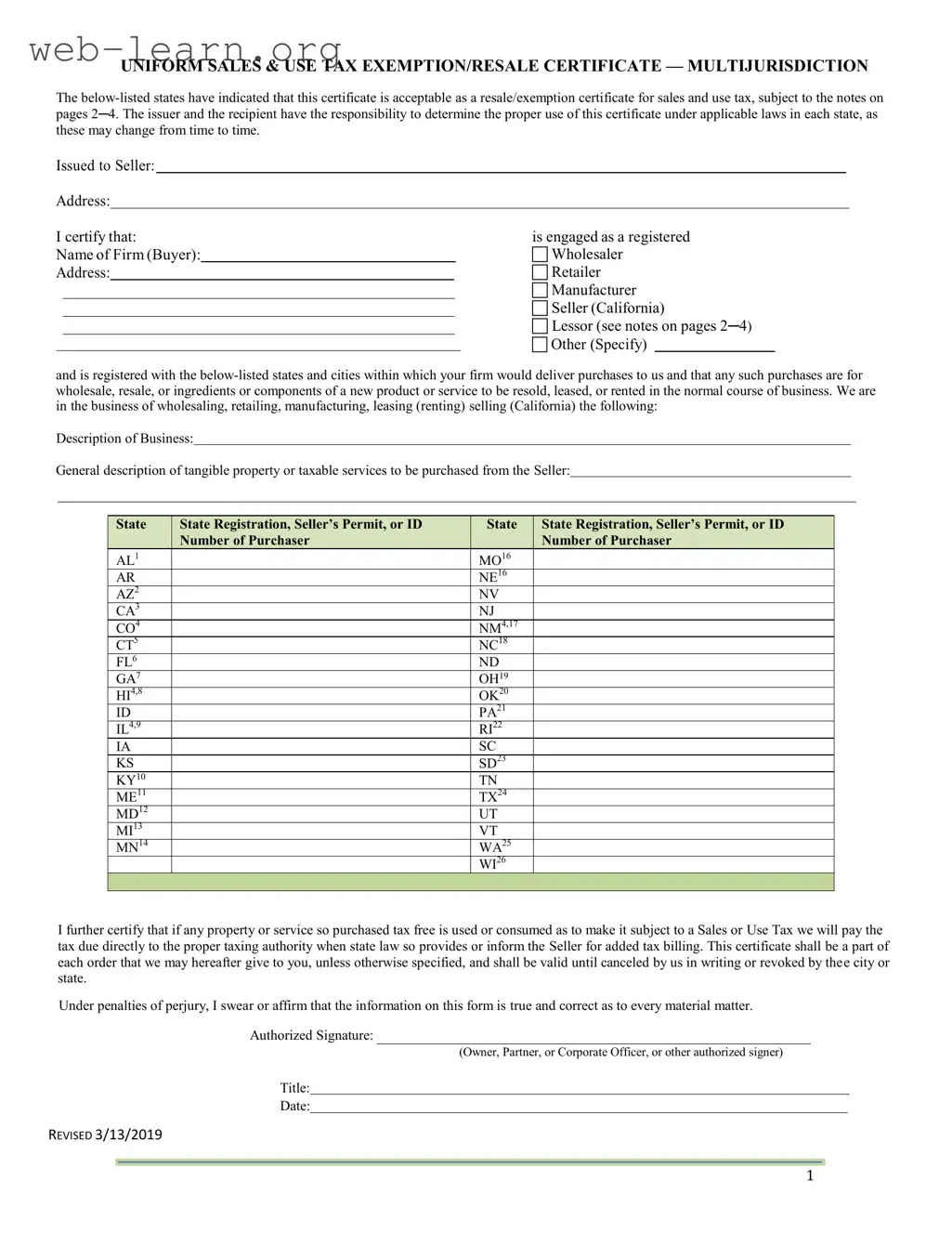
The California Sales Tax Certificate form, officially known as the Uniform Sales & Use Tax Exemption/Resale Certificate, serves as a crucial document for businesses engaged in the buying and selling of goods and services. This form allows purchasers to claim exemption from sales tax on items intended for resale, thereby streamlining the transaction process between buyers and sellers. It is essential that both the issuer and the recipient understand their responsibilities regarding the proper use of this certificate, as misuse can lead to significant tax liabilities. The form requires the buyer to provide their business name, address, and registration details, while also certifying that the purchases are meant for wholesale, resale, or as components in new products. Additionally, it outlines specific instructions and requirements for various states, emphasizing that the certificate must be retained by the seller to validate tax-exempt sales. Buyers must also be aware that if any exempt property is ultimately used or consumed in a manner that triggers sales tax, they are responsible for remitting that tax directly to the appropriate taxing authority. This certificate remains valid until revoked, ensuring that businesses maintain compliance with evolving tax regulations across multiple jurisdictions.


Sample - California Sales Tax Certificate Form

1
REVISED 3/13/2019
UNIFORM SALES & USE TAX EXEMPTION/RESALE CERTIFICATE MULTIJURISDICTION
The below-listed states have indicated that this certificate is acceptable as a resale/exemption certificate for sales and use tax, subject to the notes on
pages 24. The issuer and the recipient have the responsibility to determine the proper use of this certificate under applicable laws in each state, as
these may change from time to time.
Issued
to
Seller:
Address:
I certify that:
Name of Firm (Buyer):
Address:
is engaged as a registered
Wholesaler
Retailer
Manufacturer
Seller (California)
Lessor (see notes on pages 2─4)
Other
(Specify)
and is registered with the below-listed states and cities within which your firm would deliver purchases to us and that any such purchases are for
wholesale, resale, or ingredients or components of a new product or service
to be resold, leased, or rented in the normal course of business. We are
in the business of wholesaling, retailing, manufacturing, leasing (renting) selling (California) the following:
Description of Business:
General description of tangible property or taxable services to be purchased from the Seller:
State
State Registration, Seller’s Permit, or ID
Number of Purchaser
State
State Registration, Seller’s Permit, or ID
Number of Purchaser
AL
1
MO
16
AR
NE
16
AZ
2
NV
CA
3
NJ
CO
4
NM
4,17
CT
5
NC
18
FL
6
ND
GA
7
OH
19
HI
4,8
OK
20
ID
PA
21
IL
4,9
RI
22
IA
SC
KS
SD
23
KY
10
TN
ME
11
TX
24
MD
12
UT
MI
13
VT
MN
14
WA
25
WI
26
I further certify that if any property or service so purchased tax free is used or consumed as to make it subject to a Sales or Use Tax we will pay the
tax due directly to the proper taxing authority when state law so provides or inform the Seller for added tax billing. This certificate shall be a part of
each order that we may hereafter give to you, unless otherwise specified, and shall be valid until canceled by us in writing or revoked by the e city or
state.
Under penalties of perjury, I swear or affirm that the information on this form is true and correct as to every material matter.
Authorized Signature:
(Owner, Partner, or Corporate Officer, or other authorized signer)
Title:
Date:
2
REVISED 3/13/2019
INSTRUCTIONS REGARDING
UNIFORM SALES & USE TAX EXEMPTION CERTIFICATE
To Sellers Customers:
In order to comply with most state and local sales tax law requirements, the Seller must have in its files a properly executed exemption
certificate from all of its customers (Buyers) who claim a sales/use tax exemption. If the Seller does not have this certificate, it is
obliged to collect the tax for the state in which the property or service is delivered.
If the Buyer is entitled to a sales tax exemption, the Buyer should complete the certificate and send it to the Seller at its earliest
convenience. If the Buyer purchases tax free for a reason for which this form does not provide, the Buyer should send the Seller its
special certificate or statement.
Caution to Seller:
In order for the certificate to be accepted in good faith by the Seller, Seller must exercise care that the property or service being sold is
of a type normally sold wholesale, resold, leased, rented, or incorporated as an ingredient or component of a product manufactured by
Buyer and then resold in the usual course of its business. A Seller failing to exercise care could be held liable for the sales tax due in
some states or cities. Misuse of this certificate by Seller, lessee, or the
representative
thereof may be punishable by fine,
imprisonment
or loss of right to issue a certificate in some states or cities.
Notes:
1. Alabama: Each retailer shall be responsible for determining the validity of a purchasers claim for exemption.
2. Arizona: This certificate may be used only when making purchases of tangible personal property for resale in the ordinary
course of business, and not for any other statutory deduction or exemption. It is valid as a resale certificate only if it contains
the purchasers name, address, signature, and Arizona transaction privilege tax (or other state sales tax) license number, as
required by Arizona Revised Statutes § 42-5022, Burden of proving sales not at retail.
3. California: a) This certificate is not valid as an exemption certificate. Its use is limited to use as a resale certificate subject
to the provisions of Title 18, California Code of Regulations, Section 1668 (Sales and Use Tax Regulation
1668, Resale
Certificate).
b)
By use of this certificate, the purchaser certifies that the property is purchased for resale in the regular
course
of
business in the form of tangible personal property, which includes property incorporated as an
ingredient
or
component of an item manufactured for resale in the regular course of business.
c) When the applicable tax would be sales tax, it is the Seller who owes that tax unless the Seller takes a timely
and valid resale certificate in good faith.
d)
A valid resale certificate is effective until the issuer revokes the certificate.
4. Colorado, Hawaii, Illinois, and New Mexico: these states do not permit the use of this certificate to claim a resale exemption for
the purchase of a taxable service for resale.
5. Connecticut: This certificate is not valid as an exemption certificate. Its use is limited to use as a resale certificate subject to
Conn. Gen. State §§12-410(5) and 12-411(14) and regulations and
administrative pronouncements
pertaining to resale
certificates.
6. Florida: Allows the Multistate Tax Commission’s Uniform Sales and Use Tax Exemption/Resale Certificate –
Multijurisdictional for tax-exempt purchases for resale; however, the selling dealer must also obtain a resale authorization
number from the Florida Department of Revenue at floridarevenue.com/taxes/certificates, or by calling 877-357-3725, and
entering the purchaser’s Florida Annual Resale Certificate number.
7. Georgia: The purchasers
state-of-registration
number will be accepted in lieu of Georgias registration number when the
purchaser is located outside Georgia, does not have nexus with Georgia, and the tangible personal property is delivered by drop
shipment to the purchasers customer located in Georgia.
3
REVISED 3/13/2019
8.
Hawaii: allows this certificate to be used by the seller to claim a lower general excise tax rate or no general excise tax, rather
than the buyer claiming an exemption. The no tax situation occurs when the purchaser of imported goods certifies to the seller,
who
originally
imported the goods into Hawaii, that the purchaser will resell the imported goods at wholesale. If the lower rate
or no-tax does not in fact apply to the sale, the purchaser is liable to pay the seller the additional tax imposed. See Hawaii Dept.
of Taxation Tax Information Release No. 93-5, November 10, 1993, and Tax Information Release No. 98-8, October 30, 1998.
9. Illinois: Use of this certificate in Illinois is subject to the provisions of 86 Ill. Adm. Code Ch.I, Sec. 130.1405. Illinois does not
have an exemption for sales of property for subsequent lease or rental, nor does the use of this certificate for claiming resale
purchases of services have any application in Illinois.
The registration number to be supplied next to Illinois on page 1 of this certificate must be the Illinois registration or
re
sale
number; no other states registration number is acceptable.
Good faith is not the standard of care to be exercised by a retailer in Illinois. A retailer in Illinois is not required to determine
whether the purchaser actually intends to resell the item. Instead, a retailer must confirm that the purchaser has a valid
registration or resale number at the time of purchase. If a purchaser fails to provide a certificate of resale at the time of sale in
Illinois, the seller must charge the purchaser tax.
While there is no statutory requirement that blanket certificates of resale be renewed at certain intervals, blanket certificates
should be updated periodically, and no less
frequently
than every three years.
10. Kentucky: a) Kentucky does not permit the use of this certificate to claim resale exclusion for the purchase of a taxable
service.
b) This certificate is not valid as an exemption certificate. Its use is limited to use as a resale certificate subject to
the provisions of Kentucky Revised Statute 139.270 (Good Faith).
c) The use of this certificate by the purchaser constitutes the issuance of a blanket certificate in accordance with
Kentucky
Administrative
Regulation 103 KAR 31:111.
11. Maine: This state does not have an exemption for sales of property for subsequent lease or rental.
12. Maryland: This certificate is not valid as an exemption certificate. However, vendors may accept resale certificates that bear the
exemption number issued to a religious organization. Exemption
certifications
issued to religious
organizations
consist of 8
digits, the first two of which are always 29”. Maryland registration, exemption, and direct pay numbers may be verified on the
website of the Comptroller of the
Treasury
at www.marylandtaxes.com.
13. Michigan: This certificate is effective for a period of four years unless a lesser period is mutually agreed to and stated on this
certificate. It covers all exempt transfers when accepted by the seller in good faith as defined by Michigan statute.
14. Minnesota: a) Minnesota does not allow a resale certificate for purchases of taxable services for resale in most situations.
b) Minnesota allows an exemption for items used only once during production and not used again.
15. Missouri: a) Purchasers who improperly purchase property or services sales-tax free using this certificate may be required to
pay the tax, interest, additions to tax, or penalty.
b) Even if property is delivered outside Missouri, facts and circumstances may subject it to Missouri tax, contrary
to the second sentence of the first paragraph of the above instructions.
16. Nebraska: A blanket certificate is valid for 3 years from the date of issuance.
17. New Mexico: For transactions occurring on or after July 1, 1998, New Mexico will accept this certificate in lieu of a New
Mexico nontaxable transaction certificate and as evidence of the
deductibility
of a sale of tangible personal property provided:
a) this certificate was not issued by the State of New Mexico;
b) the buyer is not required to be registered in New Mexico; and
c) the buyer is purchasing tangible personal property for resale or incorporation as an ingredient or component of
a manufactured product.
18. North Carolina: This certificate is not valid as an exemption certificate if signed by a person such as a contractor who intends to
use the property. Its use is subject to G.S. 105-164.28 and any
administrative
rules or directives pertaining to
resale certificates.
4
REVISED 3/13/2019
19.
Ohio:
20 Oklahoma: Oklahoma would allow this certificate in lieu of a copy of the purchasers sales tax permit as one of the elements of
properly
completed documents which is one of the three requirements which must be met prior to the vendor being
relieved of
liability. The other two
requirements
are that the vendor must have the certificate in his possession at the time the sale
is made
and must accept the
documentation
in good faith. The specific
documentation
required under OAC
710
-:65-7-6 is:
a) Sales tax permit information may consist of:
(i) A copy of the purchasers sales tax permit; or
(ii) In lieu of a copy of the permit, obtain the
following:
* Sales tax permit number; and
* The name and address of the purchaser;
b) A statement that the purchaser is engaged in the business of reselling the articles purchased;
c) A statement that the articles purchased is purchased for resale;
d) The signature of the purchaser or a person authorized to legally bind the purchaser; and
e)
Certification
on the face of the invoice, bill, or sales slip, or on separate letter, that said purchaser is engaged in reselling
the articles purchased.
Absent strict compliance with these requirements, Oklahoma holds a seller liable for sales tax due on sales where the claimed
exemption is found to be invalid, for whatever reason, unless the Tax
Commission
determines that purchaser should be pursued
for collection of the tax resulting from improper presentation of a certificate.
21. Pennsylvania: This certificate is not valid as an exemption certificate. It is valid as a resale certificate only if it contains the
purchasers Pennsylvania Sales and Use Tax eight-digit license number, subject to the provisions of 61 PA
Code §32.3.
22. Rhode Island: Rhode Island allows this certificate to be used to claim a resale exemption only when the item will be resold in
the same form. It does not permit this certificate to be used to claim any other type of exemption.
23. South Dakota: Services which are purchased by a service provider and delivered to a current customer in conjunction with the
services contracted to be provided to the customer are claimed to be for resale. Receipts from the sale of a service for
resale
le
by the purchaser are not subject to sales tax if the purchaser furnishes a resale certificate which the seller accepts in good faith.
In order for the transaction to be a sale for resale, the following conditions must be present:
(a) The service is purchased for or on behalf of a current customer;
(b) The purchaser of the service does not use the service in any manner; and
(c) The service is delivered or resold to the customer without any alteration or change.
24.. Texas: Items purchased for resale must be for resale within the geographical limits of the United States, its territories, and
possessions.
25. Washington: a) Blanket resale certificates must be renewed at intervals not to exceed four years;
b) This certificate may be used to document exempt sales of chemicals to be used in processing
an
n article to be
produced for
sale.
c) Buyer
acknowledges
that the misuse of the tax due, in addition to the tax, interest, and any other penalties
imposed by law.
26. Wisconsin: Wisconsin allows this certificate to be used to claim a resale exemption only. It does not permit this certificate to be
used to claim any other type of exemption.
5
REVISED 3/13/2019
Frequently Asked Questions
Uniform Sales and Use Tax Certificate M
u
lt
i
j
u
r
is
d
i
ct
iona
l
To whom do I give this certificate?
Can I register for multiple states simultaneously?
I have received this certificate from my customer. What do I do with it?
Am I the Buyer or the Seller?
What is the purpose of this certificate?
How do I fill out the certificate?
What information goes on the line next to each state abbreviation?
What if I dont have an ID number for any (or some) state(s)?
Who should use this certificate?
Can I use this certificate?
Which states accept the certificate?
I am based in, buying from, or selling into Maine. Can I use this certificate?
I am a drop shipper. Can I use this certificate?
Do I have to fill this certificate out for every purchase?
Can this certificate be used as a blanket certificate?
Who determines whether this certificate will be accepted?
I have been asked to accept this certificate. How do I know whether I should accept it?
Is there a more recent version of this certificate?
To whom should I talk to for more information?
To whom do I give this certificate?
If you are purchasing goods for resale, you will give this certificate to your vendor, so that your vendor will
not charge you sales tax.
If you are selling goods for resale, and you have received this certificate from your buyer, you will keep the
certificate on file.
Can I register for multiple states simultaneously?
Click on the link for more information:
www.sstregister.org
I have received this certificate from my customer. What do I do with it?
Once you have examined the certificate and you have accepted it in good faith, you will keep it on file as
prescribed by applicable state laws. The relevant state will generally be the state where you are located, or
the state where the sales transaction took place.
Am I the Buyer or the Seller?
If you are purchasing goods for resale, you are the Buyer. If you are selling goods to a buyer who is
purchasing them for resale, you are the Seller.
What is the purpose of this certificate?
This certificate is to be used as supporting documentation that the Seller should not collect sales tax because
the good or service sold, or the Buyer, is exempt from the tax.
How do I fill out the certificate?
The individual filling out the certificate is referred to as the Buyer. The first two lines, Issued to Seller and
6
REVISED 3/13/2019
Address”, should be filled in with the name and address of the Seller. The rest of the information refers to
the Buyer (name and address of Buyer, business engaged in, description of business, property or services to be
purchased). The line next to each state abbreviation should be filled out with the relevant state ID number.
What information goes on the line next to each state abbreviation?
The line next to each state abbreviation should be filled in with the relevant state ID number. This will be an
identification number issued by the state (see next FAQ for an exception). For example, on the line next to
AL, provide the ID number issued by Alabama.) The relevant ID number may be given various names in the
various states. Some of the terms for this ID number are State Registration, Seller’s Permit, or ID Number.
Regardless of the name, this will be a number that has been issued by the state to the Buyer (see next FAQ for
an exception). This number is generally associated with the reseller’s authority to collect and remit sales tax.
What if I dont have an ID number for any (or some) state(s)?
The states vary in their rules regarding requirements for a reseller exemption. Some states require that the
reseller (Buyer) be registered to collect sales tax in the state where the reseller makes its purchase. Other
states will accept the certificate if an ID number is provided for some other state (e.g., the home state of the
Buyer). You should check with the relevant state to determine whether you meet the requirements of that
state.
Who should use this certificate?
A Buyer who is a reseller of tangible property or taxable services from a Seller located in one of the states
listed may be able to use this certificate for sales tax exemption. States vary in their policies for use of this
certificate. Questions regarding your specific eligibility to use this certificate should be addressed to the
revenue department of the relevant state.
Can I use this certificate?
The states vary in their rules for use of this certificate. You should check with the relevant state to determine
whether you can use this certificate. The relevant state may be the state where the Seller is located, where the
transaction takes place, or where the Buyer is located. The footnotes to the certificate provide some guidance;
however, the Multistate Tax Commission cannot guarantee that any state will accept this certificate. States may
change their policies without informing the Multistate Tax Commission.
Which states accept the certificate?
States listed on the certificate accepted this certificate as of July, 2000. States may change their policies for
acceptance of the certificate without notifying the Multistate Tax Commission. You may check with the
relevant state to determine the current status of the states acceptance policy. See next FAQ.
I am based in, buying from, or selling into Maine. Can I use this certificate?
Please contact Maine Revenue Services. See: Sales Instructional Bulletin 54
www.maine.gov/revenue/salesuse/Bull5410092013.pdf
I am a drop shipper. Can I use this certificate?
If you are the Buyer and your Seller ships directly to your customers, you may be able to use this certificate
because you are a reseller. However, your Seller may be unwilling to accept this certificate if you are not
registered to collect sales tax in the state(s) where your customers are located.
If you are the Seller, and you have nexus with the state(s) into which you are shipping to your Buyer’s
customers, you may be required by that state(s) to remit sales tax on those sales if your Buyer is not
registered to collect sales tax.
7
REVISED 3/13/2019
Do I have to fill this certificate out for every purchase?
In many cases, this certificate can be used as a blanket certificate, so that you will only need to fill it out once
for each of your Sellers. Some states require periodic replacement with a fresh certificate (see notes on
certificate). To make filling out the certificate easier, you should fill out your information and all information
that does not change, then make photocopies, and then fill out the information that is specific to the
transaction.
Can this certificate be used as a blanket certificate?
In many states this certificate can be used as a blanket certificate. You should verify this with the applicable
state. A blanket certificate is one that can be kept on file for multiple transactions between a specific Buyer
and specific Seller.
Who determines whether this certificate will be accepted?
The Seller will determine whether it will accept the certificate from the Buyer generally according to a good
faith standard. The applicable state will determine whether a certificate is acceptable for the purpose of
demonstrating that sales tax was properly exempted. The applicable state will generally be the state where
the Seller is located or the state where the sales transaction took place, or where the Buyer is located. The
Multistate Tax Commission does not determine whether this certificate will be accepted either by the Seller
or the applicable state.
I have been asked to accept this certificate. How do I know whether I should accept it?
You should contact your state revenue department if you are not familiar with the policies regarding
acceptance of resale exemption certificates.
In order for the certificate to be accepted in good faith by the Seller, Seller must exercise care that the
property or service being sold is of a type normally sold wholesale, resold, leased, rented or incorporated as
an ingredient or component of a product manufactured by Buyer and then resold in the usual course of its
business. A Seller failing to exercise care could be held liable for the sales tax due in some states.
Is there a more recent version of this certificate?
No. The most recent version is posted on our website. You may have seen a version that has been modified
in an unauthorized manner. You should not use any version other than the one available on our website.
Whom should I talk to for more information?
For information regarding whether the certificate will be accepted in the applicable state, you should talk to
the revenue department of that state. The Multistate Tax Commissions
Member States webpage has links to
revenue department websites. For other questions that have not been addressed by these FAQs, you may
contact
Elliott Dubin at the Multistate Tax Commission, 202-650-0300

Form Information

Fact Name Details
Purpose This certificate is used to document that the Buyer is purchasing goods for resale, allowing them to avoid paying sales tax.
Validity in California In California, this certificate is valid only as a resale certificate, not as an exemption certificate, under Title 18, California Code of Regulations, Section 1668.
Responsibility Both the issuer and the recipient must ensure the proper use of this certificate, as laws may change over time.
Signature Requirement The certificate must be signed by an authorized person, such as an owner or corporate officer, to be valid.
Expiration This certificate remains valid until it is canceled in writing by the issuer or revoked by the state.
Consequences of Misuse Improper use of the certificate can lead to penalties, including fines or imprisonment, depending on state laws.

Detailed Guide for Filling Out California Sales Tax Certificate

Filling out the California Sales Tax Certificate form requires careful attention to detail. This process ensures that the buyer can purchase goods without paying sales tax, provided they are for resale. The following steps will guide you through the completion of the form.

  1. Begin by entering the name of the seller in the "Issued to Seller" section.
  2. Provide the seller's address in the corresponding field.
  3. In the "Name of Firm (Buyer)" section, write the name of your business.
  4. Indicate your business type by checking the appropriate box: Wholesaler, Retailer, Manufacturer, Seller (California), Lessor, or Other. If you select "Other," specify your business type.
  5. Fill in the address of your business.
  6. Describe the nature of your business in the "Description of Business" section.
  7. List the general description of the tangible property or taxable services you plan to purchase from the seller.
  8. Next, provide the state registration, seller’s permit, or ID number for each state where your business is registered, as listed on the form.
  9. Sign the form in the "Authorized Signature" section. This must be completed by an owner, partner, corporate officer, or another authorized signer.
  10. Include your title and the date of signing in the designated fields.

Once you have completed the form, submit it to the seller. They will retain it for their records, ensuring compliance with state tax laws. This certificate will remain valid until you cancel it in writing or the issuing authority revokes it.

Obtain Answers on California Sales Tax Certificate

  1. To whom do I give this certificate?

    If you are purchasing goods for resale, you should provide this certificate to your vendor. This will ensure that your vendor does not charge you sales tax on your purchase. Conversely, if you are a seller who has received this certificate from your buyer, you must keep the certificate on file for your records.

  2. Can I register for multiple states simultaneously?

    Yes, you can register for multiple states at the same time. For more details, visit www.sstregister.org. This resource provides guidance on how to navigate the registration process across various states.

  3. I have received this certificate from my customer. What do I do with it?

    After receiving the certificate from your customer, review it carefully. If you accept it in good faith, keep it on file as required by state laws. Generally, the relevant state will be where you are located or where the sales transaction occurred.

  4. Am I the Buyer or the Seller?

    Your role depends on the transaction. If you are purchasing goods for resale, you are the Buyer. If you are selling goods to someone who intends to resell them, you are the Seller.

  5. What is the purpose of this certificate?

    The primary purpose of this certificate is to serve as documentation that the Seller should not collect sales tax. This applies when the goods or services sold, or the Buyer, are exempt from sales tax.

  6. How do I fill out the certificate?

    The Buyer is responsible for completing the certificate. Fill in the "Issued to Seller" and "Name of Firm (Buyer)" sections, along with the necessary details about your business and the nature of the purchase.

  7. What information goes on the line next to each state abbreviation?

    Next to each state abbreviation, you should provide your state registration number, Seller’s Permit, or ID number as required by that state. This information is crucial for the validity of the certificate.

  8. What if I don’t have an ID number for any (or some) state(s)?

    If you do not have an ID number for certain states, it is advisable to consult with a tax professional or the state’s tax authority for guidance. Each state has specific requirements, and it is important to comply with them.

  9. Who should use this certificate?

    This certificate should be used by businesses that are purchasing goods or services for resale. It is essential for both Buyers and Sellers to understand its proper use to avoid potential tax liabilities.

Common mistakes

Filling out the California Sales Tax Certificate form can seem straightforward, but there are common mistakes that can lead to complications down the line. One significant error is leaving out critical information. Buyers often forget to provide their name, address, or the business type. Each of these details is essential for verifying the legitimacy of the claim. Omitting any of this information can result in the seller being required to collect sales tax, which defeats the purpose of the certificate.

Another frequent mistake is failing to specify the reason for exemption. The form allows for multiple business types, such as wholesaler or retailer, and not indicating which one applies can create confusion. Sellers need this information to ensure they comply with tax regulations. If the exemption reason isn’t clearly marked, the certificate may be rejected, leading to unnecessary tax charges.

Many buyers also neglect to include their state registration or seller’s permit number. This number is crucial as it verifies that the buyer is authorized to make tax-exempt purchases. Without it, the seller may not accept the certificate, and the buyer could end up paying sales tax unnecessarily. This step is often overlooked, but it is vital for maintaining compliance.

Additionally, buyers sometimes forget to sign the certificate. A signature is not just a formality; it affirms that the information provided is accurate and true. Without a signature, the certificate is incomplete and may not be honored by the seller. This can lead to complications and additional costs for the buyer.

Lastly, many individuals mistakenly believe that this certificate is a one-time document. In reality, it should be updated regularly, especially if any of the business details change. Keeping the certificate current is essential to avoid any issues with tax authorities. Ignoring this can lead to penalties or audits, which can be both time-consuming and costly.

Documents used along the form

The California Sales Tax Certificate is a crucial document for businesses engaged in the resale of goods. It serves to exempt buyers from paying sales tax on items purchased for resale. Several other forms and documents complement this certificate, ensuring compliance with tax regulations and proper record-keeping. Below is a list of commonly used documents alongside the California Sales Tax Certificate.

  • Seller's Permit: This document is issued by the California Department of Tax and Fee Administration (CDTFA) and allows businesses to collect sales tax from customers. It is essential for retailers and wholesalers to have this permit to operate legally within the state.
  • Resale Certificate: This certificate is often used in conjunction with the Sales Tax Certificate. It provides proof that the buyer intends to resell the purchased items, thus qualifying for a tax exemption. It must be filled out correctly and kept on file by the seller.
  • Exemption Certificate: This document is utilized by buyers who claim an exemption from sales tax for specific purchases. It is necessary for items that are not intended for resale but are exempt from taxation under certain conditions.
  • Tax-Exempt Letter: This letter is issued by certain organizations, such as non-profits or government entities, indicating that they are exempt from paying sales tax. Vendors must keep this letter on file to support tax-exempt sales.

Understanding these documents and their purposes can facilitate smoother transactions and ensure compliance with California tax laws. Proper documentation not only protects businesses from potential tax liabilities but also supports the integrity of the resale process.

Similar forms

The California Sales Tax Certificate form shares similarities with several other documents used in various states for tax exemption purposes. Below is a list of seven documents that are comparable, along with their specific similarities:

  • Uniform Sales and Use Tax Exemption Certificate - This document is utilized across multiple states, similar to the California form, to certify that a buyer is exempt from sales tax on certain purchases for resale or other qualifying reasons.
  • Resale Certificate - Like the California Sales Tax Certificate, this document allows buyers to purchase goods without paying sales tax if those goods are intended for resale.
  • Exemption Certificate for Nonprofit Organizations - This certificate enables nonprofit entities to purchase goods tax-free, similar to how the California form allows certain businesses to claim tax exemption for resale purposes.
  • Direct Pay Permit - Issued in some states, this permit allows businesses to pay sales tax directly to the state rather than to the seller, akin to how the California certificate facilitates tax-exempt purchases.
  • Manufacturing Exemption Certificate - This document is used by manufacturers to claim exemptions on purchases of equipment or materials, similar to the California Sales Tax Certificate's provisions for businesses engaged in manufacturing.
  • Government Purchase Card - Government entities often use this card to make tax-exempt purchases, paralleling the California form's purpose of certifying tax-exempt transactions for eligible buyers.
  • Interstate Commerce Exemption Certificate - This certificate allows businesses engaged in interstate commerce to claim exemptions, much like the California Sales Tax Certificate provides for businesses operating across state lines.

Dos and Don'ts

When filling out the California Sales Tax Certificate form, it's important to be thorough and accurate. Here are some key dos and don'ts to keep in mind:

  • Do provide the full name and address of your business.
  • Do specify your business type, such as wholesaler, retailer, or manufacturer.
  • Do include your state registration or seller’s permit number.
  • Do describe the tangible property or taxable services you intend to purchase.
  • Do ensure that the certificate is signed by an authorized person.
  • Don't leave any required fields blank; incomplete forms may be rejected.
  • Don't use the certificate for personal purchases or non-resale items.
  • Don't forget to update your certificate if your business information changes.
  • Don't assume the certificate is valid indefinitely; check for expiration dates.
  • Don't ignore state-specific regulations that may apply to your situation.

Misconceptions

  • Misconception 1: The California Sales Tax Certificate can be used as an exemption certificate.
  • This is incorrect. The certificate is strictly a resale certificate and cannot be used to claim an exemption from sales tax.

  • Misconception 2: Any business can use this certificate for any type of purchase.
  • This is not true. The certificate is only valid for purchases intended for resale or as ingredients in products for resale.

  • Misconception 3: Once issued, the certificate is valid indefinitely.
  • The certificate remains valid until canceled in writing by the issuer or revoked by the state. Regular updates are recommended.

  • Misconception 4: The seller is not responsible for verifying the certificate.
  • Sellers must exercise due diligence to ensure the certificate is valid and applicable to the transaction. Failure to do so could lead to tax liability.

  • Misconception 5: The certificate is accepted in all states without restrictions.
  • This is misleading. Some states have specific regulations regarding the use of this certificate, and it may not be accepted for certain types of purchases.

  • Misconception 6: Buyers can use this certificate for personal purchases.
  • This is false. The certificate is only for business transactions involving resale or manufacturing.

  • Misconception 7: The seller can ignore the certificate if they suspect misuse.
  • Sellers are obligated to take the certificate seriously. Ignoring it can lead to penalties and tax liabilities.

  • Misconception 8: A verbal agreement is sufficient to use the certificate.
  • This is incorrect. The certificate must be properly filled out and signed to be valid.

  • Misconception 9: Once the certificate is accepted, the seller has no further responsibilities.
  • This is not the case. Sellers must keep the certificate on file and may need to provide it during audits or inquiries.

Key takeaways

  • Understand the Purpose: The California Sales Tax Certificate is primarily used to certify that a purchase is intended for resale. This means that if you are buying goods to sell them, you should provide this certificate to the seller to avoid being charged sales tax.

  • Complete the Certificate Accurately: When filling out the form, ensure that all required fields are completed accurately. This includes your business name, address, and the nature of your business. Any errors or omissions can lead to complications down the line.

  • Keep Records: Once you provide this certificate to a seller, it is important for both parties to keep a copy on file. Sellers must retain these certificates as proof of the exemption, and buyers should also keep a record for their own accounting purposes.

  • Be Aware of State-Specific Rules: Different states have varying regulations regarding sales tax exemptions. While this certificate is valid in California, it may not apply in the same way in other states. Always check local laws to ensure compliance.