Homepage Blank California Rs 3 Form
Outline

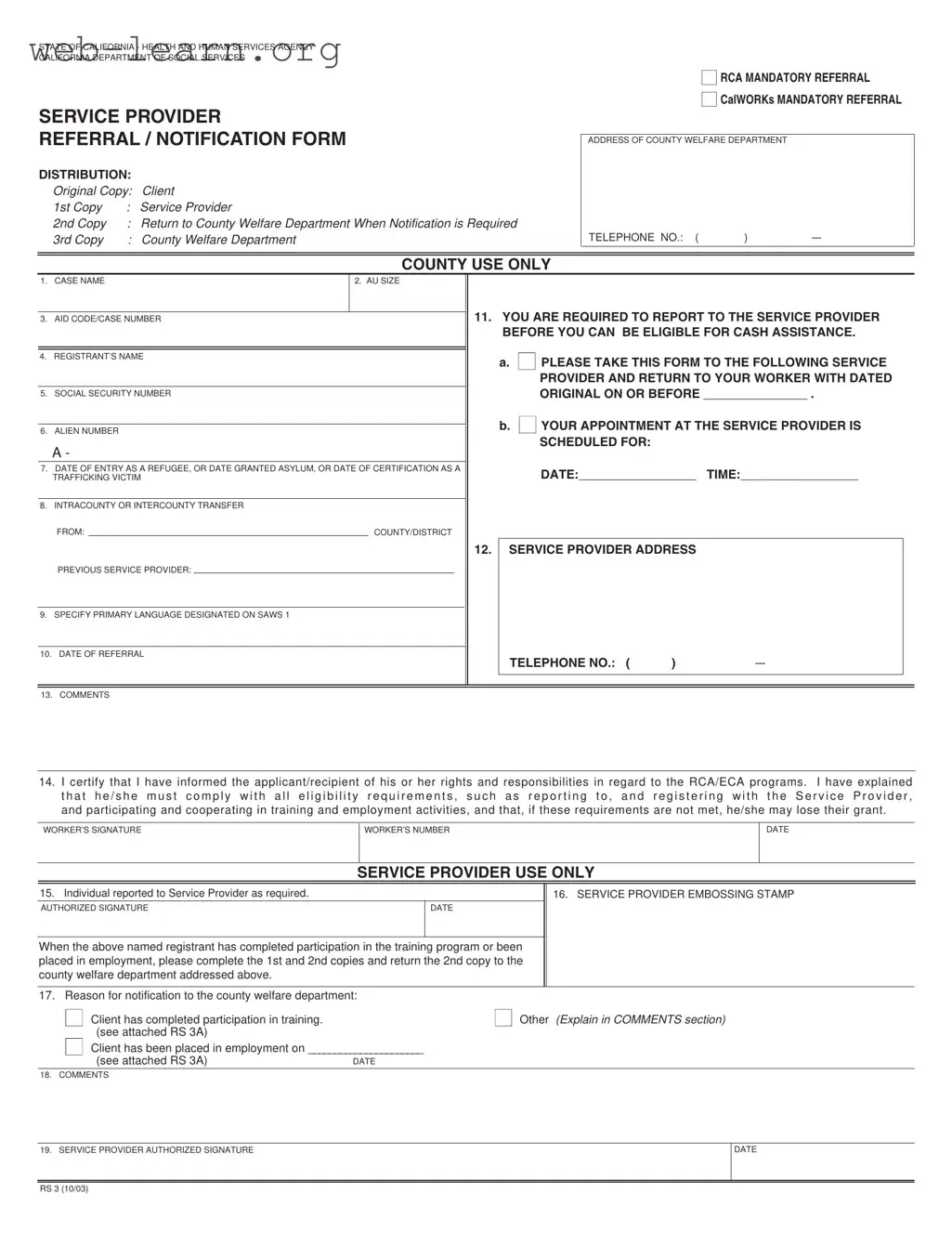
The California Rs 3 form plays a crucial role in the state's social services framework, particularly for individuals seeking assistance through programs like Refugee Cash Assistance (RCA) and CalWORKs. This mandatory referral form is designed to ensure that applicants comply with essential eligibility requirements before they can access cash assistance. It serves as a notification tool, detailing the steps that clients must take to connect with designated service providers. Key components of the form include the registrant's name, case number, and social security number, all of which help identify the individual within the assistance program. Additionally, the form outlines the responsibilities of the registrant, emphasizing the importance of attending scheduled appointments with service providers. By documenting these interactions, the Rs 3 form not only facilitates communication between clients and service providers but also helps maintain accountability within the welfare system. Moreover, it includes sections for comments and worker signatures, ensuring that all parties involved understand their roles and obligations. Ultimately, this form is an integral part of the process that supports individuals in navigating the complexities of social assistance in California.


Sample - California Rs 3 Form

ADDRESS OF COUNTY WELFARE DEPARTMENT
TELEPHONE NO.: ( ) ----
RCA MANDATORY REFERRAL
CalWORKs MANDATORY REFERRAL
STATE OF CALIFORNIA - HEALTH AND HUMAN SERVICES AGENCY
CALIFORNIA DEPARTMENT OF SOCIAL SERVICES
SERVICE PROVIDER
REFERRAL / NOTIFICATION FORM
DISTRIBUTION:
Original Copy: Client
1st Copy : Service Provider
2nd Copy : Return to County Welfare Department When Notification is Required
3rd Copy : County Welfare Department
COUNTY USE ONLY
SERVICE PROVIDER USE ONLY
1. CASE NAME
FROM:
2. AU SIZE
COUNTY/DISTRICT
PREVIOUS SERVICE PROVIDER:
3. AID CODE/CASE NUMBER
4. REGISTRANT’S NAME
5. SOCIAL SECURITY NUMBER
6. ALIEN NUMBER
7. DATE OF ENTRY AS A REFUGEE, OR DATE GRANTED ASYLUM, OR DATE OF CERTIFICATION AS A
TRAFFICKING VICTIM
8. INTRACOUNTY OR INTERCOUNTY TRANSFER
10. DATE OF REFERRAL
AUTHORIZED SIGNATURE DATE
WORKER’S SIGNATURE WORKER’S NUMBER
DATE
DATE
13. COMMENTS
18. COMMENTS
19. SERVICE PROVIDER AUTHORIZED SIGNATURE
RS 3 (10/03)
9. SPECIFY PRIMARY LANGUAGE DESIGNATED ON SAWS 1
A -
11. YOU ARE REQUIRED TO REPORT TO THE SERVICE PROVIDER
BEFORE YOU CAN BE ELIGIBLE FOR CASH ASSISTANCE.
a. PLEASE TAKE THIS FORM TO THE FOLLOWING SERVICE
PROVIDER AND RETURN TO YOUR WORKER WITH DATED
ORIGINAL ON OR BEFORE _______________ .
b. YOUR APPOINTMENT AT THE SERVICE PROVIDER IS
SCHEDULED FOR:
DATE:_________________ TIME:_________________
12. SERVICE PROVIDER ADDRESS
TELEPHONE NO.: ( ) ---
I certify that I have informed the applicant/recipient of his or her rights and responsibilities in regard to the RCA/ECA programs. I have explained
that he/she must comply with all eligibility requirements, such as reporting to, and registering with the Service Provider,
and participating and cooperating in training and employment activities, and that, if these requirements are not met, he/she may lose their grant.
15. Individual reported to Service Provider as required.
16. SERVICE PROVIDER EMBOSSING STAMP
When the above named registrant has completed participation in the training program or been
placed in employment, please complete the 1st and 2nd copies and return the 2nd copy to the
county welfare department addressed above.
17. Reason for notification to the county welfare department:
Other
(Explain in COMMENTS section)
Client has completed participation in training.
(see attached RS 3A)
Client has been placed in employment on ______________________
(see attached RS 3A) DATE
14.
SERVICE PROVIDER REFERRAL FORM
Instructions
County Use Only
1. Case Name --- Enter the refugee’s name: last name, first name, and middle initial.
2. AU Size --- Enter number of persons in the Assistance Unit
3. Aid Code/Case Number --- Enter the two-digit aid identification code for the appropriate public
assistance program/Enter the refugee’s case number as assigned by your CWD.
4. Registrant’s Name --- Enter the name of person in the AU who is being referred on a mandatory
basis, and required to register with the Service Provider.
5. Social Security Number --- Enter the registrant’s social security number.
6. Alien Number --- Enter the registrant’s alien number.
7. Date of Entry to U.S. or Date Granted Asylum --- Enter the date shown on the registrant’s I-94 form or
I-551 form or other appropriate documentation.
8. Intracounty or Intercounty Transfer --- Enter the county (or district, if Los Angeles), and the Service
Provider name and address that the registrant is transferring from.
9. Specify primary language designated on SAWS 1.
10. Date of Referral --- Enter the date on which the registrant is referred to the Service Provider.
11a. Check this box and enter the date that the registrant is to return the validated original RS 3 form to
the Worker.
11b. If you make an appointment for the registrant to report to the Service Provider, check this box and enter
the date and time of the appointment.
12. Service Provider Address --- Enter the address and telephone number of the Service Provider the
registrant is being referred to. Enter the Service Provider’s full address including, number, street, city
and zip code.
13. Comments --- Self-explanatory.
14. Worker Name and Worker Number --- Enter the name of worker assigned to the case,
and the number that your county uses to identify the worker.
Service Provider Use Only
15. Authorized Signature --- This is to be signed by the person authorized to certify that the registrant
has reported to the Service Provider for registration.
16. Service Provider Embossing Stamp --- Enter the official certification stamp.
17. Check the appropriate box to indicate why notification is being made.
18. Comments --- Self-explanatory.
19. Service Provider Authorized Signature --- This is to be signed and dated by the person authorized to
complete this form.

Form Information

Fact Name Description
Purpose The California RS 3 form serves as a mandatory referral and notification tool for clients participating in the RCA and CalWORKs programs.
Distribution The form has multiple copies: the original for the client, one for the service provider, and one for the county welfare department.
Eligibility Requirements Clients must report to the designated service provider to remain eligible for cash assistance, as indicated on the form.
Governing Law The RS 3 form is governed by California Welfare and Institutions Code, Sections 11200 and 11265.
Client Responsibilities Clients must comply with all eligibility requirements, including registration with the service provider and participation in training and employment activities.
Service Provider Notification The form requires service providers to notify the county welfare department when a client completes training or secures employment.

Detailed Guide for Filling Out California Rs 3

Filling out the California RS 3 form requires careful attention to detail. Each section must be completed accurately to ensure proper processing. After you fill out the form, you will need to return it to the appropriate county welfare department. This step is crucial for maintaining eligibility for cash assistance.

  1. Case Name: Enter the refugee's name, including last name, first name, and middle initial.
  2. AU Size: Indicate the number of persons in the Assistance Unit.
  3. Aid Code/Case Number: Provide the two-digit aid identification code for the public assistance program and the refugee's case number assigned by the county welfare department.
  4. Registrant’s Name: Write the name of the person in the AU who is being referred to the Service Provider.
  5. Social Security Number: Enter the registrant’s social security number.
  6. Alien Number: Fill in the registrant’s alien number.
  7. Date of Entry or Asylum: Input the date from the registrant's I-94 form or I-551 form.
  8. Intracounty or Intercounty Transfer: Specify the county or district the registrant is transferring from, along with the Service Provider's name and address.
  9. Primary Language: Indicate the primary language designated on SAWS 1.
  10. Date of Referral: Enter the date when the registrant is referred to the Service Provider.
  11. Reporting Requirement: Check the box and enter the date the registrant must return the validated original RS 3 form to the Worker.
  12. Appointment: If applicable, check the box and provide the date and time of the appointment with the Service Provider.
  13. Service Provider Address: Fill in the complete address and telephone number of the Service Provider.
  14. Comments: Use this section for any additional notes or information.
  15. Worker’s Name and Number: Enter the name and identification number of the worker assigned to the case.
  16. Authorized Signature: The person certifying the registrant's report to the Service Provider must sign here.
  17. Embossing Stamp: Include the official certification stamp of the Service Provider.
  18. Notification Reason: Check the appropriate box to indicate why notification is being made.
  19. Service Provider Authorized Signature: This must be signed and dated by the authorized person completing the form.

Obtain Answers on California Rs 3

  1. What is the California RS 3 form?

    The California RS 3 form is a notification and referral document used by the California Department of Social Services. It is primarily for individuals participating in the Refugee Cash Assistance (RCA) or Employment Cash Assistance (ECA) programs. This form ensures that clients report to designated service providers to maintain eligibility for cash assistance.

  2. Who needs to complete the RS 3 form?

    The form must be completed for individuals in the Assistance Unit (AU) who are required to register with a service provider. This includes refugees and individuals granted asylum or certification as trafficking victims.

  3. What information is required on the RS 3 form?

    • Case name
    • Assistance Unit size
    • Aid code or case number
    • Registrant’s name and social security number
    • Alien number
    • Date of entry or asylum
    • Service provider details
    • Date of referral

    Completing the form accurately is crucial for processing the referral and ensuring compliance with eligibility requirements.

  4. What happens after the RS 3 form is completed?

    Once the form is completed, the client must take it to the designated service provider. They are required to return the dated original to their caseworker by the specified deadline to maintain their eligibility for cash assistance.

  5. What if the client misses their appointment?

    If a client misses their appointment with the service provider, they may risk losing their cash assistance. It is essential to reschedule and report back to the caseworker as soon as possible.

  6. How does the service provider verify attendance?

    The service provider will sign and date the form to confirm that the client has reported for registration. This verification is critical for notifying the county welfare department about the client's compliance.

  7. What is the purpose of the comments section on the RS 3 form?

    The comments section allows for additional notes or explanations regarding the client's situation. This can include reasons for referral or any other relevant information that may assist in the processing of the case.

  8. What should be done after the client completes their training or finds employment?

    The service provider must complete the necessary sections of the RS 3 form and return the second copy to the county welfare department. This informs them of the client’s progress and ensures proper documentation of their employment or training completion.

  9. Where can I obtain the RS 3 form?

    The RS 3 form can typically be obtained from the county welfare department or the designated service provider. It may also be available online through the California Department of Social Services website.

Common mistakes

Filling out the California RS 3 form is a critical step for those seeking assistance through the state’s programs. However, many individuals encounter pitfalls that can delay their application or lead to complications. Here are ten common mistakes to avoid when completing this important document.

One frequent error is failing to provide the correct case name. This should include the last name, first name, and middle initial of the refugee. A simple misspelling can cause confusion and delay processing. Always double-check this information to ensure accuracy.

Another common mistake is neglecting to specify the Aid Code/Case Number. This two-digit code is essential for identifying the appropriate public assistance program. Without it, the application may be misdirected or even rejected, leaving the applicant without necessary support.

Many people also forget to include the registrant's social security number. This number is crucial for verifying identity and eligibility. Omitting it can lead to significant delays, as additional steps will be needed to obtain this information later.

It is equally important to accurately enter the Date of Entry to the U.S. or the date granted asylum. This date should match the documentation provided, such as the I-94 form. Discrepancies can result in complications with eligibility verification.

Additionally, some applicants overlook the requirement to indicate whether the transfer is intracounty or intercounty. This information helps the county welfare department understand the registrant's previous service provider and ensures proper handling of the case.

Another mistake involves the appointment details. If an appointment is scheduled with the service provider, it is essential to provide the correct date and time. Failing to do so can lead to missed appointments, which may jeopardize eligibility for assistance.

When it comes to the service provider address, applicants sometimes provide incomplete or inaccurate information. It is crucial to include the full address, including street number, city, and zip code. Missing details can lead to confusion and delays in processing.

In the comments section, some individuals provide vague or unclear information. This area is an opportunity to clarify any special circumstances or additional details that may assist the service provider. Clear communication can help facilitate a smoother process.

Finally, neglecting to obtain the authorized signature from the service provider can halt the entire process. This signature is necessary to confirm that the registrant has reported as required. Always ensure that this step is completed before submitting the form.

Avoiding these common mistakes can significantly improve the chances of a successful application. Attention to detail and thoroughness in filling out the California RS 3 form will help ensure that individuals receive the assistance they need without unnecessary delays.

Documents used along the form

The California Rs 3 form is an essential document used in the state's public assistance programs, particularly for refugees and asylees. Along with this form, there are several other documents that may be required during the process. Each of these forms serves a specific purpose and helps ensure that individuals receive the assistance they need. Below is a list of related forms commonly used in conjunction with the California Rs 3 form.

  • RCA Application Form: This form is used by refugees to apply for Refugee Cash Assistance (RCA). It collects personal information, financial details, and eligibility criteria necessary for approval.
  • RS 3A Form: This is an attachment to the Rs 3 form, used to provide additional information about the client's participation in training programs or employment status.
  • Verification of Employment Form: Employers complete this form to confirm an individual's employment status, hours worked, and wages earned. It is crucial for assessing ongoing eligibility for assistance.
  • Service Provider Referral Form: This form documents the referral of clients to various service providers. It includes details about the services offered and the client's appointment information.
  • Client Rights and Responsibilities Form: This document outlines the rights and responsibilities of clients receiving assistance. It ensures that clients are informed about their obligations and the services available to them.
  • Welfare-to-Work Participation Agreement: Clients sign this agreement to commit to participating in employment-related activities. It outlines the expectations and requirements for maintaining eligibility for assistance.
  • Notice of Action Form: This form communicates decisions regarding applications for assistance, including approvals, denials, or changes in benefits. It provides clients with important information about their cases.

Understanding these forms can help streamline the process of obtaining assistance and ensure compliance with program requirements. Each document plays a vital role in supporting individuals as they navigate the public assistance system in California.

Similar forms

The California RS 3 form is a crucial document used in the context of public assistance programs. It shares similarities with several other forms that serve related purposes. Here are seven documents that are similar to the RS 3 form:

  • CalWORKs Referral Form: This form is used to refer individuals to services under the CalWORKs program. Like the RS 3, it requires information about the applicant and the services they must engage with to receive assistance.
  • RCA Notification Form: This document notifies clients about their responsibilities in the Refugee Cash Assistance program. Similar to the RS 3, it emphasizes compliance with program requirements.
  • Employment Services Referral Form: This form directs clients to employment services. Both forms require clients to report to service providers as part of their eligibility for assistance.
  • Welfare-to-Work Plan: This plan outlines the steps a client must take to achieve self-sufficiency. Like the RS 3, it focuses on mandatory participation in services and activities.
  • Food Assistance Referral Form: This document refers clients to food assistance programs. Both forms require clients to follow through with service providers to maintain their benefits.
  • Housing Assistance Referral Form: This form connects clients with housing services. Similar to the RS 3, it mandates client participation in order to qualify for assistance.
  • Client Rights and Responsibilities Form: This form outlines the rights and responsibilities of clients in various assistance programs. Like the RS 3, it informs clients about compliance requirements to retain their benefits.

Each of these documents plays a vital role in ensuring that clients are aware of their obligations and the services available to them. Understanding these similarities can help clients navigate the assistance process more effectively.

Dos and Don'ts

When filling out the California RS 3 form, it is important to follow certain guidelines to ensure accuracy and compliance. Below is a list of things you should and shouldn't do.

  • Do enter the registrant's full name as it appears on official documents.
  • Do provide accurate information regarding the aid code and case number.
  • Do ensure that the social security number is correct and complete.
  • Do check the appointment date and time before submitting the form.
  • Do include the service provider's full address and contact information.
  • Don't leave any required fields blank, as this may delay processing.
  • Don't use abbreviations or shorthand that could cause confusion.

Following these guidelines will help facilitate the processing of the RS 3 form and ensure that all necessary information is accurately reported.

Misconceptions

Understanding the California Rs 3 form is crucial for those navigating the welfare system. However, several misconceptions can lead to confusion. Here are five common misconceptions:

  • The Rs 3 form is optional for clients. Many believe that completing the Rs 3 form is not mandatory. In reality, clients must report to the service provider to be eligible for cash assistance.
  • Only refugees need to fill out the Rs 3 form. Some think this form is solely for refugees. In fact, it applies to various individuals receiving assistance, including those under the CalWORKs program.
  • The form is only for initial registration. There is a misconception that the Rs 3 form is only required at the beginning of the assistance process. However, it is also necessary for ongoing compliance and updates throughout the assistance period.
  • Submitting the form is the end of the process. Many assume that once they submit the Rs 3 form, their responsibilities are over. This is incorrect; clients must continue to participate in required training and employment activities.
  • Service providers do not need to notify the county welfare department. Some clients believe that service providers are not obligated to report back to the county. In reality, service providers must notify the county welfare department about the client’s participation and progress.

It is essential for clients to fully understand their responsibilities related to the Rs 3 form. Misunderstandings can lead to delays in assistance or even loss of benefits. Staying informed and compliant is key to a successful experience with the welfare system.

Key takeaways

Filling out and using the California Rs 3 form is an important process for individuals seeking assistance. Here are some key takeaways to keep in mind:

  • Understand the Purpose: The Rs 3 form is a mandatory referral notification for individuals receiving cash assistance.
  • Know Your Copies: The form has multiple copies: the original goes to the client, the first copy to the service provider, and the second copy returns to the County Welfare Department.
  • Complete All Sections: Ensure that all required fields, such as the registrant's name, social security number, and aid code, are filled out accurately.
  • Report on Time: It's crucial to take the form to the designated service provider and return it to your worker by the specified date.
  • Appointment Details: If an appointment is scheduled, make sure to note the date and time clearly on the form.
  • Language Needs: Specify the primary language of the registrant as indicated on the SAWS 1 form to ensure effective communication.
  • Certification of Rights: The worker must certify that the applicant understands their rights and responsibilities regarding eligibility requirements.
  • Service Provider Actions: After the registrant completes their training or employment, the service provider must fill out and return the relevant copies to the county welfare department.
  • Keep Records: Maintain a copy of the completed form for personal records and follow up with the service provider if necessary.

By following these key points, individuals can navigate the process more smoothly and ensure compliance with the requirements set forth by the California Department of Social Services.