The California Quitclaim Deed form serves as a vital legal document in property transactions, allowing individuals to transfer ownership rights without guaranteeing the title's validity. This form is particularly useful in situations such as transferring property between family members, settling estates, or correcting title issues. Unlike a warranty deed, a quitclaim deed does not provide any warranties or guarantees regarding the property’s condition or ownership status. It simply conveys whatever interest the grantor has in the property, if any. Understanding the requirements for completing this form is essential, as it must be properly executed and notarized to be legally effective. Additionally, recording the deed with the county recorder’s office ensures that the transfer is publicly documented, protecting the interests of both the grantor and grantee. As you navigate the process of using a quitclaim deed in California, being aware of these key aspects will help ensure a smooth transfer of property rights.
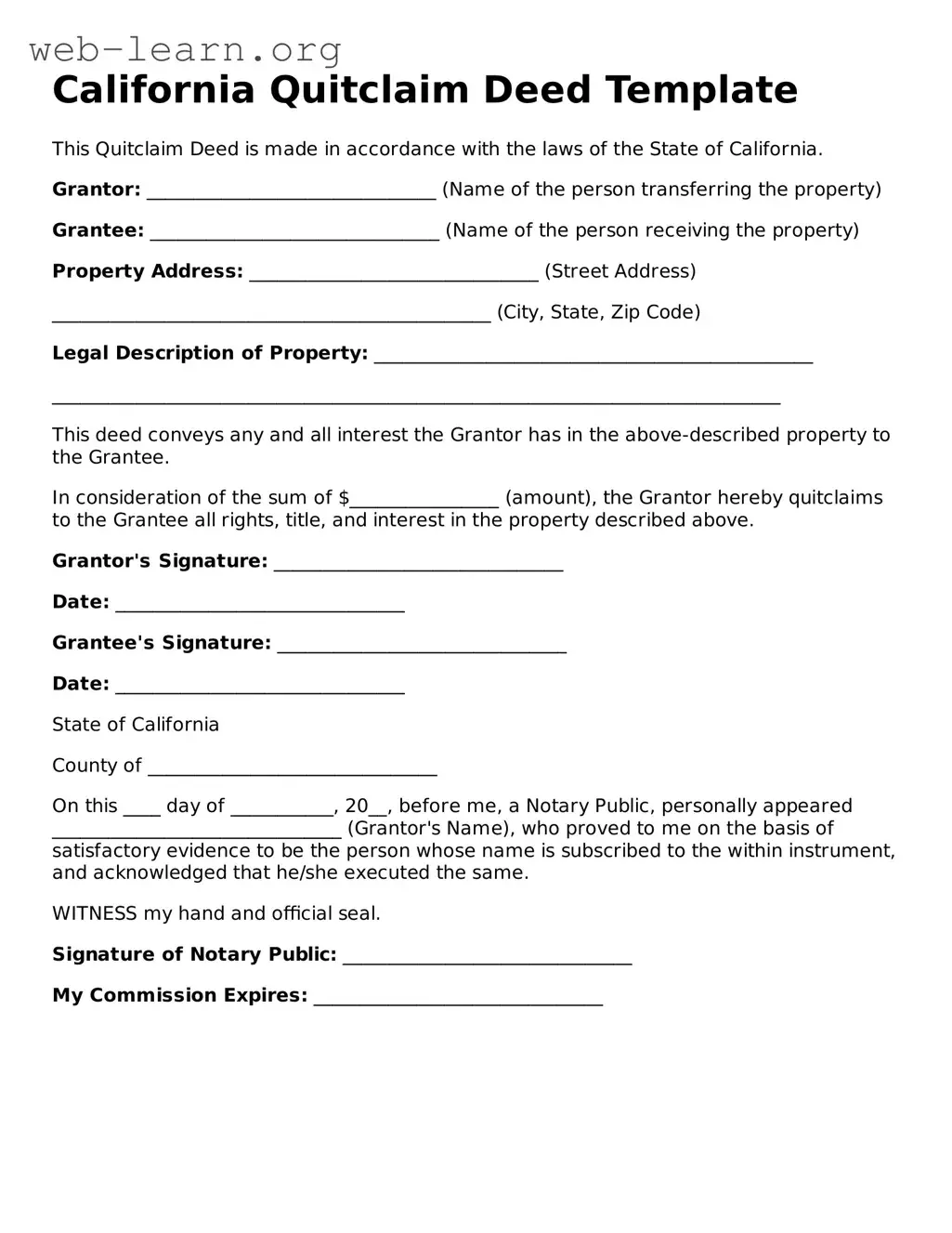
California Quitclaim Deed Template
This Quitclaim Deed is made in accordance with the laws of the State of California.
Grantor: _______________________________ (Name of the person transferring the property)
Grantee: _______________________________ (Name of the person receiving the property)
Property Address: _______________________________ (Street Address)
_______________________________________________ (City, State, Zip Code)
Legal Description of Property: _______________________________________________
______________________________________________________________________________
This deed conveys any and all interest the Grantor has in the above-described property to the Grantee.
In consideration of the sum of $________________ (amount), the Grantor hereby quitclaims to the Grantee all rights, title, and interest in the property described above.
Grantor's Signature: _______________________________
Date: _______________________________
Grantee's Signature: _______________________________
Date: _______________________________
State of California
County of _______________________________
On this ____ day of ___________, 20__, before me, a Notary Public, personally appeared _______________________________ (Grantor's Name), who proved to me on the basis of satisfactory evidence to be the person whose name is subscribed to the within instrument, and acknowledged that he/she executed the same.
WITNESS my hand and official seal.
Signature of Notary Public: _______________________________
My Commission Expires: _______________________________
| Fact Name | Details |
|---|---|
| Definition | A quitclaim deed is a legal document used to transfer ownership of real property without any warranties. |
| Governing Law | The California Quitclaim Deed is governed by California Civil Code Sections 1091 and 1092. |
| Usage | Commonly used among family members or in situations where the grantor does not wish to make any guarantees about the property. |
| Consideration | Consideration is not required for a quitclaim deed to be valid, although it may be included. |
| Signature Requirements | The deed must be signed by the grantor, and it is recommended that the signature be notarized. |
| Recording | To protect the interests of the grantee, the deed should be recorded with the county recorder’s office. |
| Tax Implications | Transfer tax may apply, depending on the county, though many transfers between family members are exempt. |
| Effect on Title | A quitclaim deed transfers whatever interest the grantor has, but it does not guarantee that the title is free of defects. |
| Revocation | Once executed and delivered, a quitclaim deed generally cannot be revoked unilaterally. |
| Limitations | It is not suitable for transactions where the buyer seeks assurance regarding the title’s validity. |
After obtaining the California Quitclaim Deed form, it's important to ensure that all necessary information is filled out accurately. This document allows for the transfer of property rights from one party to another. Following the completion of the form, it will need to be signed and notarized before being filed with the appropriate county office.
What is a California Quitclaim Deed?
A California Quitclaim Deed is a legal document used to transfer ownership of real property from one person to another. Unlike other types of deeds, a quitclaim deed does not guarantee that the person transferring the property has clear title to it. Instead, it simply conveys whatever interest the grantor has in the property, if any. This makes it a useful tool for transferring property between family members or in situations where the parties know each other well.
When should I use a Quitclaim Deed?
Consider using a Quitclaim Deed in several scenarios:
In these cases, a Quitclaim Deed can simplify the transfer process without the need for extensive legal formalities.
How do I complete a Quitclaim Deed in California?
To complete a Quitclaim Deed, follow these steps:
Ensure that all information is accurate to avoid complications later.
Are there any tax implications when using a Quitclaim Deed?
Yes, transferring property through a Quitclaim Deed can have tax implications. While the transfer itself may not trigger immediate taxes, it can affect property tax assessments. In California, a change in ownership may lead to reassessment under Proposition 13. It's crucial to consult with a tax professional to understand potential tax consequences before proceeding with the transfer.
Can a Quitclaim Deed be revoked?
Once a Quitclaim Deed is executed and recorded, it cannot be revoked unilaterally. However, the parties involved can agree to reverse the transfer by executing a new deed that conveys the property back to the original owner or another party. It’s important to document this process properly to avoid future disputes.
What are the risks associated with using a Quitclaim Deed?
Using a Quitclaim Deed carries certain risks:
Always consider these factors and seek legal advice if unsure about the implications of using a Quitclaim Deed.
Filling out a California Quitclaim Deed form can be straightforward, but many individuals make common mistakes that could lead to complications. One frequent error is failing to provide accurate property descriptions. The legal description must be precise and detailed. If it is vague or incorrect, it can create issues in the future, such as disputes over property boundaries.
Another mistake often made is neglecting to include the name of the grantee. The grantee is the person receiving the property. Omitting this information can render the deed invalid. It is essential to ensure that the name is spelled correctly and matches the identification documents.
Many individuals also overlook the need for notarization. A Quitclaim Deed must be signed in front of a notary public to be legally binding. Without this step, the document may not be recognized by the county recorder’s office, which can hinder the transfer of property ownership.
Additionally, people sometimes forget to check for existing liens or encumbrances on the property. A Quitclaim Deed does not clear these issues; it simply transfers whatever interest the grantor has. Failing to address this can lead to unforeseen financial liabilities for the grantee.
Another common oversight is not providing the correct recording information. The deed must be recorded in the county where the property is located. If the recording is done incorrectly or not at all, it can affect the legal standing of the property transfer.
Some individuals also fail to consider tax implications. While a Quitclaim Deed itself may not trigger a tax event, transferring property can have consequences for property taxes or capital gains taxes. It is advisable to consult with a tax professional to understand any potential impacts.
People often forget to include a consideration amount, which is the value exchanged for the property. Even if the transfer is a gift, stating a nominal amount is essential. This detail can help clarify the nature of the transaction and may be required for tax purposes.
Finally, many do not keep copies of the completed Quitclaim Deed. It is crucial to retain a copy for personal records and future reference. This can help resolve any disputes or questions that may arise after the transfer is complete.
A California Quitclaim Deed is a legal document used to transfer ownership of real property. When completing this process, several other forms and documents may be necessary to ensure a smooth transaction. Below is a list of commonly used documents that complement the Quitclaim Deed.
Understanding these documents is essential for anyone involved in a property transfer. Each serves a specific purpose and helps ensure that the transaction is legally sound and transparent.
A Quitclaim Deed is a specific legal document used to transfer ownership of property. Several other documents serve similar purposes in real estate transactions. Here are seven documents that are similar to a Quitclaim Deed:
When filling out the California Quitclaim Deed form, it's important to follow specific guidelines to ensure accuracy and compliance. Here are some do's and don'ts to keep in mind:
Many people have misunderstandings about the California Quitclaim Deed form. Here are nine common misconceptions:
While it does transfer whatever interest the grantor has in the property, it does not guarantee that the grantor has full ownership or clear title.
This form can be used for any type of property transfer, not just between relatives. Friends, business partners, and others can also utilize it.
The new owner may still be responsible for any existing liens or debts associated with the property. It does not absolve them of these obligations.
Recording the deed is important for public notice. It protects the new owner's interest in the property.
These two forms are different. A Warranty Deed provides guarantees about the title, while a Quitclaim Deed does not.
While it can be used for most properties, certain transactions, like those involving mortgages, may require different forms.
While notarization is strongly recommended, the deed may still be valid without it in some cases, depending on state laws.
While a Quitclaim Deed itself cannot be revoked, the grantor can create a new deed to reverse the transfer if both parties agree.
Forms can vary by state and specific circumstances. It’s important to use the correct version for California to ensure compliance.
When dealing with a California Quitclaim Deed form, there are several important points to keep in mind. This document is essential for transferring property ownership without making any guarantees about the title. Here are some key takeaways:
By following these guidelines, you can ensure a smooth process when using the California Quitclaim Deed form.
How to Transfer Land Ownership - The form requires the signature of the person transferring the property.
Quick Claim Deed Florida - Quitclaim Deeds are often used in conjunction with other legal documents.
Quitclaim Deed Georgia Cost - Using a Quitclaim Deed can help avoid lengthy court proceedings.
How to File a Quit Claim Deed in Kentucky - This form is typically recorded with the county clerk’s office.