Homepage Blank California Preliminary 20 Day Notice Form
Outline

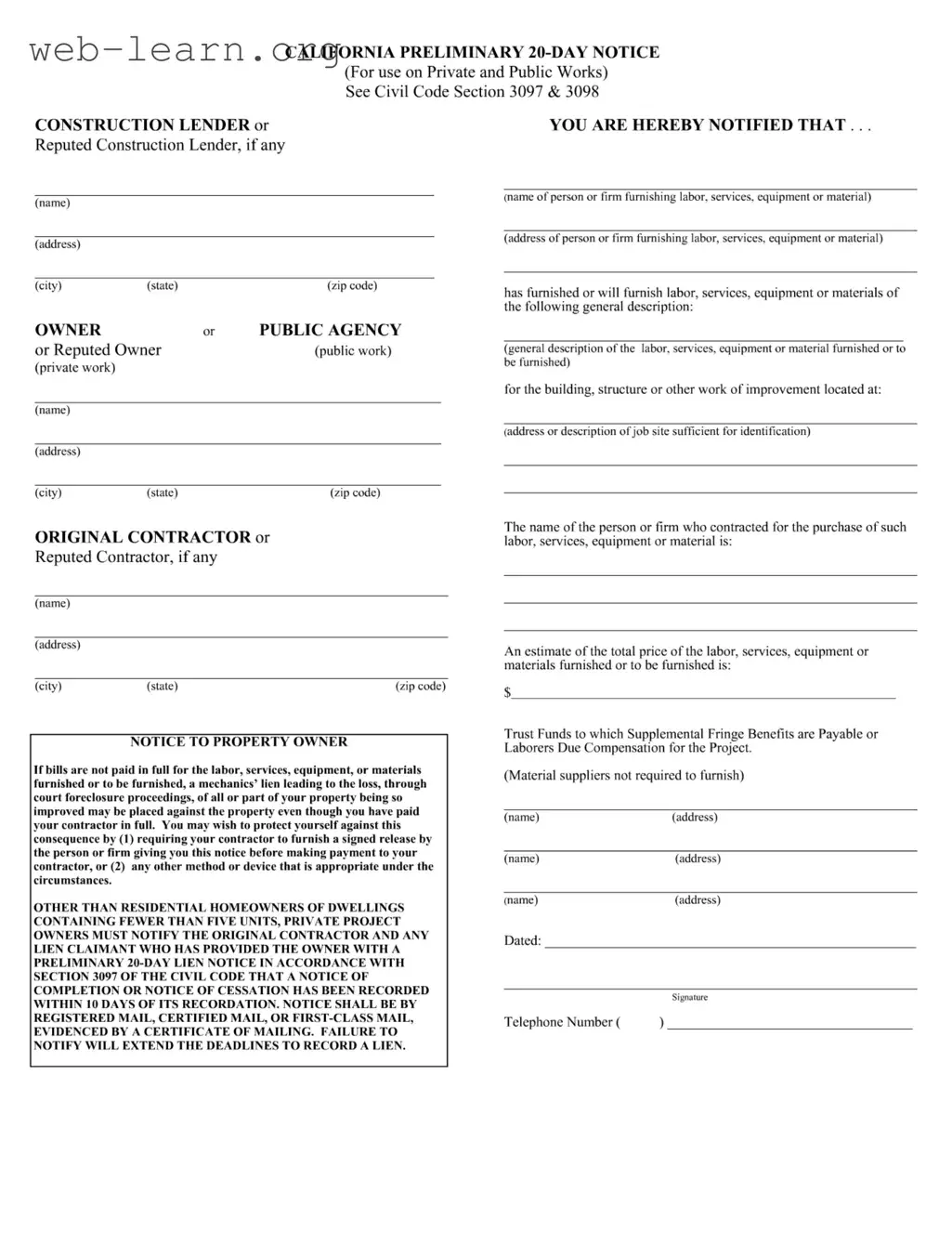
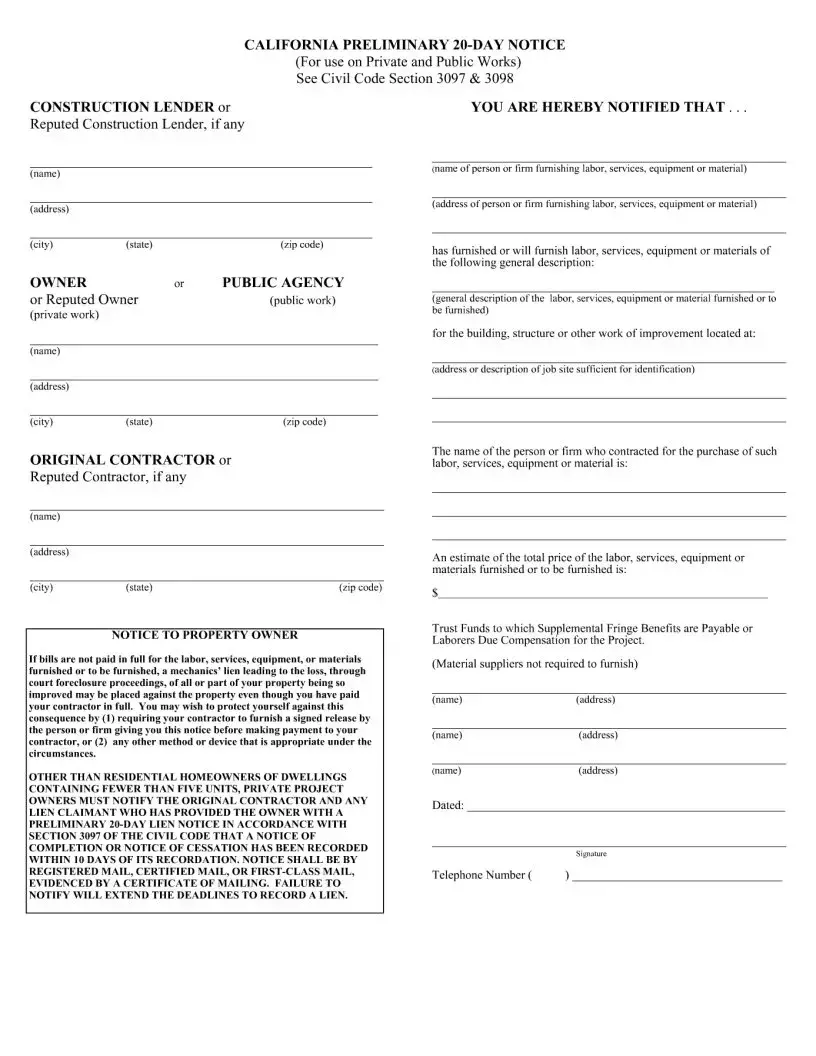
The California Preliminary 20-Day Notice form plays a crucial role in the construction industry, serving as a safeguard for those who provide labor, services, equipment, or materials for a project. This form is designed for both private and public works, ensuring that all parties involved are informed about their rights and obligations. When a contractor or supplier submits this notice, it alerts the property owner that they may be entitled to a lien if payment is not made for the work performed. The notice includes essential details such as the names and addresses of the construction lender, owner, and contractor, along with a description of the work being done and the job site location. It also emphasizes the importance of timely communication, advising property owners to notify the original contractor and any lien claimant if a notice of completion or cessation has been recorded. Failure to do so can extend the deadlines for recording a lien, which can have significant financial implications. By providing an estimate of the total cost of the labor or materials, the form helps all parties maintain transparency and accountability throughout the construction process.
Sample - California Preliminary 20 Day Notice Form

Form Information

Fact Name Details
Purpose The California Preliminary 20-Day Notice informs property owners and contractors about the provision of labor, services, equipment, or materials for a construction project.
Governing Laws This form is governed by California Civil Code Sections 3097 and 3098, which outline the requirements for preliminary notices in construction projects.
Notification Requirement Property owners must notify the original contractor and any lien claimant who has provided a Preliminary 20-Day Notice if a Notice of Completion or Notice of Cessation is recorded.
Mechanics' Lien Warning If payments are not made for the provided labor or materials, a mechanics' lien may be placed against the property, even if the owner has paid the contractor in full.
Delivery Methods Notices can be served by personal delivery or by first-class registered/certified mail, with proof of service required to ensure compliance.

Detailed Guide for Filling Out California Preliminary 20 Day Notice

After completing the California Preliminary 20 Day Notice form, it is important to deliver it to the relevant parties involved in the construction project. This notice informs property owners and contractors about the labor, services, equipment, or materials provided, ensuring that all parties are aware of their obligations. Proper delivery is crucial to protect your rights under California law.

  1. Obtain the form: You can find the California Preliminary 20 Day Notice form online or through local legal resources.
  2. Fill in the Construction Lender section: Write the name and address of the construction lender, if applicable.
  3. Provide the Owner's information: Enter the name and address of the property owner or reputed owner.
  4. Identify the Public Agency: If the work is public, include the name of the public agency involved.
  5. Detail the labor and services: Describe the labor, services, equipment, or materials that have been or will be provided.
  6. Specify the job site: Fill in the address or a sufficient description of the job site for identification.
  7. List the Original Contractor: Provide the name and address of the original contractor or reputed contractor.
  8. Identify the contracting party: State the name and address of the person or firm who contracted for the labor, services, equipment, or materials.
  9. Estimate the total price: Write the estimated total price of the labor, services, equipment, or materials.
  10. Provide Trust Funds information: List the name of trust funds to which supplemental fringe benefits are payable.
  11. Date the form: Include the date on which you are completing the form.
  12. Sign the form: Ensure you sign the document and provide your telephone number.
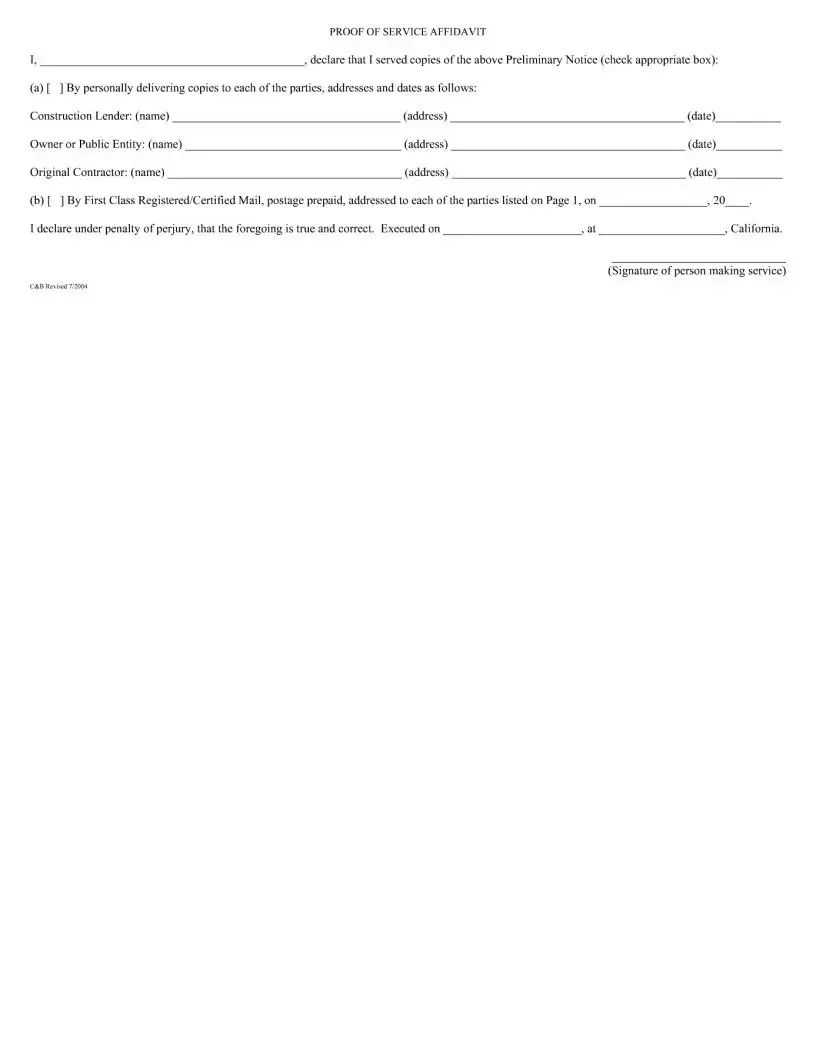
  13. Complete the Proof of Service Affidavit: Indicate how you served the notice (in person or by mail) and fill in the necessary details for each party served.
  14. Finalize the affidavit: Sign and date the affidavit to confirm the service of the notice.

Obtain Answers on California Preliminary 20 Day Notice

  1. What is the California Preliminary 20 Day Notice?

    The California Preliminary 20 Day Notice is a legal document that informs property owners and other interested parties that a contractor or subcontractor has provided or will provide labor, services, equipment, or materials for a construction project. This notice is crucial for protecting the rights of those who supply these services, as it establishes their ability to file a mechanics' lien if payment is not received.

  2. Who needs to file this notice?

  3. When should I file the notice?

    The notice should be filed within 20 days of providing labor, services, equipment, or materials. This timeframe is critical because it determines your eligibility to file a mechanics' lien later if payment issues arise.

  4. What happens if I do not file the notice?

    If you do not file the Preliminary 20 Day Notice, you risk losing your right to file a mechanics' lien. This means that if the property owner fails to pay, you may not be able to claim a lien against the property, making it difficult to recover your costs.

  5. What information is required on the notice?

    The notice must include several key pieces of information, such as:

    • Your name and address.
    • The property owner's name and address.
    • A description of the work performed or materials supplied.
    • The job site's address.
    • The original contractor's name and address, if applicable.
  6. How do I serve the notice?

    You can serve the notice by personally delivering it to the relevant parties or by sending it via registered, certified, or first-class mail. It is important to keep proof of service, as this may be needed later to verify that the notice was properly delivered.

  7. What is the consequence of not notifying the original contractor?

    If you are a private project owner and fail to notify the original contractor and any lien claimants of a recorded Notice of Completion or Notice of Cessation within 10 days, the deadlines for recording a lien may be extended. This could affect your ability to enforce your rights regarding payment.

  8. Is there a cost associated with filing this notice?

    While there is typically no fee to file the Preliminary 20 Day Notice itself, you may incur costs for mailing or delivering the notice. Additionally, if you later need to file a mechanics' lien, there may be associated filing fees. Always check local regulations for specific costs.

Common mistakes

Filling out the California Preliminary 20-Day Notice form can be straightforward, but many people make common mistakes that can lead to complications. One frequent error is leaving out essential information. For instance, failing to include the name and address of the construction lender or the reputed construction lender can cause issues. This information is crucial for ensuring that all parties are properly notified.

Another mistake involves incorrect or incomplete descriptions of the labor, services, equipment, or materials being provided. A vague or unclear description can create confusion and may weaken the notice's effectiveness. It is important to be as specific as possible to avoid any misunderstandings later on.

Many individuals also neglect to provide accurate details about the job site. Omitting the complete address or using an insufficient description can hinder the identification of the property involved. This can lead to disputes or delays in payment, as it may not be clear which project the notice pertains to.

Some people mistakenly assume that the original contractor's information is optional. However, it is essential to include the name and address of the original contractor or the reputed contractor. This ensures that all parties involved in the project are aware of the notice and can take appropriate action if necessary.

Another common oversight is not including the estimated total price of the labor, services, equipment, or materials. This estimate is important for transparency and helps to clarify the financial aspects of the project. Without this information, the notice may lack critical context.

Additionally, individuals often forget to sign and date the form. A missing signature can invalidate the notice, as it is essential for proving that the notice was properly executed. Always ensure that the form is signed and dated before submission.

Failing to serve the notice correctly is another mistake that can lead to complications. Whether delivering the notice in person or by mail, it is vital to follow the required procedures. Not doing so can result in the notice being deemed ineffective.

Lastly, people sometimes overlook the requirement to notify the original contractor and any lien claimant about the recording of a notice of completion or cessation. This notification must occur within ten days and is crucial to avoid extending the deadlines for recording a lien. Ignoring this step can create unnecessary challenges down the line.

Documents used along the form

The California Preliminary 20-Day Notice form is a crucial document in the construction process, ensuring that parties involved are aware of their rights and obligations. Alongside this form, several other documents are often utilized to facilitate communication and protect the interests of all parties involved in construction projects. Below is a list of related forms and documents that may be used in conjunction with the Preliminary 20-Day Notice.

  • Mechanics' Lien: This legal claim is filed against a property when payment for labor, services, or materials is not received. It provides the claimant a right to seek payment through foreclosure on the property.
  • Notice of Completion: This document is filed by the property owner to officially declare that the construction project has been completed. It can impact the time frame for filing a mechanics' lien.
  • Notice of Cessation: This notice is filed when a project is halted for a certain period. It serves to inform all parties that work has stopped, which may also affect lien rights.
  • Proof of Service Affidavit: This document verifies that the Preliminary 20-Day Notice was delivered to all relevant parties. It includes details on how and when the notice was served.
  • Contractor's Release of Lien: This form is used by a contractor to release their claim on a property after receiving payment. It protects the property owner from potential lien claims after payment has been made.
  • Subcontractor's Preliminary Notice: Similar to the Preliminary 20-Day Notice, this document is used by subcontractors to inform property owners and general contractors about their involvement in the project and their right to payment.
  • Change Order: This document outlines any modifications to the original construction contract. It details changes in scope, cost, or timeline and must be agreed upon by all parties involved.

Each of these documents plays a vital role in the construction process, helping to ensure that all parties are informed and protected. Understanding their purpose can aid in navigating the complexities of construction projects in California.

Similar forms

  • Mechanics Lien Notice: Similar to the Preliminary 20 Day Notice, a Mechanics Lien Notice serves to inform property owners that unpaid bills for labor or materials may result in a lien against their property. Both documents are crucial for protecting the rights of contractors and suppliers.
  • Notice of Completion: This document is filed when a construction project is completed. It informs parties involved that the work has been finished, similar to how the Preliminary Notice informs about the ongoing provision of services or materials.
  • Notice of Cessation: When work on a project stops for a specific period, this notice is filed. It is akin to the Preliminary 20 Day Notice in that it establishes important timelines for lien rights and informs parties of changes in project status.
  • Preliminary Notice for Public Works: This notice is specifically for public projects and has similar requirements to the Preliminary 20 Day Notice. It serves to alert public agencies about the provision of labor and materials.
  • Notice of Intent to Lien: This document is sent to property owners before a lien is filed, similar to the Preliminary 20 Day Notice, which alerts them of potential financial claims against their property.
  • Demand for Payment: A demand for payment is a formal request for payment from contractors or suppliers. Like the Preliminary Notice, it emphasizes the importance of timely payment to avoid legal consequences.
  • Release of Lien: This document is used to release a lien once payment has been made. It parallels the Preliminary 20 Day Notice by addressing the financial obligations related to construction work.
  • Notice of Non-Payment: This notice is sent to inform parties of non-payment for services or materials. It shares similarities with the Preliminary Notice by highlighting the risks associated with unpaid bills.
  • Construction Contract: A construction contract outlines the terms of the agreement between parties involved in a project. While it differs in purpose, it provides foundational information relevant to the obligations highlighted in the Preliminary 20 Day Notice.
  • Subcontractor Notice: This notice informs property owners about subcontractors working on a project. It is similar to the Preliminary 20 Day Notice in that it serves to protect the rights of those providing labor and materials.

Dos and Don'ts

When filling out the California Preliminary 20 Day Notice form, it is essential to approach the task with care and attention to detail. The following list outlines key actions to take and avoid to ensure the process is handled correctly.

  • Do provide accurate and complete information.
  • Do ensure that all parties' names and addresses are clearly listed.
  • Do specify the general description of the labor, services, equipment, or materials being provided.
  • Do notify the original contractor and any lien claimant of a notice of completion or cessation within the required timeframe.
  • Do keep a copy of the notice for your records.
  • Don't leave any sections blank; incomplete forms can lead to complications.
  • Don't forget to check for spelling errors in names and addresses.
  • Don't neglect to include the date of service when submitting the notice.
  • Don't assume that verbal communication suffices; written notice is crucial.
  • Don't delay in sending the notice; timely submission is vital for legal protections.

Misconceptions

  • It is only for residential projects. The California Preliminary 20-Day Notice can be used for both private and public works, not just residential properties.
  • Only contractors need to send this notice. Subcontractors and suppliers also have the right to send this notice to protect their payment rights.
  • Sending the notice guarantees payment. While it helps protect the sender's rights, it does not guarantee that payment will be received.
  • The notice must be sent before any work begins. The notice can be sent at any time within 20 days after work has commenced.
  • Homeowners are fully protected by paying their contractor. Homeowners can still face liens if subcontractors or suppliers are not paid, even if the contractor is fully paid.
  • All types of work require a 20-Day Notice. The notice is not necessary for work valued at less than $500.
  • Only one notice is needed for the entire project. Each subcontractor or supplier must send their own notice to protect their rights.
  • There are no penalties for not sending the notice. Failing to send the notice can extend deadlines for filing a lien, which may affect payment recovery.
  • It is a complicated legal document. The form is straightforward and designed to be user-friendly for those unfamiliar with legal terms.

Key takeaways

The California Preliminary 20-Day Notice form is an essential document for those involved in construction projects. Here are some key takeaways to keep in mind when filling out and using this form:

  • Purpose of the Notice: This form serves to inform property owners and other parties that labor, services, equipment, or materials have been provided or will be provided for a construction project.
  • Timeliness is Crucial: The notice must be served within 20 days of the first day of work to ensure that the right to file a mechanics' lien is preserved.
  • Property Owner's Responsibilities: Property owners should be aware that unpaid bills for work done can lead to a mechanics' lien on their property, even if they have paid their contractor in full.
  • Notification Requirements: Private project owners must notify the original contractor and any lien claimant about the recording of a Notice of Completion or Notice of Cessation within 10 days of its recordation.
  • Proof of Service: It is important to maintain a record of how the notice was served, whether by personal delivery or mail, as this may be required for legal purposes.

Understanding these points can help ensure compliance with California law and protect the rights of all parties involved in a construction project.