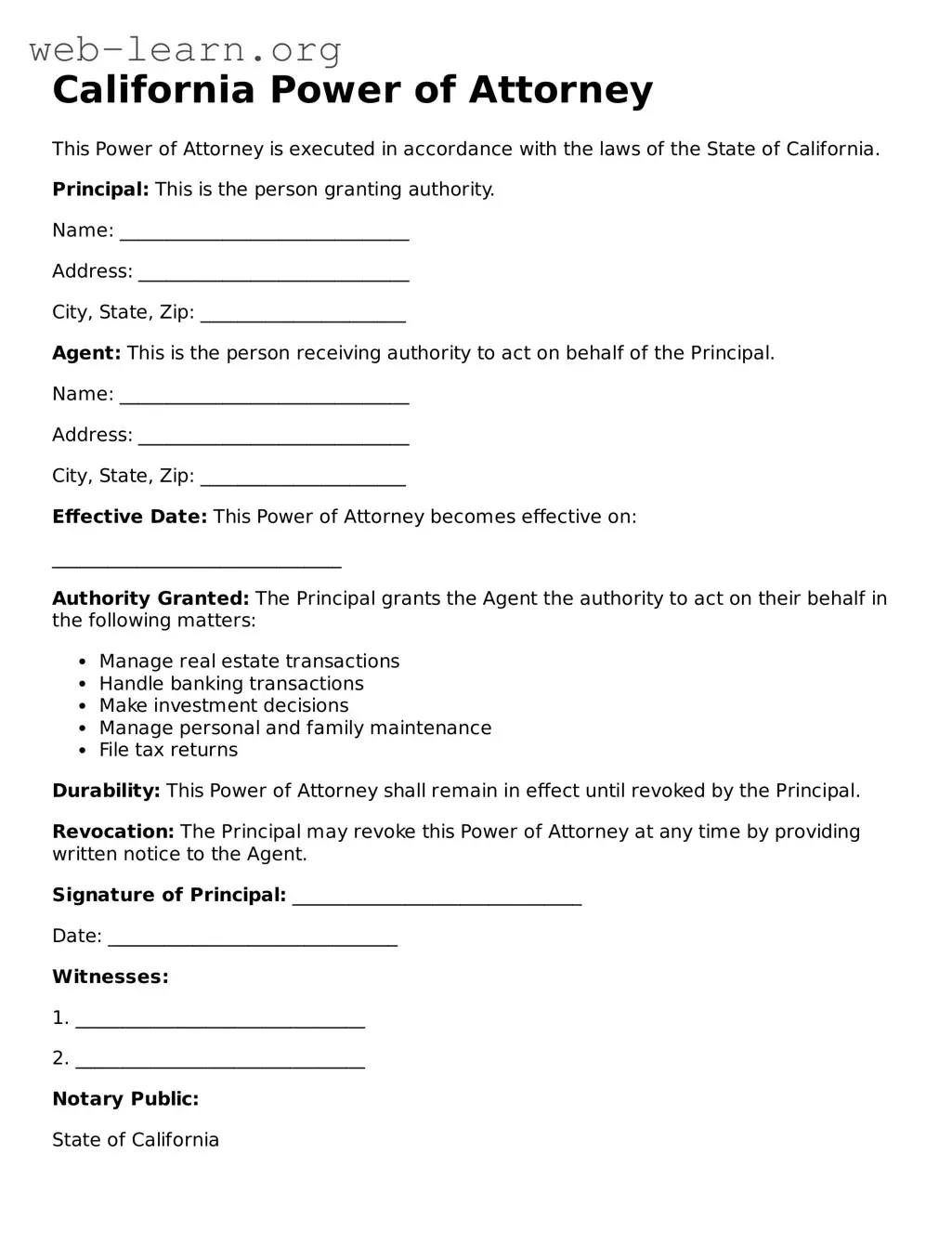
In California, the Power of Attorney (POA) form serves as a crucial legal instrument that empowers individuals to designate someone else to make decisions on their behalf, particularly in matters concerning financial and healthcare decisions. This form can be tailored to meet specific needs, offering flexibility in the scope of authority granted to the agent. For instance, a durable power of attorney remains effective even if the principal becomes incapacitated, ensuring that the appointed agent can act without interruption. Conversely, a limited power of attorney can restrict the agent's authority to particular tasks or timeframes, allowing for greater control over specific situations. Additionally, the California POA form must be executed with particular formalities, including the principal's signature and, in some cases, notarization or witness signatures, to ensure its validity. Understanding these nuances is essential for anyone considering this powerful tool, as it not only facilitates the management of personal affairs but also provides peace of mind in times of uncertainty.
California Power of Attorney
This Power of Attorney is executed in accordance with the laws of the State of California.
Principal: This is the person granting authority.
Name: _______________________________
Address: _____________________________
City, State, Zip: ______________________
Agent: This is the person receiving authority to act on behalf of the Principal.
Name: _______________________________
Address: _____________________________
City, State, Zip: ______________________
Effective Date: This Power of Attorney becomes effective on:
_______________________________
Authority Granted: The Principal grants the Agent the authority to act on their behalf in the following matters:
Durability: This Power of Attorney shall remain in effect until revoked by the Principal.
Revocation: The Principal may revoke this Power of Attorney at any time by providing written notice to the Agent.
Signature of Principal: _______________________________
Date: _______________________________
Witnesses:
1. _______________________________
2. _______________________________
Notary Public:
State of California
County of ___________________________
On this _____ day of ____________, 20___, before me, __________________________, a Notary Public, personally appeared __________________________, who proved to me on the basis of satisfactory evidence to be the person whose name is subscribed to this instrument.
_____________________________ (Seal)
Notary Public Signature: _______________________________
| Fact Name | Description |
|---|---|
| Definition | A Power of Attorney (POA) allows one person to authorize another to act on their behalf in legal and financial matters. |
| Governing Law | The California Power of Attorney is governed by the California Probate Code, specifically Sections 4000-4545. |
| Types | There are different types of POAs in California, including General, Durable, and Limited Power of Attorney. |
| Durability | A Durable Power of Attorney remains effective even if the principal becomes incapacitated. |
| Agent Responsibilities | The agent must act in the best interest of the principal and follow their instructions. |
| Revocation | The principal can revoke the Power of Attorney at any time, as long as they are mentally competent. |
| Signing Requirements | The form must be signed by the principal and, in most cases, witnessed by at least one person or notarized. |
| Limitations | A Power of Attorney cannot be used to make medical decisions unless specifically stated in a separate document. |
Filling out the California Power of Attorney form requires careful attention to detail. This document will allow someone you trust to make decisions on your behalf regarding financial or legal matters. It’s important to ensure that all sections are completed accurately to avoid any potential issues in the future.
What is a Power of Attorney in California?
A Power of Attorney (POA) is a legal document that allows one person (the principal) to appoint another person (the agent or attorney-in-fact) to make decisions on their behalf. In California, this can cover a wide range of decisions, including financial matters, health care, and property management. The principal can specify which powers are granted and can limit the agent's authority as needed.
What types of Power of Attorney are available in California?
California recognizes several types of Power of Attorney, including:
How do I create a Power of Attorney in California?
To create a Power of Attorney in California, follow these steps:
Can I revoke a Power of Attorney in California?
Yes, you can revoke a Power of Attorney at any time, as long as you are mentally competent. To do this, you should create a written revocation document and notify your agent and any institutions that had a copy of the original POA. It’s a good idea to destroy any copies of the old POA to prevent confusion.
What happens if my agent misuses their authority?
If your agent misuses their authority, you have options. You can revoke the Power of Attorney, as mentioned earlier, and you may also consider legal action against the agent for any damages incurred. It’s essential to choose an agent you trust, as they will have significant control over your affairs.
When completing the California Power of Attorney form, individuals often overlook critical details that can lead to complications later. One common mistake is failing to specify the powers granted to the agent clearly. The form provides sections where specific authorities can be outlined, but some people either leave these sections blank or use vague language. This can create confusion about what the agent is permitted to do, potentially leading to disputes or legal challenges.
Another frequent error involves not signing the document correctly. California law requires that the principal, the person granting the authority, must sign the form in the presence of a notary public or two witnesses. Many individuals neglect this requirement, thinking that their signature alone suffices. Without proper notarization or witness signatures, the Power of Attorney may not be considered valid, rendering it ineffective when needed.
People also sometimes forget to update their Power of Attorney forms after significant life changes. Events such as marriage, divorce, or the death of an agent can affect the validity of the document. Failing to revise the form accordingly can lead to complications, especially if the principal becomes incapacitated and the outdated document is presented. Regularly reviewing and updating this important document is essential for ensuring that it reflects current wishes and circumstances.
Lastly, individuals may not fully understand the implications of granting someone Power of Attorney. This document provides significant authority to the agent, including financial and health-related decisions. Some people rush through the process without considering the responsibilities and potential consequences. Taking the time to understand what it means to grant this power can help ensure that the principal makes informed choices about who they trust to act on their behalf.
When preparing a California Power of Attorney, it is often beneficial to consider additional forms and documents that can complement this legal tool. These documents help ensure that your wishes are clearly communicated and legally upheld. Below are four commonly used forms that may accompany a Power of Attorney.
Using these documents in conjunction with a Power of Attorney can provide clarity and peace of mind. Each serves a distinct purpose, ensuring that personal and financial matters are handled according to your wishes.
The Power of Attorney form shares similarities with several other legal documents. Here are eight documents that are comparable:
When filling out the California Power of Attorney form, it's important to approach the task with care. Here are some key dos and don'ts to keep in mind:
By following these guidelines, you can ensure that your Power of Attorney form is completed correctly and effectively. This will help protect your interests and provide clarity in decision-making when needed.
Understanding the California Power of Attorney form can be tricky, and several misconceptions often arise. Here are five common misunderstandings that people have:
Many believe that a Power of Attorney (POA) is solely for managing financial affairs. However, a POA can also grant authority for healthcare decisions, legal matters, and more. It’s important to specify the powers you want to grant.
Some think that a Power of Attorney is set in stone. In reality, you can revoke or modify your POA at any time, as long as you are mentally competent. Just make sure to follow the proper procedures.
This misconception suggests that only seniors or those facing health issues need a POA. In truth, anyone can benefit from having a POA, especially if you travel frequently or have specific wishes regarding your affairs.
People often assume that a POA form is a one-size-fits-all document. However, each state has its own requirements and forms. It’s crucial to use the California-specific form to ensure it meets legal standards.
Many fear that signing a POA means they lose control over their decisions. In reality, a POA is designed to help you by allowing someone you trust to act on your behalf when you cannot. You can set limits on what decisions your agent can make.
Being informed about these misconceptions can help you make better decisions regarding your Power of Attorney. Always consult with a trusted professional if you have questions or need guidance.
Filling out and using the California Power of Attorney form involves several important considerations. Here are key takeaways to keep in mind:
New York Power of Attorney - This document can be crucial for seniors planning for potential health issues.
Florida Power of Attorney - Some people opt for a co-agent arrangement for added oversight.