In California, the Power of Attorney for a Child form serves as a vital tool for parents and guardians who need to delegate authority for the care of their minor children. This legal document allows a designated individual, often a relative or trusted friend, to make important decisions on behalf of the child in the absence of the parent or legal guardian. It encompasses various aspects of caregiving, including medical decisions, educational matters, and day-to-day welfare considerations. By completing this form, parents can ensure that their child receives appropriate care and attention, especially during emergencies or extended absences. Additionally, the form must be signed by the parent or guardian and may require notarization, depending on specific circumstances. Understanding the nuances of this document can provide peace of mind, ensuring that children are well cared for even when parents are not physically present.
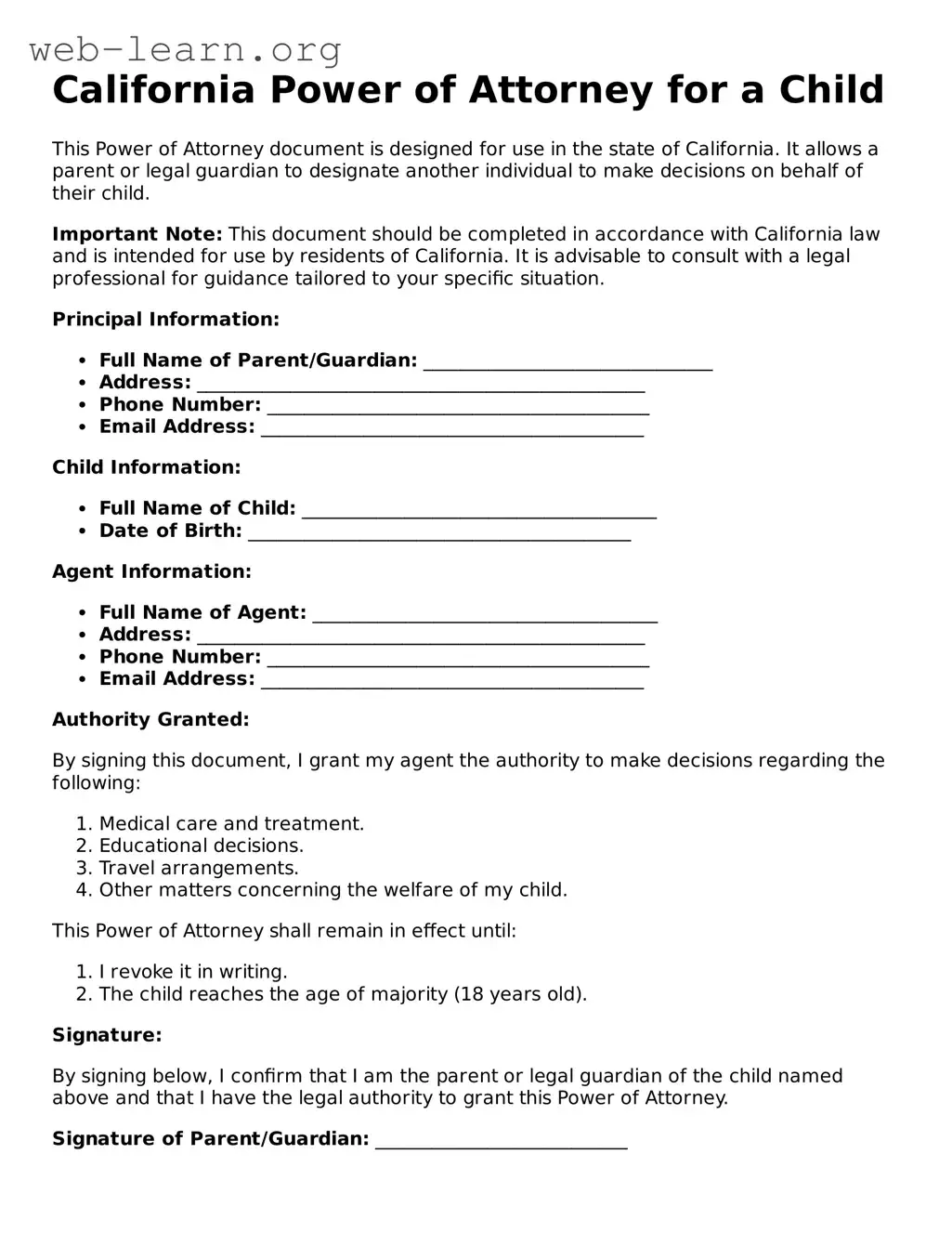
California Power of Attorney for a Child
This Power of Attorney document is designed for use in the state of California. It allows a parent or legal guardian to designate another individual to make decisions on behalf of their child.
Important Note: This document should be completed in accordance with California law and is intended for use by residents of California. It is advisable to consult with a legal professional for guidance tailored to your specific situation.
Principal Information:
Child Information:
Agent Information:
Authority Granted:
By signing this document, I grant my agent the authority to make decisions regarding the following:
This Power of Attorney shall remain in effect until:
Signature:
By signing below, I confirm that I am the parent or legal guardian of the child named above and that I have the legal authority to grant this Power of Attorney.
Signature of Parent/Guardian: ___________________________
Date: ________________________________________________
Notary Acknowledgment:
State of California, County of ________________
On this _____ day of ______________, 20____, before me, a notary public, personally appeared __________________________, known to me to be the person whose name is subscribed to this document, and acknowledged that they executed it.
Notary Public Signature: _______________________________
My Commission Expires: ________________________________
| Fact Name | Description |
|---|---|
| Purpose | The California Power of Attorney for a Child form allows a parent or legal guardian to grant temporary authority to another adult to make decisions on behalf of their child. |
| Eligibility | This form can be used by parents or legal guardians of children under the age of 18 in California. |
| Duration | The authority granted by this form is typically valid for up to one year, unless specified otherwise. |
| Revocation | Parents can revoke the Power of Attorney at any time, provided they do so in writing and notify the designated agent. |
| Agent Responsibilities | The appointed agent can make decisions regarding education, health care, and general welfare of the child. |
| Signature Requirement | The form must be signed by the parent or guardian granting the authority, and it may need to be notarized for certain situations. |
| Governing Law | This form is governed by California Family Code Section 6550-6552. |
| Limitations | The Power of Attorney does not grant the agent the authority to make decisions regarding the child's adoption or to consent to marriage. |
| Emergency Use | This form is particularly useful in emergency situations, such as when a parent is unavailable due to travel or illness. |
| Access to Records | The agent may have access to the child's medical and educational records, allowing for informed decision-making. |
Filling out the California Power of Attorney for a Child form is an important step in designating someone to make decisions on behalf of a minor. It is essential to ensure that all information is accurate and complete to avoid any issues in the future.
Once the form is filled out and notarized, it is advisable to communicate with the appointed agent about their responsibilities. Keeping all parties informed will help ensure that the child's needs are met effectively.
A Power of Attorney for a Child is a legal document that allows a parent or legal guardian to designate another adult to make decisions on behalf of their child. This can include medical decisions, educational choices, and other important matters. This form is especially useful for parents who may be traveling or temporarily unable to care for their child.
The agent can be any responsible adult, such as a relative, friend, or neighbor. However, it is crucial to choose someone who you trust to act in the best interest of your child. The agent must be at least 18 years old and capable of making decisions.
The Power of Attorney for a Child remains valid until the specified end date in the document, or until the parent or guardian revokes it. If no end date is mentioned, it typically lasts until the child reaches the age of 18.
Yes, in California, the Power of Attorney for a Child must be signed in front of a notary public to be legally valid. This step adds an extra layer of protection and ensures that the document is recognized by authorities.
Absolutely! You can revoke the Power of Attorney at any time as long as you provide written notice to the agent and any relevant parties. It’s a good idea to also notify any institutions, such as schools or medical facilities, that may have been informed of the original Power of Attorney.
If the designated agent is unable to act due to illness, relocation, or other reasons, it’s advisable to have a backup agent named in the document. This ensures that there is always someone available to make decisions for your child.
No, they are different. A Power of Attorney is temporary and grants specific decision-making authority, while guardianship is a more permanent arrangement that involves legal custody of the child. Guardianship requires a court process and is typically more involved than a Power of Attorney.
The agent can make a variety of decisions, including:
However, the specific powers granted can vary based on how the document is drafted, so it’s important to clearly outline the agent’s authority.
While it is not legally required to have a lawyer, consulting one can be beneficial. A legal professional can help ensure that the document meets all legal requirements and is tailored to your specific situation.
Keep the original document in a safe place, such as a locked file or safe. It’s also wise to provide copies to the agent, your child’s school, and any medical providers who may need it. This way, everyone involved knows who has the authority to make decisions for your child.
Filling out the California Power of Attorney for a Child form can be a straightforward process, yet many people make common mistakes that can lead to complications down the line. One prevalent error is failing to specify the duration of the power of attorney. Without a clear start and end date, the authority granted may remain in effect longer than intended, potentially leading to misunderstandings among family members.
Another frequent oversight involves not clearly identifying the child. It’s essential to provide the child's full legal name, date of birth, and any other identifying information. Omitting this information can create confusion and may even render the document ineffective in legal situations.
Additionally, many individuals neglect to sign the form in the presence of a notary public. In California, notarization is a critical step that lends credibility to the document. Without this official stamp, the power of attorney may not be recognized by schools, medical facilities, or other institutions that require proof of authority.
Some people also mistakenly assume that a single signature is sufficient. In reality, both the parent granting the power and the agent receiving it must sign the document. This ensures that both parties are aware of the responsibilities and limitations involved, fostering transparency and trust.
Another common mistake occurs when individuals fail to provide specific instructions regarding the agent’s authority. General language can lead to misunderstandings about what decisions the agent can make on behalf of the child. Clearly outlining the scope of authority helps prevent potential conflicts and confusion.
Moreover, many overlook the importance of discussing the arrangement with the child, if they are old enough to understand. Failing to involve the child in the conversation can lead to feelings of uncertainty or anxiety about who will be making decisions on their behalf.
Lastly, individuals often forget to keep copies of the completed form. It’s vital to retain a copy for personal records and to provide copies to the agent and any institutions that may require it. This ensures that everyone involved has access to the same information, promoting clarity and reducing the likelihood of disputes.
When creating a Power of Attorney for a Child in California, there are several other forms and documents that may be useful to consider. These documents can help clarify responsibilities and provide additional legal support regarding the care and custody of a child.
Having these documents prepared alongside the Power of Attorney for a Child can help ensure that all aspects of a child's care and well-being are properly addressed. Each document plays a crucial role in providing clarity and protection for both the child and the designated caregiver.
The Power of Attorney for a Child form allows a parent or guardian to designate another individual to make decisions on behalf of a child. This document is similar to several other legal documents that also grant authority to act on someone else's behalf. Below is a list of ten documents that share similarities with the Power of Attorney for a Child form:
When filling out the California Power of Attorney for a Child form, certain practices can help ensure the document is completed correctly. Below is a list of things to do and avoid during this process.
Understanding the California Power of Attorney for a Child form can be challenging. Here are ten common misconceptions about this important legal document:
Understanding these misconceptions can help ensure that parents make informed decisions regarding their children's care and legal representation.
Filling out and using the California Power of Attorney for a Child form is an important step for parents and guardians. Here are some key takeaways to keep in mind:
By following these key points, you can ensure that the process of creating a Power of Attorney for a Child is smooth and effective. It is always advisable to consult with a professional if you have any questions or concerns.
Michigan Power of Attorney - This form can be particularly useful during family emergencies or unexpected events.
Temporary Poa for Child - The form should be signed and dated by the parent for it to be valid.
How to Get Power of Attorney in Arkansas - It is advisable to consult with a legal professional to ensure the form meets state requirements.
Colorado Power of Attorney Requirements - It can be revoked at any time by the parent who created it.