Homepage Blank California Pos 010 Form
Outline

The California POS-010 form, known as the Proof of Service of Summons, plays a crucial role in the legal process by ensuring that all parties involved in a case are properly notified. This form is required when initiating a lawsuit, as it provides the court with evidence that the summons and other essential documents have been served to the relevant parties. It includes sections for detailing the names and addresses of the parties involved, the method of service, and the date and time of delivery. Whether documents are served personally, through substituted service, or by mail, the POS-010 captures all necessary information to validate the service process. Additionally, the form requires a declaration under penalty of perjury, which underscores the importance of accuracy and honesty in the information provided. Understanding how to correctly fill out this form is vital for anyone involved in a legal proceeding in California, as it helps maintain the integrity of the judicial process and ensures that all parties receive fair notice of the actions taken against them.
Sample - California Pos 010 Form

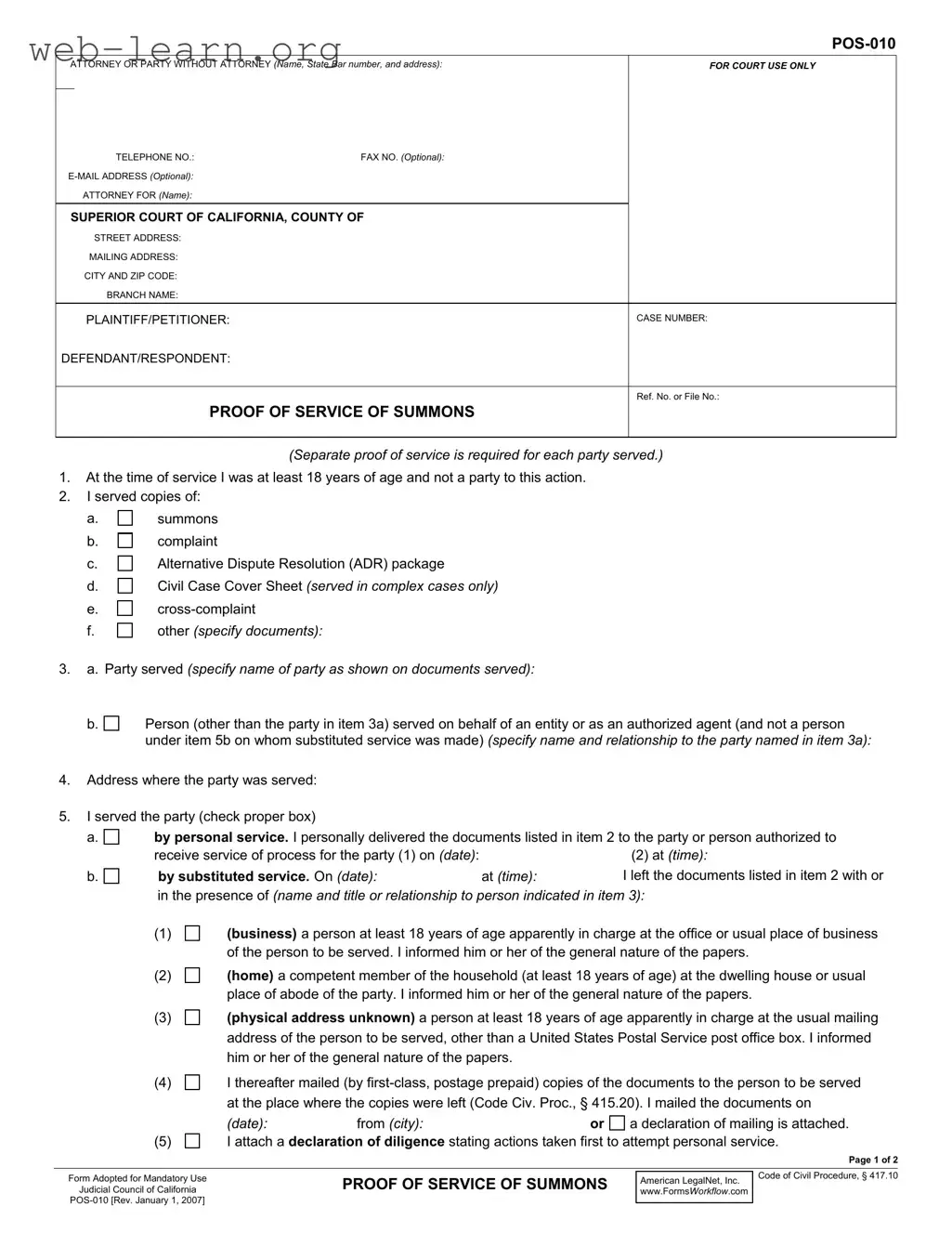
POS-010
Page 1 of 2
Form Adopted for Mandatory Use
Judicial Council of California
POS-010 [Rev. January 1, 2007]
PROOF OF SERVICE OF SUMMONS
Code of Civil Procedure, § 417.10
American LegalNet, Inc.
www.FormsWorkflow.com
ATTORNEY OR PARTY WITHOUT ATTORNEY (Name, State Bar number, and address):
TELEPHONE NO.: FAX NO. (Optional):
E-MAIL ADDRESS (Optional):
ATTORNEY FOR (Name):
SUPERIOR COURT OF CALIFORNIA, COUNTY OF
STREET ADDRESS:
MAILING ADDRESS:
CITY AND ZIP CODE:
BRANCH NAME:
FOR COURT USE ONLY
PLAINTIFF/PETITIONER:
DEFENDANT/RESPONDENT:
CASE NUMBER:
PROOF OF SERVICE OF SUMMONS
Ref. No. or File No.:
(Separate proof of service is required for each party served.)
1. At the time of service I was at least 18 years of age a
nd not a party to this action.
2. I served copies of:
a.
summons
b.
complaint
c.
Alternative Dispute Resolution (ADR) package
d.
Civil Case Cover Sheet (served in complex cases only)
e.
cross-complaint
f. other (specify documents):
3. a. Party served (specify name of party as shown on documents served):
b.
Person (other than the party in item 3a) served on behalf of an entity or as an authorized agent (and not a person
under item 5b on whom substituted service was made) (specify name and relationship to the party named in item 3a):
4. Address where the party was served:
5. I served the party (check proper box)
a.
by personal service. I personally delivered the documents listed in item 2 to the party or person authorized to
receive service of process for the party (1) on (date): (2) at (time):
b. by substituted service. On (date): at (time):
I left the documents listed in item 2 with or
in the presence of (name and title or relationship to person indicated in item 3):
(1)
(business) a person at least 18 years of age apparently in charge at the office or usual place of business
of the person to be served. I informed him or her of the general nature of the papers.
(2)
(home) a competent member of the household (at least 18 years of age) at the dwelling house or usual
place of abode of the party. I informed him or her of the general nature of the papers.
(3) (physical address unknown) a person at least 18 years of age apparently in charge at the usual mailing
address of the person to be served, other than a United States Postal Service post office box. I informed
him or her of the general nature of the papers.
(4)
I thereafter mailed (by first-class, postage prepaid) copies of the documents to the person to be served
at the place where the copies were left (Code Civ. Proc., § 415.20). I mailed the documents on
(date):
from (city): or
a declaration of mailing is attached.
(5) I attach a declaration of diligence stating actions taken first to attempt personal service.
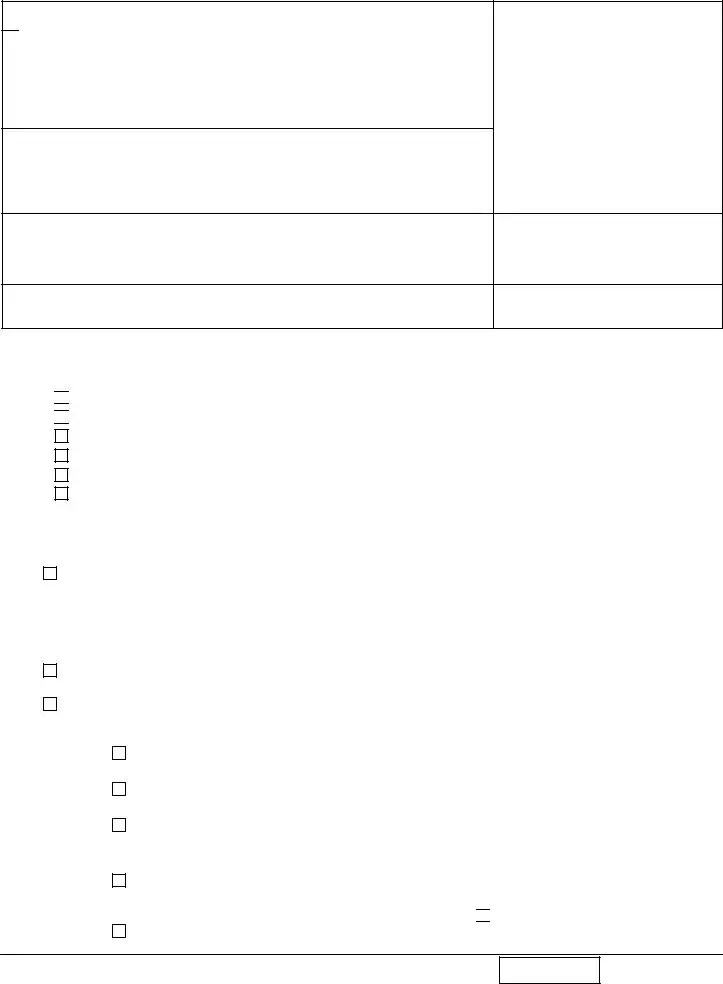
POS-010 [Rev. January 1, 2007] PROOF OF SERVICE OF SUMMONS Page 2 of 2
American LegalNet, Inc.
www.FormsWorkflow.com
PLAINTIFF/PETITIONER:
DEFENDANT/RESPONDENT:
CASE NUMBER:
5. c. by mail and acknowledgment of receipt of service. I mailed the documents listed in item 2 to the party, to the
address shown in item 4, by first-class mail, postage prepaid,
(1) on (date): (2) from (city):
(3) with two copies of the Notice and Acknowledgment of Receipt and a postage-paid return envelope addressed
to me. (Attach completed Notice and Acknowledgement of Receipt.) (Code Civ. Proc., § 415.30.)
(4) to an address outside California with return receipt requested. (Code Civ. Proc., § 415.40.)
d.
by other means (specify means of service and authorizing code section):
Additional page describing service is attached.
6. The "Notice to the Person Served" (on the summons) was completed as follows:
a.
as an individual defendant.
b.
as the person sued under the fictitious name of (specify):
c. as occupant.
d.
On behalf of (specify):
under the following Code of Civil Procedure section:
416.10 (corporation) 415.95 (business organization, form unknown)
416.20 (defunct corporation) 416.60 (minor)
416.30 (joint stock company/association) 416.70 (ward or conservatee)
416.40 (association or partnership) 416.90 (authorized person)
416.50 (public entity) 415.46 (occupant)
other:
7. Person who served papers
a. Name:
b. Address:
c. Telephone number:
d. The fee for service was: $
e. I am:
(1)
not a registered California process server.
(2)
exempt from registration under Business and Professions Code section 22350(b).
(3)
a registered California process server:
(i) owner employee independent contractor.
(ii) Registration No.:
(iii) County:
8.
I declare under penalty of perjury under the laws of the State of California that the foregoing is true and correct.
or
9.
I am a California sheriff or marshal and I certify that the foregoing is true and correct.
Date:
`
(NAME OF PERSON WHO SERVED PAPERS/SHERIFF OR MARSHAL) (SIGNATURE)

Form Information

Fact Name Details
Purpose The POS-010 form is used to provide proof of service of summons in California civil cases.
Governing Law This form is governed by California Code of Civil Procedure, specifically sections 415.10 to 415.40.
Mandatory Use The POS-010 form is mandated for use by the Judicial Council of California, ensuring uniformity in legal processes.
Service Methods Service can be completed through personal delivery, substituted service, or by mail, depending on circumstances.
Age Requirement The person serving the documents must be at least 18 years old and not a party to the action.
Declaration of Diligence If personal service is unsuccessful, a declaration of diligence may be attached to explain the attempts made.

Detailed Guide for Filling Out California Pos 010

Filling out the California POS-010 form requires attention to detail. This form is essential for documenting the service of legal papers in a court case. After completing the form, it will need to be filed with the court as part of your case documentation.

  1. At the top of the form, provide the name, state bar number, and address of the attorney or party without an attorney.
  2. Fill in the telephone number, fax number (if applicable), and email address (optional).
  3. Indicate the name of the attorney for the plaintiff or petitioner.
  4. Complete the court information section, including the street address, mailing address, city, zip code, and branch name.
  5. Enter the names of the plaintiff or petitioner and the defendant or respondent, along with the case number.
  6. In the proof of service section, confirm that you were at least 18 years old and not a party to the action at the time of service.
  7. List the documents served, such as the summons, complaint, and any other relevant documents.
  8. Specify the name of the party served and, if applicable, the name of the person who accepted service on behalf of an entity.
  9. Provide the address where the party was served.
  10. Indicate how the documents were served by checking the appropriate box: personal service, substituted service, or by mail and acknowledgment of receipt.
  11. If using substituted service, provide details about the person served and the circumstances of the service.
  12. Complete the section regarding the "Notice to the Person Served," indicating how the service was made (e.g., individual defendant, occupant).
  13. Fill in the information about the person who served the papers, including their name, address, and telephone number.
  14. State the fee for service and indicate whether the server is a registered California process server or exempt from registration.
  15. Finally, sign and date the form, declaring under penalty of perjury that the information provided is true and correct.

Obtain Answers on California Pos 010

  1. What is the California POS-010 form?

    The California POS-010 form, also known as the Proof of Service of Summons, is a legal document used to confirm that a summons and other related documents have been properly served to the parties involved in a court case. This form is crucial in ensuring that all parties are notified of the legal actions being taken against them, thereby upholding their right to due process.

  2. Who needs to fill out the POS-010 form?

    The POS-010 form must be filled out by the individual or entity that serves the legal documents. This could be an attorney, a registered process server, or even an individual who is at least 18 years old and not involved in the case. The person serving the documents must provide their details, including their name, address, and telephone number, on the form.

  3. What information is required on the POS-010 form?

    The form requires several pieces of information:

    • The name and address of the person serving the documents.
    • The name of the party being served and the address where service occurred.
    • The method of service used (personal service, substituted service, or mail).
    • The date and time of service.
    • A declaration stating that the person serving the documents is at least 18 years old and not a party to the action.

  4. How is the POS-010 form submitted?

    Once the form is completed, it must be filed with the court where the case is being heard. This filing serves as proof that the required documents were served to the parties involved. It is essential to ensure that the form is filed promptly, as delays could affect the timeline of the case.

  5. What happens if the POS-010 form is not completed correctly?

    If the POS-010 form is not filled out correctly, it may lead to complications in the legal process. The court may reject the form, which could delay proceedings or even result in the case being dismissed. Therefore, it is vital to ensure that all required information is accurate and complete before submission.

Common mistakes

Filling out the California POS-010 form can be straightforward, but several common mistakes can lead to delays or complications in the legal process. One frequent error is failing to include the full name of the party being served. It is essential to specify the name exactly as it appears on the legal documents. Omitting or misspelling the name can result in service being deemed ineffective.

Another mistake is neglecting to provide the correct address where the documents were served. The address must be accurate and complete. If the address is incorrect, it may hinder the ability to prove that service was properly executed. Additionally, not checking the appropriate box for the method of service can create confusion. Whether the documents were served personally, by mail, or through substituted service, clarity is crucial.

Some individuals forget to include the date and time of service. This information is vital for establishing when the party was served. Without it, the court may question the legitimacy of the service. Similarly, failing to indicate who served the papers can lead to complications. It is important to provide the name and contact details of the person who performed the service.

Another common error involves not attaching the required documents. For example, if service was completed by mail, a completed Notice and Acknowledgment of Receipt should accompany the form. Omitting this can delay proceedings. Furthermore, individuals often overlook the necessity of signing the declaration under penalty of perjury. This signature confirms that the information provided is true and accurate, which is a critical component of the form.

People sometimes fail to note whether the server is a registered process server or exempt from registration. This detail is significant for the court’s records. Lastly, not keeping a copy of the completed form for personal records is a mistake that can lead to issues down the line. Having a copy ensures that individuals can reference the details if needed.

By being aware of these common pitfalls, individuals can fill out the California POS-010 form more effectively. Attention to detail is key in ensuring that all information is accurate and complete, which helps facilitate a smoother legal process.

Documents used along the form

The California POS-010 form is essential for proving that legal documents have been served to the involved parties in a case. However, several other forms and documents often accompany it to ensure that the legal process runs smoothly. Understanding these documents can help you navigate the complexities of legal proceedings more effectively.

  • Summons: This document notifies the defendant that a lawsuit has been filed against them. It outlines the time frame in which they must respond to avoid a default judgment.
  • Complaint: The complaint is the initial pleading that outlines the plaintiff's case, including the facts and legal grounds for the lawsuit. It sets the stage for the legal proceedings.
  • Alternative Dispute Resolution (ADR) Package: This package provides information on options available for resolving disputes outside of court, such as mediation or arbitration. It encourages parties to consider alternatives to litigation.
  • Civil Case Cover Sheet: Required in complex cases, this form helps the court manage and categorize the case effectively. It includes basic information about the case and the parties involved.
  • Cross-Complaint: A cross-complaint is filed by a defendant against the plaintiff or other parties, asserting their own claims in response to the original complaint. This can complicate the proceedings but allows for a more comprehensive resolution.
  • Notice and Acknowledgment of Receipt: This document is used to confirm that the recipient has received the legal documents. It requires the recipient to sign and return it, providing proof of service.
  • Declaration of Diligence: This declaration outlines the efforts made to serve the documents personally before resorting to alternative methods of service. It demonstrates due diligence in attempting to notify the parties involved.
  • Declaration of Mailing: This document is attached to verify that documents were mailed to the party in accordance with legal requirements. It serves as evidence of service by mail.
  • Proof of Service by Mail: This form is used to confirm that documents were sent to a party via mail, including details about the mailing process and the recipient's address.

Each of these documents plays a crucial role in the legal process, ensuring that all parties are informed and that the court has the necessary information to proceed with the case. Familiarity with these forms can enhance your understanding of legal procedures and help facilitate a smoother legal experience.

Similar forms

The California POS-010 form, known as the Proof of Service of Summons, is an important document in legal proceedings. It serves as a formal declaration that a summons and related documents have been properly served to the involved parties. Several other documents share similarities with the POS-010 form in terms of purpose and function. Below are nine such documents:

  • POS-030: Proof of Service by Mail - This document is used to confirm that legal documents were sent via mail. It outlines the recipient's information and the method of mailing, similar to how the POS-010 verifies service of summons.
  • POS-040: Proof of Service of Summons (Substituted Service) - This form is specifically for cases where the documents were served to someone other than the party involved. It details the circumstances of the service, akin to the methods outlined in the POS-010.
  • POS-050: Proof of Service of a Petition - Similar to the POS-010, this document provides evidence that a petition has been served to the necessary parties, ensuring that all parties are informed of the legal actions.
  • POS-060: Proof of Service of Motion - This form is used to confirm that a motion has been served, detailing the recipient and method of service, paralleling the requirements of the POS-010.
  • POS-070: Proof of Service of Complaint - This document serves to confirm that a complaint has been delivered to the defendant, similar to the POS-010's function in serving summons and complaints.
  • POS-080: Proof of Service of Response - This form is utilized to show that a response has been served to the opposing party, reflecting the same principles of service verification as the POS-010.
  • POS-090: Proof of Service of Notice - This document is used to confirm that a notice has been served, ensuring all parties are aware of important legal updates, much like the notifications included in the POS-010.
  • POS-100: Proof of Service of Discovery Documents - This form verifies that discovery documents have been served, maintaining transparency in legal proceedings, similar to the service verification in the POS-010.
  • POS-110: Proof of Service of Judgment - This document confirms that a judgment has been served to the relevant parties, fulfilling the same role of ensuring parties are informed as the POS-010 does for summons.

Each of these documents plays a crucial role in the legal process, ensuring that all parties involved are properly notified and that the court has a record of such notifications. Understanding these forms can help individuals navigate the complexities of legal proceedings with greater confidence.

Dos and Don'ts

When filling out the California POS-010 form, it is essential to follow specific guidelines to ensure accuracy and compliance. Below is a list of things you should and shouldn't do:

  • Do provide your full name, State Bar number, and complete address at the top of the form.
  • Do include a valid telephone number and, if applicable, your email address for communication purposes.
  • Do clearly specify the names of the parties involved in the case, including both the plaintiff and defendant.
  • Do check the appropriate box for the method of service used, whether personal, substituted, or by mail.
  • Do ensure that the address where the documents were served is accurate and complete.
  • Don't forget to list all documents served, including the summons and any other relevant paperwork.
  • Don't leave out the date and time of service; these details are crucial for the record.
  • Don't provide incomplete or inaccurate information about the person who served the papers.
  • Don't neglect to sign and date the form to affirm its accuracy under penalty of perjury.
  • Don't submit the form without reviewing it for errors or missing information.

Misconceptions

Misconceptions about the California POS-010 form can lead to confusion for those involved in legal proceedings. Here are four common misunderstandings:

  • Anyone can serve legal documents. Many believe that any person can serve documents, but the law requires that the server be at least 18 years old and not a party to the action. This ensures that the person serving the documents is impartial.
  • Only one proof of service is needed for multiple parties. Some think that a single proof of service suffices for all parties involved. However, a separate proof of service is required for each party served. This is crucial for maintaining accurate records in legal proceedings.
  • Proof of service can be completed after the deadline. It is a common misconception that the proof of service can be filled out after the documents have been served. In reality, it must be completed and filed promptly to ensure compliance with court rules.
  • Mailing documents is the only way to serve them. Some individuals believe that mailing documents is the only method of service. While mailing is an option, personal service or substituted service is often required. Understanding the correct method is essential for proper legal procedure.

Key takeaways

When using the California POS-010 form, keep these key points in mind:

  • Eligibility for Service: Ensure that the person serving the documents is at least 18 years old and not a party to the action. This is crucial for the validity of the service.
  • Document List: Clearly specify all documents served, including the summons, complaint, and any additional paperwork. Each document must be listed to avoid confusion.
  • Method of Service: Choose the appropriate method of service, whether personal, substituted, or by mail. Each method has specific requirements that must be followed to ensure proper service.
  • Declaration of Service: Complete the declaration of service accurately. This includes providing the name of the person who served the documents and their relationship to the party served, if applicable.