Homepage Blank California Pm110 Form
Outline

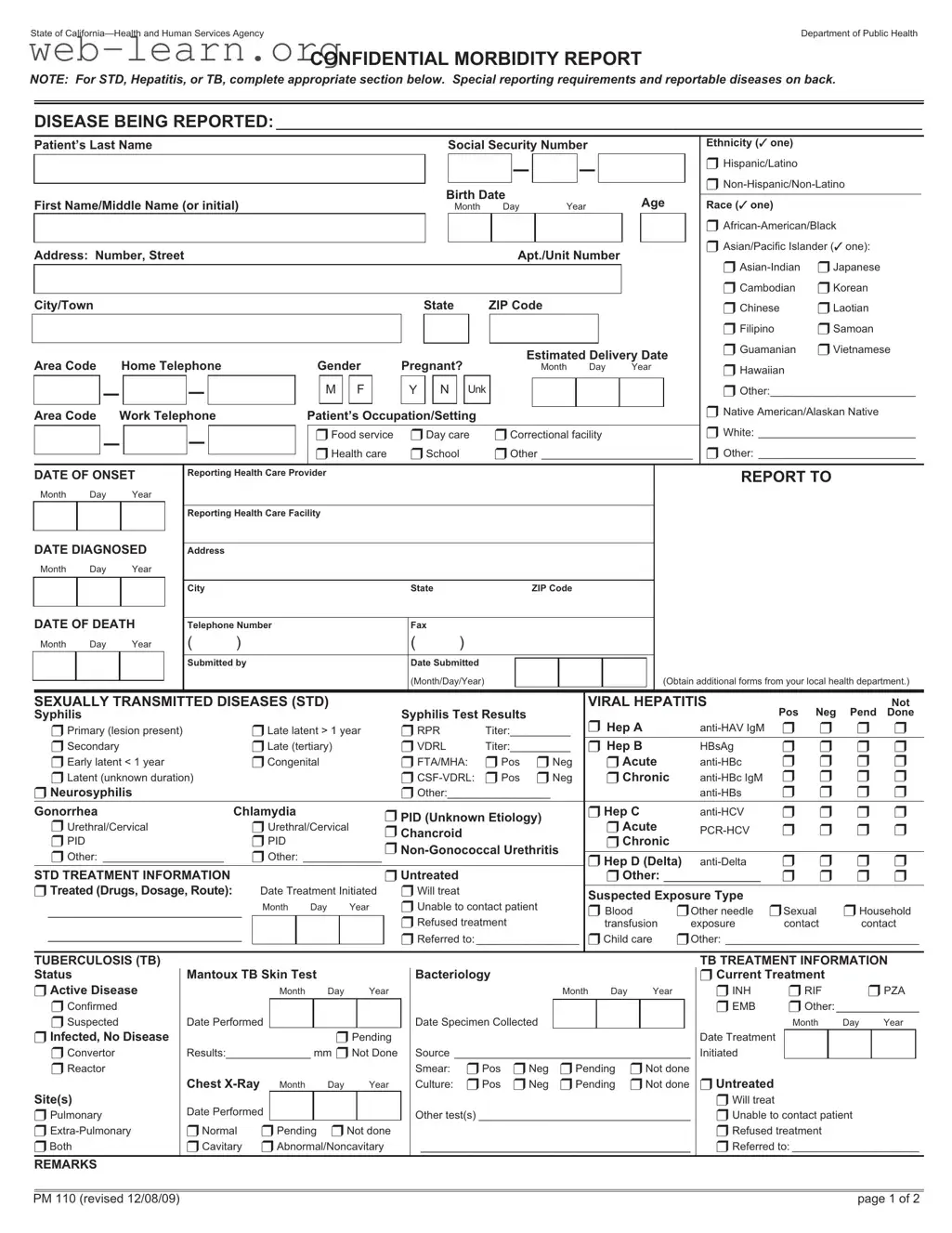
The California PM110 form serves as a vital tool for health care providers in reporting specific communicable diseases and conditions to local health authorities. This form is particularly important for tracking sexually transmitted diseases (STDs), viral hepatitis, and tuberculosis (TB), as it includes designated sections for each category. It requires essential patient information such as name, date of birth, ethnicity, and contact details, alongside clinical data like the disease being reported, test results, and treatment information. Health care providers must complete the form accurately and submit it promptly, adhering to California's reporting regulations outlined in Title 17 of the California Code of Regulations. The PM110 form also highlights special reporting requirements for certain diseases and includes a comprehensive list of reportable diseases and conditions, ensuring that public health officials can monitor and respond to outbreaks effectively. By maintaining confidentiality and compliance, the PM110 form plays a crucial role in safeguarding public health and managing communicable diseases across the state.


Sample - California Pm110 Form

____________________________
____________________________
State of California—Health and Human Services Agency Department of Public Health
CONFIDENTIAL MORBIDITY REPORT
NOTE: For STD, Hepatitis, or TB, complete appropriate section below. Special reporting requirements and reportable diseases on back.
DISEASE BEING REPORTED: ___________________________________________________________________________________
Patient’s Last Name Social Security Number
Birth Date
First Name/Middle Name (or initial) Month Day Year
Age
Address: Number, Street Apt./Unit Number
Ethnicity (one)
Hispanic/Latino
Non-Hispanic/Non-Latino
Race (one)
African-American/Black
Asian/Pacific Islander (one):
Asian-Indian Japanese
Cambodian Korean
City/Town State ZIP Code
Area Code Home Telephone Gender Pregnant?
Estimated Delivery Date
Month Day Year
Area Code Work Telephone Patient’s Occupation/Setting
M F
Y
Unk
N
Chinese Laotian
Filipino Samoan
Guamanian Vietnamese
Hawaiian
Other:________________________
Native American/Alaskan Native
White: __________________________
Other: __________________________
REPORT TO
DATE OF ONSET
Month Day Year
DATE DIAGNOSED
Month Day Year
DATE OF DEATH
Month Day Year
Food service Day care Correctional facility
Health care School Other _________________________
Reporting Health Care Provider
Reporting Health Care Facility
Address
City State ZIP Code
Telephone Number Fax
( ) ( )
Submitted by Date Submitted
(Month/Day/Year)
Secondary Late (tertiary) VDRL Titer:__________
Primary (lesion present) Late latent > 1 year RPR Titer:__________
SEXUALLY TRANSMITTED DISEASES (STD)
Syphilis Syphilis Test Results
Neurosyphilis Other:_________________
Early latent < 1 year Congenital FTA/MHA: Pos Neg
Latent (unknown duration) CSF-VDRL: Pos Neg
Gonorrhea Chlamydia
PID (Unknown Etiology)
Urethral/Cervical Urethral/Cervical
Chancroid
PID PID
Non-Gonococcal Urethritis
Other: ____________________ Other: _____________
STD TREATMENT INFORMATION Untreated
Treated (Drugs, Dosage, Route): Date Treatment Initiated Will treat
Month Day Year Unable to contact patient
Refused treatment
Referred to: _________________
(Obtain additional forms from your local health department.)
VIRAL HEPATITIS Not
Pos Neg Pend Done
Hep A anti-HAV IgM
Hep B HBsAg
Acute anti-HBc
Chronic anti-HBc IgM
anti-HBs
Hep C anti-HCV
Acute
PCR-HCV
Hep D (Delta) anti-Delta
Chronic
Other: ______________
Suspected Exposure Type
Blood
Other needle
Sexual
Household
transfusion exposure contact contact
Child care Other: ________________________________
TUBERCULOSIS (TB)
Status Mantoux TB Skin Test Bacteriology
Active Disease Month Day Year Month Day Year
Confirmed
Suspected Date Performed Date Specimen Collected
Infected, No Disease Pending
Convertor Results:______________ mm Not Done Source _______________________________________
Reactor Smear: Pos Neg Pending Not done
Chest X-Ray Month Day Year Culture: Pos Neg Pending Not done
Site(s)
Pulmonary
Date Performed
Other test(s) ___________________________________
Extra-Pulmonary Normal Pending Not done
Both Cavitary Abnormal/Noncavitary _______________________________________
TB TREATMENT INFORMATION
Current Treatment
INH RIF PZA
EMB Other: ____________
Month Day Year
Date Treatment
Initiated
Untreated
Will treat
Refused treatment
Unable to contact patient
Referred to: _____________________
REMARKS
PM 110 (revised 12/08/09) page 1 of 2
State of Califonria - Health and Human Sevices Agency Department of Public Health
§ 2500.
REPORTING TO THE LOCAL HEALTH AUTHORITY.
§ 2500(b)
It shall be the duty of every health care provider, knowing of or in attendance on a case or suspected case of any of the diseases or condition listed below, to report to the
local health officer for the juridiction where the patient resides. Where no health care provider is in attendance, any individual having knowledge of a person who is suspected to be
suffering from one of the diseases or conditions listed below may make such a report to the local health officer for the jurisdiction where the patient resides.
§ 2500(c)
The administrator of each health facility, clinic, or other setting where more than one health care provider may know of a case, a suspected case or an outbreak of disease
within the facility shall establish and be responsible for administrative procedures to assure that reports are made to the local officer.
§ 2500(a)(14)
"Health care provider" means a physician and surgeon, a veterinarian, a podiatrist, a nurse practitioner, a physician assistant, a registered nurse, a nurse midwife, a school
nurse, an infection control practitioner, a medical examiner, a coroner, or a dentist.
URGENCY REPORTING REQUIREMENTS [17 CCR §2500(h)(i)]
✆✆
=
Report immediately by telephone (designated by a in regulations).
=
Report immediately by telephone when two or more cases or suspected cases of foodborne disease from separate households are suspected to have the same source of illness
(designated by a in regulations.)
FAX
✆✉ =
Report by electronic transmission (including FAX), telephone, or mail within one working day of identification (designated by a + in regulations).
=
All other diseases/conditions should be reported by electronic transmission (including FAX), telephone, or mail within seven calendar days of identification.
REPORTABLE COMMUNICABLE DISEASES §2500(j)(1)
Acquired Immune Deficiency Syndrome (AIDS)
FAX
✆✉
Poliovirus Infection
(HIV infection only: see "Human Immunodeficiency Virus")
FAX
✆✉
Psittacosis
FAX
✆✉
Amebiasis
FAX
✆✉
Q Fever
Anaplasmosis/Ehrlichiosis
✆✆
Rabies, Human or Animal
✆✆
Anthrax
FAX
✆✉
Relapsing Fever
✆✆
Avian Influenza (human) Rheumatic Fever, Acute
FAX
✆✉
Babesiosis Rocky Mountain Spotted Fever
✆✆
Botulism (Infant, Foodborne, Wound) Rubella (German Measles)
✆✆
Brucellosis Rubella Syndrome, Congenital
FAX
✆✉
Campylobacteriosis
FAX
✆✉
Salmonellosis (Other than Typhoid Fever)
Chancroid
✆✆
Scombroid Fish Poisoning
FAX
✆✉
Chickenpox (only hospitalizations and deaths)
✆✆
Severe Acute Respiratory Syndrome (SARS)
Chlamydia trachomatis infections, including Lymphogranuloma Venereum (LGV)
✆✆
Shiga toxin (detected in feces)
✆✆
Cholera
FAX
✆✉
Shigellosis
✆✆
Ciguatera Fish Poisoning
✆✆
Smallpox (Variola)
Coccidioidomycosis
FAX
✆✉
Staphylococcus aureus infection (only a case resulting in death or admission to an
FAX
✆✉
Colorado Tick Fever intensive care unit of a person who has not been hospitalized or had surgery, dialysis,
Creutzfeldt-Jakob Disease (CJD) and other Transmissible Spongiform or residency in a long-term care facility in the past year, and did not have an indwelling
Encephalopathies (TSE) catheter or percutaneous medical device at the time of culture)
FAX
✆✉
Cryptosporidiosis
FAX
✆✉
Streptococcal Infections (Outbreaks of Any Type and Individual Cases in Food
Cysticercosis or Taeniasis Handlers and Dairy Workers Only)
✆✆
Dengue
FAX
✆✉
Syphilis
✆✆
Diphtheria Tetanus
✆✆
Domoic Acid Poisoning (Amnesic Shellfish Poisoning) Toxic Shock Syndrome
FAX
✆✉
Encephalitis, Specify Etiology: Viral, Bacterial, Fungal, Parasitic
FAX
✆✉
Trichinosis
✆✆
Escherichia coli : shiga toxin producing (STEC) including E. coli O157
FAX
✆✉
Tuberculosis
FAX
✆✉
Foodborne Disease
✆✆
Tularemia
Giardiasis
FAX
✆✉
Typhoid Fever, Cases and Carriers
Gonococcal Infections Typhus Fever
FAX
✆✉
Haemophilus influenzae invasive disease (report an incident
FAX
✆✉
Vibrio Infections
less than 15 years of age)
✆✆
Viral Hemorrhagic Fevers (e.g., Crimean-Congo, Ebola, Lassa, and Marburg viruses)
✆✆
Hantavirus Infections
FAX
✆✉
Water-Associated Disease (e.g., Swimmer's Itch or Hot Tub Rash)
✆✆
Hemolytic Uremic Syndrome
FAX
✆✉
West Nile Virus (WNV) Infection
Hepatitis, Viral
✆✆
Yellow Fever
FAX
✆✉
Hepatitis A
FAX
✆✉
Yersiniosis
Hepatitis B (specify acute case or chronic)
✆✆
OCCURRENCE of ANY UNUSUAL DISEASE
Hepatitis C (specify acute case or chronic)
✆✆
OUTBREAKS of ANY DISEASE (Including diseases not listed in §2500). Specify if
Hepatitis D (Delta) institutional and/or open community.
Hepatitis, other, acute
Influenza deaths (report an incident of less than 18 years of age)
HIV REPORTING BY HEALTH CARE PROVIDERS
§2641.5-2643.20
Kawasaki Syndrome (Mucocutaneous Lymph Node Syndrome) Human Immunodeficiency Virus (HIV) infection is reportable by traceable mail or person-to-person
Legionellosis transfer within seven calendar days by completion of the HIV/AIDS Case Report form (CDPH 8641A)
Leprosy (Hansen Disease) available from the local health department. For completing HIV-specific reporting requirements, see
Leptospirosis
Title 17, CCR, §2641.5-2643.20 and http://www.cdph.ca.gov/programs/aids/Pages/OAHIVReporting.aspx
FAX
✆✉
Listeriosis
Lyme Disease
REPORTABLE NONCOMMUNICABLE DISEASES AND CONDITIONS §2800–2812 and §2593(b)
FAX
✆✉
Malaria
Disorders Characterized by Lapses of Consciousness (§2800-2812)
FAX
✆✉
Measles (Rubeola)
Pesticide-related illness or injury (known or suspected cases)**
FAX
✆✉
Meningitis, Specify Etiology: Viral, Bacterial, Fungal, Parasitic Cancer, including benign and borderline brain tumors (except (1) basal and squamous skin cancer
✆✆
Meningococcal Infections unless occurring on genitalia, and (2) carcinoma in-situ and CIN III of the cervix) (§2593)***
Mumps
✆✆
Paralytic Shellfish Poisoning
LOCALLY REPORTABLE DISEASES (If Applicable):
Pelvic Inflammatory Disease (PID)
FAX
✆✉
Pertussis (Whooping Cough)
✆✆
Plague, Human or Animal
* This form is designed for health care providers to report those diseases mandated by Title 17, California Code of Regulations (CCR). Failure to report is a misdemeanor (Heatlh and Safety Code
§120295) and is a citable offense under the Medical Board of California Citation and Fine Program (Title 16, CCR, §1364.10 and 1364.11).
** Failure to report is a citable offense and subject to civil penalty ($250) (Health and Safety Code §105200).
*** The Confidential Physician Cancer Reporting Form may also be used. See Physician Reporting Requirements for Cancer Reporting in CA at: www.ccrcal.org.
PM110 (revised 12/08/09
) page 2 of 2
Title 17, California Code of Regulations (CCR) §2500, §2593, §2641.5-2643.20, and §2800-2812 Reportable Diseases and Conditions*

Form Information

Fact Name Description
Purpose The PM110 form is designed for healthcare providers to report specific communicable diseases and conditions to local health authorities in California.
Governing Law This form is governed by Title 17 of the California Code of Regulations, specifically sections §2500, §2593, and §2641.5-2643.20.
Confidentiality The PM110 form is a confidential morbidity report, ensuring that patient information is protected while facilitating necessary public health reporting.
Reportable Diseases Healthcare providers must report diseases such as STDs, hepatitis, and tuberculosis, among others, using this form.
Reporting Timeline Urgent cases require immediate reporting, while other conditions should be reported within specific timeframes, usually within one to seven days.
Legal Obligation Failure to report as mandated by the regulations can result in misdemeanor charges and civil penalties for healthcare providers.
Additional Resources Healthcare providers can obtain additional PM110 forms from their local health department to ensure compliance with reporting requirements.

Detailed Guide for Filling Out California Pm110

After completing the California PM110 form, it must be submitted to the appropriate local health authority. Ensure that all information is accurate and complete to facilitate proper processing. This form is crucial for reporting specific diseases and conditions as mandated by state regulations.

  1. Begin by entering the disease being reported in the designated space at the top of the form.
  2. Fill in the patient's last name and social security number.
  3. Select the patient's ethnicity by marking the appropriate box.
  4. Provide the patient's birth date and age.
  5. Enter the first name and middle name (or initial) of the patient.
  6. Choose the patient's race by marking the correct option.
  7. Complete the address section, including street number, apartment/unit number, city, state, and ZIP code.
  8. Fill in the home telephone and work telephone numbers.
  9. Indicate the patient's gender and whether they are pregnant.
  10. Provide the estimated delivery date if applicable.
  11. Enter the patient's occupation/setting from the provided options.
  12. Document the date of onset of the disease.
  13. Fill in the details of the reporting health care provider and the reporting health care facility, including address and contact information.
  14. Record the date diagnosed and, if applicable, the date of death.
  15. Complete the sexually transmitted diseases section, indicating test results and treatments.
  16. Provide information regarding tuberculosis (TB) testing and treatment if applicable.
  17. Include any additional remarks in the designated area.
  18. Finally, ensure that the form is submitted by the appropriate individual, including the date submitted.

Obtain Answers on California Pm110

  1. What is the California PM110 form?

    The California PM110 form is a Confidential Morbidity Report used by healthcare providers to report specific communicable diseases, including sexually transmitted diseases (STDs), viral hepatitis, and tuberculosis (TB). This form is essential for public health monitoring and disease control efforts in the state of California.

  2. Who is required to complete the PM110 form?

    Healthcare providers, including physicians, nurse practitioners, and other designated medical professionals, are required to complete the PM110 form when they know of or attend to a case of a reportable disease. In cases where no healthcare provider is present, any individual with knowledge of a suspected case can report it to the local health authority.

  3. What diseases must be reported using the PM110 form?

    The PM110 form is specifically designed for reporting various communicable diseases, such as:

    • Sexually Transmitted Diseases (STDs) like syphilis and gonorrhea
    • Viral Hepatitis, including Hepatitis A, B, and C
    • Tuberculosis (TB)

    Additionally, it covers other diseases as mandated by California regulations.

  4. How soon must the PM110 form be submitted?

    The urgency of reporting varies by disease. For example, certain diseases must be reported immediately by phone, while others should be reported within one working day or seven calendar days. It is crucial to check the specific requirements for each disease listed on the form.

  5. What information is required on the PM110 form?

    The form requires detailed patient information, including:

    • Patient's name and contact details
    • Social Security number
    • Ethnicity and race
    • Details about the disease being reported
    • Information about the reporting healthcare provider

    This information helps public health officials track and manage disease outbreaks effectively.

  6. What are the consequences of failing to report?

    Failure to report a communicable disease using the PM110 form is considered a misdemeanor and can lead to penalties. Healthcare providers may face civil penalties for non-compliance, emphasizing the importance of timely and accurate reporting.

  7. Where can I obtain additional PM110 forms?

    Healthcare providers can obtain additional copies of the PM110 form from their local health department. It is advisable to keep a supply of these forms on hand to ensure compliance with reporting requirements.

Common mistakes

Completing the California PM110 form can be a straightforward process, but there are common mistakes that individuals may encounter. One frequent error is failing to provide the patient's full name. The form requires both the first and last names, and omitting any part can lead to confusion or delays in processing.

Another mistake is not including the social security number. This information is crucial for identification and tracking purposes. If the social security number is missing, it may hinder the ability to link the patient to their medical history or other relevant records.

Many people also overlook the importance of selecting the correct ethnicity and race. It is essential to check the appropriate boxes, as this data can affect public health reporting and resource allocation. Incomplete or inaccurate selections can lead to misrepresentation in health statistics.

Additionally, individuals often forget to specify the disease being reported. Clearly indicating the specific condition helps ensure that the report is directed to the right health authority. Without this detail, the report may not be processed correctly.

Another common issue arises with the dates provided on the form. Errors in entering the date of onset, diagnosis, or death can lead to significant complications. It is vital to double-check these dates for accuracy, as they are critical for tracking disease outbreaks and understanding epidemiological trends.

Some submitters may also neglect to include the contact information for the reporting health care provider. This information is necessary for follow-up questions or clarifications. Without it, the health department may struggle to obtain additional details if needed.

People sometimes misinterpret the instructions regarding treatment information for sexually transmitted diseases or tuberculosis. Failing to provide details about treatment can result in incomplete records, which may affect patient care and public health responses.

Another frequent oversight involves the signature and date submitted sections. Missing a signature or incorrect dating can delay the processing of the report. It is important to ensure these fields are filled out correctly before submission.

Lastly, individuals may not be aware of the specific reporting requirements for different diseases. Each condition may have unique guidelines, and misunderstanding these can lead to improper reporting. Familiarizing oneself with these requirements can prevent unnecessary errors.

Documents used along the form

The California PM110 form is a crucial document for reporting various communicable diseases to the local health authorities. Along with this form, there are several other documents that healthcare providers frequently use to ensure accurate reporting and compliance with state regulations. Here’s a brief overview of five commonly associated forms and documents.

  • HIV/AIDS Case Report Form (CDPH 8641A): This form is specifically designed for reporting cases of Human Immunodeficiency Virus (HIV) infection. Healthcare providers must submit it within seven calendar days of diagnosis to maintain compliance with state regulations.
  • Confidential Physician Cancer Reporting Form: Used by healthcare providers to report cases of cancer, this form ensures that all cancer cases, including benign and borderline tumors, are tracked for public health purposes. It helps in understanding cancer trends and improving treatment options.
  • Tuberculosis (TB) Case Report Form: This document is essential for reporting cases of tuberculosis. It collects detailed information about the patient’s condition, treatment, and any potential contacts, facilitating timely public health interventions.
  • Reportable Noncommunicable Diseases Form: This form is used to report specific noncommunicable diseases and conditions, such as pesticide-related illnesses and certain cancers. It aids in monitoring health issues that may not be infectious but still pose significant public health concerns.
  • Local Health Department Reporting Guidelines: This document outlines the procedures and requirements for reporting various diseases to local health authorities. It provides essential information on timelines, methods of reporting, and specific diseases that need to be reported.

Understanding these forms and documents is vital for healthcare providers. They not only ensure compliance with state laws but also play a significant role in protecting public health. Proper reporting can lead to better disease tracking, prevention, and treatment strategies, ultimately benefiting the community as a whole.

Similar forms

The California PM110 form is a vital document used for reporting certain communicable diseases and conditions. It shares similarities with several other forms that serve similar purposes in public health reporting. Below is a list of eight documents that are comparable to the PM110 form, along with a brief explanation of how they are alike.

  • CDC Form 50.34: This form is used for reporting cases of communicable diseases to the Centers for Disease Control and Prevention (CDC). Like the PM110, it collects patient information and details about the disease being reported.
  • HIV/AIDS Case Report Form (CDPH 8641A): This form specifically addresses the reporting of HIV and AIDS cases. It is similar to the PM110 in that it requires detailed patient information and reporting timelines mandated by health regulations.
  • Report of Death (California Department of Public Health): This document is used to report deaths due to specific causes, including communicable diseases. Both forms require detailed patient demographics and information about the disease or condition that led to the death.
  • Confidential Physician Cancer Reporting Form: This form is utilized for reporting cancer cases in California. Like the PM110, it is confidential and requires specific patient information, ensuring compliance with state reporting laws.
  • Notifiable Disease Report Form (various states): Many states have their own versions of a notifiable disease report form. These forms, including California's PM110, serve the purpose of tracking and managing outbreaks of communicable diseases through standardized reporting.
  • Tuberculosis (TB) Case Report Form: This form is specifically designed for reporting TB cases. Similar to the PM110, it gathers comprehensive patient information and details on the diagnosis, treatment, and reporting requirements.
  • Syphilis Case Report Form: This form is used to report cases of syphilis and requires similar patient demographics and disease-specific information as the PM110, focusing on sexually transmitted infections.
  • Foodborne Illness Report Form: This document is used for reporting cases of foodborne illnesses. Like the PM110, it collects essential information about the patient and the suspected source of illness, ensuring that health authorities can respond effectively.

Understanding these forms and their similarities can help ensure that health care providers comply with reporting requirements and contribute to public health surveillance efforts.

Dos and Don'ts

When filling out the California PM110 form, it is crucial to ensure accuracy and compliance with reporting requirements. Here are six things you should and shouldn't do to facilitate a smooth process.

  • Do double-check all patient information for accuracy, including names, dates, and contact details.
  • Don't leave any required fields blank. Each section must be completed to avoid delays.
  • Do ensure you are familiar with the specific diseases or conditions that need to be reported, as outlined in the form.
  • Don't use abbreviations or shorthand that may confuse the reader. Clarity is essential.
  • Do submit the form promptly, especially for reportable diseases, to comply with the urgency reporting requirements.
  • Don't forget to keep a copy of the submitted form for your records and follow up if you do not receive confirmation of receipt.

By adhering to these guidelines, you can help ensure that the reporting process is efficient and effective, contributing to public health efforts in California.

Misconceptions

  • Misconception 1: The PM110 form is only for reporting sexually transmitted diseases (STDs).
  • This form is designed to report a variety of communicable diseases, not just STDs. It includes sections for hepatitis and tuberculosis as well.

  • Misconception 2: Only doctors can fill out the PM110 form.
  • While healthcare providers are primarily responsible for reporting, anyone with knowledge of a suspected case can submit the form to the local health officer.

  • Misconception 3: Submitting the PM110 form is optional.
  • Reporting is mandatory under California law. Failing to report can result in legal penalties.

  • Misconception 4: The information on the PM110 form is not confidential.
  • The form is confidential and designed to protect patient privacy. Information is shared only with authorized health authorities.

  • Misconception 5: The PM110 form must be submitted immediately for all diseases.
  • While some diseases require immediate reporting, others can be reported within a specified timeframe, such as seven days.

  • Misconception 6: The PM110 form can only be submitted by fax.
  • The form can be reported by various methods, including electronic transmission, telephone, or mail.

  • Misconception 7: Once the PM110 form is submitted, there is no need for follow-up.
  • Follow-up may be necessary, especially if additional information is requested by health authorities.

  • Misconception 8: The PM110 form is only for reporting cases of active disease.
  • The form can also be used to report suspected cases and outbreaks, not just confirmed ones.

  • Misconception 9: The PM110 form is the same for all states.
  • Each state has its own reporting requirements and forms. The PM110 is specific to California and its regulations.

Key takeaways

When filling out the California PM110 form, it is essential to ensure accuracy and completeness. Here are some key takeaways to help guide you through the process:

  • Understand the Purpose: The PM110 form is used for reporting specific communicable diseases to local health authorities.
  • Confidentiality Matters: Patient information is confidential. Handle the form with care to protect the patient's privacy.
  • Complete All Sections: Ensure every section of the form is filled out, including patient demographics and disease details.
  • Reportable Diseases: Familiarize yourself with the list of reportable diseases. This includes STDs, tuberculosis, and viral hepatitis, among others.
  • Timely Submission: Submit the form within the required time frame. Some diseases must be reported immediately, while others have a seven-day window.
  • Consult Local Guidelines: Check your local health department's guidelines for any specific requirements or additional forms needed.
  • Use Clear Language: Write clearly and legibly. Avoid abbreviations that may cause confusion.
  • Double-Check Information: Review the completed form for any errors or omissions before submitting it.
  • Keep Copies: Retain a copy of the submitted form for your records. This can be useful for future reference.
  • Follow Up: If you do not receive confirmation of receipt, follow up with the local health department to ensure the report was received.

By keeping these points in mind, you can ensure that the PM110 form is completed correctly and efficiently, contributing to public health efforts in your community.