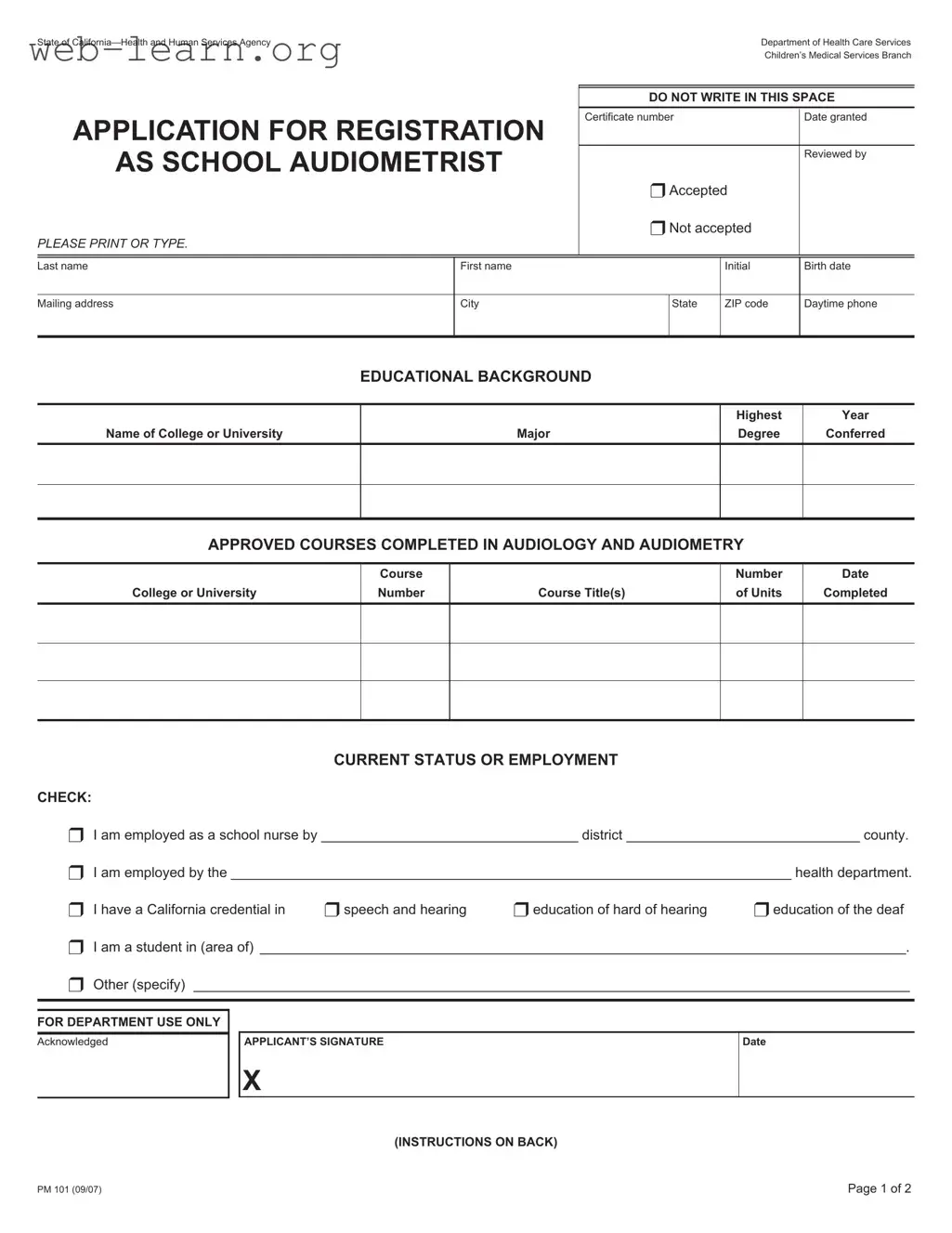
The California PM 101 form plays a crucial role in the registration process for individuals seeking to become certified school audiometrists. This form is essential for those who conduct hearing tests in California's schools, ensuring that they meet the required qualifications set forth by the state. Applicants must provide their personal information, including their name, birth date, and contact details, alongside their educational background and the relevant courses completed in audiology and audiometry. The form also requires applicants to indicate their current employment status, which may include working as a school nurse, being employed by a health department, or holding a California credential in related fields. Additionally, the PM 101 form mandates the submission of official transcripts to verify the completion of required training, along with a registration fee. By following the instructions outlined in the form, applicants can ensure that they fulfill all necessary criteria for registration as school audiometrists, thereby contributing to the health and well-being of students across California.
| Fact Name | Description |
|---|---|
| Purpose of the Form | The PM 101 form is used for individuals applying for registration as School Audiometrists in California. |
| Governing Laws | This form is governed by Section 44879 and Sections 49420 and 49452 of the California Education Code, as well as Section 2950 of the California Code of Regulations. |
| Required Documents | Applicants must submit a completed PM 101 form, a transcript verifying completion of required training in audiology and audiometry, and a $10 registration fee. |
| Submission Details | Completed applications should be mailed to the California Department of Health Care Services, Accounting Section, Cashiers MS 1101, P.O. Box 997413, Sacramento, CA 95899-7413. |
Completing the California PM 101 form is an important step in the registration process for school audiometrists. After filling out the form, you will need to gather additional documents, including your official transcripts and a registration fee. Once you have everything prepared, you will submit your application to the appropriate department for processing.
After completing the form, make sure to gather your official transcript and prepare a $10 registration fee. Mail everything to the California Department of Health Care Services at the address provided in the instructions.
What is the California PM 101 form?
The California PM 101 form is an application for registration as a school audiometrist. This form is used by individuals who conduct hearing tests in California schools. It collects essential information about the applicant's educational background, employment status, and qualifications in audiology and audiometry.
Who needs to complete the PM 101 form?
Individuals employed as school audiometrists or those qualified as supervisors of health must complete this form. This includes school nurses, health department employees, and students in relevant fields. Registration is necessary to ensure compliance with California's education code regarding hearing tests in schools.
What documents are required to submit with the PM 101 form?
Applicants must provide the following:
Where do I send the completed PM 101 form?
Mail the completed application, along with the official transcript and the registration fee, to:
California Department of Health Care Services
Accounting Section, Cashiers MS 1101
P.O. Box 997413
Sacramento, CA 95899-7413
For any questions, you can contact the Hearing Conservation Specialist at (916) 323-8087.
Completing the California PM 101 form can be straightforward, but many applicants make common mistakes that can delay the registration process. One frequent error is failing to print or type the information clearly. Handwritten forms can be difficult to read, leading to misunderstandings or misinterpretations of the provided information.
Another common mistake involves incomplete sections. Applicants often overlook certain fields, such as the mailing address or daytime phone number. Leaving these sections blank can prevent the Department of Health Care Services from contacting you for further information or clarification.
Incorrectly listing educational background is also a prevalent issue. Applicants may forget to include the name of the college or university, or they might not specify their major or highest degree earned. This information is essential for verifying qualifications, and any discrepancies can result in delays.
Many individuals do not provide the correct course details in the "Approved Courses Completed in Audiology and Audiometry" section. It is crucial to include accurate course numbers and titles, as well as the number of units completed. Incomplete or inaccurate course information can hinder the evaluation of your qualifications.
Some applicants fail to check the appropriate current status or employment box. This section helps the department understand your professional background. Not indicating your current employment status can lead to confusion regarding your qualifications.
Another mistake is neglecting to sign and date the application. The applicant's signature is vital for validating the application. Without a signature or a date, the form may be considered incomplete and could be returned.
Applicants sometimes forget to include the required registration fee. The application requires a $10 fee, payable to the California State Department of Health Care Services. Omitting this payment can result in processing delays or rejection of the application.
Some individuals do not include the official transcript of records or grade cards. This documentation is necessary to verify the completion of required training in audiology and audiometry. Without it, the application cannot be processed.
Lastly, failing to read the instructions on the back of the form can lead to misunderstandings about the requirements. The instructions provide critical information that can help avoid errors and ensure a smooth application process.
By being aware of these common mistakes, applicants can improve their chances of a successful registration as a school audiometrist in California. Taking the time to double-check the application before submission can save time and effort in the long run.
The California PM 101 form is essential for individuals seeking registration as school audiometrists. However, several other documents complement this application, providing necessary information and verification of qualifications. Below is a list of these forms, along with a brief description of each.
In summary, while the PM 101 form is a critical component of the registration process, the additional documents listed above play a vital role in ensuring a comprehensive evaluation of each applicant's qualifications. Properly preparing and submitting these documents can significantly enhance the chances of a successful registration as a school audiometrist in California.
The California PM 101 form is specifically designed for individuals seeking registration as school audiometrists. Several other documents share similarities with the PM 101 form in terms of purpose, content, and the application process. Here’s a list of nine similar documents:
When filling out the California PM 101 form, there are important dos and don'ts to keep in mind. Following these guidelines can help ensure your application is processed smoothly.
Misconceptions about the California PM 101 form can lead to confusion for applicants. Here are four common misunderstandings:
Here are key takeaways about filling out and using the California PM 101 form:
For any questions, contact the Hearing Conservation Specialist at the provided phone number.