In the vibrant landscape of California's business environment, the Operating Agreement stands as a crucial document for Limited Liability Companies (LLCs). This form outlines the internal workings of the LLC, setting the stage for how the business will operate and how decisions will be made. It typically includes key elements such as the ownership structure, management responsibilities, and the distribution of profits and losses among members. Additionally, the Operating Agreement addresses important aspects like voting rights, dispute resolution procedures, and the process for adding or removing members. Having a well-crafted Operating Agreement is essential, as it not only helps prevent misunderstandings among members but also provides a framework that can be referred to in times of conflict. Ultimately, this document serves as a foundational blueprint for any LLC, ensuring that all members are on the same page and that the business can thrive in a competitive marketplace.
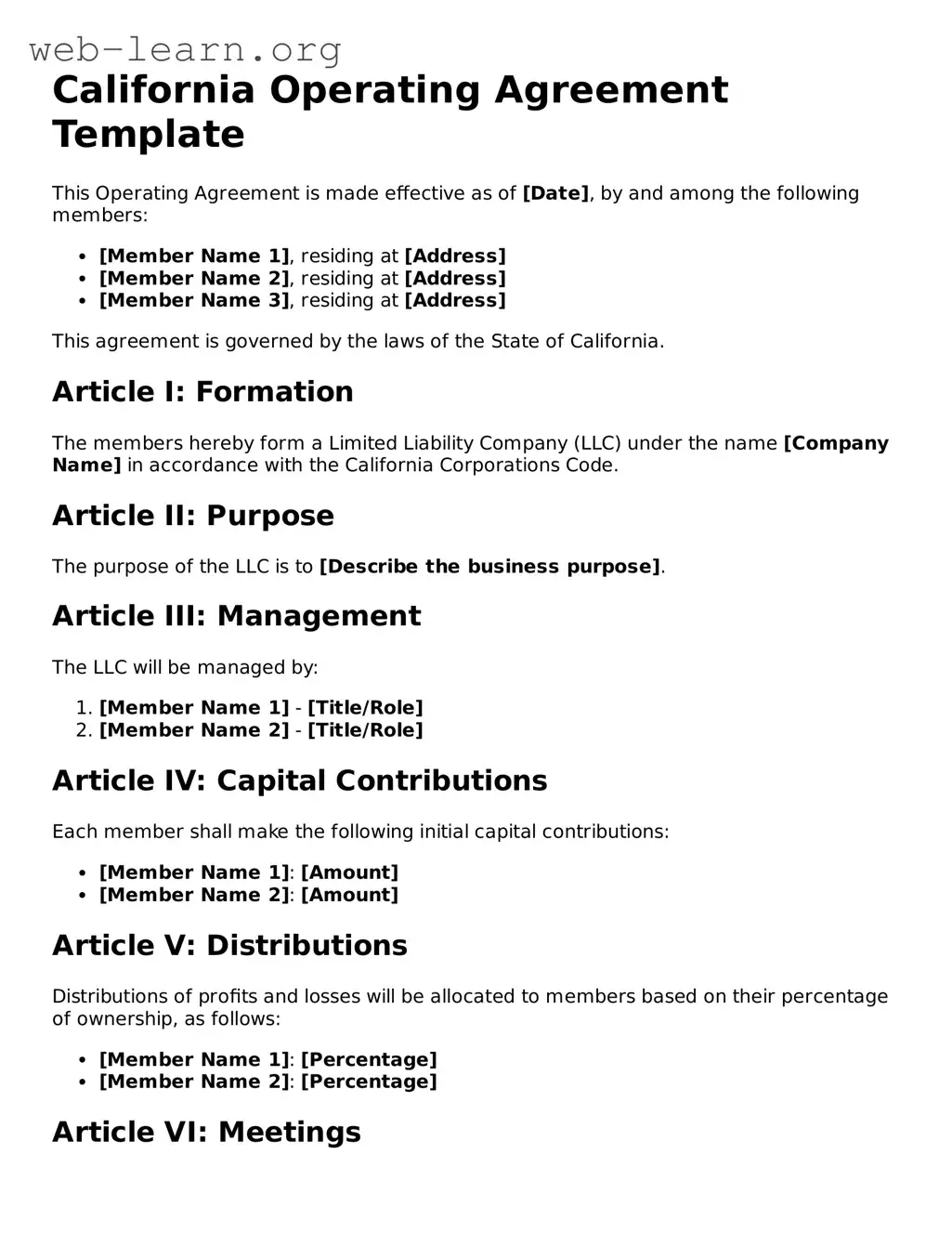
California Operating Agreement Template
This Operating Agreement is made effective as of [Date], by and among the following members:
This agreement is governed by the laws of the State of California.
Article I: Formation
The members hereby form a Limited Liability Company (LLC) under the name [Company Name] in accordance with the California Corporations Code.
Article II: Purpose
The purpose of the LLC is to [Describe the business purpose].
Article III: Management
The LLC will be managed by:
Article IV: Capital Contributions
Each member shall make the following initial capital contributions:
Article V: Distributions
Distributions of profits and losses will be allocated to members based on their percentage of ownership, as follows:
Article VI: Meetings
Meetings of members will be held at least once a year. Notice of the meeting must be given at least [Number] days in advance.
Article VII: Amendments
This Operating Agreement may be amended only by a written agreement signed by all members.
Article VIII: Miscellaneous
This agreement constitutes the entire agreement among the members. It supersedes all prior agreements or understandings.
IN WITNESS WHEREOF, the members have executed this Operating Agreement as of the date first above written.
_________________________ [Member Name 1]
_________________________ [Member Name 2]
_________________________ [Member Name 3]
| Fact Name | Details |
|---|---|
| Purpose | The California Operating Agreement outlines the management structure and operating procedures of a Limited Liability Company (LLC). |
| Governing Law | This agreement is governed by the California Corporations Code, specifically sections related to LLCs. |
| Members' Rights | It defines the rights and responsibilities of the members, including voting rights and profit distribution. |
| Flexibility | The agreement allows for customization to suit the specific needs of the LLC and its members. |
| Not Mandatory | While not legally required, having an Operating Agreement is highly recommended for clarity and protection. |
| Amendments | Members can amend the agreement as needed, provided they follow the procedures outlined within it. |
| Dispute Resolution | The agreement often includes provisions for resolving disputes among members, which can help avoid litigation. |
Filling out the California Operating Agreement form is an important step in establishing the rules and guidelines for your business. Make sure to gather all necessary information before you start. Follow the steps below to complete the form accurately.
After completing the form, make sure to keep a copy for your records. Consider consulting with a professional to ensure everything is in order before submitting it to the appropriate state office.
What is a California Operating Agreement?
A California Operating Agreement is a legal document that outlines the internal operations of a limited liability company (LLC) in California. It serves as a foundational blueprint for how the LLC will be managed, detailing the rights and responsibilities of its members. Although not required by law, having an Operating Agreement is highly recommended as it helps prevent misunderstandings and disputes among members.
Why is an Operating Agreement important?
The Operating Agreement is crucial for several reasons:
What should be included in a California Operating Agreement?
An effective Operating Agreement should cover several key components:
Can an Operating Agreement be amended?
Yes, an Operating Agreement can be amended. The process for making changes should be clearly outlined within the document itself. Typically, amendments require a vote or consent from the members, depending on the terms specified in the original agreement. Keeping the Operating Agreement up-to-date is essential to reflect any changes in membership or management structure, ensuring that it continues to serve the needs of the LLC.
When filling out the California Operating Agreement form, many people overlook crucial details that can lead to complications down the road. One common mistake is failing to clearly define the roles and responsibilities of each member. Without this clarity, misunderstandings can arise, leading to conflicts and inefficiencies in managing the business.
Another frequent error is neglecting to specify the distribution of profits and losses. Many assume that this will be understood, but it’s essential to outline how profits will be shared among members. If this section is vague, disputes may occur, and members may find themselves at odds when it comes time to distribute earnings.
Additionally, some individuals forget to include provisions for decision-making processes. It’s vital to establish how decisions will be made, whether by majority vote or unanimous consent. Without this agreement, a single member could potentially hold too much power, which can lead to frustration among other members.
Finally, many people fail to update the Operating Agreement as circumstances change. Life events, such as new members joining or existing members leaving, should trigger a review and potential amendment of the agreement. Ignoring this can result in an outdated document that no longer reflects the current state of the business, leading to confusion and potential legal issues.
When forming a Limited Liability Company (LLC) in California, the Operating Agreement is a crucial document that outlines the management structure and operating procedures of the business. However, several other forms and documents may accompany the Operating Agreement to ensure compliance with state laws and regulations. Below is a list of these important documents.
Understanding and preparing these documents is essential for the smooth operation of your LLC. Each document plays a specific role in ensuring that your business complies with legal requirements and operates effectively. Taking the time to gather and complete these forms can save you from potential legal issues down the line.
The Operating Agreement is an important document for a business, particularly for LLCs. It outlines how the business will be run and the responsibilities of its members. Here are seven other documents that share similarities with the Operating Agreement:
When filling out the California Operating Agreement form, it is important to be thorough and accurate. Here are some guidelines to consider:
When it comes to the California Operating Agreement form, there are several misconceptions that can lead to confusion. Understanding these myths can help ensure that business owners are well-informed and prepared. Here are nine common misconceptions:
Many believe that only large companies need an Operating Agreement. In reality, every LLC, regardless of size, can benefit from having this document to outline its structure and operations.
While having an Operating Agreement is highly recommended, it is not a legal requirement in California. However, lacking one can lead to disputes and complications down the road.
Some people think the Operating Agreement is just another name for the Articles of Organization. In fact, these are two distinct documents serving different purposes in the formation and management of an LLC.
There is a misconception that all members of an LLC must unanimously agree on every aspect of the Operating Agreement. While consensus is important, members can agree to delegate certain decisions to specific individuals.
Some believe that once an Operating Agreement is established, it cannot be modified. This is not true; members can amend the agreement as needed to reflect changes in the business or membership.
While financial aspects are important, the Operating Agreement also addresses management structure, member roles, and procedures for resolving disputes. It is a comprehensive document.
Many think that an Operating Agreement does not affect personal liability. However, having a well-drafted agreement can help reinforce the limited liability protection that LLCs offer to their members.
Single-member LLC owners often think they don’t need an Operating Agreement. However, having one can still provide clarity and protection, especially if the business grows or if there are plans to add members.
Some individuals may feel that drafting an Operating Agreement is overly complex. In reality, templates and resources are available to simplify the process, making it accessible for all business owners.
By debunking these misconceptions, business owners can better appreciate the importance of the California Operating Agreement and its role in the successful management of their LLC.
When filling out and using the California Operating Agreement form, it is essential to keep a few key points in mind. These guidelines will help ensure that your agreement is clear and effective.
By keeping these takeaways in mind, you can create a comprehensive Operating Agreement that supports your business's success and fosters a positive working relationship among members.
Forming an Llc in Alabama - This document can outline procedures for decision-making within the company.
How to Write an Operating Agreement - This document can clarify how to handle unexpected changes in membership.