In the realm of landlord-tenant relationships, the California Notice to Quit form serves as a crucial legal instrument that facilitates the process of terminating a rental agreement. This form is typically utilized when a landlord seeks to regain possession of their property, often due to a tenant's failure to comply with the terms of the lease or rental agreement. It outlines specific reasons for the eviction, which may include non-payment of rent, lease violations, or the expiration of a rental agreement. Importantly, the Notice to Quit must be delivered to the tenant in a manner prescribed by law, ensuring that they are adequately informed of the landlord's intentions. This notice also provides a timeframe within which the tenant must vacate the premises, allowing for a clear understanding of their rights and obligations. Failure to adhere to the proper procedures outlined in this form can lead to complications in the eviction process, emphasizing the necessity for both landlords and tenants to understand its implications thoroughly.
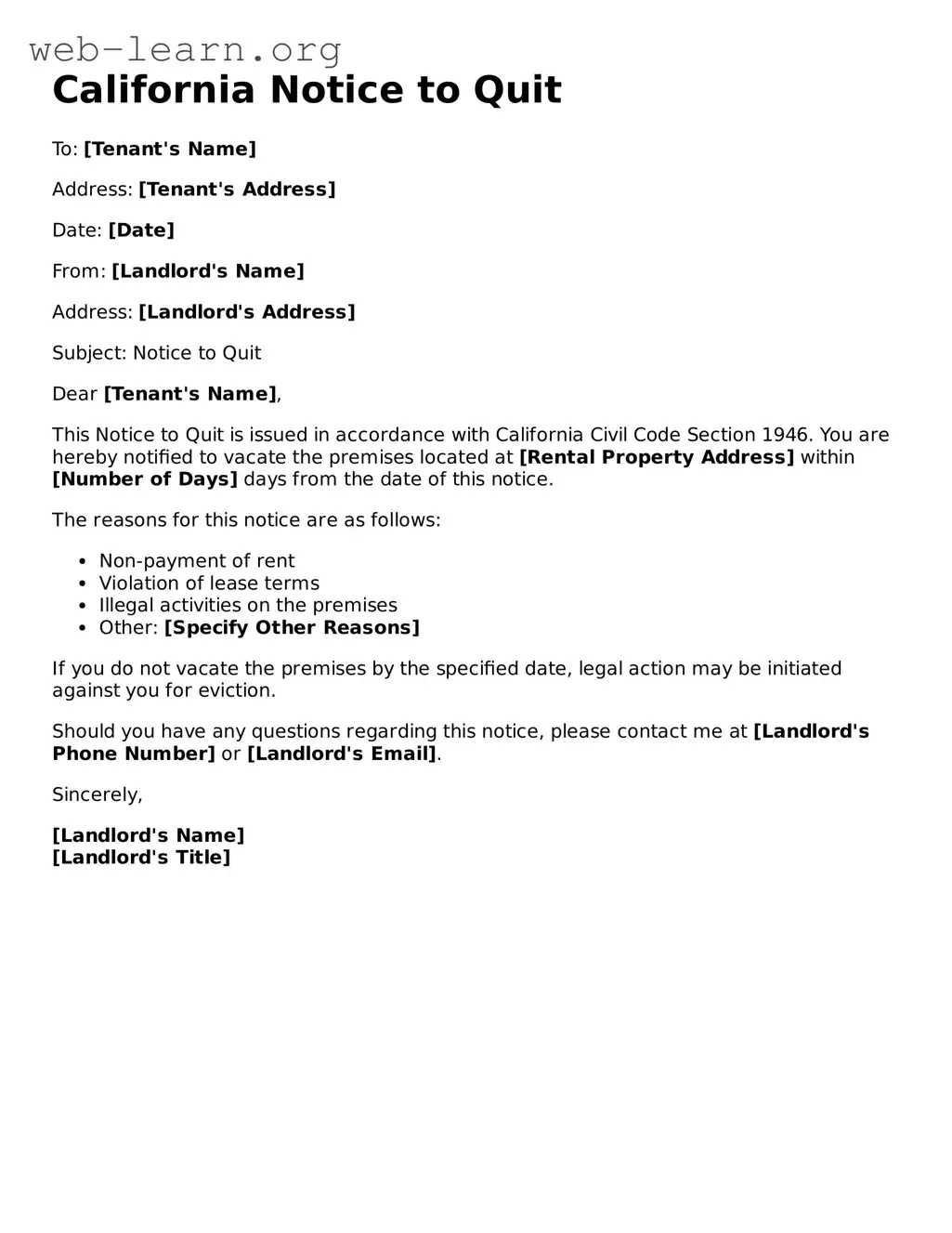
California Notice to Quit
To: [Tenant's Name]
Address: [Tenant's Address]
Date: [Date]
From: [Landlord's Name]
Address: [Landlord's Address]
Subject: Notice to Quit
Dear [Tenant's Name],
This Notice to Quit is issued in accordance with California Civil Code Section 1946. You are hereby notified to vacate the premises located at [Rental Property Address] within [Number of Days] days from the date of this notice.
The reasons for this notice are as follows:
If you do not vacate the premises by the specified date, legal action may be initiated against you for eviction.
Should you have any questions regarding this notice, please contact me at [Landlord's Phone Number] or [Landlord's Email].
Sincerely,
[Landlord's Name]
[Landlord's Title]
| Fact Name | Description |
|---|---|
| Purpose | The California Notice to Quit form is used by landlords to notify tenants to vacate the rental property. |
| Governing Law | This form is governed by California Civil Code Section 1946. |
| Types of Notices | There are different types of notices, including a 3-Day Notice to Pay Rent or Quit and a 30-Day Notice to Quit. |
| Delivery Methods | The notice can be delivered in person, by mail, or posted on the property if the tenant cannot be reached. |
| Response Time | Tenants typically have a specific number of days to respond or vacate, depending on the type of notice given. |
| Legal Requirements | The notice must include the date, the tenant's name, the address of the rental property, and the reason for eviction. |
| Signature Requirement | The landlord or their agent must sign the notice for it to be valid. |
| Use in Court | The Notice to Quit can be used as evidence in court if the eviction process escalates. |
| Tenant Rights | Tenants have the right to contest the notice if they believe it is unjust or incorrect. |
| Filing for Eviction | If the tenant does not comply, the landlord may file for eviction in court after the notice period expires. |
After obtaining the California Notice to Quit form, it is essential to complete it accurately. This will ensure that the document serves its purpose effectively. Follow the steps below to fill out the form correctly.
Once the form is completed, it will need to be served to the tenant following the appropriate legal procedures. Ensure that you keep a copy for your records as well.
The California Notice to Quit form is a legal document used by landlords to inform tenants that they must vacate the rental property. This notice is typically issued when a tenant has violated the terms of their lease or rental agreement, such as failing to pay rent or engaging in illegal activities. The form outlines the reason for the eviction and provides a specific timeframe for the tenant to leave the premises.
The amount of notice a landlord must provide depends on the reason for the eviction. Generally, the following timeframes apply:
It is important for landlords to adhere to these timeframes to ensure compliance with California law.
A properly completed Notice to Quit should include the following information:
Providing clear and detailed information helps avoid confusion and ensures that the tenant understands their obligations.
If the tenant does not vacate the property by the specified date in the Notice to Quit, the landlord may proceed with legal action to evict the tenant. This typically involves filing an unlawful detainer lawsuit in the appropriate court. It is crucial for landlords to follow the legal process to avoid complications and ensure a lawful eviction.
Filling out the California Notice to Quit form can be a straightforward process, but many individuals make common mistakes that can lead to complications. One frequent error is failing to provide accurate tenant information. It's essential to include the full name of the tenant and the correct address of the rental property. Missing or incorrect details can delay the eviction process.
Another mistake is not specifying the reason for the notice. The form requires a clear statement of why the notice is being issued, whether it’s for non-payment of rent or a lease violation. Without this information, the notice may be considered invalid.
Some individuals neglect to include the correct date. The date on the notice should reflect when the notice is served to the tenant. An incorrect date can create confusion and may lead to legal challenges.
Additionally, people often forget to sign the Notice to Quit. A signature is crucial as it verifies the authenticity of the notice. Without a signature, the document may not hold up in court.
Another common oversight is not providing the tenant with the appropriate amount of time to respond. California law requires specific notice periods depending on the reason for eviction. Failing to adhere to these timeframes can invalidate the notice.
Some individuals mistakenly believe they can serve the notice verbally. However, the Notice to Quit must be delivered in writing. This written notice serves as a formal record of the eviction process.
In some cases, people do not keep a copy of the notice for their records. Retaining a copy is important for future reference and can be helpful if the eviction goes to court.
Another mistake involves using outdated forms. Laws and regulations can change, so it’s essential to use the most current version of the Notice to Quit. Using an outdated form may lead to legal issues.
Moreover, some individuals overlook the requirement for proper delivery of the notice. The form must be delivered in accordance with California law, which may include personal delivery, mail, or posting on the property.
Lastly, misunderstanding the local laws and regulations regarding eviction can lead to mistakes. Each city or county may have specific rules that differ from state law. It’s important to be aware of these local regulations to ensure compliance.
The California Notice to Quit form is a crucial document in the eviction process, signaling a tenant to vacate the premises. However, several other forms and documents are often used in conjunction with this notice to ensure compliance with legal requirements and to facilitate the eviction process. Below is a list of commonly associated documents.
These documents work together to ensure that landlords can navigate the eviction process effectively while adhering to California's legal requirements. Understanding each form's purpose is essential for both landlords and tenants involved in rental agreements.
The Notice to Quit form serves as a crucial document in the landlord-tenant relationship, primarily signaling the intent to terminate a lease. However, several other documents share similarities with the Notice to Quit, each serving its own purpose in the realm of housing and tenancy. Here’s a look at eight documents that are comparable:
Understanding these documents can help both landlords and tenants navigate their rights and responsibilities effectively. Each serves a unique purpose but shares the common goal of clarifying the terms of the rental relationship.
When filling out the California Notice to Quit form, it is important to adhere to specific guidelines to ensure the document is valid and effective. The following list outlines key actions to take and avoid during this process.
Understanding the California Notice to Quit form is essential for both landlords and tenants. However, several misconceptions can lead to confusion. Here are eight common misunderstandings:
Many people think a Notice to Quit is an eviction notice. In reality, it is a preliminary step that informs a tenant they must vacate the property. An eviction process follows if the tenant does not comply.
Some believe a landlord can issue a Notice to Quit for any reason. However, California law requires specific grounds, such as non-payment of rent or lease violations.
While personal service is one option, a Notice to Quit can also be delivered via mail or posted on the property if certain conditions are met. Understanding these methods is crucial.
Another misconception is that landlords can demand immediate vacating. Depending on the reason for the notice, California law mandates specific notice periods, ranging from 3 to 60 days.
Some think that once a Notice to Quit is issued, the eviction is guaranteed. However, tenants have the right to respond and challenge the notice, which can delay or prevent eviction.
People often assume that all Notices to Quit follow a standard format. In California, the content and format can vary based on the specific circumstances and legal requirements.
This is not true. Tenants have the right to dispute the notice and present their case in court if they believe it was issued improperly or without cause.
Some tenants feel hopeless after receiving a Notice to Quit. However, they can seek legal advice, negotiate with the landlord, or explore options to remain in the property.
By clarifying these misconceptions, both landlords and tenants can navigate the eviction process more effectively and understand their rights and responsibilities.
When dealing with the California Notice to Quit form, it's essential to understand its purpose and proper usage. Here are some key takeaways:
Printable Indiana Eviction Notice Form - It must be delivered in accordance with state laws.
Landlord:23dca7yshec= Eviction Letter - In some jurisdictions, tenants may have the right to remedy the situation before eviction is finalized.