Homepage Blank California Notice Consumer Form
Outline

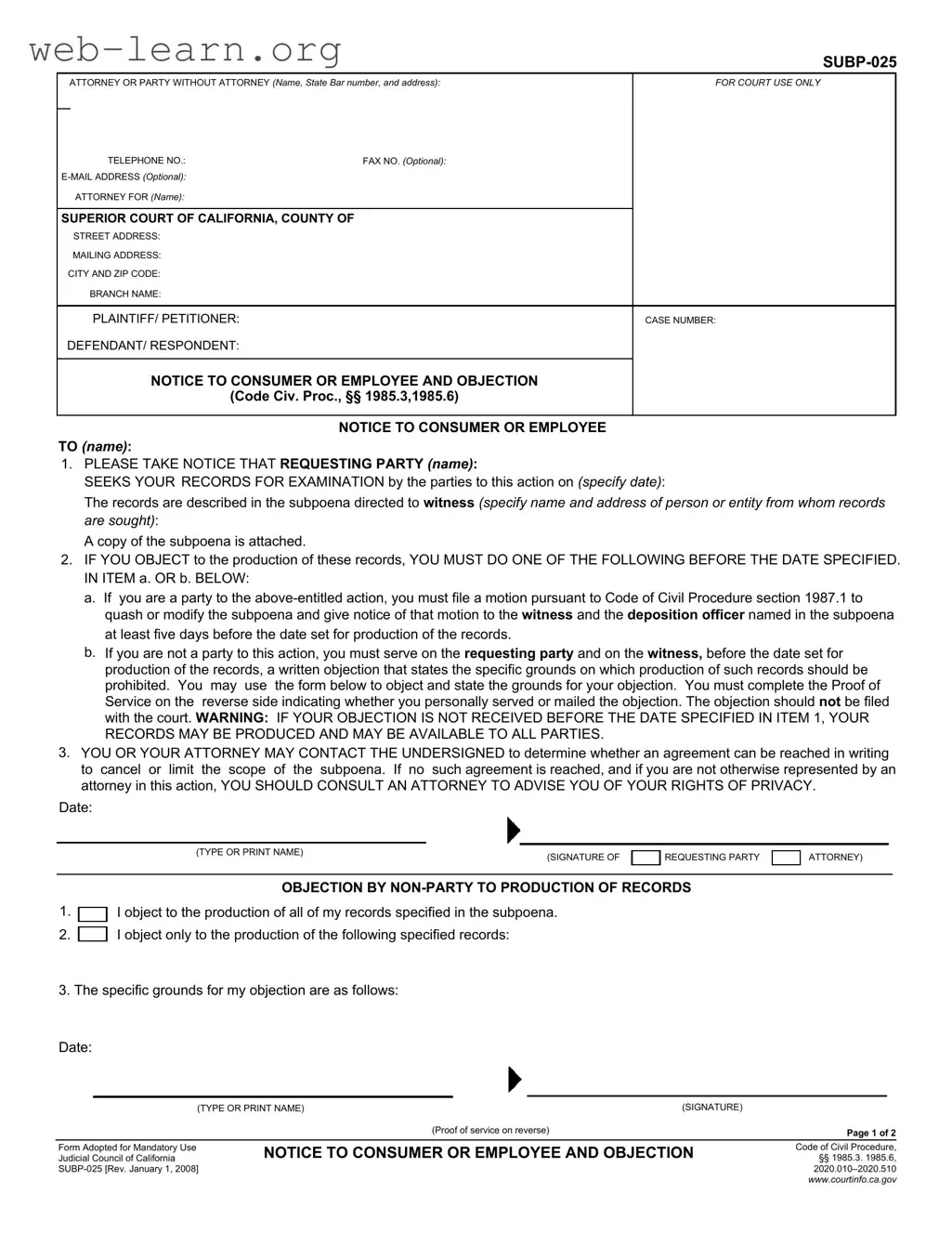
The California Notice Consumer form serves as a critical document in legal proceedings, specifically when a party seeks access to another individual's records. This form is designed to ensure that consumers or employees are informed about requests for their personal records and provides them with the opportunity to object to such requests. It outlines the necessary steps for individuals to take if they wish to contest the production of their records, whether they are parties to the action or not. The form includes instructions for filing a motion to quash or modify the subpoena, as well as guidelines for submitting a written objection. Additionally, it emphasizes the importance of timely responses, warning that failure to object may result in the release of personal records. The form also encourages communication between the parties involved, allowing for the possibility of reaching an agreement regarding the scope of the subpoena. Overall, the California Notice Consumer form is an essential tool that protects individual privacy rights while balancing the needs of the legal process.

Sample - California Notice Consumer Form

(SIGNATURE OF
SUBP-025
ATTORNEY OR PARTY WITHOUT ATTORNEY (Name, State Bar number, and address): FOR COURT USE ONLY
TELEPHONE NO.:
FAX NO. (Optional):
ATTORNEY FOR (Name):
SUPERIOR COURT OF CALIFORNIA, COUNTY OF
STREET ADDRESS:
MAILING ADDRESS:
CITY AND ZIP CODE:
BRANCH NAME:
PLAINTIFF/ PETITIONER:
CASE NUMBER:
DEFENDANT/ RESPONDENT:
NOTICE TO CONSUMER OR EMPLOYEE AND OBJECTION
(Code Civ. Proc., §§ 1985.3,1985.6)
NOTICE TO CONSUMER OR EMPLOYEE
TO (name):
1. PLEASE TAKE NOTICE THAT REQUESTING PARTY (name):
A copy of the subpoena is attached.
2. IF YOU OBJECT to the production of these records, YOU MUST DO ONE OF THE FOLLOWING BEFORE THE DATE SPECIFIED.
IN ITEM a. OR b. BELOW:
a. If you are a party to the above-entitled action, you must file a motion pursuant to Code of Civil Procedure section 1987.1 to
quash or modify the subpoena and give notice of that motion to the witness and the deposition officer named in the subpoena
at least five days before the date set for production of the records.
YOU OR YOUR ATTORNEY MAY CONTACT THE UNDERSIGNED to determine whether an agreement can be reached in writing
to cancel or limit the scope of the subpoena. If no such agreement is reached, and if you are not otherwise represented by an
attorney in this action, YOU SHOULD CONSULT AN ATTORNEY TO ADVISE YOU OF YOUR RIGHTS OF PRIVACY.
Date:
(TYPE OR PRINT NAME)
OBJECTION BY NON-PARTY TO PRODUCTION OF RECORDS
1.
I object to the production of all of my records specified in the subpoena.
2.
3. The specific grounds for my objection are as follows:
Date:
(TYPE OR PRINT NAME)
(SIGNATURE)
(Proof of service on reverse)
NOTICE TO CONSUMER OR EMPLOYEE AND OBJECTION
Form Adopted for Mandatory Use
Judicial Council of California
SUBP-025 [Rev. January 1, 2008]
Code of Civil Procedure,
§§ 1985.3. 1985.6,
2020.010–2020.510
www.courtinfo.ca.gov
b.
If you are not a party to this action, you must serve on the requesting party and on the witness, before the date set for
production of the records, a written objection that states the specific grounds on which production of such records should be
prohibited. You may use the form below to object and state the grounds for your objection. You must complete the Proof of
Service on the reverse side indicating whether you personally served or mailed the objection. The objection should not be filed
with the court. WARNING: IF YOUR OBJECTION IS NOT RECEIVED BEFORE THE DATE SPECIFIED IN ITEM 1, YOUR
RECORDS MAY BE PRODUCED AND MAY BE AVAILABLE TO ALL PARTIES.
RECORDS FOR EXAMINATION by the parties to this action on (specify date):
3.
The records are described in the subpoena directed to witness (specify name and address of person or entity from whom records
are sought):
REQUESTING PARTY ATTORNEY)
I object only to the production of the following specified records:
E-MAIL ADDRESS (Optional):
SEEKS YOUR
Page 1 of 2
SUBP-025
PLAINTIFF/PETITIONER:
CASE NUMBER:
DEFENDANT/RESPONDENT:
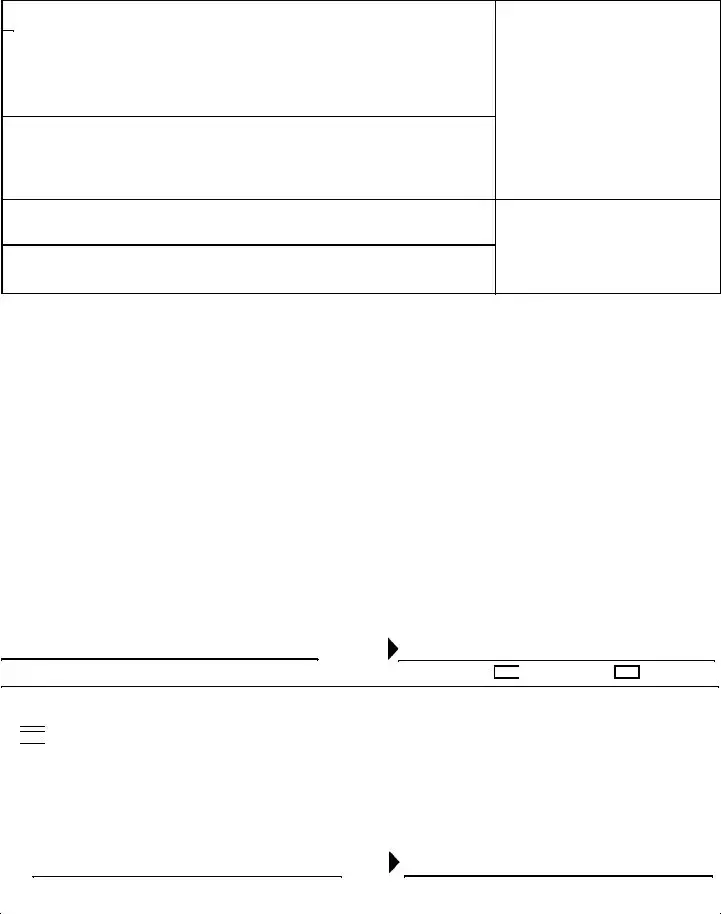
PROOF OF SERVICE OF NOTICE TO CONSUMER OR EMPLOYEE AND OBJECTION
(Code Civ. Proc., §§ 1985.3,1985.6)
Personal Service Mail
1. At the time of service I was at least 18 years of age and not a party to this legal action.
2. I served a copy of the Notice to Consumer or Employee and Objection as follows (check either a or b):
a.
Personal service. I personally delivered the Notice to Consumer or Employee and Objection as follows:
(3) Date served:
(4) Time served:
Mail. I deposited the Notice to Consumer or Employee and Objection in the United States mail, in a sealed envelope
with postage fully prepaid. The envelope was addressed as follows:
b.
(3) Date of mailing:
(5) I am a resident of or employed in the county where the Notice to Consumer or Employee and Objection was mailed.
d. My phone number is (specify):
I declare under penalty of perjury under the laws of the State of California that the foregoing is true and correct.
Date:
(TYPE OR PRINT NAME OF PERSON WHO SERVED)
(SIGNATURE OF PERSON WHO SERVED)
PROOF OF SERVICE OF OBJECTION TO PRODUCTION OF RECORDS
(Code Civ. Proc., §§ 1985.3,1985.6)
Personal Service Mail
1. At the time of service I was at least 18 years of age and not a party to this legal action.
2. I served a copy of the Objection to Production of Records as follows (complete either a or b):
a. ON THE REQUESTING PARTY
(1)
Personal service. I personally delivered the Objection to Production of Records as follows:
(iii) Date served:
(iv) Time served:
(2) Mail. I deposited the Objection to Production of Records in the United States mail, in a sealed envelope with
postage fully prepaid. The envelope was addressed as follows:
(iii) Date of mailing:
(v) I am a resident of or employed in the county where the Objection to Production of Records was mailed.
(1) Personal service. I personally delivered the Objection to Production of Records as follows:
(iii) Date served:
(iv) Time served:
(2)
Mail. I deposited the Objection to Production of Records in the United States mail, in a sealed envelope with
postage fully prepaid. The envelope was addressed as follows:
(iii) Date of mailing:
(v) I am a resident of or employed in the county where the Objection to Production of Records was mailed.
3. My residence or business address is (specify):
4. My phone number is (specify):
I declare under penalty of perjury under the laws of the State of California that the foregoing is true and correct.
Date:
(TYPE OR PRINT NAME OF PERSON WHO SERVED)
(SIGNATURE OF PERSON WHO SERVED)
NOTICE TO CONSUMER OR EMPLOYEE AND OBJECTION
Page 2 of 2
SUBP-025 [Rev. January 1, 2008]
b. ON THE WITNESS
(iv) Place of mailing (city and state):
(ii) Address:
(i) Name of person served:
(ii) Address where served:
(i) Name of person served:
(ii) Address:
(i) Name of person served:
(ii) Address where served:
c. My residence or business address is (specify):
(2) Address:
(1) Name of person served:
(2) Address where served:
(1) Name of person served:
(4) Place of mailing (city and state):

Form Information

Fact Name Details
Purpose The California Notice to Consumer form informs individuals about the request for their records in a legal proceeding.
Governing Laws This form is governed by California Code of Civil Procedure, sections 1985.3 and 1985.6.
Parties Involved The form is used by attorneys or parties in a legal action seeking records from consumers or employees.
Objection Process Individuals can object to the production of records by filing a motion or serving a written objection.
Timeframe for Objection Objections must be received before the specified date in the notice to avoid production of records.
Proof of Service The form includes a section for proof of service, indicating how the notice was delivered.
Contact Information Individuals may contact the requesting party or their attorney to discuss potential agreements regarding the subpoena.
Privacy Rights The form advises individuals to consult an attorney to understand their rights regarding privacy.
Mandatory Use This form is adopted for mandatory use in California courts to ensure compliance with legal requirements.
Signature Requirement The requesting party must sign the form to validate the request for records.

Detailed Guide for Filling Out California Notice Consumer

Filling out the California Notice Consumer form is an important step in responding to a subpoena for records. This process allows individuals to formally object to the release of their records if they believe there are valid reasons to do so. Below are the steps to guide you through completing the form accurately.

  1. Begin by entering your name, State Bar number (if applicable), and address at the top of the form under "ATTORNEY OR PARTY WITHOUT ATTORNEY."
  2. Provide your telephone number and, if you wish, your fax number and email address.
  3. Indicate the name of the attorney you are representing (if applicable) under "ATTORNEY FOR (Name)."
  4. Fill in the details for the "SUPERIOR COURT OF CALIFORNIA, COUNTY OF" section, including the street address, mailing address, city, and zip code.
  5. Write the branch name of the court you are addressing.
  6. State the names of the plaintiff/petitioner and the defendant/respondent, as well as the case number.
  7. In the section titled "NOTICE TO CONSUMER OR EMPLOYEE TO (NAME):", enter the name of the consumer or employee whose records are being requested.
  8. Specify the requesting party's name and the date on which the records are sought for examination.
  9. Describe the records in question as indicated in the subpoena, including the name and address of the person or entity from whom records are sought.
  10. If you object to the production of records, choose either option (a) or (b) and provide the necessary information as instructed.
  11. In the "OBJECTION BY NON-PARTY TO PRODUCTION OF RECORDS" section, indicate whether you object to all records or only specific ones, and state the grounds for your objection.
  12. Complete the "Proof of Service" section on the reverse side. Indicate whether you served the notice personally or by mail, and fill in the required details accordingly.
  13. Finally, sign and date the form, ensuring that all information is accurate and complete.

Obtain Answers on California Notice Consumer

  1. What is the California Notice Consumer form?

    The California Notice Consumer form, known as SUBP-025, is a legal document used to inform consumers or employees that their records are being requested in connection with a legal case. It outlines the process for objecting to the production of these records.

  2. Who can receive a Notice Consumer form?

    This form can be sent to any individual whose records are being requested, including consumers and employees. It is typically issued by a party involved in a legal action.

  3. What should I do if I receive this notice?

    If you receive this notice, you have options. You can either comply with the request or file an objection. If you choose to object, you must do so by following the instructions provided in the notice.

  4. How can I object to the production of my records?

    • If you are a party to the action, file a motion to quash or modify the subpoena.
    • If you are not a party, serve a written objection to both the requesting party and the witness, stating your specific grounds for objection.
  5. What happens if I do not respond to the notice?

    If you do not respond by the specified date, your records may be produced without further notice. This means they could be available to all parties involved in the case.

  6. Can I reach an agreement to limit the scope of the subpoena?

    Yes, you or your attorney may contact the requesting party to discuss the possibility of reaching a written agreement to cancel or limit the subpoena's scope.

  7. Is it necessary to consult an attorney?

    If you are unsure about your rights or how to respond, it is advisable to consult an attorney. They can provide guidance tailored to your situation.

  8. What information is included in the Notice Consumer form?

    The form includes details such as the name of the requesting party, the records being sought, and instructions for objecting. It also contains a proof of service section to confirm that the notice was delivered properly.

  9. What is the Proof of Service section?

    The Proof of Service section verifies that the notice or objection was served to the appropriate parties. It includes details about how and when the documents were delivered.

  10. Where can I find more information about the California Notice Consumer form?

    For additional information, you can visit the California court website or consult legal resources that provide guidance on legal forms and procedures.

Common mistakes

Filling out the California Notice Consumer form can be a daunting task, and many people inadvertently make mistakes that can complicate their situation. One common error is neglecting to include all required personal information. The form asks for specific details such as the name, address, and contact information of the requesting party. Omitting any of these details can lead to delays or even a rejection of the objection. Always double-check that all fields are filled out completely and accurately.

Another frequent mistake involves misunderstanding the objection process. Some individuals mistakenly believe that simply stating an objection is sufficient. However, the form outlines two distinct paths depending on whether the individual is a party to the action or not. Those who are parties must file a motion to quash or modify the subpoena, while non-parties need to serve a written objection to the requesting party. Failing to follow the correct procedure can result in the production of records despite an objection.

Additionally, many people overlook the importance of timing. The form specifies that objections must be received before the date set for the production of records. Waiting until the last minute to submit an objection can be risky. If the objection is not received on time, the records may be released, potentially compromising privacy. It’s crucial to be proactive and ensure that all documents are submitted well in advance.

Another common oversight is the failure to properly complete the Proof of Service section. This part of the form is vital as it confirms that the objection has been served to the appropriate parties. Not providing accurate information about how and when the objection was served can lead to complications. Whether serving in person or by mail, ensure that all details are meticulously documented.

Lastly, some individuals do not seek legal advice when needed. The form encourages consulting an attorney, especially for those who feel uncertain about their rights or the implications of the subpoena. Navigating legal processes can be complex, and having professional guidance can make a significant difference in ensuring that the objection is handled correctly. Never hesitate to reach out for help if the process feels overwhelming.

Documents used along the form

The California Notice Consumer form is an important document in legal proceedings involving the examination of records. Along with this form, several other documents are often used to ensure compliance with legal requirements and to protect the rights of individuals involved. Here is a list of related forms and documents that you may encounter:

  • Subpoena Duces Tecum: This document orders a person or entity to produce documents, records, or evidence for a legal proceeding. It specifies what records are needed and when they should be provided.
  • Motion to Quash: A party may file this motion if they believe a subpoena is invalid or overly burdensome. It requests the court to cancel or modify the subpoena.
  • Proof of Service: This form confirms that the Notice to Consumer or other documents were properly served to the required parties. It includes details about how and when the service was completed.
  • Objection to Production of Records: Individuals can use this document to formally object to the release of their records. It outlines specific reasons why the records should not be produced.
  • Confidentiality Agreement: This agreement ensures that any sensitive information disclosed during the legal process is kept private and used only for the intended purpose.
  • Deposition Notice: This document informs a witness about the time and place they need to appear to provide testimony under oath regarding the case.
  • Request for Production of Documents: This is a formal request made by one party to another to obtain specific documents related to the case. It outlines what documents are needed and why.
  • Affidavit of Service: This sworn statement confirms that a specific document was served to a party. It provides details about the service process and is often required by the court.

Each of these documents plays a vital role in the legal process. Understanding them can help individuals navigate their rights and responsibilities during legal proceedings. If you have questions about these forms, consider reaching out for guidance.

Similar forms

The California Notice Consumer form shares similarities with several other legal documents. Each serves a specific purpose related to consumer rights and privacy. Below are six documents that are comparable:

  • Subpoena Duces Tecum: This document compels a person or entity to produce documents or records for a legal proceeding. Like the Notice Consumer form, it allows for objections to be raised regarding the production of records.
  • Notice of Deposition: This form informs a party that they will be deposed in a legal matter. Similar to the Notice Consumer form, it requires parties to respond or object to the deposition before a specified date.
  • Request for Production of Documents: This document requests specific documents from another party in a legal case. Both forms require a response or objection to be filed within a set timeframe.
  • Motion to Quash: This is a request to a court to nullify a subpoena or other legal request. Like the Notice Consumer form, it provides a mechanism for parties to protect their rights regarding personal records.
  • Affidavit of Objection: This document is used to formally object to the production of documents. Both forms require the objecting party to state specific grounds for their objection.
  • Privacy Notice: This document informs individuals about how their personal information will be used and shared. Similar to the Notice Consumer form, it emphasizes the importance of privacy and the rights individuals have concerning their records.

Dos and Don'ts

When filling out the California Notice Consumer form, it is essential to follow specific guidelines to ensure accuracy and compliance. Below is a list of ten recommended actions and pitfalls to avoid.

  • Do provide accurate names and addresses for all parties involved.
  • Do include the correct case number to avoid confusion.
  • Do specify the date for the examination of records clearly.
  • Do ensure that any objections are submitted in writing before the specified date.
  • Do consult an attorney if you are unsure about your rights regarding privacy.
  • Don't forget to sign the form where required.
  • Don't file your objection with the court; serve it to the requesting party and the witness instead.
  • Don't delay in sending your objection; late submissions may result in records being produced.
  • Don't leave out the Proof of Service section; it is crucial for verifying that the objection was served.
  • Don't use vague language in your objections; state specific grounds for your concerns.

Misconceptions

  • Misconception 1: The Notice Consumer form is only for parties involved in a lawsuit.
  • This form is applicable not only to parties in a legal action but also to non-parties whose records are being sought. Non-parties can object to the production of their records, ensuring their privacy rights are protected.

  • Misconception 2: You must file your objection with the court.
  • Many believe that objections must be filed with the court. However, the form specifically states that objections should be served on the requesting party and the witness, not filed with the court. This helps streamline the process and keeps the court's workload manageable.

  • Misconception 3: If you ignore the notice, your records will not be produced.
  • Ignoring the notice can lead to unintended consequences. If an objection is not received by the specified date, the records may be produced and accessible to all parties involved in the action. It is crucial to respond promptly to protect your interests.

  • Misconception 4: You can object to any records without specifying grounds.
  • Simply stating an objection is not enough. The form requires that you provide specific grounds for your objection. This clarity is essential for the requesting party to understand the basis of your concerns and for any potential negotiations.

  • Misconception 5: You do not need legal advice to respond to the notice.
  • While it is possible to respond without legal counsel, consulting an attorney can be beneficial. An attorney can provide guidance on your rights and help you navigate the complexities of privacy laws and the legal process.

Key takeaways

  • Understand the Purpose: The California Notice Consumer form is designed to inform consumers or employees about a request for their records in a legal action.
  • Identify the Requesting Party: The form specifies the party seeking access to the records. It’s crucial to know who is making the request.
  • Know Your Rights: If you receive this notice, you have the right to object to the production of your records.
  • Respond Promptly: If you wish to object, you must do so before the specified date. Failure to respond may result in your records being released.
  • Choose Your Method of Objection: You can either file a motion if you are a party to the action or send a written objection if you are not.
  • Consult an Attorney: If you are unsure about your rights or how to proceed, consider consulting an attorney for guidance.
  • Complete the Proof of Service: Make sure to fill out the Proof of Service section to confirm how you served your objection.