In the competitive landscape of California's job market, businesses often seek to protect their interests through various legal agreements, one of which is the Non-compete Agreement. This form serves as a tool for employers to restrict employees from engaging in similar work with competitors after leaving the company. While California generally limits the enforceability of such agreements, specific conditions can still allow for their use, particularly in protecting trade secrets or proprietary information. The Non-compete Agreement form typically outlines the duration and geographical scope of the restrictions, ensuring that both parties have a clear understanding of their rights and obligations. Employers must tread carefully, as the state’s legal framework tends to favor employee mobility, making it essential to craft these agreements with precision. Understanding the nuances of this form can help businesses navigate the legal landscape while safeguarding their interests.
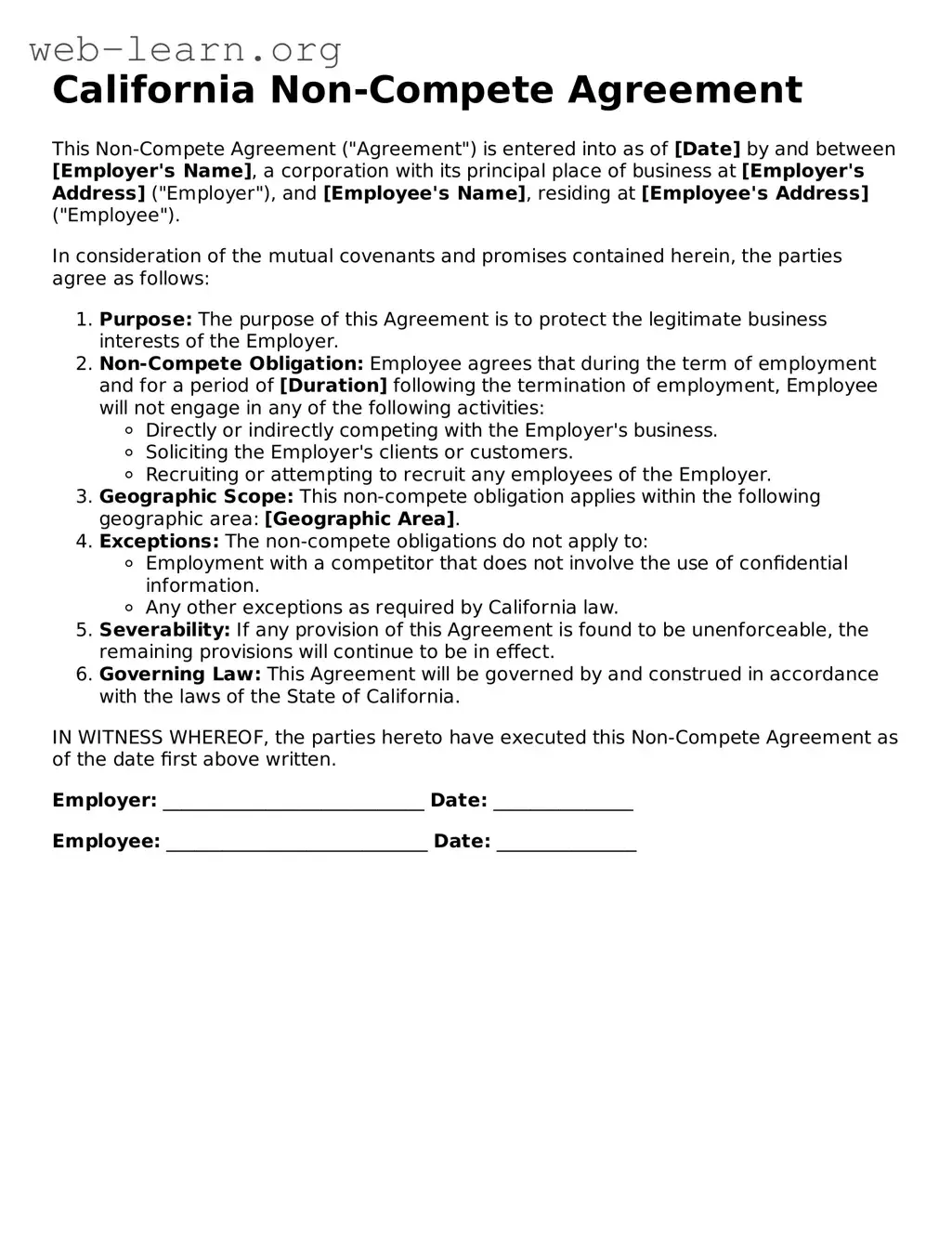
California Non-Compete Agreement
This Non-Compete Agreement ("Agreement") is entered into as of [Date] by and between [Employer's Name], a corporation with its principal place of business at [Employer's Address] ("Employer"), and [Employee's Name], residing at [Employee's Address] ("Employee").
In consideration of the mutual covenants and promises contained herein, the parties agree as follows:
IN WITNESS WHEREOF, the parties hereto have executed this Non-Compete Agreement as of the date first above written.
Employer: ____________________________ Date: _______________
Employee: ____________________________ Date: _______________
| Fact Name | Details |
|---|---|
| Legality | Non-compete agreements are generally unenforceable in California, except in limited circumstances. |
| Governing Law | California Business and Professions Code Section 16600 governs non-compete agreements. |
| Exceptions | Certain exceptions exist, such as in the sale of a business or partnership dissolution. |
| Employee Rights | Employees have the right to work in their chosen field without restrictions imposed by non-compete clauses. |
After obtaining the California Non-compete Agreement form, you will need to complete it accurately. This process involves providing specific information about the parties involved and the terms of the agreement. Follow these steps to fill out the form correctly.
What is a Non-compete Agreement in California?
A Non-compete Agreement is a contract between an employer and an employee that restricts the employee from working for competitors or starting a competing business for a specified period after leaving the company. In California, these agreements are generally unenforceable, with few exceptions.
Are Non-compete Agreements legal in California?
In California, Non-compete Agreements are largely considered void and unenforceable. The state has a strong public policy against restricting individuals from pursuing their profession or trade. This means that most employees can freely seek employment with competitors without legal repercussions.
What are the exceptions to the enforceability of Non-compete Agreements?
While Non-compete Agreements are generally unenforceable, there are a few exceptions. For instance, they may be valid in the context of the sale of a business, where the seller agrees not to compete with the buyer. Additionally, certain restrictions may apply to partners in a partnership or members of an LLC.
What should I do if my employer asks me to sign a Non-compete Agreement?
If your employer requests that you sign a Non-compete Agreement, it is crucial to understand its implications. Consider discussing it with a legal professional who can provide guidance based on your specific situation. It may also be helpful to negotiate the terms, especially if you feel the restrictions are too broad or unreasonable.
Can I be sued for violating a Non-compete Agreement in California?
Since Non-compete Agreements are generally unenforceable in California, it is unlikely that you would face legal action for violating one. However, if you signed an agreement that falls under one of the exceptions, you may still face legal consequences. Always seek legal advice if you find yourself in this situation.
What is the purpose of a Non-compete Agreement?
The primary purpose of a Non-compete Agreement is to protect a company's business interests. Employers may seek to prevent former employees from using proprietary information, trade secrets, or client relationships to gain a competitive advantage. However, in California, the enforceability of such agreements is limited.
How long do Non-compete Agreements typically last?
When enforceable, Non-compete Agreements can last anywhere from a few months to several years. However, in California, most agreements are not enforceable, and therefore, the duration is often irrelevant. If you are considering signing one, be sure to review the duration and terms carefully.
What happens if I refuse to sign a Non-compete Agreement?
If you refuse to sign a Non-compete Agreement, your employer may choose to terminate your employment offer or employment. However, since such agreements are generally unenforceable in California, you should weigh the risks and benefits before making a decision. Consulting with a legal expert can help clarify your options.
Can I still work in my field if I signed a Non-compete Agreement?
If you signed a Non-compete Agreement in California, you may still be able to work in your field, especially if the agreement is unenforceable. However, if the agreement falls under an exception, you should adhere to its terms. Always consult with a legal professional to understand your rights and limitations.
When individuals fill out the California Non-compete Agreement form, they often make several common mistakes that can undermine their intentions. One frequent error is failing to understand the legal limitations of non-compete agreements in California. In this state, such agreements are generally unenforceable, except in specific circumstances. Ignoring this fundamental aspect can lead to wasted time and resources.
Another mistake is providing incomplete or inaccurate information. Many individuals rush through the form, neglecting to double-check their personal details or the terms outlined in the agreement. This oversight can create confusion and may even result in the agreement being deemed invalid. Accuracy is essential to ensure that all parties understand their rights and obligations.
Additionally, individuals often overlook the importance of defining key terms. A non-compete agreement should clearly outline what constitutes competition and the geographical scope of the restrictions. Without clear definitions, the agreement may be too vague, leading to disputes down the line. Clarity is crucial in legal documents to prevent misunderstandings.
Another common error involves not considering the duration of the non-compete clause. Some individuals may agree to terms that impose unreasonable time limits on their ability to work in their field. It is vital to strike a balance that protects the interests of the employer while still allowing the employee to pursue their career without excessive restrictions.
Finally, many people fail to seek legal advice before signing a non-compete agreement. Consulting with a legal professional can provide valuable insights into the implications of the agreement. Without this guidance, individuals may unwittingly agree to terms that are not in their best interest. Taking the time to understand the agreement can save individuals from future complications.
When entering into a California Non-compete Agreement, several other forms and documents may be relevant to ensure clarity and legality. Understanding these documents can help both employers and employees navigate their rights and obligations effectively.
These documents play a crucial role in defining the employment relationship and protecting the interests of both parties. Familiarity with them can help ensure that all parties are on the same page and reduce the risk of disputes in the future.
When filling out the California Non-compete Agreement form, it’s important to be careful and thorough. Here are some things to keep in mind:
Taking these steps can help you navigate the process smoothly and protect your rights.
In California, non-compete agreements are often misunderstood. Here are five common misconceptions:
Understanding these misconceptions can help employees and employers navigate the complexities of employment agreements in California.
When considering a Non-compete Agreement in California, it’s essential to understand its implications and requirements. Here are some key takeaways to keep in mind:
Understanding these points can help you navigate the complexities of non-compete agreements in California effectively.
Staffing Agency Non-compete Agreement - It outlines the duration and geographic area where the employee cannot compete.
How to Get Out of a Non Compete Agreement - The agreement should balance the interests of the employer and the rights of the employee.
Connecticut Non-compete Law - Non-compete agreements should be reasonable in scope to be enforceable in court.